Musk Struggles in AI, Yet Transcends It
 06/26 2026
 542
542
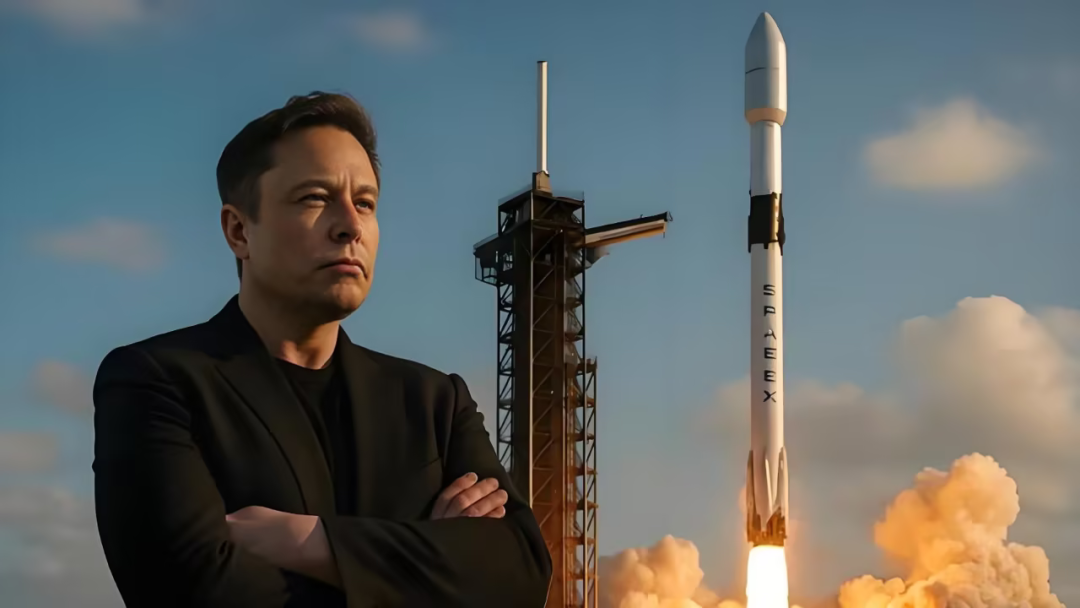
Musk remains Musk; software isn't his forte. Yet, Musk being Musk, he's anything but ordinary.

By She Zongming
Musk has encountered setbacks—in the realm of AI large models.
From its high-profile launch in July 2023 to its quiet dissolution in May 2026, xAI lasted less than three years.
In March of this year, Musk admitted his mistake on X, stating, "xAI got off on the wrong foot," but added, "Now, we need to start from scratch."
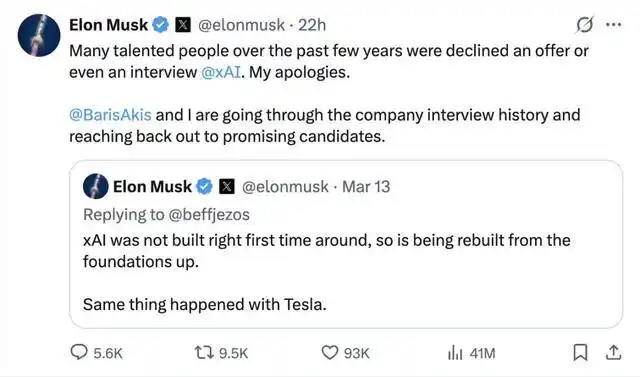
▲Musk admits his mistake.
However, Yann LeCun, another luminary and Turing Award winner, poured cold water on Musk's ambitions. In a June 18 interview with CNBC, LeCun stated, "Frankly, xAI failed because the founding team left."
Musk has found success—in the commercial spaceflight sector.
Following its remarkable IPO, SpaceX's market value soared past $2 trillion on its debut, positioning it among the world's most valuable companies.
Even LeCun, after dismissing xAI, had to acknowledge SpaceX's prowess: "SpaceX is doing an outstanding job."
What does this reveal?
Let me provide a more straightforward, honest, unequivocal, unreserved, concise, and no-nonsense answer than Doubao:
Musk remains Musk; software isn't his forte. Yet, Musk being Musk, he's anything but ordinary.
01 /
The past month has been particularly significant for Musk, with a series of major events unfolding rapidly:
Disbanding xAI and integrating it into SpaceX;
Leasing 220,000 NVIDIA GPUs to competitor Anthropic;
Losing the century-long lawsuit "Musk v. OpenAI";
The successful first test flight of Starship V3;
SpaceX's successful listing, with its market value once surpassing $3 trillion;
SpaceX announcing the acquisition of Cursor's parent company for $60 billion...
Together, these events symbolically represent a condensed version of Musk's entrepreneurial journey:
He falters in software, where he lacks expertise, but excels in hardware, where he shines.
Take xAI, for instance. When Musk founded it in July 2023, xAI had a promising start.
Led by the world's richest man and a star-studded founding team of 11 top AI scientists from DeepMind, Google, and OpenAI, one could sense the formidable challenge Musk posed to OpenAI.
Coupled with X's vast real-time social data and the 220,000 NVIDIA GPU computing cluster Colossus 1, it seemed OpenAI would weep and Anthropic would fall silent.
At its peak, xAI's valuation soared to $250 billion, with over $40 billion in funding.
Yet, Grok's ambitions soared higher than the sky, but its fate was thinner than that of the GPT, Claude, and Gemini series.
Unless the "Big Three of Silicon Valley" expands into the "Fantastic Four," xAI will remain a "first-tier outsider."
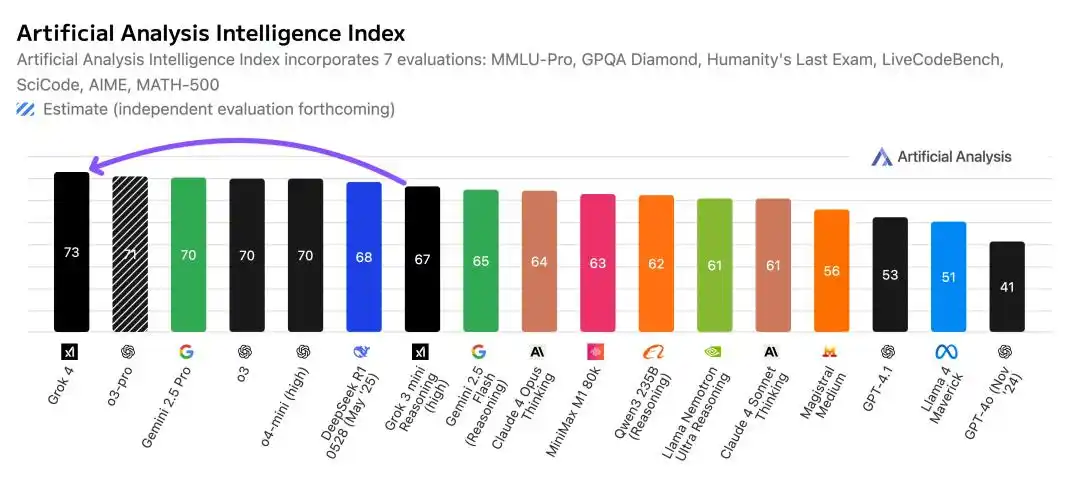
▲All is fleeting, just a spark in the pan.
The founding team also disintegrated: Within three years, everyone except Musk left, not a single member remaining.
What does it mean to be a lone wolf? This is it.
In a fit of rage, Musk disbanded xAI, filled with a sense of "hating the iron for not becoming steel."
He also leased Colossus 1, which had a utilization rate of less than 11%, to the computing-hungry Anthropic—even though three months earlier, he had criticized Anthropic for having skewed values and being "evil." He might as well have added to the xAI team: "Given the opportunity (computing power), you're useless."
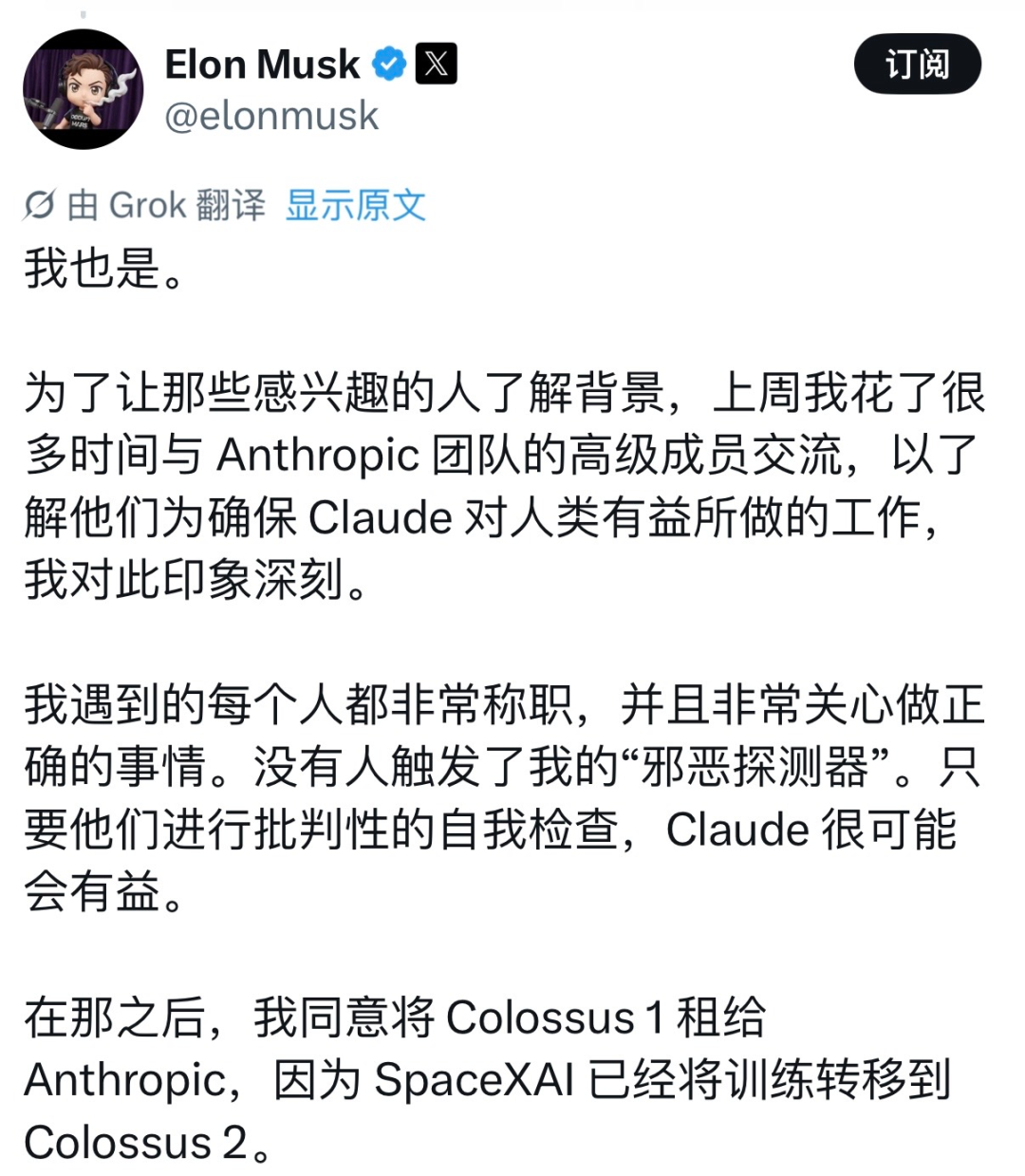
▲Calling Anthropic evil in competition but "beneficial to humanity" in cooperation?
However, a closer look at Musk's software ventures reveals that xAI's failure was no accident.
He created X.com, the predecessor to PayPal, but due to technical flaws and internal conflicts, he was ousted by the board, and X.com's self-developed software system was entirely abandoned.
He aimed to transform the X platform (formerly Twitter), which he acquired at great cost, into another WeChat, but the reality was: a significant decline in basic service stability, ineffective paid blue verification logic...
In the realm of pure bits, Musk is certainly no "omnipotent god."
But a true visionary never looks back at explosions. Musk could simply say, "Let's compete in hardware," followed by, "SpaceX + Tesla + Neuralink—what do you think?"
Just the Starship "chopsticks catching rocket" maneuver alone is enough to awe future generations.
02 /
The question arises: Why can Musk, the contemporary world's top hardware engineering innovator, excel in rockets, electric cars, and energy storage but fail in AI?
But this is a flawed question. The reasons for one's success in some endeavors often hide the reasons for failure in others. Bits and atoms are two different realms.
All of Musk's successful projects are concentrated in the hardware engineering domain, characterized by clear physical boundaries, defined rules, and quantifiable, decomposable iteration. The first principles are his unbeatable weapon.
The core of this methodology is to step outside industry conventions, break down complex systems into fundamental physical units, and thoroughly reconstruct cost curves through vertical integration, minimalist structures, and large-scale production.
Must rockets use high-end aluminum-lithium alloys as the only material? Must aerospace components be niche, high-priced, single-use launch vehicles?
Musk said: "I won't use expensive carbon fiber. I'll use low-cost stainless steel for the Starship's body, self-develop 80% of the core components, and implement vertical recovery and reuse of the first-stage rocket. What do you think?"
The result? SpaceX drastically reduced launch costs through rocket reuse, with the Falcon 9's first-stage booster surpassing 30 reuses. If Yang Dong from "The Three-Body Problem" were an aerospace scientist, she might say: Traditional aerospace science has failed.
Tesla reshaped automotive manufacturing with integrated die-casting and vertical integration, while Neuralink's microelectrodes, implantation surgical devices, and chip modules entered mass production—all victories in hardware.
Simply put, rocket thrust, material strength, and thermodynamic limits are Musk's forte.
In fact, all hardware projects share a common trait: clear physical boundaries, traceable failure causes, and quantifiable optimization paths.
Musk's "Five-Step Algorithm" starts by questioning requirements, precisely eliminating redundant components and processes, and using industrial-scale production to reduce costs... It's like a fish in water in the physical world.
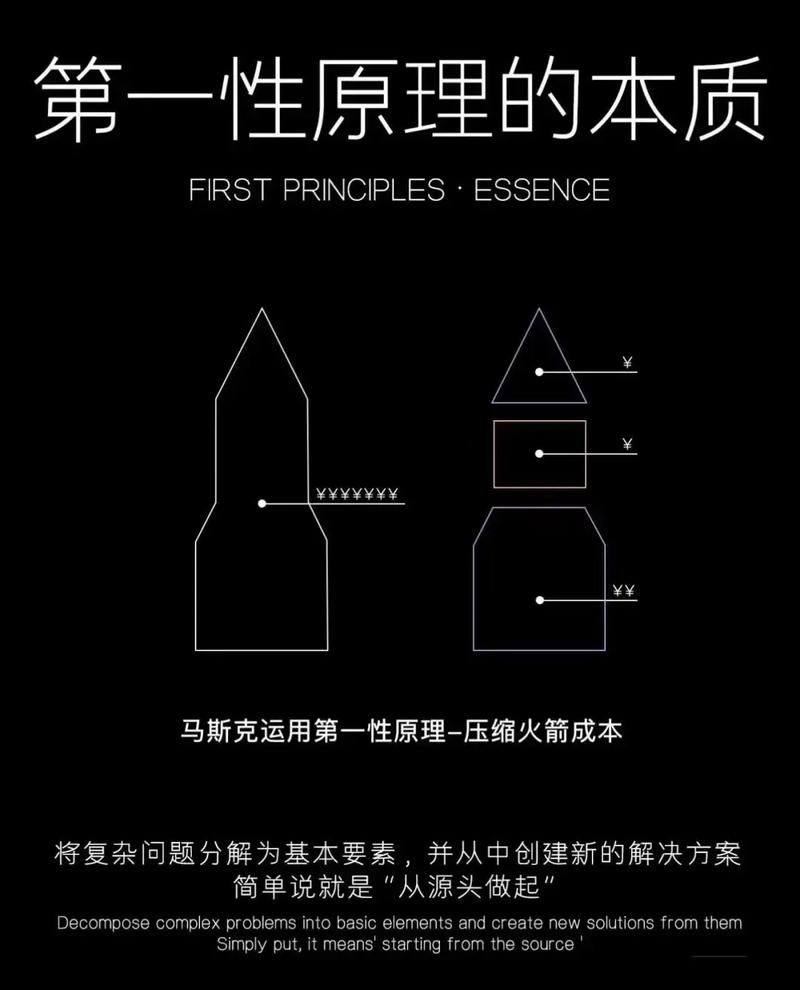
▲Musk is becoming the top spokesperson for "first principles."
But AI doesn't adhere to Newtonian physics; it's a chaotic field with no fixed physical formulas, no clear decomposition, or linear optimization paths. Intelligence emerges uncontrollably from massive data training.
Asking Musk to succeed in xAI the way he does in SpaceX is like asking Sun Wukong to fight Sha Wujing in the Flowing Sand River for 300 rounds.
SpaceX can break down rockets into modules like aerodynamics, engines, and landing systems. If a test flight explodes, veers off course, or crashes, just fix the corresponding hardware defect. But Grok doesn't work that way—you can't fix its weak logical reasoning, frequent hallucinations, or poor programming by replacing a module.
Data annotation, pre-training, and alignment fine-tuning form a multi-layered, entangled, and fuzzy coupled system. Model defects stem from thousands of variables in data distribution, parameter architecture, and alignment strategies. Trying to decompose and correct them one by one? That's humorous, bro.
Not only do the underlying logics clash, but the organizational cultures are also incompatible. Musk imposed SpaceX's militaristic management style on xAI, leading scientists to defect to Anthropic, OpenAI, and Google.
When LeCun delivered xAI's death sentence, a key reason was that xAI now struggles to attract top AI talent because Musk "previously treated team members improperly."
Media reports say Musk is a notorious workaholic who has publicly praised intense work schedules. When busy, he works 120 hours a week, sleeps 3-4 hours a day, and operates 7 days a week. The extreme 80-120-hour work culture he imposed at X drove many researchers to collapse.
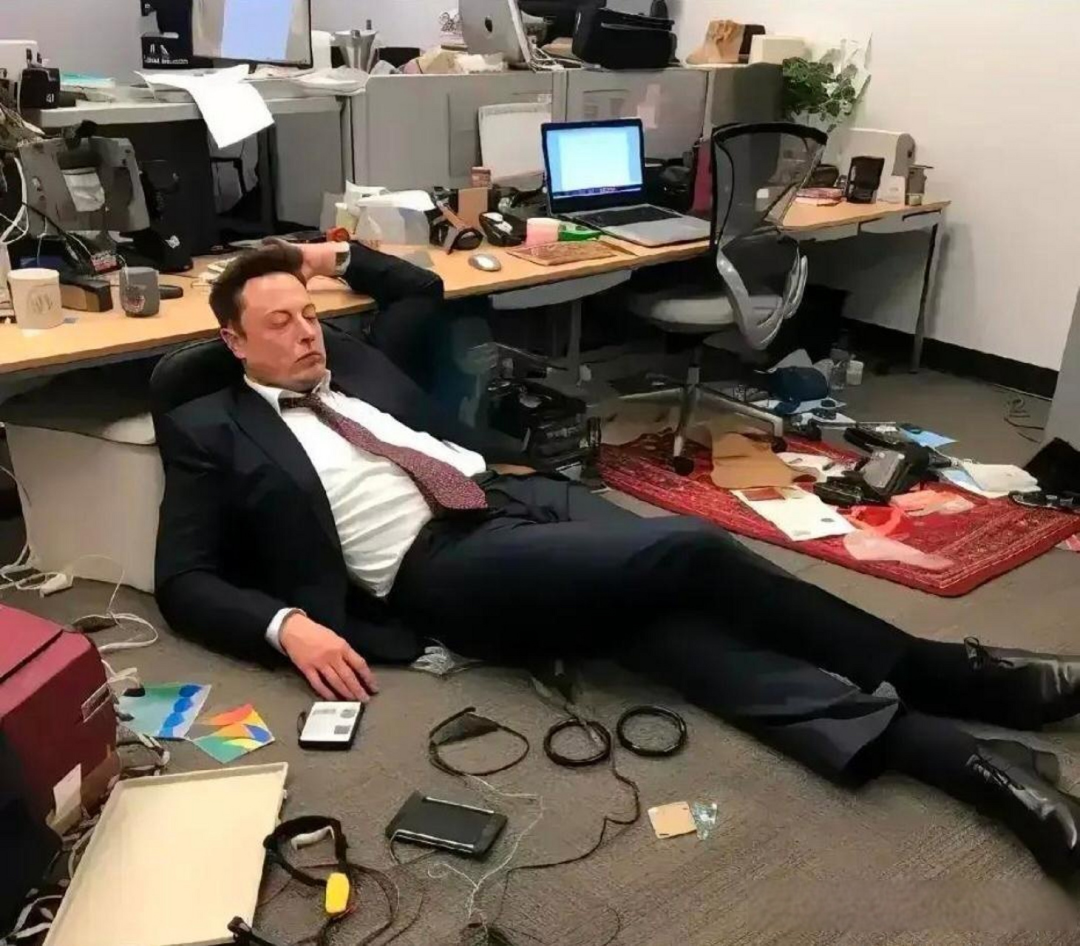
▲The big boss sleeps on the floor.
A former xAI executive revealed that team members almost never slept, with many living at the company for weeks, having no time for family.
This clearly clashes with AI's R&D rhythm—AI large model development requires a relaxed, long-term, and KPI-free research environment.
(Ps: Does Musk also believe in "no moves surpass all moves"? Such zealots make great idols but terrible leaders...)
03 /
Musk can't excel in AI, at least not in the sense of cutting-edge foundational models.
But if you think Musk is "doomed," you're naive.
After disbanding xAI and integrating it into SpaceX, many see the "xAI disbandment" as a failure but overlook the "xAI integration into SpaceX" as a dimensional upgrade.
SpaceX, now valued at over $2 trillion, has torn a massive gap in the tech power landscape dominated by the "Magnificent 7" AI giants, becoming a "gigantic valuation black hole" in the U.S. stock market—due to its scarcity and uniqueness. While many play with AI in the U.S. stock market, only one combines "rockets + satellites + AI."
Viewing SpaceX solely as a rocket launch company cannot justify its $2 trillion valuation.
But as a trifecta of space economy infrastructure + global communication network infrastructure + AI infrastructure? The perspective shifts.
Interestingly, SpaceX's prospectus estimates its total future addressable market at $28.5 trillion, with aerospace launch + Starlink communication accounting for only $2 trillion (less than 7%), while the remaining 93% comes from AI.
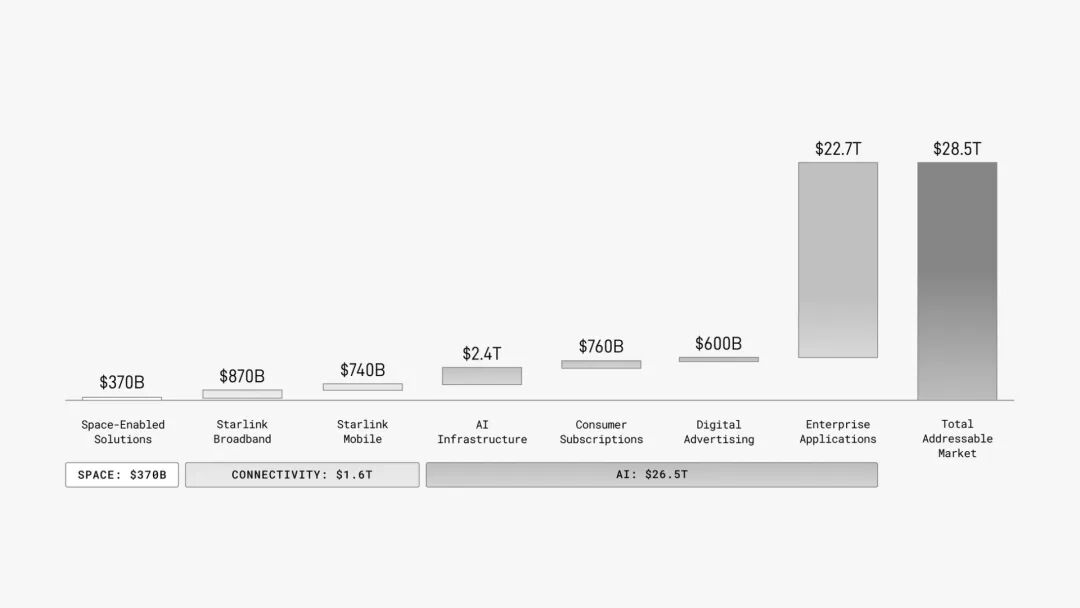
▲SpaceX drew a big pie.
Keith Snyder, a senior Wall Street analyst, calculates that to support SpaceX's $2 trillion valuation, AI must have extremely high long-term growth expectations, with AI's long-term option premium accounting for 71% of the total valuation.
Musk didn't disband xAI to abandon AI; he abandoned "self-developed general-purpose large models" and positioned AI as a supporting auxiliary system for SpaceX's space hardware ecosystem. When AI can leverage SpaceX's hardware infrastructure advantages, its impact grows significantly.
Its role manifests in two ways: 1) Leasing space computing power and satellite data to global AI firms for stable cash flow; 2) Using self-developed vertical AI to optimize rocket launches and satellite operations.
Musk isn't retreating; he's shifting to a higher-dimensional battlefield.
The AI industry relies on several key production factors: computing hardware, clean energy, global data, and cross-regional transmission networks... Seeing this, Musk might chuckle: I have them all.
First, space computing capacity. Ground data centers are constrained by electricity, cooling, and land costs. Global power production growth can't keep up with large models' computing demands. Space is different—solar irradiance isn't attenuated by the atmosphere, with annual equivalent power generation hours 5-8 times longer than on Earth.
Leveraging Starship's reusable large-scale launch capability, SpaceX plans to mass-launch AI computing satellites, building orbital data center clusters. By 2030, its space computing deployment will reach the hundred-gigawatt level, approaching the total computing power of global ground data centers.
Second, a global full-domain data collection network. Traditional AI models rely solely on internet text for training, lacking real-time spatial data.
But with tens of thousands of Starlink satellites in orbit, covering the globe without dead zones, they continuously collect surface imagery, environmental sensors, and global communication data streams, forming a full-domain spatial coverage capability unmatched by ground-based internet.
Musk not making the strongest AI matters less. What matters is that future firms aiming to create the strongest AI will need to purchase launch, computing, data, and transmission services from SpaceX—by then, Musk could rightfully be called "Jiren Xu, a.k.a. Iron Man."
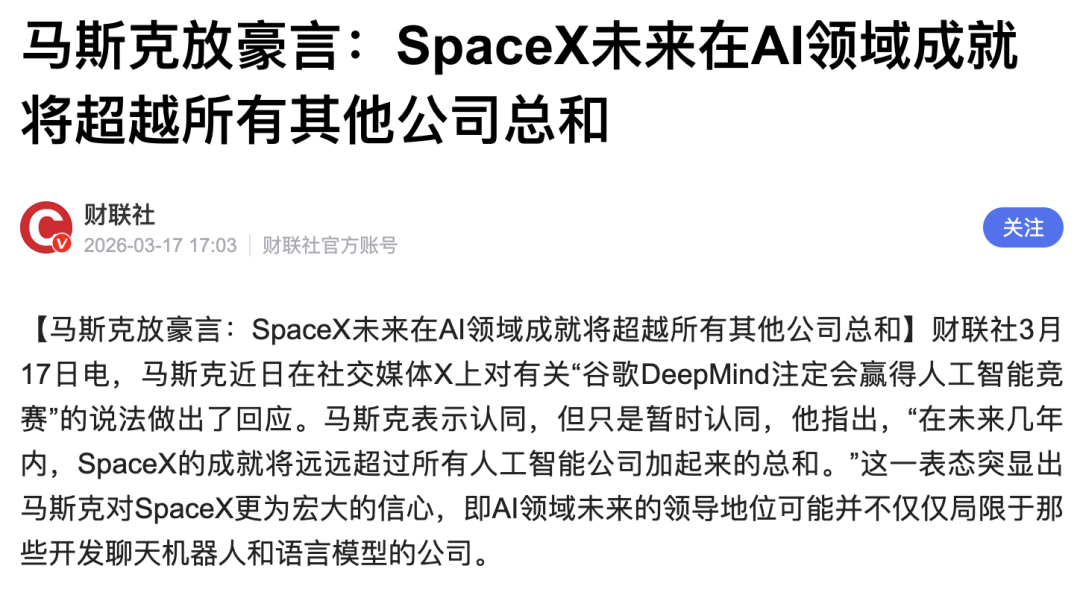
▲Musk makes a bold statement.
As for xAI, it's not directly cast aside.
When it comes to large models, xAI can't compete with Anthropic or OpenAI. But when compared in terms of "AI integrated into aerospace and communication systems," Musk might just sing a tune of "loneliness at the top."
After the spin-off, xAI is no longer competing independently in the general AI market. Instead, it has transformed into a vertical AI department serving Starship simulation, satellite scheduling, orbital computing power operation and maintenance, and
To assert that Musk's endeavors surpass those of AI is to acknowledge that he has shifted the competitive arena from the "software development stratum" to the "infrastructure stratum," marking a significant leap at the civilizational level.
In the 1960s, astronomer Nikolai Kardashev introduced a classification system for cosmic civilizations based on their "total energy consumption"—now known as the Kardashev Scale. According to this scale, Type I civilizations harness energy on a planetary scale, Type II on a stellar scale, and Type III on a galactic scale.
Within this framework, the aspiration of AI companies—to achieve Artificial General Intelligence (AGI)—is essentially an effort to maximize the information utilization efficiency of Type I civilizations. In stark contrast, SpaceX's pursuits propel humanity toward the threshold of Type II civilization.
This is not to diminish the importance of AI. On the contrary, AGI could represent humanity's final invention or the culmination of all inventions. However, Musk's vision extends into a broader coordinate system.
Historian Jill Lepore once coined the term "Muskism," equating it with Neo-Capitalism and Interstellar Capitalism. In her perspective, Musk and his contemporaries draw inspiration from science fiction, with their beliefs firmly rooted in the idea that technology and engineering can solve all political, social, and economic challenges.
Common themes in science fiction include the destruction of Earth, machine domination, interstellar wars, apocalyptic scenarios, heroic redemption, and the creation of new civilizational systems.
Indeed, Musk's approach of "posing problems and solving problems" operates within the vast expanse of galactic civilization. He perceives humanity as existing within a "simulated matrix game orchestrated by higher-dimensional civilizations" and views humans as biological bootloaders for silicon-based life, all from the vantage point of galactic civilization.
Currently, there exists a fundamental disparity in the target levels between SpaceX and AI enterprises: the ultimate objective of general AI often revolves around reshaping our production and lifestyles; whereas SpaceX's core mission is to construct interstellar survival infrastructure and expand the living space for human civilization.
AI, despite its immense power, has its limitations: it primarily induces, infers, and simulates based on existing data, incapable of breaking physical laws or creating entirely new survival environments. SpaceX, on the other hand, is dedicated to accomplishing civilizational-scale projects that AI cannot achieve.
Musk's ambition is to create a "multi-planetary civilization" system that enables humanity to become an interstellar species. Within such a system, AI serves merely as a component, akin to an engine in a car or solar panels on a Mars base.
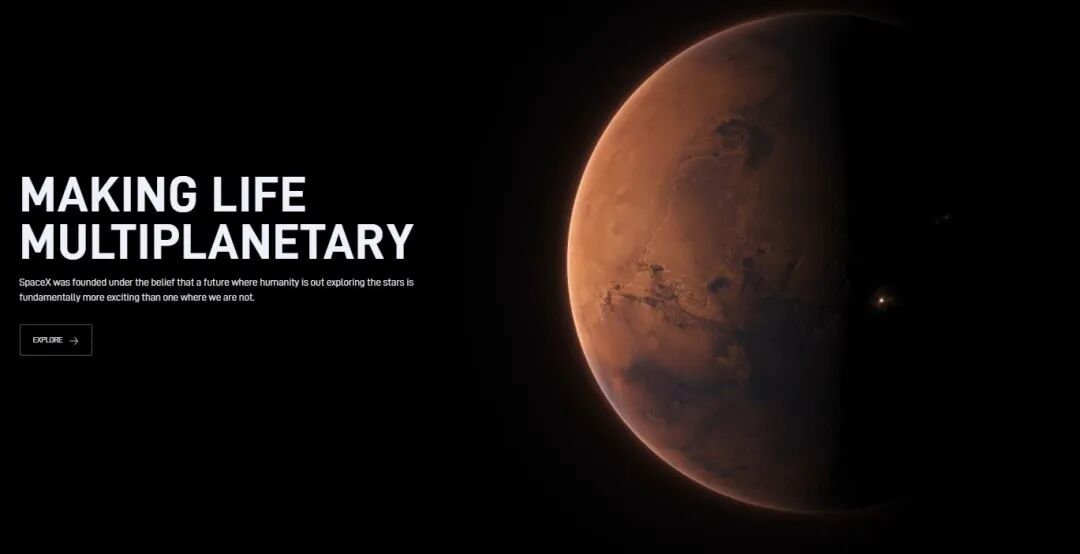
▲Image sourced from SpaceX's official website.
Thus, while both SpaceX and AI companies are sketching out future scenarios, SpaceX's vision is undeniably grander. If Anthropic and OpenAI represent the Plus or Pro versions, then SpaceX is the Ultra Max version.
It's noteworthy that the revaluation of tech company market caps driven by this AI wave can no longer be confined to traditional valuation frameworks such as price-to-earnings (P/E) ratios, discounted cash flow (DCF) analysis, or margins of safety. Their pricing logic has diverged from financial fundamentals and is now more narrative-driven.
SpaceX's "science fiction narrative" operates at a higher dimension than that of pure AI large model companies. Given this, it's unsurprising that its valuation anchor is continually pushed higher by long-term visions like "Space AI = Low-Latency Starlink Network × Distributed Orbital Computing Power," resulting in Musk's personal net worth roughly equating to the combined wealth of the world's second to fifth richest individuals.
Thus, on the path of "monetizing science fiction narratives," Musk once again leads by a substantial margin.
While xAI has indeed been outmatched by Anthropic and OpenAI in the realm of AI, even they must acknowledge SpaceX's superiority—after all, SpaceX has already transcended the atmosphere.
It has taken to the skies; one cannot help but recognize its lead.
-
![]()
ByteDance, DJI, and Xiaohongshu Secure Top Three Positions Among China’s Fastest-Growing Unicorns
-
Tesla's in-car voice system in China is finally learning to 'understand human language'
-
![]()
Foreigners Are Amazed: Chinese Electric Vehicle Drive Systems Unveil Innovative 'Poses'
-
![]()
700,000 Brothers and the Future of Robots: Behind JD.com's 'Nirvana Plan'
-
![]()
Zhipu's Trillion-Dollar Valuation: A New Chapter for China's AI
-
![]()
Is Laifen, a 'Dyson Alternative' on the Rise, Now Ensnared by the 'Alternative Curse'?
-
![]()
Beyond Patents: Insta360 and DJI Compete in Retail
-
![]()
Piercing Through Industry Chaos: The Curtain Rises on Compliance for Autonomous Driving