Is Laifen, a 'Dyson Alternative' on the Rise, Now Ensnared by the 'Alternative Curse'?
 06/26 2026
 560
560
Text by | Bishan
Source | Bowang Finance
In May 2026, Laifen hosted three consecutive launch events, unveiling eight new products. The standard version of the AirFold handheld folding fan was priced at 399 yuan, sparking a flood of comments in the live chat such as "Has Laifen lost its mind?" and "Is it crazy to spend 399 yuan on a fan?" Ye Hongxin, the company's leader, retorted on the spot: "399 yuan is really not expensive! Look at similar products from foreign brands—those are the ones that are truly overpriced!" This was no coincidental pricing mishap but rather a manifestation of the "alternative curse."
01 From 150 Million to 4.1 Billion: A Single Video Transformed the Landscape
Ye Hongxin was born in 1986 into a modest family in Lishui, Zhejiang. He dropped out of school early and ventured to Guangzhou to work on factory assembly lines. During his toughest times, he even scavenged for trash with his father. At the age of eight, he connected used batteries in series to power a desk lamp bulb; in middle school, his skills in modifying radio-controlled cars far outstripped those of his peers. These experiences paint a vivid picture of a young man instinctively drawn to motors.
During the Taobao e-commerce boom, Ye Hongxin struck gold, earning his first 10 million yuan. He bet his entire fortune on the research and development of manned aircraft, only to lose everything when the project failed. Around 2019, standing beneath an aircraft and feeling the gale-force winds, a thought struck him: "Could this motor be used inside a hair dryer?"
This idea proved to be worth 4.1 billion yuan.
Founded in 2019, Laifen launched its first high-speed hair dryer in 2021, boasting a rotational speed of 115,000 RPM, comparable to Dyson's, but priced at just 599 yuan—one-fifth of Dyson's price. Its minimalist "Apple-style" design resonated with consumers during the era of consumption downgrade: they wanted high-end performance without the brand premium.
The real turning point came in 2022. A video titled "Why Can't a Hair Dryer That Outperforms Dyson Grow Big?" garnered billions of views. When investor Wang Cen questioned, "Where do you surpass Dyson?" Ye Hongxin replied, "We surpass them in every way—greater airflow, lower noise, and a cheaper price." This statement firmly implanted the "Dyson alternative" label in consumers' minds.
From 2021 to 2024, Laifen's annual sales skyrocketed from 150 million yuan to 4.1 billion yuan. In the first half of 2023, in the online channel for high-speed hair dryers, Laifen accounted for 64% of sales volume and 40% of sales value, surpassing Dyson to claim the top spot. Laifen fully capitalized on the traffic dividends of content e-commerce platforms like Douyin.
The "Dyson alternative" label fueled high growth, but its essence was parasitic positioning. Dyson had spent over a decade convincing consumers that "a high-speed hair dryer is worth 3,000 yuan." Laifen didn't need to educate the market; it just needed to offer a cheaper option. From its inception, the brand struggled to independently define value.
At the 2024 Berlin IFA Expo, this contradiction was laid bare under the spotlight. According to 36Kr, at Dyson's request, a German local court seized Laifen's samples for infringement. Ye Hongxin later stated, "I want to prove that we're not just capable of being a big-brand alternative but also have innovative capabilities."
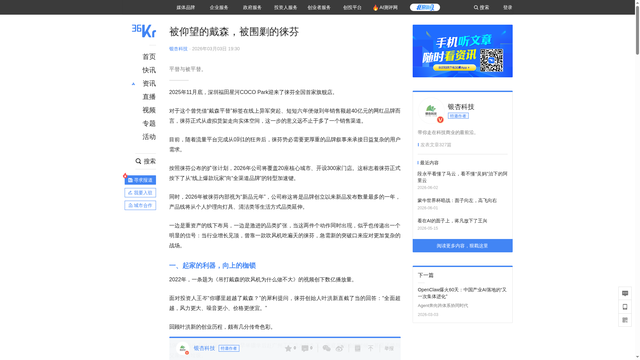
Figure: 36Kr Report: Dyson, the Admired, Laifen, the Besieged
When you try to shed a label, it's often already firmly attached. In the first three quarters of 2024, the sub-300-yuan price segment dominated online hair dryer sales, with its market share increasing by nearly 11 percentage points year-on-year and sales volume growing by 76.8%. The Dreame G10, priced at 199 yuan, featured an 110,000-RPM motor; Xiaomi's ecosystem products pushed prices down to the 100-150 yuan range; and Flyco's entry-level models cost just 30-100 yuan. Most of Laifen's hair dryers were priced above 399 yuan, with only two models below 300 yuan. In August 2025, although Laifen maintained its top spot with a 26.5% market share, this represented a 5.9% year-on-year decline. The transition from "being an alternative" to "being besieged by alternatives" happened faster than expected.
02 What the 399-Yuan Fan Revealed
From May 11 to 15, 2026, Laifen held three consecutive launch events, introducing eight new products across four previously unexplored categories: folding fans, hair curlers, smart makeup mirrors, eye-protection floor lamps, and children's electric toothbrushes. Ye Hongxin personally hosted the livestreams, attempting to signal that Laifen was no longer just a hair dryer brand.
The signal was drowned out by the chat. After the 399-yuan price of the AirFold handheld folding fan was revealed, the chat flooded with accusations like "Laifen has gone crazy" and "ripping off consumers." Ye Hongxin grew agitated: "399 yuan is really not expensive! Look at similar products from foreign brands—those are the ones that are truly overpriced!" The "foreign counterpart" he referred to was Dyson, which had just released its Mini Cool handheld fan a month earlier, priced at 799 yuan in China.
With aviation-grade aluminum, a self-developed axial flux motor, and an ultra-compact folding design, priced at half of Dyson's—the narrative should have been "a conscientious domestic brand," but consumers weren't convinced. The issue wasn't cost or specifications but a fundamental difference in product category attributes.
Hair dryers are non-standardized products. Their functions are difficult to quantify, and they carry aesthetic and social value, leading consumers to willingly pay a premium for "more than just drying." Fans are standardized products. Their core function is reduced to simply "blowing cool air," with extremely low technical barriers and a highly transparent supply chain. Basic experiences provided by budget brands like Mijia and Midea, priced in the tens of yuan, already meet or exceed acceptable standards, firmly anchoring consumer price expectations in the 100-200 yuan range.
Laifen's 399-yuan fan is stuck in the middle: neither cheap enough nor premium enough. Without revolutionary innovation in a non-standardized category, it forcibly raised the price point of a standardized product—defying the objective laws of retail.
A deeper dilemma lies in the "curse of being an alternative." Laifen's core audience consists of budget-conscious young people, students, and young professionals. They buy Laifen for the thrill of "getting more for less." When a brand's pricing exceeds their perceived value benchmark, this highly rational consumer group turns against it far faster than expected.
Data shows that 47% of negative reviews in the price dimension cite "overpricing," while 50% of negativity in the service and trust dimension stems from similar concerns. Data from the "2025 China Personal Care Appliance Consumption White Paper" is even more stark: 68% of consumers believe "alternative products lack stable quality," and 52% explicitly state they "will not pay extra for alternative products."
The 399-yuan fan isn't a product failure—it's a strategic failure. It exposes a fundamental issue with Laifen: the pricing power established in non-standardized products cannot automatically transfer to standardized ones. Moving from hair dryers to fans changes the category but not consumer perception—they still believe Laifen's products should be cheap.
03 The Collective Failure of the 'Favored Sons'
(See below: Reported by Tencent News)
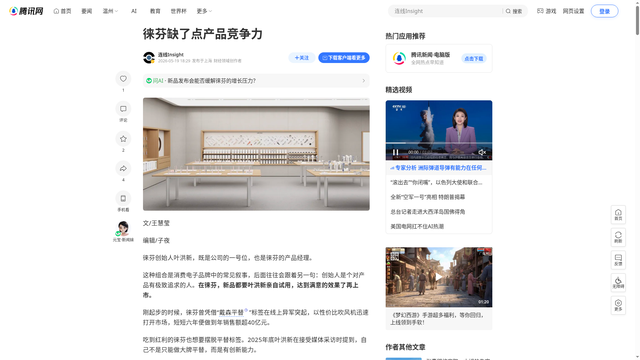
Figure: Tencent News Report: Laifen Lacks Product Competitiveness
In 2023, Laifen launched its first oscillating-rotating electric toothbrush, which Ye Hongxin openly favored, calling it his "favored son." The oscillating-rotating technology represented an innovative attempt in the industry, and Laifen hoped to prove it was more than just a hair dryer brand. However, market feedback was far colder than expected.
In 2024, this "favored son" incurred a net loss of 80 million yuan. By the 2025 618 shopping festival, Laifen had slipped to fifth place in electric toothbrush sales on Tmall, surpassed by Usmile and Philips. In an interview, Ye Hongxin rarely admitted embarrassment: "At a 299-yuan price point, our gross margin is less than 40%, while competitors with 70% margins are crushing us."
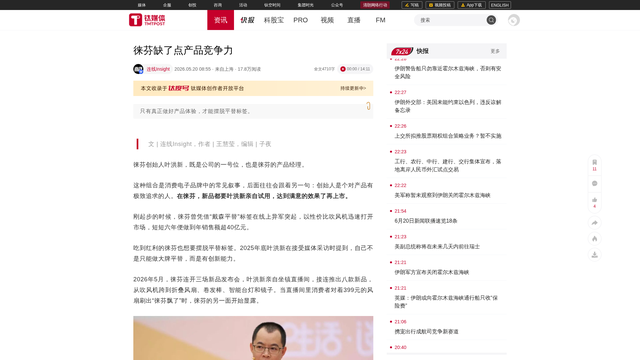
Figure: TMTPost Report: Laifen Lacks Product Competitiveness—Electric Toothbrush Loses 80 Million Yuan
The shaver story follows a similar trajectory. In May 2025, after four years and over 100 million yuan in investment, Laifen's first electric shaver, the T1 Pro, finally launched. At the event, technical jargon like linear motors, new energy vehicle-grade flat-wire windings, 0.2mm ultra-thin silicon steel sheets, and 12,000 reciprocating cuts per minute painted a hardcore picture. But after the initial excitement, troubles followed.
CNC machining improved precision but also constrained production capacity. The first batch yielded only 2,000 units, and user feedback was unimpressive: "Doesn't shave cleanly," "loud noise," "short battery life." Ye Hongxin candidly admitted at the event: "Gross margins are very low, and the shaver will likely incur 100% losses in 2025."
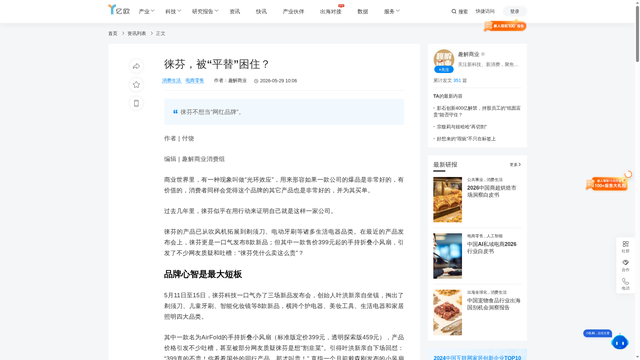
Figure: EqualOcean Report: Is Laifen Trapped by Being an 'Alternative'?—Patent Shortcomings and Insufficient R&D Investment
The repeated setbacks of the "favored sons" have also tarnished Laifen's growth myth. (See below: Reported by Sohu, citing Lanjing News)
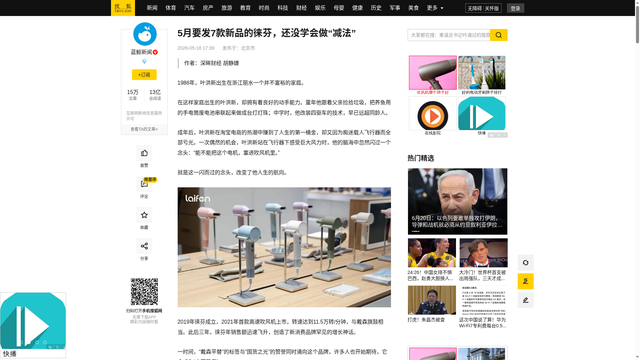
Figure: Sohu/Lanjing News Report: Laifen, Launching Seven New Products in May, Hasn't Learned to 'Subtract'—618 GMV Just Over 300 Million Yuan
During the 2025 618 shopping festival, Laifen's cross-channel GMV totaled just over 300 million yuan, a nearly 40% drop from 500 million yuan in 2024. The annual GMV target of 6 billion yuan set earlier in the year now seems unattainable. Double 11 data was equally grim: sales growth plummeted from 51.7% in 2023 to 13% in 2024. Data from Aowei Cloud poured cold water on the industry: in 2025, online hair dryer retail sales reached 9.1 billion yuan, down 9.2% year-on-year. The overall market is shrinking, and Laifen's room to maneuver is narrowing.
Even colder than the numbers is the personnel turmoil. (See below: Reported by Jiemian News)
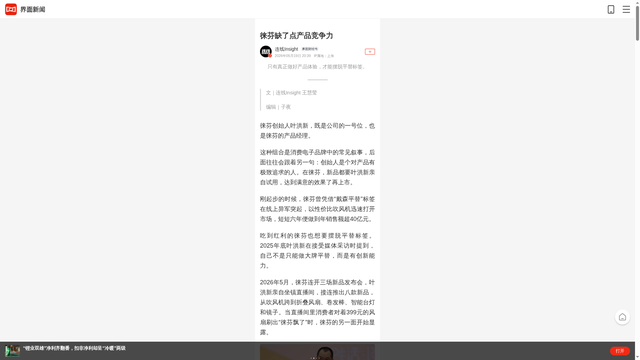
Figure: Jiemian News Report: Laifen Lacks Product Competitiveness—R&D Director Jiang Jun Departs, Overseas Head Shao Shili Exits, Shaver Lead Liu Xuan Leaves
In early 2025, R&D Director Jiang Jun resigned; soon after, Overseas Business Head Shao Shili departed; and before the 2026 Spring Festival, Shaver R&D Lead Liu Xuan also left. The密集 (frequent) departures of three core leaders are hard to interpret as normal team optimization.
From hair dryers to electric toothbrushes to shavers, Laifen's expansion path seemed logical on the surface: motor-driven, personal care track, targeting the same consumer base. But each crossover repeated the same mistake—transplanting the "high performance + low pricing" strategy validated in non-standardized products directly into standardized product battles. The result wasn't replicated success but replicated losses.
Patent shortcomings further support this assessment. By the end of 2025, Laifen's affiliated companies had publicly disclosed 342 patents, but most focused on design patents and low-threshold utility models. "Invention patents" representing core R&D strength accounted for only a single-digit percentage. R&D investment accounted for just 5% of revenue, below average in the consumer electronics industry.
Laifen's desire to shed the "alternative" label is commercially understandable. No ambitious brand wants to be stuck in price wars forever. But escaping the "alternative" label doesn't come from pricing the next product higher.
In standardized product battles, consumers don't care about brand stories—they care about cost-effectiveness and reputation. If Laifen wants to continue down this path, it has only two choices: either slash prices further, using ruthless cost control to outcompete rivals and fully embrace the "price destroyer" role, or achieve a true generational leap in non-standardized products, making consumers willingly pay a premium for aesthetics and technology, thereby establishing independent pricing power.
Business is unforgiving. Consumers initially chose Laifen because it saved them thousands of yuan. This trust is real but fragile—it doesn't mean they're willing to pay extra for Laifen's ambitions. The 399-yuan fan lesson was a painful one. Before creating overwhelming independent value, pricing power in standardized products demands respect. The consumer market is increasingly sober, and the window for profiting from brand hype has closed. The most insidious curse of "being an alternative" isn't that it limits your ability to charge high prices—it's that it makes you believe the method that once helped you win can help you win again.
-
![]()
ByteDance, DJI, and Xiaohongshu Secure Top Three Positions Among China’s Fastest-Growing Unicorns
-
Tesla's in-car voice system in China is finally learning to 'understand human language'
-
![]()
Foreigners Are Amazed: Chinese Electric Vehicle Drive Systems Unveil Innovative 'Poses'
-
![]()
700,000 Brothers and the Future of Robots: Behind JD.com's 'Nirvana Plan'
-
![]()
Zhipu's Trillion-Dollar Valuation: A New Chapter for China's AI
-
![]()
Is Laifen, a 'Dyson Alternative' on the Rise, Now Ensnared by the 'Alternative Curse'?
-
![]()
Beyond Patents: Insta360 and DJI Compete in Retail
-
![]()
Piercing Through Industry Chaos: The Curtain Rises on Compliance for Autonomous Driving