Foreigners Are Amazed: Chinese Electric Vehicle Drive Systems Unveil Innovative 'Poses'
 06/26 2026
 419
419
The evolution of passenger vehicles has traversed a century, with traditional fuel vehicles, powered by internal combustion engines, predominantly relying on a singular power source. The transmission of power and its distribution to the four wheels are primarily accomplished through drive shafts and differentials, a domain where European and American automotive giants have long excelled. However, in the current era of electric vehicles (EVs), encompassing pure electric, plug-in hybrid, and range-extended models, distributed drive solutions are steadily emerging as the new norm. This shift has given rise to diverse configurations, including dual-motor, three-motor, and even four-motor setups, fully unlocking novel 'poses' for EVs. These advancements have not only enhanced performance but also functionality, leaving foreign observers in awe.
● Dual-Motor 'Front 0, Rear 2' Configuration
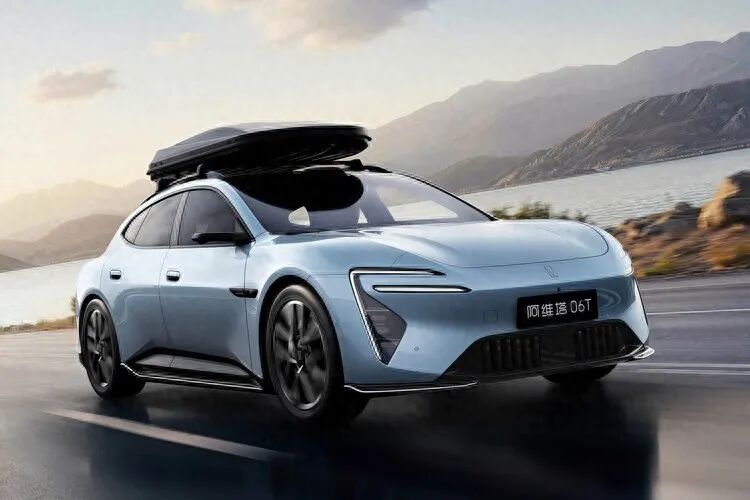
▲ Representative Model: Avatar 06T
Mainstream models like the Tesla Model 3, Xiaomi SU7, and BYD Han L all feature a 'front 1, rear 1' dual-motor layout in their all-wheel-drive variants. In this setup, two motors, one at the front and one at the rear, independently drive the respective different wheelsials through and half-shafts. This configuration represents the current standard for decoupled electric all-wheel-drive vehicles.
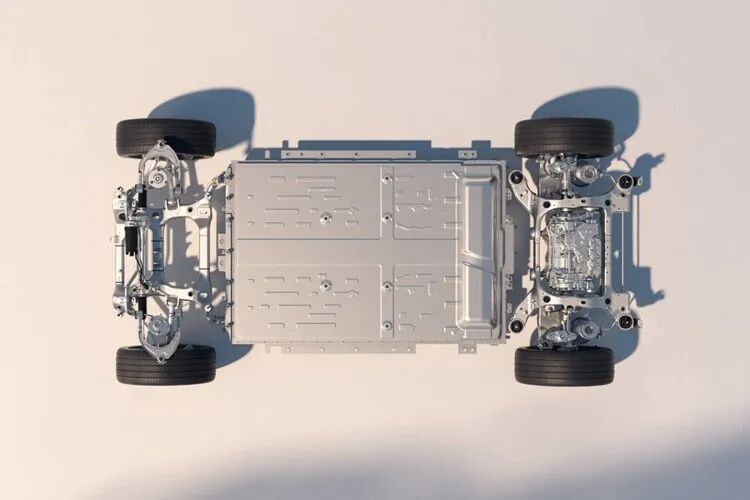
'Front 0, Rear 2' Layout
However, the newly launched GT sports sedan from Avatar, the 06T, introduces a groundbreaking dual-motor rear-wheel-drive solution. Here, two permanent magnet synchronous motors are placed on the rear axle and are fully decoupled. The left motor drives the left rear wheel via reducer 1 and half-shaft 1, while the right motor drives the right rear wheel through reducer 2 and half-shaft 2.
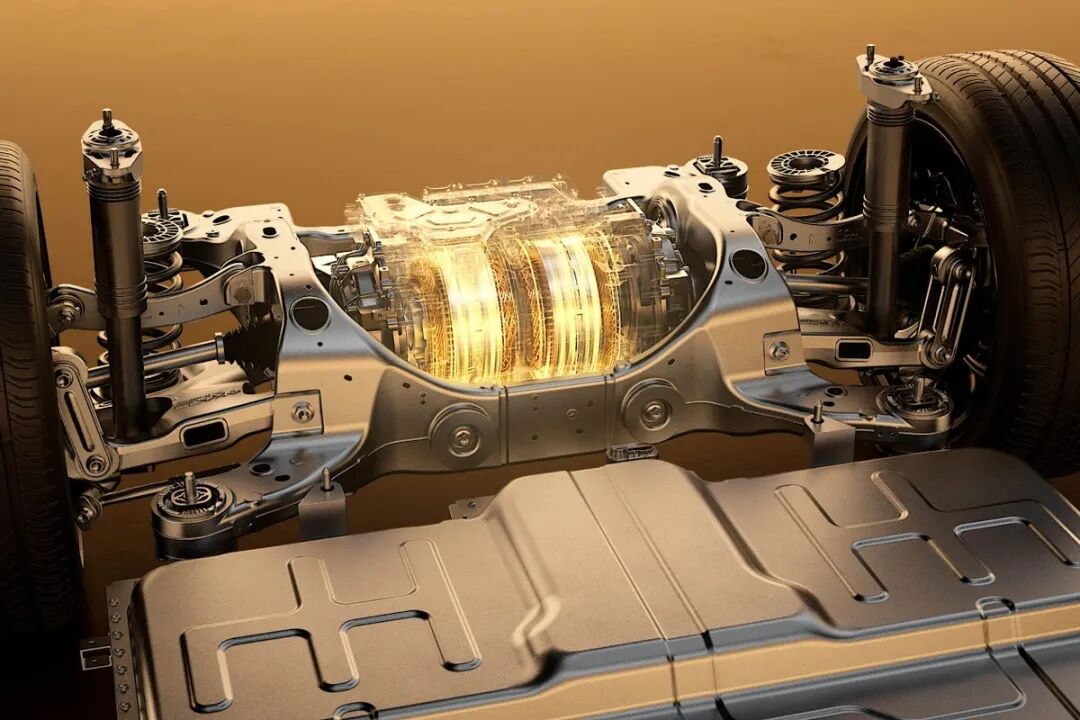
Dual-Motor Rear-Wheel Drive
Compared to a single-motor rear-wheel-drive system, this dual-motor setup allows for more precise control over the power delivered to each wheel, even enabling forward and reverse rotation. For instance, during low-speed turns and U-turns, it effectively reduces the turning radius. In high-speed cornering and lane-changing scenarios, the chassis remains more stable and is less prone to skidding.
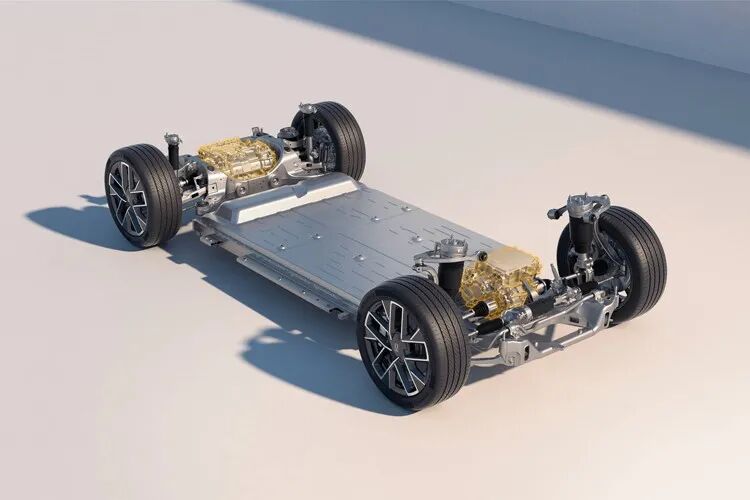
Three-Motor All-Wheel Drive
Moreover, the top-trim model is equipped with the Taihang distributed electric drive system, featuring an induction asynchronous motor on the front axle. This motor primarily provides additional power output under high-demand conditions, offering higher efficiency at high speeds compared to permanent magnet synchronous motors. This layout is also a common practice in the industry.
● Three-Motor 'Front 1, Rear 2' Configuration
▲ Representative Models: Xiaomi SU7 Ultra, Tengshi N9, Geely Galaxy Warship 700
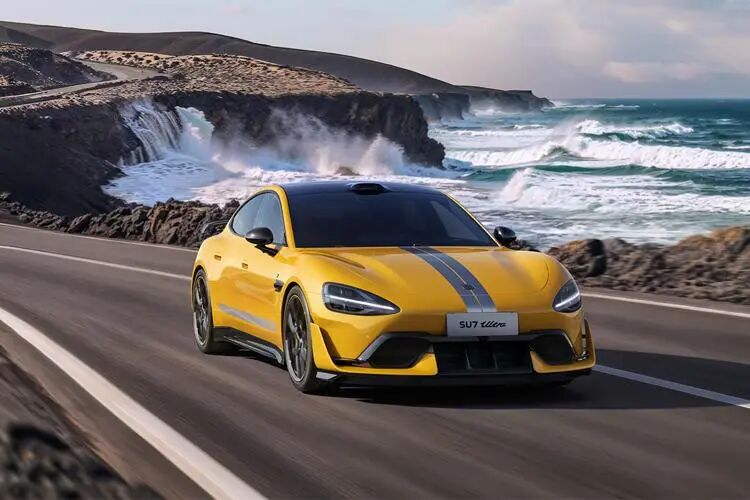
Including the aforementioned top-trim Avatar 06T, high-performance EVs are increasingly adopting a 'front 1, rear 2' three-motor solution. Among them, the Xiaomi SU7 Ultra stands out, holding the record for the fastest EV on the Nürburgring.
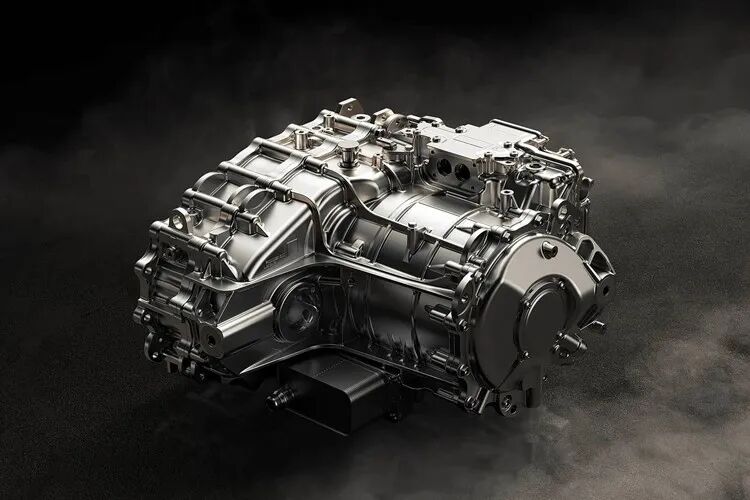
Xiaomi V8S Motor
With a total of three motors, front and rear, the SU7 Ultra achieves a maximum power output of 1138kW and an astonishing torque of 1770Nm, figures unattainable by any high-displacement fuel vehicle in mass production. The vehicle accelerates from 0-100km/h in just 2.1 seconds, with a top speed of 350km/h. Considering it's a four-door coupe with a curb weight of 2360kg, such acceleration performance and lap times are bound to impress foreign observers.
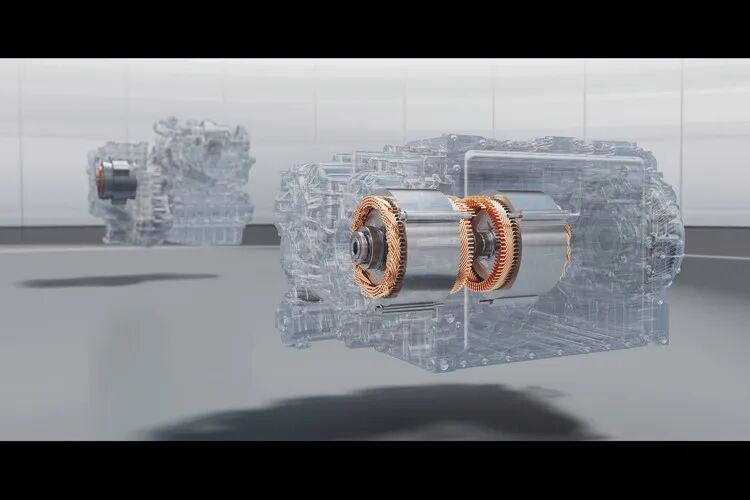
BYD Easy Three
Similarly, BYD's 'Easy Three' platform also adopts a 'front 1, rear 2' layout. Although its power figures are not as exaggerated as the SU7 Ultra's, thanks to BYD's leading electronic control system and ±15° active rear-wheel steering, nearly all models in this series can achieve extreme steering, compass-style U-turns, Easy Three parking, intelligent crab walking, stable driving with a blown tire, and other special functions. These are all 'black technologies' unimaginable for vehicles with a single power source.
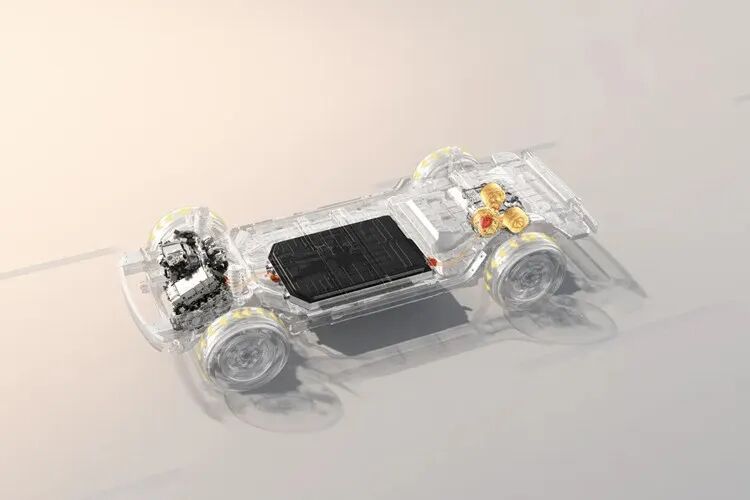
Geely Native Off-Road Platform
Finally, the upcoming Galaxy Warship 700 features a brand-new native new energy off-road platform developed by Geely. This platform also boasts a 'front 1, rear 2' three-motor layout, with the front axle housing a hybrid-specific engine in an electric hybrid system. This marks the first time in the industry that a decoupled vector all-wheel-drive electric hybrid solution with a front transverse layout has been used on an off-road vehicle.
● Three-Motor 'Front 2, Rear 1' Configuration
▲ Representative Models: JETOUR Shanhai T2, Great Wall GT Sports Car

Three-motor configurations can vary, with options like 'front 1, rear 2' and 'front 2, rear 1.' Taking the Chery C-DM electric hybrid system used in the JETOUR Shanhai T2 as an example, the front axle is equipped with a 1.5T engine and two motors, P2 and P2.5, while the rear axle is driven by a P2 motor.
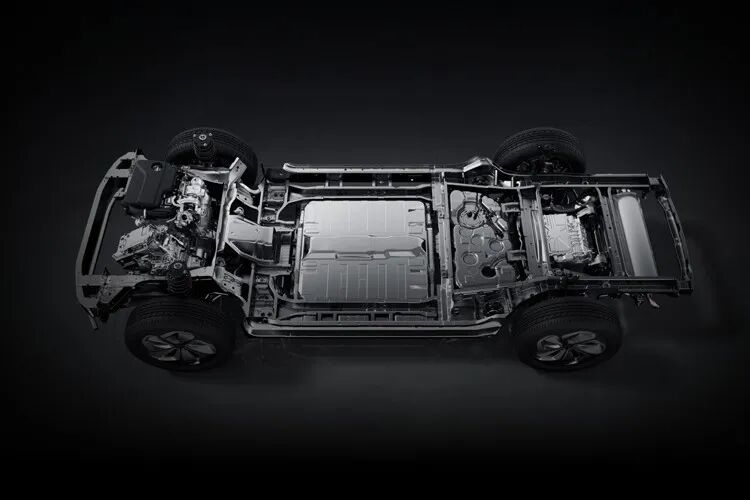
Chery P2+P2.5+P4
Overall, Chery's C-DM electric hybrid system shares similarities with BYD's DM-p and Geely's EM-P, both being decoupled electric hybrid all-wheel-drive systems. The key difference lies in the fact that the dual motors on the front axle of the C-DM can both drive the front wheels through corresponding reduction gears. In contrast, the P1+P3 front axle dual-motor solution used by competitors only allows the P3 motor to directly drive the wheels, with the P1 motor primarily responsible for power generation. Of course, the P2+P2.5 layout's dual motors have only one power output end (transmitting power to the left and right front wheels through a differential), so they do not possess the left-right decoupled vector power distribution function of the rear axle dual-motor solution (which does not require a differential).
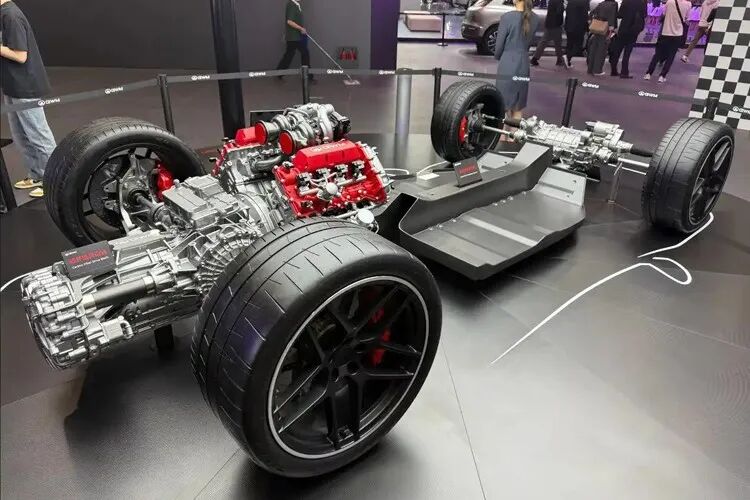
Great Wall P2+P4+P4 (Reverse Layout)
Additionally, the V8 super electric hybrid system that Great Wall Motors is set to showcase on its first GT sports car also, in principle, belongs to a 'front 2, rear 1' three-motor layout. In this setup, the front axle houses two vector motors that drive the left and right front wheels through reducers and half-shafts, while the rear axle is powered by a combination of a V8 engine and a P2 electric hybrid unit. This solution is not only used in the Great Wall GT sports car but also in the latest electric hybrid supercars from Ferrari, Lamborghini, and McLaren, all featuring similar decoupled electric hybrid all-wheel-drive systems.
● Four-Motor 'Front 2, Rear 2' Configuration
▲ Representative Models: Yangwang U9, Yangwang U7, Zeekr 001 FR
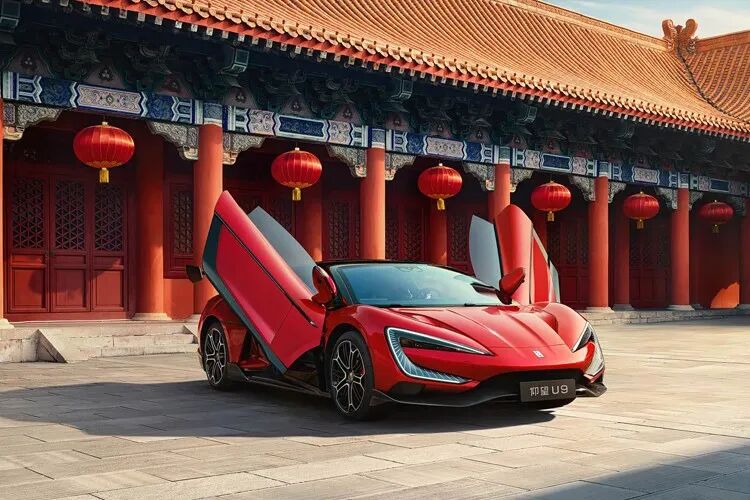
The pinnacle of distributed electric drive is undoubtedly the use of four in-wheel motors, each driving a wheel through a reducer and half-shaft. This setup not only maximizes the vehicle's performance but also eliminates the need for differentials, allowing the speed, torque, and direction of all four wheels to be controlled independently. Among these, BYD's 'Easy Four' architecture in the Yangwang series is undoubtedly a representative example of this solution.
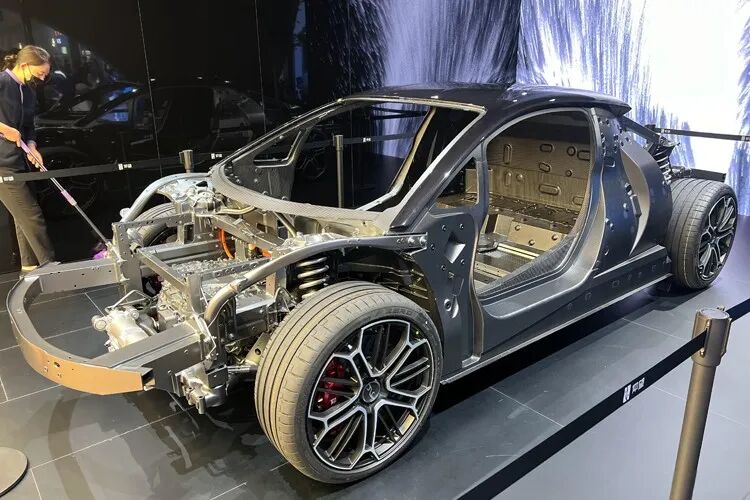
Take the flagship supercar, the Yangwang U9 Xtreme, as an example. With a full-domain 1200V ultra-high-voltage electrical system, four 555kW/30000rpm motors, and a 30C discharge rate lithium battery, this vehicle achieves a top speed of 496.22km/h in mass production, representing the ultimate form of electric drive.
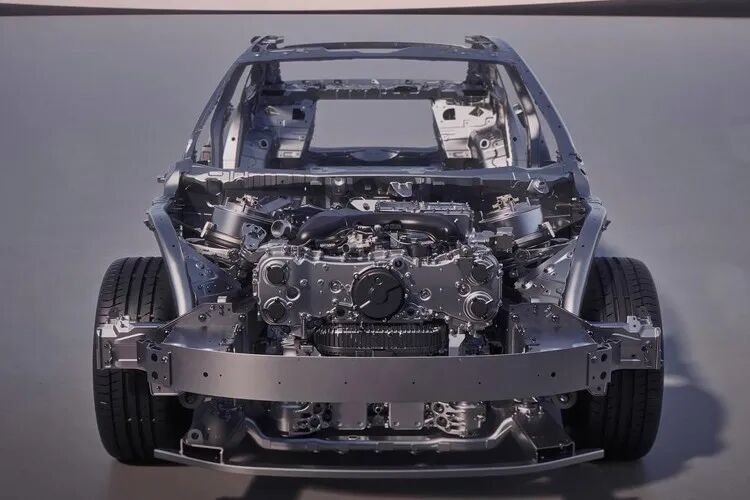
The Yangwang U7 not only retains the vector four-motor solution but also features a 2.0T engine as a range extender to ensure sufficient driving range. Interestingly, due to the shallow vertical space in the engine compartment of this four-door coupe, which makes it impossible to fit an inline-four engine like in the Yangwang U8, BYD developed a horizontally opposed four-cylinder engine specifically for this model. The cylinders/pistons are completely laid flat, and with a dry-sump lubrication system, the vertical height is compressed to 420mm, making it even thinner than the 2.0T engine in the Porsche 718.
-
![]()
ByteDance, DJI, and Xiaohongshu Secure Top Three Positions Among China’s Fastest-Growing Unicorns
-
Tesla's in-car voice system in China is finally learning to 'understand human language'
-
![]()
Foreigners Are Amazed: Chinese Electric Vehicle Drive Systems Unveil Innovative 'Poses'
-
![]()
700,000 Brothers and the Future of Robots: Behind JD.com's 'Nirvana Plan'
-
![]()
Zhipu's Trillion-Dollar Valuation: A New Chapter for China's AI
-
![]()
Is Laifen, a 'Dyson Alternative' on the Rise, Now Ensnared by the 'Alternative Curse'?
-
![]()
Beyond Patents: Insta360 and DJI Compete in Retail
-
![]()
Piercing Through Industry Chaos: The Curtain Rises on Compliance for Autonomous Driving