700,000 Brothers and the Future of Robots: Behind JD.com's 'Nirvana Plan'
 06/26 2026
 432
432
Yi Yan Business Observer
JD.com's 'Nirvana Plan' at least practices a possibility at the micro level—making technology an extension of humans rather than a scythe for substitution.
Liu Qiangdong speaks up for his 'brothers' again.
Recently, at the APEC CEO Summit China in Beijing, Liu Qiangdong, founder and chairman of JD.com, made two thought-provoking remarks.
The first was an industry prediction: 'In the future, robots will handle all deliveries. There will be no need for couriers; it will definitely be robots doing the deliveries.' Immediately after, his second statement was almost stubborn: 'But I don't want our 700,000 brothers to lose their jobs or livelihoods.'
This rhetoric is very Liu Qiangdong—consistent with his usual style. Accompanying his speech was JD.com's internal strategic initiative, codenamed 'Nirvana Plan.' The company has signed agreements with 124 vocational colleges across the country to send 700,000 couriers and warehouse blue-collar workers back to classrooms in batches. They will receive systematic skills training in robot maintenance, upkeep, and fault diagnosis, transitioning frontline employees from outdoor delivery roles 'exposed to wind and rain' to indoor technical operation and maintenance positions. Wages and social security benefits will continue during training, and JD.com has explicitly promised: not a single employee replaced by machines will be laid off.
Objectively speaking, at a time when most companies equate automation with 'cost-cutting and layoffs' amid the AI wave, JD.com has chosen a counterintuitive path: not evading the inevitability of technological substitution but using corporate resources to secure a chance for existing employees to 'reskill and rebirth ' (rebirth through skill transformation). This stance has propelled the 'Nirvana Plan' beyond mere business news, turning it into a landmark event in public discussions about labor-management relations and corporate social responsibility in the AI era.

01 The 'Nirvana Plan': JD.com is 'Revolutionizing Itself'
To grasp the weight of this commitment, one must first understand the underlying business model of JD Logistics.
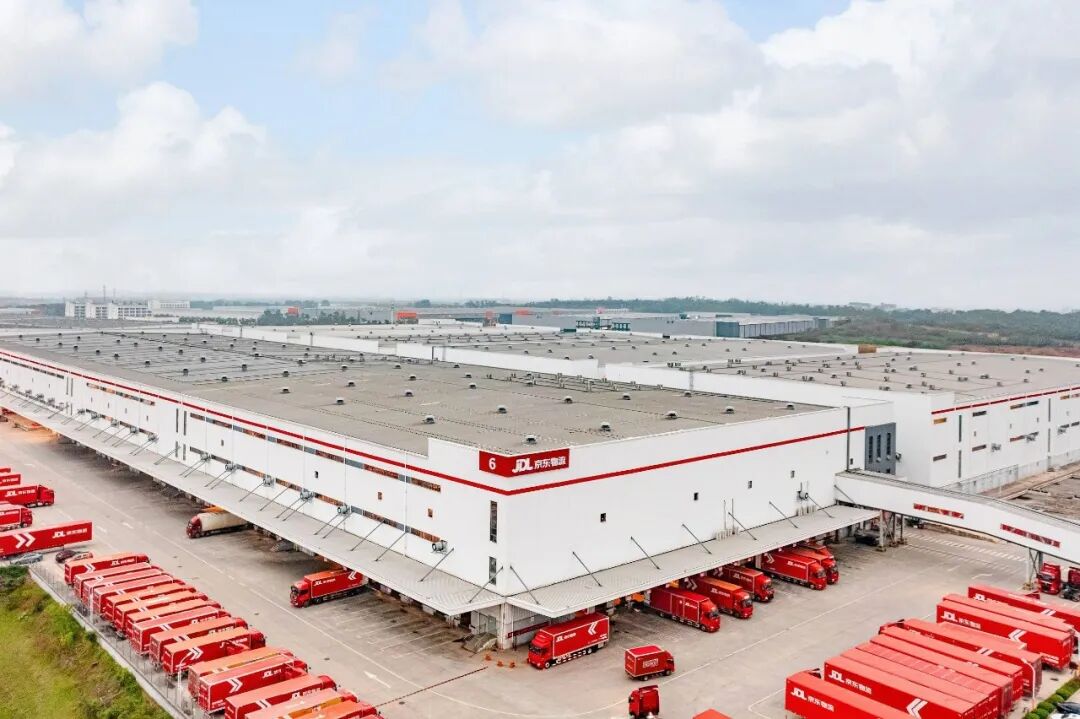
Unlike the franchise or crowdsourced models prevalent in the industry—where end (end-point) delivery personnel are hired by franchise outlets or even paid per delivery as crowdsourced riders, with headquarters bearing no fixed salaries or social security costs—JD Logistics operates a fully direct model. Its transfer centers, sorting hubs, and end-point delivery stations are all directly managed, with frontline employees signing labor contracts, receiving Five Social Insurances and One Housing Fund (five social insurances and one housing fund), and guaranteed base salaries. As of 2026, JD.com employs over 900,000 people system-wide, with roughly 700,000 being frontline logistics blue-collar workers—the only e-commerce platform in the industry assuming full employer responsibility for such a large frontline workforce.
This direct model has built JD Logistics' reputation for 'doorstep delivery, scheduled delivery, and low damage rates,' forming its differentiated competitive moat. However, the cost is substantial: as automation gradually replaces manual labor, JD.com cannot externalize labor costs by not renewing contracts or reducing network staffing, as franchise-based peers do. The salaries and benefits of 700,000 employees remain real, rigid fixed expenses on its balance sheet.
Financial reports show that in the first quarter of 2026, JD.com's total human resources expenditure surged year-on-year to 166.4 billion yuan, while net profit attributable to shareholders for the quarter slumped 53% year-on-year. Market discussions have already emerged: amid an ongoing price war in the express delivery industry and competitors maintaining labor cost flexibility through franchise models, JD.com's insistence on 'no layoffs + full training' amounts to voluntarily enduring margin pressure, trading current profits for organizational stability and time.
From this perspective, Liu Qiangdong is not just making empty promises. After acknowledging a harsh reality, he is actively bringing the 'social costs of technological substitution' back into the corporate sphere—a rarity among domestic private enterprises and why JD.com is said to be 'revolutionizing itself.'
02 Behind the Warm Narrative: Three Unavoidable Scientific Challenges
JD.com and Liu Qiangdong's decision-making attitude deserves respect. But respect aside, the 'Nirvana Plan' faces three industry-validated objective challenges in implementation.
First, the capacity of maintenance and operation roles is far lower than that of the operational roles being replaced.
Industry data shows that the typical maintenance-to-equipment ratio for logistics automation is one technician per 10–50 robots or automated terminals (varying based on equipment complexity and centralization). Even if JD.com deploys millions of end (end-point) delivery robots and humanoid operational robots in the long term, the total internal capacity for dedicated maintenance, scheduling, and monitoring roles is optimistically estimated at 100,000–200,000—less than one-third of the original 700,000 frontline personnel. McKinsey Global Institute and the World Economic Forum's *Future of Jobs Report* similarly point out: the 'creative destruction' triggered by AI and automation exhibits classic structural mismatches—old jobs vanish intensively and abruptly, while new job creation is dispersed and lagging. Net job growth may occur, but individual workers' cross-occupational transitions are not seamless.
In other words, while the logic 'machines break down and need humans to fix them' holds, 'not as many humans are needed to fix them' is also a mathematical property of automation. This is the capacity ceiling all retraining-for-employment programs must confront.
Second, skills transfer faces a real capability gap.
Modern logistics robot maintenance is a cross-disciplinary field—requiring mechanical assembly/disassembly basics, circuit diagram reading, multimeter usage, embedded system knowledge (CAN bus, sensor calibration), foundational understanding of SLAM mapping, and even simple Linux commands. However, most of JD.com's 700,000 frontline blue-collar workers have weak numeracy and literacy foundations while supporting elderly parents and children. Whether they can afford to leave their posts for 6–18 months of systematic training is a practical concern. Even with JD.com establishing over 80 Robobase robot training bases and partnering with 124 vocational schools to offer customized, short, and efficient courses, training conversion rates—especially for older, less academically inclined groups—remain a challenge. A layered, gradient design is needed (e.g., deep maintenance teams/basic inspection roles/station operation scheduling/lateral shifts to same-city delivery or customer service, where AI substitution is harder). Forcing a 'one-size-fits-all' approach would be inefficient and demoralizing.
Third, the direct-operation cost structure remains under sustained pressure in a highly competitive market.
If JD.com slows its automation pace or maintains excess personnel to preserve jobs, while competitors using franchise/crowdsourced models continue participating in price wars with lower fulfillment costs, JD Logistics' gross margins will face medium- to long-term pressure. Capital markets will also question the ROI of human capital investments. Liu Qiangdong is betting that trained existing employees, with their deep understanding of China's 'last-mile' scenarios, can transform into robot operation and station management teams, creating a competitive moat that rivals 'can buy equipment but not replicate equal scenario-based operational capabilities.' This strategic judgment awaits time to validate, but short-term financial costs are very real.
03 'Run First, Then Iterate': More Meaningful Than the Plan Itself
Ideals are plump (plump with ambition), but reality is bony (bony with challenges). The systemic displacement of tens of millions of low-skilled service sector jobs by automation cannot be fully absorbed by the goodwill of individual companies alone.
The World Economic Forum predicts that by 2030, roughly 92 million jobs globally will be replaced by AI, while 170 million new jobs will be created—a net positive, but transitional frictional unemployment, skills mismatches, and regional imbalances pose real risks. Publications like *Study Times* have argued that if AI's impact on employment breaches a critical threshold, policy systems must 'shift from passive post-hoc relief to proactive pre-emptive intervention and mid-course adjustment.' This includes improving national-level 'skills accounts' and micro-credential systems, driving industry-education-evaluation ecosystems where chain-leading enterprises (like JD.com) and vocational schools jointly set standards, and exploring robot taxes/AI substitution taxes for redistribution and social security safety nets for displaced workers.
However, these factors do not diminish the value of JD.com's current actions. On the contrary: when an industry leader is willing to internalize the social buffering costs of technological substitution and publicly commit to creating retraining pathways for 700,000 people, it is effectively blazing a trail for the entire industry—proving that companies can pursue efficiency while retaining responsibility for people.
This 'run first, then iterate' approach holds more sample significance than whether the plan itself achieves 100% flawless execution.
Nobel laureate in economics Daron Acemoglu distinguishes AI as 'wrong AI that substitutes laborers' versus 'right AI that augments labor capabilities,' noting that markets naturally lean toward the former and require institutional incentives to steer technological evolution toward the latter. JD.com's 'Nirvana Plan' may not solve all macro-level employment substitution issues, but it at least practices a possibility at the micro level—making technology an extension of humans rather than a scythe for substitution.
04 'Technology for Good': Its Difficulty Makes It Precious
When Liu Qiangdong says, 'I don't want 700,000 brothers to lose their livelihoods,' some will dismiss it as marketing rhetoric, while others will be moved. Stripping away emotions, the essence is this: a direct-operation logistics enterprise, fully aware that automation will drastically reduce its frontline job demand, has chosen not to push employees into society. Instead, it is signing agreements with schools, building training bases, and spending real money to buy time for transformation.
It has idealistic elements, mathematical imperfections, and financial costs. But precisely because it is difficult, it is precious.
Chinese companies now rank among the global first tier in AI competition. As technology races ahead, 'technology for good' cannot remain confined to corporate social responsibility reports. JD.com's 'Nirvana' journey for 700,000 people offers a partial answer—not evading substitution, not abandoning people. For this path to succeed, sustained corporate investment, proactive reform of the vocational education system, and supportive public policies are all indispensable.
But at least, someone has taken the first step.
END
-
![]()
ByteDance, DJI, and Xiaohongshu Secure Top Three Positions Among China’s Fastest-Growing Unicorns
-
Tesla's in-car voice system in China is finally learning to 'understand human language'
-
![]()
Foreigners Are Amazed: Chinese Electric Vehicle Drive Systems Unveil Innovative 'Poses'
-
![]()
700,000 Brothers and the Future of Robots: Behind JD.com's 'Nirvana Plan'
-
![]()
Zhipu's Trillion-Dollar Valuation: A New Chapter for China's AI
-
![]()
Is Laifen, a 'Dyson Alternative' on the Rise, Now Ensnared by the 'Alternative Curse'?
-
![]()
Beyond Patents: Insta360 and DJI Compete in Retail
-
![]()
Piercing Through Industry Chaos: The Curtain Rises on Compliance for Autonomous Driving