Shenzhen’s Most Mysterious Robot Startup Secures 1 Billion Yuan in Funding, Targeting a 150 Billion Yuan Market
 06/30 2026
 555
555
Cover image generated by ChatGPT
A Shenzhen-based robotics startup has quietly raised 1 billion yuan in Series A financing, marking a significant milestone in the rapidly evolving field of embodied artificial intelligence.
The company, RoboScience, may not yet be a household name, but it has positioned itself as a pioneer in developing large-scale embodied AI models—effectively creating a "brain" for robots.
This AI "brain" enables robots to comprehend tasks, assess their surroundings, and manipulate objects autonomously, representing one of the most formidable technical challenges in embodied intelligence.
The market is poised for explosive growth. Consulting firm MarketsandMarkets projects that the global embodied AI market will surge from $4.44 billion in 2025 to $23.06 billion by 2030 (roughly 157 billion yuan).
Founded in 2024 by Tian Ye, a post-90s entrepreneur from Zigong, Sichuan Province, RoboScience is making waves in the industry.
Tian holds a bachelor's degree in physics from the University of Science and Technology of China and a master's degree from the Stanford AI Lab. Prior to starting RoboScience, he spent seven years at Apple, where he led the AI Platform division.
Recently, RoboScience unveiled its groundbreaking general-purpose embodied large model, Visics. Pencil News sat down with Tian Ye and Wang Tao, the company's co-founder and CEO, in Shenzhen to discuss the most pressing questions in the market: What are the true opportunities in embodied AI?
- 01 -
Why Are Embodied AI Large Models Gaining Momentum?
Embodied AI large models are riding three key trends: the expansion of large models from the digital realm into physical environments, the robotics industry's urgent need to overcome generalization challenges, and investors' search for the next wave of AI commercialization.
The advent of ChatGPT sparked a critical question: If large models can understand language, can they also enable robots to comprehend objects, spaces, forces, and actions in the real world?
This is the core excitement surrounding embodied AI large models.
Traditionally, factories have employed robotic arms, warehouses use automated guided vehicles (AGVs), and automotive production lines are highly automated. However, these robots typically operate in relatively fixed, standardized, and closed environments. In other words, they lack generalization—struggling when removed from their original settings or tasks.
Truly valuable robots should not be limited to grasping a single type of bottle, moving one kind of box, or folding one style of clothing. They should handle objects of varying shapes, materials, and arrangements, knowing what to do in each scenario.
Nor should they be confined to a single robotic arm or dexterous hand. Instead, they should transfer learned capabilities across different robotic bodies.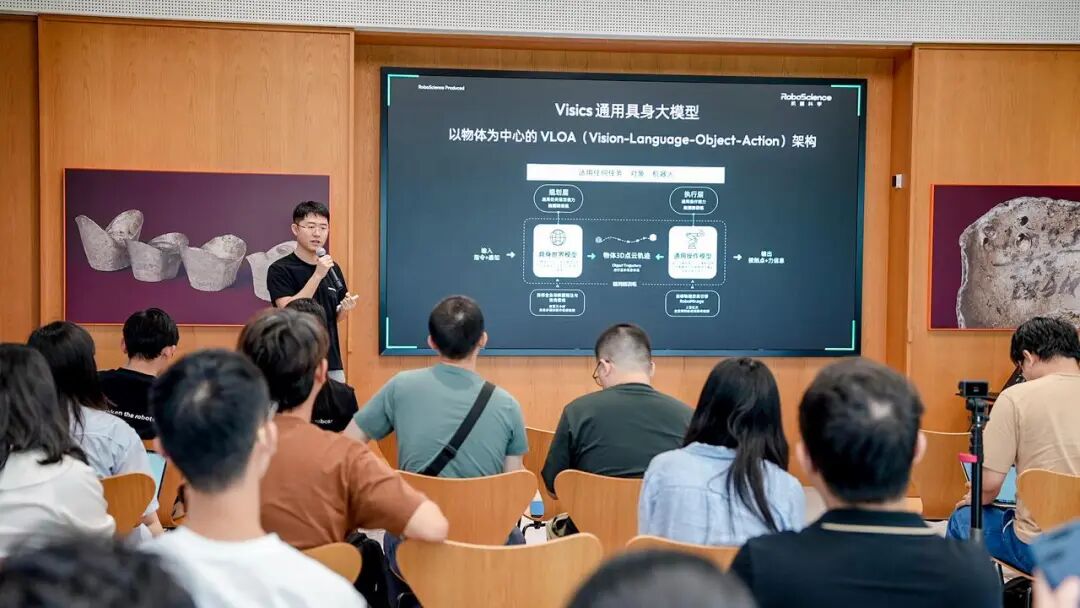
Tian Ye explains at the Visics launch event
RoboScience aims to equip robots with a universal "brain," enabling them to operate autonomously—understanding tasks, judging environments, and manipulating objects—without remote control.
Selling robots in the past was akin to selling hardware, with each unit delivered and deployed individually. If a robot "brain" can adapt to different hardware, it could evolve into a software, controller, cloud service, or even an API-like business—offering high margins and low costs.
Currently, tech giants like NVIDIA, Google DeepMind, OpenAI, Amazon, Microsoft, Meta, and Tesla are all exploring this direction.
- 02 -
Challenges in Embodied AI Large Models
The hurdles for embodied AI large models lie in the "non-standardized real world" and "data scarcity." They must simultaneously address data collection, generalization, physics, simulation, cross-body adaptation, long-task execution, and safe deployment.
RoboScience developed Visics (vision + physics), an embodied intelligence "brain" capable of two key functions:
First, understanding human-assigned tasks; second, determining how objects should change and instructing robots to execute those changes.
Based on this approach, RoboScience aims to solve four industry pain points.
The first pain point is poor robot generalization.
RoboScience's solution is to avoid tying the model to a specific robotic body, instead decoupling the "brain" from hardware. The same model could adapt to different robots, grippers, and scenarios in the future. The commercial vision: selling not just a robot but an operational capability that empowers many robots.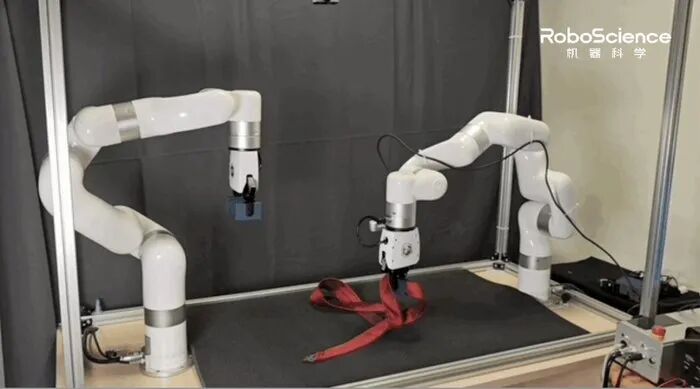
RoboScience's robotic arm tying a tie
The second pain point is excessive reliance on manual data collection.
RoboScience argues that to achieve a ChatGPT-like foundational model for embodied intelligence, data cannot rely solely on manual collection. In the real world, few robots work daily in factories, warehouses, or homes, making real robotic data inherently scarce.
RoboScience's approach combines internet videos with simulated data. Internet videos provide real-world examples of human-object interactions, while simulation systems generate vast amounts of robotic operation data in virtual environments.
They summarize this as "compute as capacity": instead of relying on manual data factories, they use GPUs, automated cleaning and labeling systems, and simulation engines to produce training data, turning "data production" into "compute production."
The third pain point is robots' lack of physical understanding.
This is why RoboScience developed its physics simulation engine, RoboMirage. It trains robots in virtual environments, teaching them how to grasp, fold, drag, rotate, insert, and assemble objects—mastering skills in a realistic virtual world before deployment.
This aligns with a global industry consensus. NVIDIA's latest robotics infrastructure emphasizes multi-physics simulation and complex dexterous manipulation, while DeepMind describes Gemini Robotics as a model capable of reasoning about the physical world, planning complex tasks, and executing actions.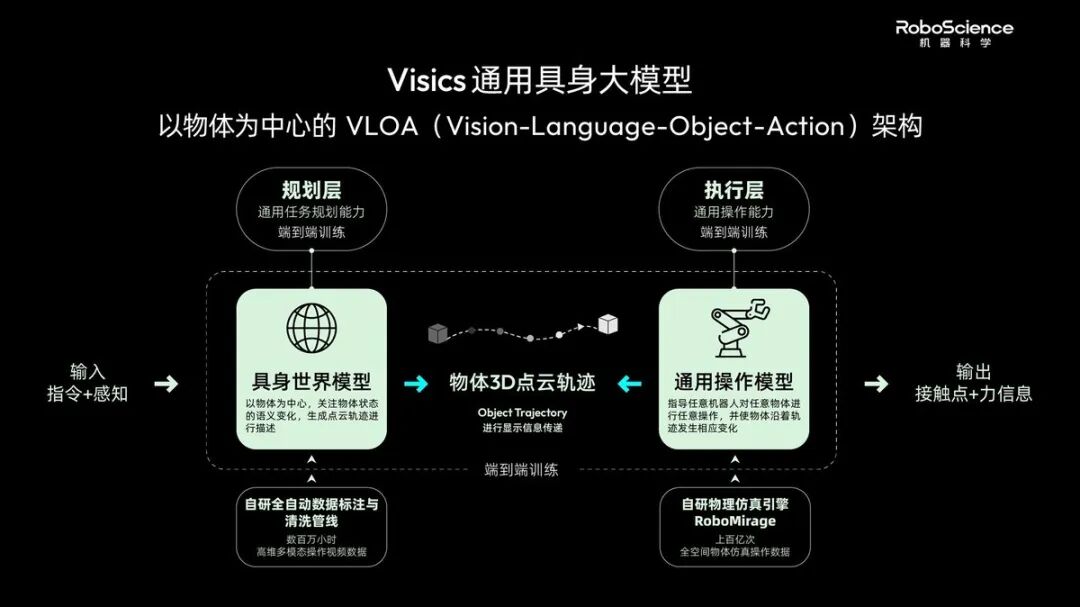
Visics' VLOA architecture for general-purpose embodied large models
The fourth pain point is many robots' inability to complete long tasks, only short actions.
RoboScience divides Visics into two parts: an embodied world model and a general-purpose operation model. Using continuous 3D point cloud trajectories, it describes how objects move and change in space. Robots learn not just isolated actions but task processes. The world model "imagines"—planning actions mentally before execution.
- 03 -
Commercial Opportunities in Embodied AI Large Models
Tian revealed that RoboScience's robot "brain" will prioritize serving B-end scenarios like logistics, retail, and supermarkets.
These environments feature diverse objects, repetitive tasks, and genuine demand for "generalized operations." While home robots offer vast imagination, household settings are too complex, with stricter cost, safety, and stability requirements.
Global markets reflect this. Agility Robotics' Digit is used in manufacturing, distribution, and logistics, with clients like Toyota, Schaeffler, and Mercado Libre. The company, soon to go public, is valued at approximately $2.5 billion, handling repetitive, dangerous, or labor-short tasks like warehousing.
Figure 02 operates in BMW's Spartanburg plant. BMW disclosed that Figure 02 supported over 30,000 BMW X3 productions in 2025, working ten hours a day, Monday to Friday.
This doesn't mean home robots lack opportunity. 1X's NEO, using Redwood AI, is already learning and repeating household tasks for early users, though complex tasks still require remote expert supervision.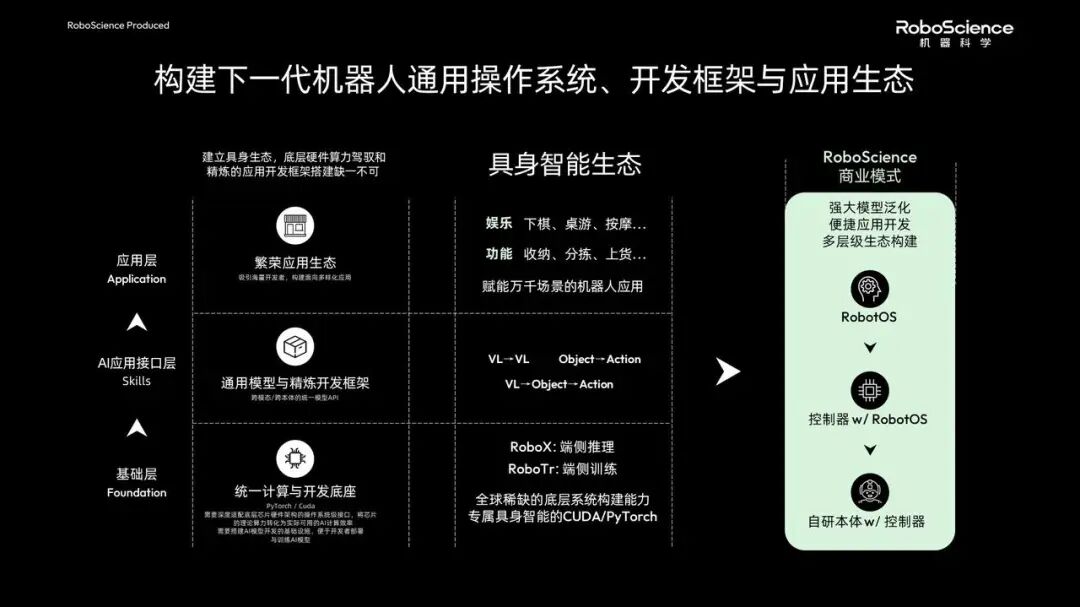
RoboScience's business model
Second, becoming a robot "brain" supplier—a foundational software layer for the robotics industry. This is RoboScience's most notable opportunity, aligning with global trends.
For example, U.S.-based Physical Intelligence aims to develop foundational software usable across different robots, eliminating the need for custom software per robot or task. Skild launched Skild Brain, claiming its foundational model runs on nearly any robot, from assembly-line machines to humanoids, enhancing thinking, navigation, and responsiveness.
RoboScience plans to sell its "brain" as a software service (MaaS) or charge per operation token or annual subscription, similar to large models.
Third, selling edge-side controllers—embedding large model capabilities into a control device sold to robotics, robotic arm, or dexterous hand companies.
For instance, in 2024, global factories installed approximately 542,000 new industrial robots, but traditional industrial robots excel at standardized tasks like welding, painting, and moving fixed parts. They struggle with complex, cluttered, irregular, or frequently changing tasks, such as varying parcel sizes in warehouses, differently packaged goods in supermarkets, flexible materials in factories, or non-standard operations in commercial kitchens.
Controllers add value by equipping existing robots with stronger generalized operation capabilities.
With controllers, industrial robots could transcend traditional automation boundaries, transforming from "fixed-program machines" into "adaptive intelligent labor."
- 04 -
Biggest Opportunity: One Brain, Multiple Bodies
If each robot requires separate software training, the industry cannot scale. "One brain, multiple bodies" has emerged as one of the most promising directions in embodied intelligence.
It means future robots may not all learn from scratch. Instead, a universal robot "brain" could adapt to different robotic bodies.
This resembles the relationship between computers and operating systems. Different computer brands and hardware configurations run many software programs on the same system.
The robotics industry is more complex, as robots must compute, move, grasp, collide, and manage forces. However, the business logic is similar: if a robot "brain" can reuse hardware, it becomes foundational software for the industry rather than an internal algorithm for a single robotics company.
This is why many global embodied intelligence companies are pursuing this direction.
RoboScience aims to decouple its "brain" from specific hardware.
According to their vision, this capability can be delivered as software, embedded in edge controllers sold to robotics, dexterous hand, or integrator companies, or deployed alongside their robotic bodies in specific scenarios.
This logic reflects a shift in embodied intelligence business models.
Selling robots alone remains hardware delivery—a slow, costly process of individual sales and deployments.
Selling a "brain" expands commercial boundaries. It can serve diverse hardware and enter various scenarios. A client with a robotic arm but lacking generalized grasping can integrate the "brain"; a dexterous hand company needing operational capabilities can do the same; a scenario provider with automation equipment might upgrade via controllers.
This is undoubtedly challenging.
Robotic bodies vary greatly. A two-finger gripper differs from a five-finger dexterous hand, just as a robotic arm differs from a humanoid. A single model must understand different bodies' structures, forces, degrees of freedom, and motion limits to complete tasks reliably—a formidable challenge. If this were easy, the industry would already see widespread adoption.
But this difficulty creates barriers. Once cross-body generalization succeeds, its commercial value will far exceed selling individual robots.
The main content of this article was collected by Pencil News during interviews and supplemented with authoritative public sources. It does not constitute investment advice.
-
![]()
5G Standalone Private Network Policy Breaks the Ice, Creating an Exclusive 'Nervous System' for Physical AI in Industrial Scenarios
-
![]()
Two Investments Totaling 700 Million Yuan! Sunny Optical Sets Its Sights Beyond Lens Supply, Launching a Strategic Move in the XR Optics Arena
-
![]()
Xianyu Initiates Internal Testing of 'Yu Maimai' and 'Yu Maimai': Can AI Revolutionize Secondhand Transactions?
-
![]()
The Dullest 618 in History, with AI Being the Busiest
-
![]()
Shenzhen’s Most Mysterious Robot Startup Secures 1 Billion Yuan in Funding, Targeting a 150 Billion Yuan Market
-
![]()
Why Are Celebrities So Keen on Diving into the AI Realm?
-
Can WeChat AI Sidestep the Quandary Faced by Doubao Phone?
-
![]()
Luxury Lineup, Highly Anticipated! The Pioneer of Physical AI Gears Up for Hong Kong Stock Exchange Debut!