Alibaba DAMO Academy’s AI Agent Unveils Four New Superconducting Materials—Experimentally Confirmed!
 07/03 2026
 549
549
Kuaikeji, July 3rd news: Superconducting materials boast immense potential in applications spanning power transmission, maglev trains, and quantum devices. Yet, for over a century, the lack of clarity in underlying mechanisms has made new material development reliant on inefficient trial-and-error methods. The globally recognized authoritative superconducting database, SuperCon, has amassed just around 2,000 materials over decades.
To tackle this challenge, Alibaba DAMO Academy, in partnership with Renmin University of China and the University of the Chinese Academy of Sciences, has unveiled ElementsClaw—an AI agent meticulously crafted for new material R&D. By harnessing AI-driven reasoning and the capacity to autonomously devise experiments, it revolutionizes the conventional trial-and-error R&D paradigm.
This agent employs a hybrid architecture combining a "specialized atomic large model with a general intelligence framework." It has trained a 1B-parameter atomic foundation model using 125 million molecular and crystal datasets, achieving remarkable accuracy in discerning superconducting properties. The error margin in predicting superconducting critical temperatures is controlled within 1K.
Simultaneously, it can autonomously search academic literature, organize research leads, and self-iterate, fully automating the entire material screening and experimental design process.
Its computational power consumption is remarkably low, requiring only 28 GPU hours to screen 2.4 million crystal structures, thereby identifying 68,000 candidate substances with superconducting potential.
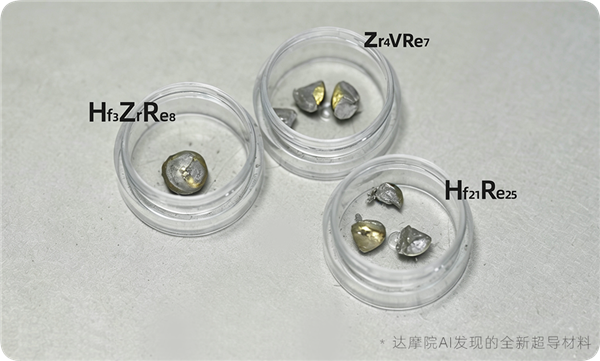
The research team selected four categories from the vast array of candidates for physical synthesis and experimental validation. The four novel materials originate from diverse sources: HfRe, previously overlooked in the database; ZrVRe, confirmed after rectifying its original structural errors; HfZrRe, a completely new crystal designed by AI from the ground up; and ZrScRe, derived through analogous structural deduction. Among them, the highest critical temperature reaches 6.5K.
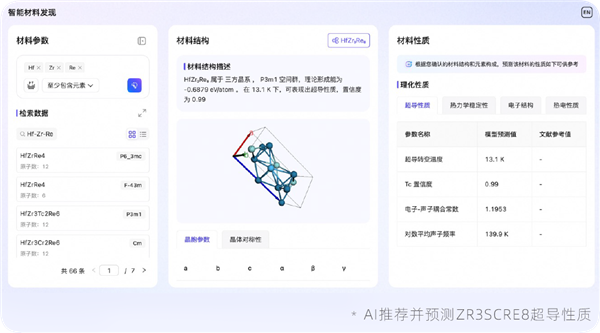
These are also the first batch of superconducting materials independently discovered by AI in China and experimentally verified, vividly showcasing the agent's practical value in the realm of cutting-edge materials.
The research team has made the entire database of 2.4 million stable crystal predictions publicly accessible, allowing researchers worldwide to freely access and utilize it.
Experts note that this technology is not confined to superconducting R&D but can also be extended to the exploration of various new materials, such as solid-state battery electrolytes, catalysis, and thermoelectrics, in the future. The relevant research paper has been published on arXiv, and the research team will also present this AI material discovery system at the ICML conference.
-
Alibaba Initiates Cultural Transformation: Is Jack Ma Making a Strategic Comeback?
-
Tianfeng Heads to Hong Kong for IPO with RMB 3.8 Billion in Funds: Xingyu's Cross-Border Foray into Embodied AI Faces Uncertain Future
-
![]()
Mengshi Auto’s High-End Aspirations Dashed: Huawei Partnership Fails to Revive Sales, New Model’s Entry Price Dips Below 300,000 Yuan
-
A Single-Day 40% Plunge! AI-Themed New Listings: The Cruelest 'Slashes' for Retail Investors in Hong Kong Stocks
-
China’s Fourth-Largest Token Factory Accelerates IPO Plans Amid -24% Gross Margin and AI Infrastructure Reduced to a "Traffic Business"
-
![]()
Humanoid Robots Take Center Stage at Electronica Munich: Auto Chip Titans Embrace Robotics Revolution
-
![]()
Purchasing the Casket and Sending Back the Pearl: Meta's Foray into Computing Power Business
-
![]()
AI Computing Power is Pushing Global Power Grids to Their Limits