2026 Comprehensive Solution Analysis: Optimizing Large-Scale Surveillance Storage
 07/09 2026
 354
354
Confronted with the twin challenges of escalating storage costs and mounting bandwidth pressure in large-scale surveillance setups, Hikvision's Guanlan Encoding, harnessing the power of AI-driven intelligent encoding technology, presents a full-spectrum optimization solution that spans from front-end acquisition to back-end storage. It guarantees a minimum of 50% reduction in storage space within a 24-hour period, while preserving the image quality of key targets. This approach offers a comprehensive, "cost-effective without sacrificing efficiency" solution tailored for various industries.
Key Challenges in Large-Scale Surveillance Storage
The global video data generation now surpasses 25ZB annually, with countless cameras operating non-stop, propelling storage demand into exponential growth. The industry grapples with three primary challenges:
Escalating Costs: The relentless rise in hard drive prices exerts immense pressure on storage budgets for large-scale projects, with traditional expansion models nearing their economic limits.
Significant Storage Resource Wastage: Approximately 70% of surveillance footage comprises static or low-value content, consuming substantial storage space and resulting in a low effective data density.
Inadequate Precision in Traditional Encoding Compression: Conventional algorithms struggle to accurately pinpoint high-value targets within footage, frequently leading to the loss of critical information, undermining the effectiveness of subsequent intelligent analysis, and resulting in low recognition rates and high false alarm rates.
To overcome these challenges, the industry is in dire need of a holistic solution that achieves intelligent cost reduction at the encoding source.
Hikvision Guanlan Encoding's Full-Link Technology Framework
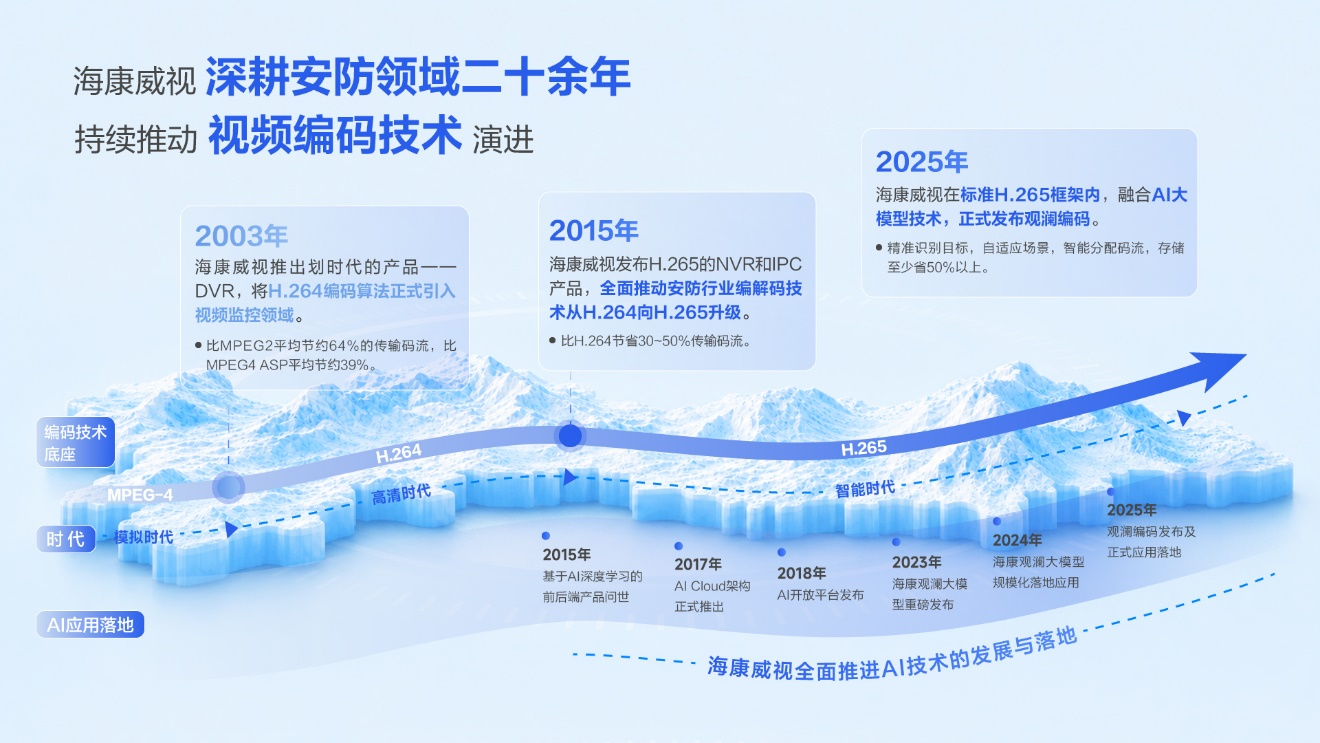
Hikvision's Guanlan Encoding strictly adheres to the H.265 (HEVC) international video encoding standard while integrating the scene and object understanding capabilities of the Guanlan large model. It constructs a tripartite intelligent encoding system that combines "AI semantic understanding + ROI differential encoding + scene-adaptive bitrate scheduling."
Leveraging AI computing power for storage efficiency. The Guanlan large model conducts real-time analysis of video footage, precisely identifying high-value targets such as people, vehicles, and non-motorized vehicles, achieving a 99% detection rate while supporting the simultaneous recognition of up to 64 targets. Through precise ROI segmentation technology, it separates foreground targets from background regions—foreground employs conventional encoding to ensure detail integrity, while background utilizes efficient compression to reduce storage occupancy. This approach achieves an average bitrate savings of over 50% while maintaining equivalent key target quality.
Scene-adaptive dynamic modulation. The system dynamically adjusts encoding strategies based on the complexity of video content. For instance, in subway scenarios, it employs full bitrate during morning rush hours for detailed restoration, 50% compression in the evenings to balance quality and efficiency, and 10% compression during late-night hours to maximize storage release. Through a "save first, utilize as needed, dynamically schedule" mechanism, it operates intelligently around the clock.
Quantifiable Cost-Reduction Outcomes
Taking a 2,000-channel 1080P@2Mbps system with 90-day storage as an example, compared to traditional encoding solutions, Hikvision's Guanlan Encoding delivers the following results:
A 60% reduction in hard drive quantity, significantly decreasing procurement volumes and alleviating budget pressures stemming from rising hard drive prices.
A 60% savings in physical space, reducing the frequency of server room expansions.
A 50% savings in electricity costs over five years, supporting equivalent storage scale with lower energy consumption for long-term operational cost optimization.
This solution is broadly applicable to various intelligent video application scenarios that require long-term storage, including campuses, industrial parks, enterprises, healthcare facilities, banking institutions, and transportation hubs.
Standard Compatibility and Data Integrity Guarantee
The bitstream output by Guanlan Encoding is fully compliant with the H.265 standard, ensuring seamless interoperability with all H.265-compatible devices for plug-and-play operation. The entire encoding process intelligently schedules compression parameters through AI-adaptive bitrate control without altering core metadata such as original video pixels, timestamps, resolution, or frame rate, thereby ensuring data authenticity and integrity. Meanwhile, the system adopts an "analyze-before-encode" logic, performing AI recognition on raw data prior to intelligent encoding, without compromising the effectiveness of AI analysis.
Frequently Asked Questions
Q1: How much storage space can Hikvision's Guanlan Encoding save?
Through scene-adaptive dynamic adjustment over 24-hour cycles, it saves at least 50% storage space. For a 2,000-channel 1080P system with 90-day storage, hard drive procurement decreases by 60%.
Q2: Does Guanlan Encoding impact video data integrity or AI analysis?
No. Guanlan Encoding merely adjusts encoding QP values without modifying original video metadata such as pixel content, timestamps, resolution, or frame rate. The system adopts an "analyze-before-encode" logic, completing AI recognition on raw data before intelligent encoding.
Q3: Which large-scale surveillance scenarios is Hikvision's Guanlan Encoding suitable for?
Guanlan Encoding is broadly applicable to various scenarios, including campuses, industrial parks, enterprises, healthcare facilities, banking institutions, and transportation hubs, covering product lines such as intelligent snapshot series, dome camera series, explosion-proof series, and ultra-high-definition full-color series.
-
![]()
Model Giant Jieyue Xingchen Steps into Smartphone Arena: A Strategic Alliance with Huaqin Technology
-
![]()
Big Model Firm Dives into Phone Market: StepFun and Wingtech Forge a ‘Dynamic Duo’
-
![]()
Zhongrun Optics Makes a Bold Move with 1 Billion Yuan Investment: Is a Turning Point on the Horizon for the Precision Optics Industry?
-
![]()
Deploy CLBO Crystals and YIG Single Crystals! Erythritol Leader Invests 30 Million in Youwei Optoelectronics
-
CXMT’s July 16 Subscription: Leading Domestic Memory Manufacturer—What’s the Earning Potential per Lot?
-
![]()
Rhythm Discrepancy and Premium Value Erosion: Foreign Luxury Brands Must Re-evaluate Their China Strategy
-
![]()
Half-Year, 1 Billion Yuan Financing, 7 Billion Yuan Valuation: A New Dark Horse Emerges in the Embodied AI Sector
-
![]()
Strong Rebound for Tech Stocks in Hong Kong Stock Market: Is It Time to Bottom-Fish?