Tencent Spearheads Manus Buyback: Unveiling the Strategy
 07/13 2026
 417
417
Author|Zhang Qian
Editor|Hu Zhanjia
Operations|Chen Jiahui
Produced by|LingTai LT (ID: LingTai_LT)
Header Image|Sourced from the Public Domain
On July 10, the Financial Times reported that Tencent is leading a consortium, including ZhenFund and Sequoia China, to repurchase Manus from Meta at a valuation of $2 billion (approximately RMB 13.6 billion). Tencent will secure the largest stake but will not hold a controlling position, allowing Manus to continue its independent operations in Singapore.
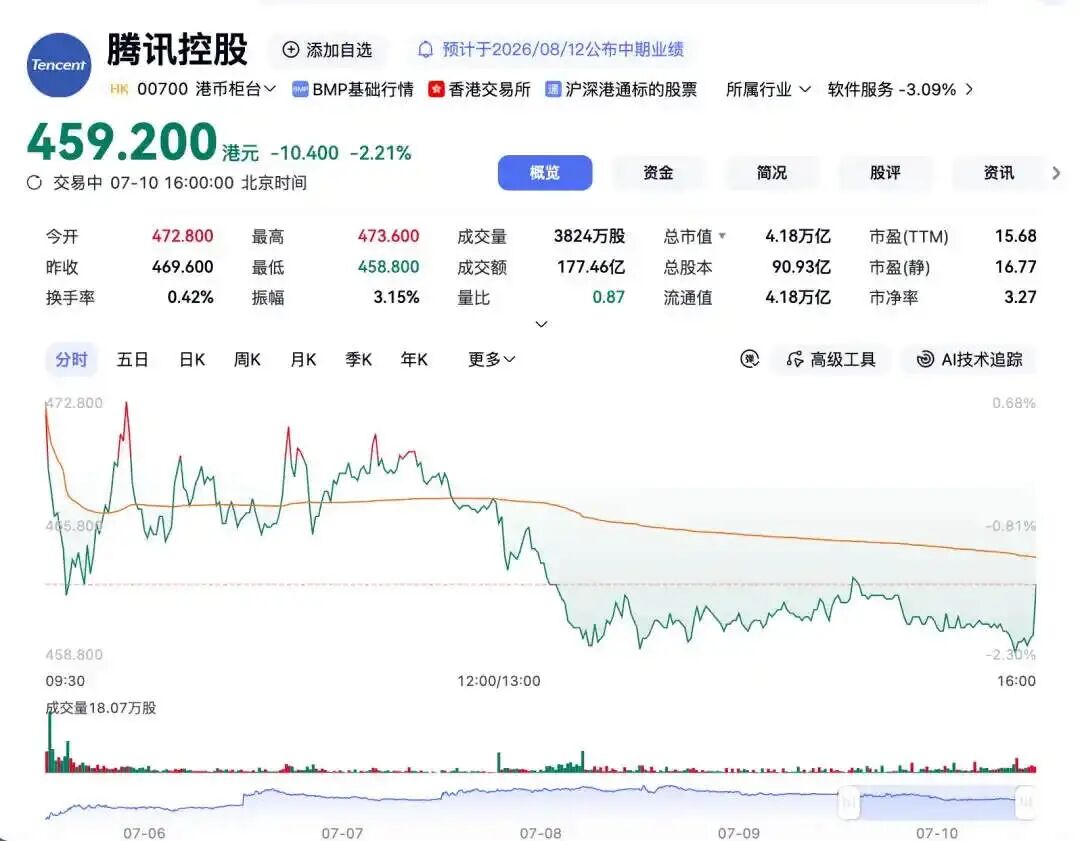
Following the announcement, Tencent's Hong Kong-listed shares experienced a 2.21% decline.
This transaction appears unusual. Tencent was neither an early major investor nor a business partner of Manus. Why is it taking the lead? What benefits does it gain by investing $2 billion in a company it won't control?

Is a $2 Billion Valuation Exorbitant?
When Meta acquired Manus, its annualized revenue stood at approximately $100 million. Six months later, this figure skyrocketed to $400-500 million. A buyback at a $2 billion valuation represents 4-5 times Annual Recurring Revenue (ARR). How does this compare within the AI sector? Anthropic is valued at roughly 20 times ARR, while Zhipu commands an even higher multiple. At 4-5 times, this valuation is considered a baseline.
However, there's a rationale behind this seemingly low price. The quality of Manus's growth over the past six months warrants close examination.
Manus operates as a "general-purpose AI agent"—users issue natural language commands, and it autonomously navigates browsers, conducts research, fills out forms, sends emails, and completes complex tasks within a cloud-based virtual machine. Upon its launch in March 2025, invitation codes were resold for as much as RMB 50,000 each, with high demand evident on social media. This enthusiasm underscored the product's uniqueness—no other AI product at the time could "independently operate a computer" like Manus.
Post-acquisition by Meta, Manus gained three critical assets: Meta's advertising system (significantly reducing customer acquisition costs), Meta's enterprise client network (accelerating B2B sales), and technical support from Meta's infrastructure (computing power, storage, security). Essentially, Manus's ARR growth from $100 million to $450 million in six months was propelled by Meta's "accelerator" rather than organic product growth.
Now, the accelerator is being removed. Under the National Development and Reform Commission's (NDRC) April investment ban, Meta is required to delete all Manus user data within China, terminate technical authorizations, and restore localized data storage. This means Manus must rebuild its customer acquisition channels, expand enterprise clients anew, and reconstruct its technical infrastructure.
Founder Xiao Hong is acutely aware of this. Post-acquisition, he assumed the role of Meta's Vice President, with his team integrated into Meta Superintelligence Labs, enjoying Silicon Valley's resources. Now, everything must be reversed—data, systems, clients, and teams must revert to their pre-acquisition state. This is not a simple "return" but a high-stakes operation.

Why is Tencent Stepping In?
First Card: Strategic Positioning.
Tencent must secure a leading position in the AI Agent sector. In March, Pony Ma first articulated the "shrimp-farming" strategy—not pursuing the largest models but building an open Agent ecosystem atop them. Tencent has released its Hunyuan Hy3 large model and is testing embedded AI agents in WeChat. However, it lacks a "killer app." Manus fills this void—it is the first team globally to validate the "general-purpose Agent" concept and its commercial viability.
Contrast this with competitors' Agent strategies: Alibaba has integrated Tongyi Qianwen with DingTalk, ByteDance has linked Doubao with Feishu, and Baidu has tied ERNIE Bot to search. Tencent's differentiator is WeChat—a super-app with 1.4 billion users, naturally the largest traffic entry point and distribution platform for AI Agents. Yet, WeChat's AI features are still in testing, lacking a breakout hit. By integrating Manus into the WeChat ecosystem, Tencent instantly gains access to a user pool larger than Meta's. This is Tencent's strategic logic—I may not build the best Agent, but the best Agent must run in my ecosystem.
Second Card: Synergistic Collaboration.
Tencent is not seeking control but "the highest level of access to information and products." Public records reveal a deep connection between Xiao Hong and Tencent—his previous venture, Yiban Assistant (a WeChat official account management tool), received Tencent investment. When WeChat began testing AI agent features, Xiao was among the first external users invited. This relationship enables Tencent to deeply influence Manus's product roadmap, technical direction, and ecosystem integration, even without a controlling stake. The minority shareholder status allows Manus to maintain its independent brand, avoiding direct conflict with Tencent's own products (WorkBuddy, Yuanbao).
A telling detail: Tencent President Martin Lau stated publicly in May's earnings call that "AI agents are increasingly emerging as a breakthrough use case" and "our platforms naturally offer significant advantages for hosting AI agents." These remarks were not made casually.
Third Card: Regulatory Compliance. The timeline is clear: NDRC halted Meta's acquisition in April, the founding team initiated self-rescue in May, and Tencent led the buyback in July. This marks China's first use of the Foreign Investment Security Review Measures to block an AI-sector foreign M&A, setting a precedent. Tencent's role as the lead buyer carries strategic value far beyond financial returns.

From Kuaishou Divestment to Kling Investment to Manus Acquisition: Tencent's AI 'Cage-Swapping' Strategy
Viewing this deal within Tencent's recent capital maneuvers clarifies the underlying logic.
Tencent divested Kuaishou, recouping over RMB 10 billion in cash. Kuaishou competes with WeChat for user time, and with Videos already established, Kuaishou's strategic value to Tencent has diminished. Tencent then invested $200 million in Kling (video generation) and led the ~RMB 4 billion buyback of Manus (general-purpose Agent). What it sold were historically synergistic but now weakly aligned equity stakes; what it bought were AI-native strategic assets.
Kling fills the video generation gap, while Manus addresses the general-purpose Agent deficiency—two areas where Tencent's product ecosystem was most lacking. From large models (Hunyuan) to video generation (Kling) to general-purpose Agents (Manus), Tencent is methodically completing its AI portfolio.
However, risks are inherent. Tencent's lack of control means it cannot dictate Manus's strategic direction, only "influence" rather than "decide."
More critically, Tencent must also manage this acquisition internally. The WeChat, Hunyuan, and WorkBuddy teams are all developing Agent-related products, and now Manus joins the fray. Resource allocation, boundary definition, and potential internal conflicts are all issues Tencent's management must navigate.
Financially, a $2 billion valuation for an AI Agent company with $450 million in ARR and rapid growth is reasonable. Strategically, securing a track position, gaining ecosystem synergy, and earning regulatory trust justify the investment. Risk-wise, the lack of control, post-Meta growth uncertainties, and open-source competitor pursuits remain question marks.
Tencent's calculation is sound but involves an element of speculation—betting that Manus can continue to thrive without Meta and that the AI Agent sector will indeed become the next frontier in human-computer interaction.
For inquiries regarding this article, please contact
-
![]()
Why Hasn’t AI-Driven Payment Flourished Despite Tech Giants’ Push?
-
![]()
Intensify Efforts in the High-End Optoelectronic Semiconductor Sector! Aipu Dingchun and Jiangsu Meidong Forge a New Joint Venture
-
![]()
From Endoscopes to Optical Interconnects for AI Computing Power: A Veteran Optical Company's Strategic Shift
-
![]()
Behind the Scenes of Token Factories' Rise as a Capital Market Sensation
-
![]()
What Does MaaS Ultimately Bring to Chinese Cloud Providers? | In-Depth Industry Analysis
-
![]()
China’s Auto Resale Value Report Unveiled: AITO M9 Electric and Hybrid Variants Dominate Rankings
-
![]()
Dialogue with Huang Yangming: On the Eve of the Physical AI Boom, the Value of Data Infrastructure Begins to Materialize
-
![]()
The Experience is a Bit Unusual! Logitech G Cloud Review: Great Feel, but Not Ideal for Cloud Gaming