Dialogue with Huang Yangming: On the Eve of the Physical AI Boom, the Value of Data Infrastructure Begins to Materialize
 07/13 2026
 386
386
Building on a Data Foundation, Awaiting a Slowed-Down Momentum.
Before formally starting the dialogue with Huang Yangming, he had just concluded his trip to the United States and had not fully adjusted to the time difference.
During this trip to the U.S., he met with a group of leading embodied intelligence companies. According to him, there has been a surge in demand for data infrastructure, with some potential clients even requesting 10,000 hours of real robot data, with a deadline set before September.
Based on current pricing, this represents a potential order worth tens of millions. However, Huang Yangming did not show much excitement.
This has been the most tumultuous year for the embodied intelligence industry. Humanoid robot launches have followed one after another, with large model companies venturing into world models. Hot money has flowed from upstream to downstream along the industrial chain, with everyone waiting for a breakthrough moment.
But Huang Yangming is an exception. In 2022, he left a major company to found Kexing Space-Time. Amidst a whirlwind of trends, he chose the seemingly slowest track (translated as "sector") in embodied intelligence—his old expertise—continuing to work with data and anchoring on "embodied intelligence data infrastructure."
This concept may sound abstract, but in simpler terms, as large models transition from the textual world into the physical world, the data robots require is no longer confined to web pages, images, and chat logs. Instead, it involves spatiotemporal multimodal experiences composed of vision, sound, joint states, motion trajectories, and task outcomes.
What Kexing aims to do is organize this data—from requirement understanding, scenario design, collection and production, quality assessment, to governance and delivery—into a closed-loop system that can be engineered and operated.
In Huang Yangming's words, he stands in the least conspicuous position along the entire industrial chain, doing the most fundamental yet equally critical work: organizing every action, trajectory, success, and failure of robots in the physical world into data assets that can be understood by models and used in training.
In fact, Huang Yangming has been deep cultivation (translated as "deeply involved") in data infrastructure for a decade.
His career trajectory has almost entirely covered the key milestones in the evolution of China's data infrastructure—from being an early contributor to the Hadoop community, to working on infrastructure architecture for health big data and autonomous driving at Apple, to building a complete data closed-loop system at Inceptio Technology.
In a sense, he is one of the few engineers in China who has truly experienced the entire process of "how data drives the iteration of intelligent systems."
Now, he brings all his past experience to bear on his new venture.
01
From Autonomous Driving to Robotics
The Journey of a Data Engineer
Huang Yangming's career began with integrating transaction data in banks. That was the wild west era of big data, shortly after Google published its MapReduce and BigTable papers, and Hadoop was beginning to sprout as the first open-source responder.
He was among the first in China to work with Hadoop and an early contributor to the community. That experience laid the foundation for structured tabular data processing—where all data had clear fields, types, and boundaries.
The real turning point came in 2015 after he joined Apple.
The first project he took on was the health big data architecture for the Apple Watch. Heart rate, respiration, aerobic capacity—continuous signals of bodily states flooded into the system, and for the first time, data transformed from structured tables into unstructured multimodal fusions.
This was his first systematic encounter with multimodal temporal data, and it became the starting point for everything that followed.
Later, he was transferred to Apple's internal autonomous driving department, where he participated in three out of five major infrastructure areas: machine learning infrastructure, data infrastructure, cloud infrastructure, device infrastructure, and build infrastructure.
This experience gave him a complete understanding of one thing: the iteration speed of intelligent systems has never been determined by algorithms alone but by the efficiency of the entire data closed loop.
From data collection, cleaning, and labeling to training, testing, and feedback, the longer the chain and the more nodes involved, the greater the challenge to the underlying architecture.
In other words, the iteration speed of intelligent systems essentially depends on the efficiency of the data closed loop.
As we all know, Apple's autonomous driving project ultimately did not advance, and Huang Yangming chose to return to China, joining Inceptio Technology.
There, he had the first opportunity to build a complete data closed-loop system from scratch, turning architectural diagrams on whiteboards into running code in production environments.
He often spent entire days in conference rooms, sketching out complete system architectures on whiteboards, then organizing teams according to the inverse of Conway's Law—designing software components first, then recruiting based on those components, rather than defining software by functional roles like front-end and back-end.
Conway's Law states that the design of systems mirrors the communication structure within and between organizations. The inverse of Conway's Law suggests that if you want a certain software architecture, you should first organize your team accordingly—a principle Huang Yangming firmly believes in.
If the story had continued, he might have gone further down the path of autonomous driving data infrastructure. But in 2021, a closed-door sharing session at Matrix Partners changed his thinking. At that meeting, an investor shared a judgment: the golden age of infrastructure innovation had arrived, and there was no need to pursue ToC or ToB applications—Infra itself could be a business, and "any relatively crude advancement could defeat refined backwardness."
This resonated with him.
He had always wanted to start a business but had never settled on a direction. The landscape of the autonomous driving industry also gave him pause—the market was large but the scenarios were singular. Cars move forward, turn left or right, and roads and lanes are uniform worldwide, inevitably leading to oligopoly. With only a few clients, suppliers' bargaining power would be severely limited.
Later, he briefly joined Gaoxian Robotics, where he saw another possibility. AMR companies also had a strong demand for data, but they lacked both internet DNA and autonomous driving's data engineering experience.
Everyone mouth (translated as "verbally") said data was important, but almost no one was seriously building the infrastructure. Every company was chasing business demands, and no one had the bandwidth for such long-term foundational work.
This judgment, which seems like common sense today, was far from consensus in 2021 when "embodied intelligence" had not yet become a shared vision, and the robotics industry was still debating between AMR and AGV routes. Huang Yangming, along with colleagues and friends, officially founded Kexing Space-Time in 2022. Nearly all core team members came from autonomous driving data engineering backgrounds, with a "high Inceptio rate," as he joked.
Over four years of entrepreneurship, the core team has barely seen any attrition. This is uncommon among startups, and Huang Yangming attributes it to the team's shared belief in the value of data infrastructure and the conviction that their work will be validated at some point.
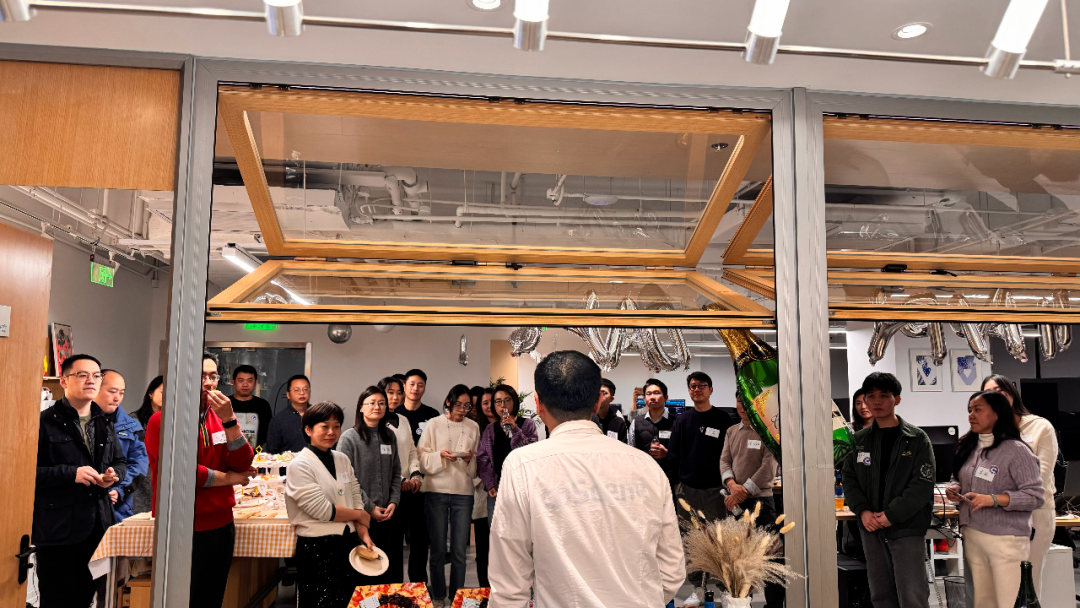
Since its founding, Kexing Space-Time has maintained a flat organizational structure and an engineer-centric culture, regularly hosting "TGIF"-style events to foster casual communication among colleagues. "Thank God It's Friday" originated at Google, aiming to promote equal dialogue and spark innovation.
The benefit of this team consensus is resilience to change. Over four years of entrepreneurship, industry concepts have shifted several times—from autonomous driving to robot operations, from embodied intelligence to spatial intelligence, and now to world models. The upper-level narratives have constantly evolved, but Kexing's underlying architecture has rarely undergone disruptive adjustments.
Huang Yangming often says that infrastructure work requires identifying what remains constant. Devices will iterate, scenarios will change, concepts will refresh, but the underlying logic of how data is collected, tracked, governed, fed back, and made compliant is universal.
02
Data Is Not a Standardized Product but a Complete Engineering System
Kexing's product suite has two names: StarBase and coScene.
The former is designed for data production sites, while the latter targets data application ends. Both products share the same underlying data engine, a design philosophy Huang Yangming carried over from his time at Inceptio: all upper-layer applications are built upon a unified data foundation.
The core concept of this foundation is "Scene," a semantic, time-bound recording unit. A Scene can organize anything from a single grasping action to a complete project.
Small units ensure data traceability, while large units manage permissions, automation workflows, and the organizational structure of data collections. Whether it's collection via StarBase, processing via coScene, or labeling, quality inspection, and regression testing, everything revolves around this unified base.
Huang Yangming likes to use mining and coal refining as metaphors for this system. StarBase is the production system in the mines, deployed wherever coal is found, responsible for continuously extracting data. coScene is the central refinery, processing, grading, and governing raw coal from various locations into deliverable data products.
Just as databases can serve diverse business needs and CPUs can run on various computers, the key lies in a well-abstracted layer.
Kexing aims to do the same—the robotics industry is highly fragmented, with medical robots prioritizing precision, brick-laying robots focusing on load-bearing, and loading docks using large robotic arms. Each scenario has different body configurations, sensor setups, and control frequencies, but the underlying data organization logic remains consistent.
"Neutrality" is a principle Huang Yangming repeatedly emphasizes.
Kexing does not bind itself to any specific robot body nor does it manufacture hardware. This neutrality allows Kexing to act as a data translation layer between different bodies and positions it more objectively when engaging with model companies.
In its first two years, Kexing's primary revenue came from software licensing. It deployed StarBase and coScene privately at client sites, charging per project. This path was not easy.
Huang Yangming later realized that delivering a toolset was just the beginning. For clients to truly operationalize it, they needed to allocate personnel, establish processes, and define standards—resulting in high implementation costs. Even tougher was the sales process: deploying enterprise-grade software required sequentially convincing economic buyers, technical buyers, and end-users, each with distinct motivations and potential resistances.
He spent considerable time visiting clients, traveling from Longhua to Guangming, then from Bao'an to Nanshan in Shenzhen, moving between factories and R&D buildings to refine his client communication approach.
For a technical leader accustomed to solving problems internally—where needs were communicated directly and iterations were rapid—facing external clients lengthened feedback loops significantly.
The engineer-centric culture in China also differed from what he knew in the U.S.—many people preferred figuring things out on their own rather than providing proactive feedback when encountering usability issues. This cultural gap initially made him quite uncomfortable.
03
On the Eve of the Physical AI Boom, Cognition Is Rapidly Evolving
For Kexing today, data operations have become the absolute focus. Two parallel paths exist: one is self-operated, where Kexing builds its own data collection sites, handles everything from collection and governance to labeling and quality inspection, and sells finished data directly to end clients. The other is contract processing, where Kexing assists external data producers with governance, quality control, evaluation, and sales matching, gradually transitioning toward a platform model.
According to Huang Yangming, data is primarily priced by the hour rather than sold by the piece. For example, non-physical data costs around 300 RMB/hour, while real robot data is priced at 2,000-3,000 RMB/hour, with additional markups for specific labeling. Price fluctuations are significant, reflecting a sophisticated value judgment system.
Short tasks are simple—picking up a cup and moving it takes just a few seconds. Long tasks are far more complex, such as preparing a set of guest refreshments: opening the fridge, retrieving ingredients, plating, heating, serving in the living room, pulling out a chair—the entire process can take ten minutes to half an hour.
The low probability of robots operating continuously for long periods without errors makes such long-duration tasks scarce and thus command a premium.
Beyond task length, action density, failure recovery capabilities, and scenario diversity all influence the final value of data. An hour of data filled with frequent action transitions and state changes holds vastly different training value compared to an hour of repetitive, single-action data. Greater scenario diversity enhances data reusability, encouraging clients to keep repurchasing.
In Huang Yangming's view, embodied data has never been a standardized commodity on shelves. It resembles engineering services—buyers rarely place million-dollar orders upfront. Typically, they start with a small sample for testing, scale up after validation, and only after several rounds of refinement enter stable procurement.
The sole criterion for judging data quality is whether it can be embedded into real training closed loops and effectively improve model performance.
This is why merely stacking production capacity makes no sense. Kexing's core competitive barrier has never been the number of robots or collection stations it owns but its end-to-end capability—from requirement translation to delivery.
When a client specifies a training objective, the team can break it down into concrete scenario designs, body selections, task SOPs, and quality control standards. Through StarBase, these are dispatched to various collection sites for execution. The produced data undergoes governance, labeling, and quality inspection via coScene before being delivered to the client's training pipeline with complete metadata and compliance documentation.
If any link in this chain fails, the entire closed loop collapses.
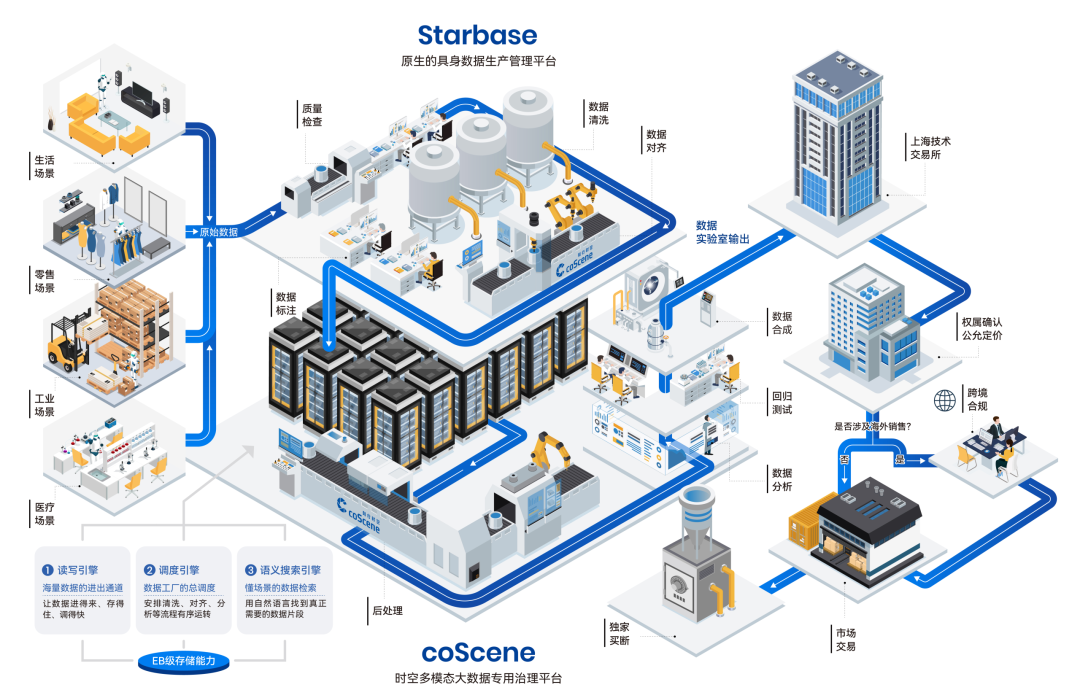
Kexing integrates domestic and overseas model training demands
and has built a complete delivery closed loop
During his North American trip, Huang Yangming met with many leading model companies and gained a strong impression: the demand for non-physical data far exceeds that for real robot data.
Requests for millions or even two to three million hours of non-physical data are now commonplace, even from relatively small startups.
Specifically, non-physical collection logic is straightforward—using first-person devices worn by humans to record operations, then mapping these onto robots via retargeting technology. This approach is highly versatile, theoretically processable once and sellable to all companies engaged in pre-training. With low hardware costs and the ability to outsource, scaling is much faster than with real robots.
However, Huang Yangming has always been clear about the value of real robot data in post-training stages.
Pre-training prioritizes volume, generality, and low cost—non-physical and simulation data suffice. Post-training addresses real dynamics, sensor noise, latency, failure recovery, force control, and tactile feedback—areas where non-physical and simulation data can only approximate but never truly close the loop.
If pre-training data resembles industrial standard parts, post-training data is bespoke craftsmanship. They serve different stages and cannot fully replace each other.
Laying out two parallel paths, we use non-proprietary data to meet the massive demand for pre-training on one side, while leveraging real robot data to delve deeply into the high-value aspects of post-training on the other.
Currently, Kexing operates one of the largest heterogeneous humanoid robot data collection sites in China, with Indent Order (intended orders) valued at over 100 million yuan. The robotic platforms we have integrated cover the vast majority of mainstream manufacturers in the market.
However, Huang Yangming is well aware that all of this is just the beginning.
04
Waiting for the Breakthrough: Building the Data Foundation for the Physical World
When discussing the differences between this round of AI boom and the previous one, Huang Yangming has deep insights. At the data level, all data collection in the industry today is essentially "artificial."
Dedicated spaces are rented, machines are purchased, personnel are hired to design tasks, and data is collected through deliberate operations. The data is intentionally produced for training purposes, rather than naturally emerging from real-world operations.
This stands in stark contrast to the data landscape of the internet era—JD.com's logistics data comes from real warehouse operations, Meituan's food delivery data comes from real order fulfillment, and Douyin's behavioral data comes from real user interactions. Data was a byproduct of business operations, inherently carrying the complexity of real-world scenarios.
Today's data market for the physical world has not yet reached this stage.
Without large-scale deployment of robotic services, there is no natural emergence of real data. Everyone must first establish data collection sites and artificially create training materials. This is an inevitable path in the early stages of the industry, but it also means that current data is costly, limited in scope, and lacking in diversity.
According to Huang Yangming's judgment, the true turning point will come after robots achieve vertical deployment.
He expects that within three years, a group of mid-tier robotics companies will successfully establish commercial closed loops in specific vertical scenarios. Whether it's factory material handling, logistics sorting, surgical assistance, or home services... once robots begin working stably in real-world scenarios, data will naturally emerge as a byproduct of business operations, just as it did in the internet era. Only then will the true value of data infrastructure be unlocked.
Not every company with a scenario has the capability to manage, evaluate, and trade its own data. Just as the internet era gave rise to a plethora of data platforms and governance tools, the robotics era will also require a complete set of infrastructure to handle the massive amounts of spatiotemporal data generated in real-world scenarios.
This process will not happen quickly. Huang has always believed that the industry's expectations for the pace of embodied AI deployment are overly optimistic. It's like how everyone once thought self-driving cars would be fully deployed within three to five years, yet today they are only gradually being rolled out in specific scenarios. The complexity of embodied AI scenarios far exceeds that of self-driving cars, so the deployment timeline will only be longer. Capital lacks the patience to wait a decade, so it will continue to create new concepts and hype cycles, but the evolution of technology itself follows its own rhythm.
In this process, robotics companies will see waves of consolidation and replacement, and concepts will come and go in cycles, but data will always remain at the core. Without data, even the most sophisticated models cannot iterate.
Thus, Kexing's strategy is clear: we do not chase hype cycles, we do not build hardware, we do not compete to be a full-stack solution provider. Instead, we maintain ecological neutrality and firmly guard the data infrastructure layer. Collection devices will evolve, the form of data collection sites will change, and even the form of robots will transform, but the underlying logic of how data is organized, tracked, evaluated, and circulated will remain unchanged. By mastering this layer deeply and thoroughly, we can reap the benefits of the entire industry's growth.
This sounds simple in theory, but executing it requires tremendous resolve.
Huang Yangming often says that the world is changing rapidly. When the industry is hot, there are opportunities everywhere to make quick money—building robots, developing models, or creating solution packages all seem to offer faster returns than building infrastructure.
But Huang has always believed that people should focus on what they are good at and where they have long-term expertise. As he often tells those around him, when choosing a major, opt for something timeless like mathematics rather than chasing popular applied fields. The same applies to running a business.
Among all the constants, compliance is one of the variables he values most.
In fact, Kexing was one of the first companies in China to establish a compliant data pathway, having built a domestic compliance chain through Lingang and the Shanghai Technology Exchange, and also having partners in North America to assist with local compliance processes.
This comes at a high cost and requires significant time investment, but he insists on doing it. In any industry, regulations tend to tighten after initial liberalization. Once the industrial scale grows, supervision will inevitably follow. Establishing robust compliance measures early on may increase costs in the short term, but in the long run, it becomes the deepest moat.
This is also why Kexing has always emphasized that it is an infrastructure company, not merely a data seller.
Data delivery is just the current method of monetization. The underlying product platform, production organization capabilities, quality assessment systems, and compliant delivery capabilities are what truly support long-term value.
Toward the end of our conversation, when asked about the most fulfilling moment since starting the company, Huang Yangming fell silent for a long time. He said that every time a link is connected, every time a partnership is secured, and every time an order is won, he feels a sense of accomplishment. But when it comes to the proudest moment, he feels it hasn't arrived yet. There is always another problem to solve, always another hurdle to overcome.
He is still waiting for that moment when everything truly comes together. It's like planting a seed and watching it slowly sprout and grow branches—you know it will become a great tree, but for now, patience is required.
Whether it's embodied AI or physical AI, the true moment of explosion has not yet arrived, but someone must first lay the foundation of data infrastructure.
— END — For more, click below to follow
-
![]()
Why Hasn’t AI-Driven Payment Flourished Despite Tech Giants’ Push?
-
![]()
Intensify Efforts in the High-End Optoelectronic Semiconductor Sector! Aipu Dingchun and Jiangsu Meidong Forge a New Joint Venture
-
![]()
From Endoscopes to Optical Interconnects for AI Computing Power: A Veteran Optical Company's Strategic Shift
-
![]()
Behind the Scenes of Token Factories' Rise as a Capital Market Sensation
-
![]()
What Does MaaS Ultimately Bring to Chinese Cloud Providers? | In-Depth Industry Analysis
-
![]()
China’s Auto Resale Value Report Unveiled: AITO M9 Electric and Hybrid Variants Dominate Rankings
-
![]()
Dialogue with Huang Yangming: On the Eve of the Physical AI Boom, the Value of Data Infrastructure Begins to Materialize
-
![]()
The Experience is a Bit Unusual! Logitech G Cloud Review: Great Feel, but Not Ideal for Cloud Gaming