The 'Last Millimeter' of Interaction Between Robots and the Physical World
 07/14 2026
 391
391

Only Self-Sustaining Capabilities Can Endure Through Cycles
Editor: Wen Ruyan
The human hand, agile and densely packed with nerves, is one of the most flexible parts of the body, with a highly complex structure. Most people can perform many actions almost without thinking, such as tying shoelaces or buttoning a shirt, which actually require a complex set of neural commands and precise movements. Previously, no machine could truly replicate 'humanity's greatest tool.'
—Adapted from a report by The Guardian, 'China Aims to Crack the Toughest Problem in Robotics—the Mechanical Hand.'
In 2025, capital flooded into humanoid robotics as a whole, with a walking, talking demo model easily securing hundreds of millions in funding. By 2026, the venture capital trend had completely shifted, with funds collectively pouring into the core components of humanoid robots—dexterous hands.
A company established just five months ago has reached a valuation of over $1 billion, with leading manufacturers targeting valuations nearing 41 billion yuan. Financing in the sector for the first half of the year has already surpassed the total for the entire previous year. The underlying logic of capital's crazy (fengkuang, 'frenzied') bets is clear: dexterous hands are essential for humanoid robots to become practical, representing the 'last millimeter' of interaction between robots and the physical world. However, beneath the surface of prosperity, the industry harbors fatal risks: most companies have yet to establish profitable models, ongoing price competition squeezes profits, and the four core bottlenecks—hardware, data, algorithms, and scenarios—remain unbroken.
Once the hype fades, companies unable to achieve mass production or commercialization will inevitably trigger an industry bubble.
01 Capital Frenzy in the Dexterous Hand Sector
In the first half of 2026, the domestic dexterous hand sector witnessed an unprecedented wave of financing. Leading companies secured large-scale funding rounds one after another, with valuations continuing to rise. The speed of capital inflow far exceeded the 2025 hype around whole-robotics.
According to multiple media reports and incomplete statistics from IT Juzi, total financing in the domestic dexterous hand sector reached 16.877 billion yuan in 2025. In just the first half of 2026, financing surpassed 25 billion yuan, marking a more than 48% increase over the entire previous year in a single half-year period. The intensity of capital inflow is visually apparent.
Breaking down the quarterly data, financing in the dexterous hand sector approached 5 billion yuan in the first quarter of 2026, a 70% surge compared to the total financing for all of 2025. The sector's popularity has thoroughly (chedi, 'completely') broken out.
Two phenomenal star companies have emerged in the sector, setting new valuation records:
The first is AGILINK, a subsidiary formally spun off by Zhiyuan in January this year, focusing on the dexterous hand sector. Within just five months, it completed four dense (miji, 'intensive') funding rounds, with the latest round totaling nearly 1 billion yuan and a post-investment valuation exceeding $1 billion. It has become the fastest-growing unicorn in the dexterous hand sector, setting a new industry financing record.
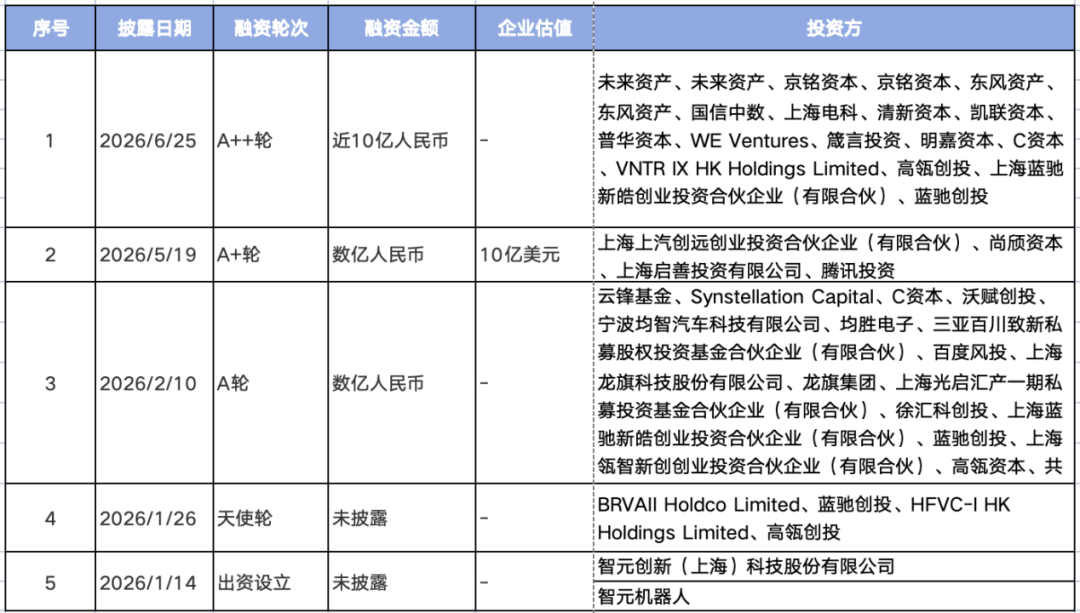
The investor lineup includes Baidu, Hillhouse Venture Capital, BlueRun Ventures, Guoxin Zhongshu, Shanghai Dianke Fund, and other industrial capital and top-tier financial investment institutions. All funds will be used for three key directions: capacity expansion, operational data platform construction, and contact intelligence model development.
Notably, AGILINK did not rely solely on storytelling for financing. By Q1 2026, the company achieved operational net profitability, with cumulative deliveries of its OmniHand series dexterous hands exceeding 8,000 units and industrial grippers surpassing 10,000 units. Its commercialization capabilities have become the core confidence for heavy capital investment.
The second is Lingxin Qiaoshou, the global leader in high-degree-of-freedom dexterous hands (with up to 42 degrees of freedom). The company currently holds over 80% of the global market share for similar products and is the only manufacturer in the industry to achieve mass production of high-degree-of-freedom dexterous hands at a scale of 1,000 units per month. The company plans to target a $6 billion valuation in its next funding round, approximately 41 billion yuan. This valuation scale directly rivals the IPO issuance valuation of domestic humanoid robotics leader Unitree Technology, marking a symbolic phenomenon where 'one robotic hand's valuation rivals that of an entire humanoid robot.'
Industry statistics show that there are over 150 domestic humanoid robotics manufacturers. Excluding a few top players, Lingxin Qiaoshou's valuation exceeds that of the remaining 146 manufacturers, underscoring capital's extreme premium on the dexterous hand sector.
Beyond these two, financing has blossomed across the sector: in March, Paxini Sensing announced the completion of a B round exceeding 1 billion yuan; in May, Xinuo Future secured several hundred million yuan in A round financing; upstream component manufacturers like Zhaowei Electromechanical and Leishai Intelligence simultaneously completed industrial capital increases. From new spin-offs of whole-robotics firms to vertical dexterous hand manufacturers and upstream module suppliers, the entire industrial chain (chanlianshang, 'supply chain') has been comprehensively covered by capital.
AI tech self-media outlet 'Houchangcun' believes that capital investment logic has fundamentally transformed. In 2025, institutional investors in humanoid robots focused on team technical backgrounds and demo effects. By 2026, investment criteria for dexterous hands have become thoroughly pragmatic, with mass production capacity, real-world orders, stable delivery volumes, and phased (jieduanxing, 'phased') profitability becoming mandatory quantitative indicators. Pure PPT presentations and laboratory prototype projects now struggle to secure large-scale funding.
02 A Must-Have for Humanoid Robot Deployment
A must-have for humanoid robot deployment, the industry officially transitions from laboratories to mass production. Capital's collective bet on dexterous hands is not merely chasing concepts but addressing the core bottleneck of humanoid robot industrialization.
After robots master walking, balance, and basic locomotion, their ability to achieve commercial viability depends entirely on the fine manipulation capabilities of their end effectors—dexterous hands.
Traditional industrial scenarios predominantly use two-finger rigid grippers and vacuum suction cups, which can only perform simple grasping and handling tasks. These tools are highly inflexible, with extremely high costs for product changeovers and debugging, making them unable to handle complex tasks like sorting, assembly, and fine manipulation.
In contrast, dexterous hands integrate multi-degree-of-freedom motors, microsensors, and precision transmission structures. A single unit can adapt to dozens of different material forms, making them essential hardware for flexible manufacturing, domestic services, warehousing and sorting, and scientific research experiments. They represent the core threshold for humanoid robots to move from showroom demos to real production lines and civilian applications.
The industry has moved beyond the 'laboratory prototype stage' and officially entered a scaling (guimohua, 'large-scale') production turning point.
Before 2024, all domestic dexterous hands were customized laboratory products, characterized by high per-unit costs, short lifespans, and poor product consistency, used only for exhibition demos and university research.
By 2026, leading companies have fully established mass production lines, delivering standardized products in bulk. Manufacturing processes and supply chain support are becoming increasingly mature.
Production and sales data from GGII High-Tech Industry Research Institute directly confirm the industrial turning point: total domestic dexterous hand sales reached 19,200 units in 2025, a 236.84% year-over-year surge. The institution predicts domestic sales will reach 70,200 units in 2026, a 265.63% increase, and by 2030, annual national sales could exceed 430,000 units. The industry's compound annual growth rate from 2025 to 2030 is projected at 87%, with clear long-term market growth potential.
From a technological roadmap perspective, after years of iteration, the strengths and weaknesses of the three mainstream approaches—direct drive, tendon-driven, and linkage—have become clear. Direct drive and tendon-driven solutions have emerged as industry standards, while linkage schemes continue to lose market share.
The core reason lies in the explosive demand for embodied AI simulation training. Direct drive and tendon-driven structures exhibit smaller errors in virtual-to-real simulations, making them better suited for sim-to-real model training. The industry widely agrees that the ultimate winners in the sector must simultaneously master hardware manufacturing and general-purpose operational AI model training. Upstream component manufacturers focusing solely on motors, reducers, or transmission modules risk long-term marginalization by downstream whole-robot and dexterous hand manufacturers.
Industry players are clearly divided into three categories:
The first category consists of vertical dexterous hand specialists, represented by AGILINK, Lingxin Qiaoshou, Inspire Robotics, and Oyi Technology. A few leading companies have achieved phased profitability.
The second category includes upstream component module manufacturers like Zhaowei Electromechanical, Leishai Intelligence, and Dahuan Robotics, which primarily supply single-finger modules and transmission kits, often in OEM models.
The third category encompasses full-stack humanoid robotics companies like Unitree, Zhiyuan, and Galaxy General, which develop dexterous hands exclusively for their own robots without external commercial sales, giving them a natural advantage in AI model adaptation.
03 Stories Behind the Robotics Industry
In the first half of 2026, amid the sustained hype around humanoid robots, the sector achieved multiple milestone breakthroughs. However, beneath the prosperity lie multiple industry risks. On one hand, capital continues to pour in, triggering severe homogeneous competition among numerous players. On the other hand, fundamental industry contradictions persist, with two core risks continuously eroding the sector's long-term development potential.
The first major risk is severe homogeneous competition triggered by a flood of players.
Over 100 domestic companies have entered the humanoid and commercial delivery robot sectors. In the commercial segment, products from companies like Keenon, Pudu, and Yunji Technology are highly similar, all focusing on hotel meal delivery and mall guidance functions. In the humanoid segment, players like RoboTech, Galaxy General, and Songyan Dynamics can only perform standardized actions like continuous backflips, sword fighting, walnut cracking, and clothes folding (point-to-point, linear, or circular motions).
The second major risk involves systemic mismatches between 'high commercialization expectations' and 'physical limits, data scarcity, and cost structures.'
The 'impossible triangle' of intelligence and data: Embodied AI requires massive volumes of high-quality, multimodal (force control/tactile/pose) interaction data. However, existing data suffers from an inability to simultaneously achieve high quality, large scale, and low cost. Internet text data cannot be directly converted into physical operational capabilities, resulting in poor generalization of large models in real unstructured scenarios—'they look capable but perform unstably.'
Hard mismatches between energy systems and operational conditions: Humanoid robots' bipedal walking and high-degree-of-freedom movements lead to extremely high power consumption. Limited by body space, existing lithium battery energy densities struggle to balance self-weight, safety, and long endurance (typically only 2-4 hours of effective operation). Energy bottlenecks directly limit data collection duration and commercial availability, constraining the intelligent iteration flywheel.
Additionally, while the majority of current robot costs still lie in hardware (joints/motors), future costs will shift toward a sharp increase in computing power and algorithms. However, hardware costs have not yet been reduced through mass production, while software lacks sufficient real-world data for training, creating a deadlock where 'expensive hardware lacks data, and insufficient data weakens software.'
04 Only Self-Sustaining Capabilities Can Endure Through Cycles
The sector remains in the early stages of industrialization, with four core challenges demanding urgent breakthroughs. Despite impressive market growth and sustained capital enthusiasm, the dexterous hand industry is fundamentally still in its early industrialization phase. Core bottlenecks in hardware, data, AI models, and practical scenarios remain difficult to resolve in the short term, representing key obstacles to large-scale commercialization.
Moreover, product prices have plummeted, continuously squeezing industry profit margins. Scaled-up domestic production of dexterous hands has driven down costs but also triggered industry-wide price competition. The price gap between domestic and international products has narrowed significantly, with corporate gross margins steadily declining.
Overseas benchmark products like Shadow's high-end dexterous hands sell for over 1 million yuan, while domestic products with similar performance cost only a fraction of that: Lingxin Qiaoshou's high-degree-of-freedom dexterous hands are priced around 50,000 yuan, Zhiyuan's OmniHand series drops below 20,000 yuan, and Inspire's standardized mass-produced models retail for just 10,000-20,000 yuan. Upstream module manufacturers have also lowered prices, with Dahuan's single-finger modules falling to the thousand-yuan level and Zhaowei's self-produced transmission modules continuously reducing overall BOM costs.
Behind the sustained price declines lie stubbornly high costs for hardware raw materials and precision transmission components. Lead screw costs are 2-3 times those of matching (peitao, 'matching') motors, while high-end tactile encoder chips remain subject to supply chain barriers, preventing rapid cost reductions on the cost side. Under this dual pressure, the industry's overall profitability continues to narrow.
The hype will eventually fade—only self-sustaining capabilities can endure through cycles.
05 Conclusion
For entrepreneurs, investors, and industry practitioners, dexterous hands represent not a short-term trend but a hard-tech sector with a decade-plus timeline. Setting aside short-term valuation frenzies, the only path to long-term industry development lies in patiently resolving three core issues: mass production consistency, general-purpose operational models, and large-scale practical deployment.
-
It's Time to Tally the ROI for Tokens
-
![]()
WPS, with 678 Million Users, Seeks Equilibrium Between Revenue Growth and User Experience
-
![]()
Seres, Once a Profit Leader, Shifts from Gains to Losses in H1: It’s Not Entirely Huawei’s Fault | MIRROR Pro
-
![]()
Why Google Remains 'Others' After 16 Years in the Smartphone Business
-
![]()
The Theory of Distillation Threat
-
![]()
Iterative Communication in Automotive Electronics: ADI's Innovative AB, GMSL, and EB Solutions
-
![]()
Despite AITO’s Explosive Sales, Why is Seres Still Struggling Financially?
-
![]()
For Seres, Losses Aren't the Toughest Challenge