The Surge of AI-Generated Faces Sparks the Uncanny Valley Effect: Short Videos Lack Originality, and the 'Human Element' Becomes a Rarity
 07/15 2026
 536
536
In the era of AI-Generated Content (AIGC), the 'human element' has become a precious commodity.
Who would have anticipated that the homogenization of content in the AI age would arrive sooner than expected? Before delving into the article, let's examine a screenshot from an AI-generated short video:

Image source: Douyin AI short video
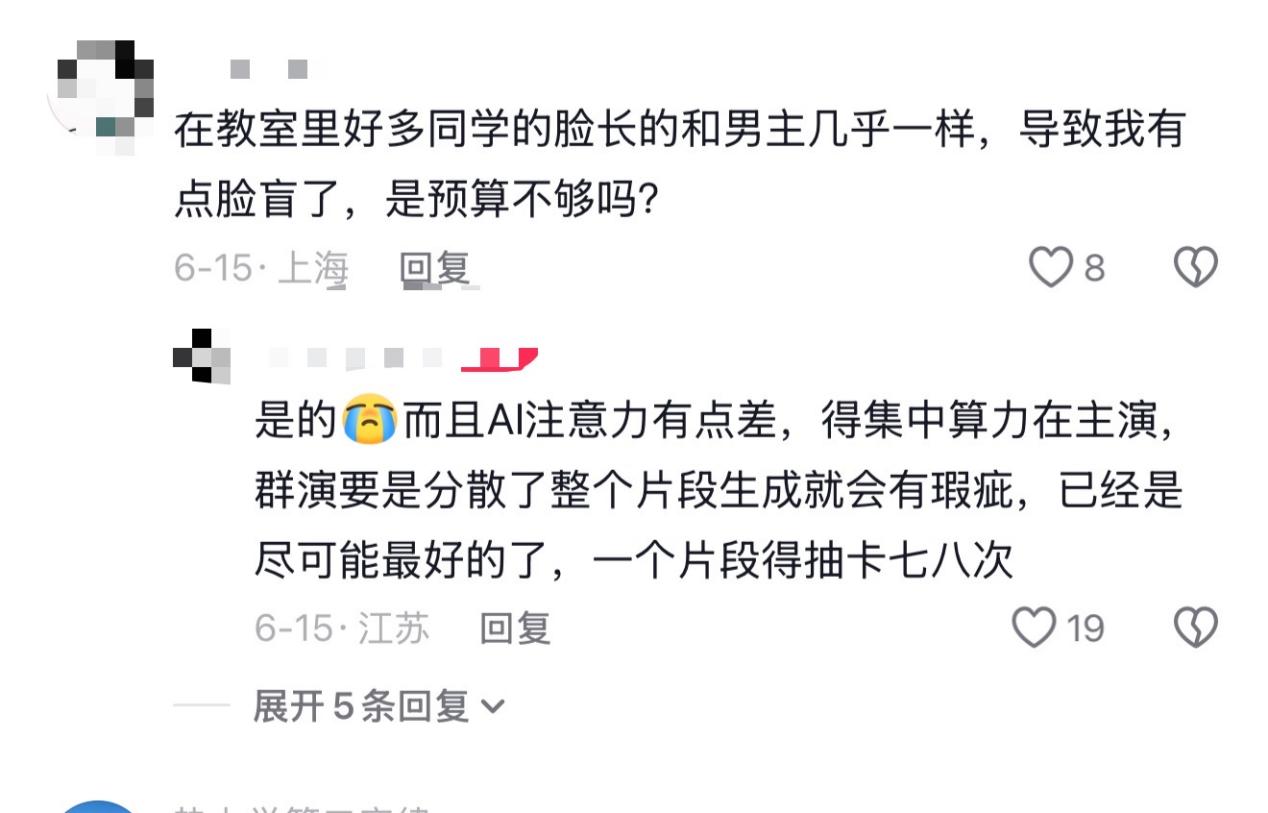
Have you observed that the male characters in this video all bear a striking resemblance, with nearly identical face shapes, hairstyles, and even the same middle-parted fringe? This issue is not confined to a single video; if you explore another AI-generated short video, you'll notice that the AI actors, both male and female, look remarkably similar.
Some viewers have also picked up on this issue, and the creator responded by stating that this was the best possible outcome, achieved after seven or eight attempts to generate a single clip.
Leitech (ID: leitech) has discovered that this is not an isolated incident. Data from the China Network Audio-Visual Program Association for the first quarter of 2026 reveals that AI micro-short videos constitute over 95% of all micro-short videos released in the industry. In other words, the majority of short videos you encounter now feature digital actors.
Data from NewRank also indicates that between January 1 and June 30, 2026, at least nine AI-related videos (identified as AI-generated) on Douyin amassed cumulative view counts exceeding 100 million.
While the quantity has skyrocketed, so has audience patience. On Weibo, the topic 'AI Faces and the Uncanny Valley Effect' trended, garnering 2.747 million views. The trending content highlighted the frequent appearance of identical male and female faces in AI-simulated human dramas, leading to an overwhelming presence of AI faces and causing physical discomfort. So, why do all AI-generated faces look alike?
Firstly, it's crucial to understand that AI's aesthetic sense is not innate but is shaped by the data it is trained on. Currently, over 70% of the training materials for mainstream image and video models originate from social media and fashion websites, where photos are already highly homogenized, featuring traits like large eyes, high noses, and pointed chins—the standard features that attract the most traffic and widespread dissemination.
When generating human faces, AI models essentially engage in a probability game, with their primary objective being to create a face that is unmistakably human.
To achieve this, the algorithm naturally converges toward the statistical average of all human faces, smoothing out niche and extreme facial features in a process known as 'central tendency stabilization.' Drooping eyelids are perceived as gentler and less aggressive than upturned ones; a blurred jawline is less likely to appear flawed than a sharply defined one. To avoid generating deformed or asymmetrical faces, AI tends to opt for the safest combination of features.

Image source: AI-generated
Video models face even stricter requirements, as they must ensure consistency across numerous frames, naturally favoring faces with symmetrical features, standard contours, and controllable expressions—faces that remain appealing regardless of the camera angle.
Platform-level factors also contribute to this issue. Many video generation platforms have enabled 'prompt enhancement' by default. You might think you're only inputting a few simple keywords, but in reality, the backend has already inserted a comprehensive set of standard aesthetic preferences: large eyes, high noses, fair skin, soft lighting, cinematic quality, and refined facial features. Everyone receives the same set of descriptors, resulting in identical faces.
Interestingly, when we explicitly include specific appearance requirements in the prompts, such as wheat-colored skin, short cropped hair, or black-rimmed glasses, the generated results immediately become more diverse. This suggests that the model is capable of diversity; the problem lies in the fact that most creators do not provide sufficient descriptions, leading the system to default to a standardized direction. Diversity requires intentional design and investment, which the current assembly-line model least encourages.
From a cost perspective, the production costs of AI short videos are inherently low. With the capability of one person producing one video per day, producers have neither the incentive nor the time to refine character images individually.
Wang Xiwen, Dean of the Beijing Huaxia IOT Intelligent Technology Research Institute, described the current standard process in an interview with China Economic Net: Producers first use popular prompts to generate a standardized beauty base, then lock in fixed 'seed values' to ensure consistent facial features throughout the video, and finally reuse this template to produce videos in bulk.
Even pre-packaged AI character libraries, including front, side, and back views, have emerged online. Producers simply purchase these ready-made asset packs (material packages) to train the model, leading to a situation where the same face is shared across the entire internet.
It must be acknowledged that in today's AI age, the 'human element' is becoming increasingly scarce.
A recent article published by People's Daily Online, titled 'Art Lies in Having a 'Human Element',' mentioned: After watching 10 short videos, nine of the protagonists' faces seem to have come from the same plastic surgery clinic. Homogenized appearances and stiff, hollow expressions strip AI-generated images of their warmth. The 'human element' lies in the half-second hesitation in an actor's gaze, the unsuppressable sob in the corner of their mouth, or an impromptu line of dialect dialogue. These expressions, which cannot be precisely calculated by algorithms, constitute the soul of performance.
If you believe that identical faces are exclusive to AI short videos, you're underestimating the issue. AI composition, AI animation, and AI writing—almost all AIGC content sectors are rapidly moving toward homogenization.
For instance, AI animation faces the same problem. When generating characters, it relies on mainstream aesthetics in the training data and is similarly constrained by the algorithm's tendency toward central tendency stabilization. The character designs in AI-generated comic dramas also feature uniformly refined facial features and standard contours. The difference lies in the fact that short videos involve realistic human faces clashing, while animations involve 2D characters clashing.
If AI short videos' faces are nauseating, AI-written novels are unreadable.
In February 2026, Fanqie Novel took action against 855 accounts that abused AI for bulk creation, pointing out in its announcement that these accounts updated hundreds of works daily, producing content that was shoddily made, highly homogenized, and unreadable, with even the covers being identical.

Image source: Sohu
Data shows that among the novels newly released in March 2026, the 'rejected marriage,' 'rebirth,' and 'system' tropes accounted for 62%, with AI-generated works making up over 90% of this share. Opening a new book, the first ten chapters all involve the protagonist awakening a system after being rejected in marriage, embarking on a journey of humiliation and upgrade—like eating pre-made meals with identical side dishes.
During the same period, U.S. publishing giant Hachette urgently took down the bestselling horror novel 'The Shy Girl' after an AI detection company found that 78% of its content was suspected to be AI-generated.
AI writing suffers from even more severe homogenization than short videos because AI models learn from online literature tropes themselves. The training data contains numerous templates of rejected marriages leading to comebacks and underdogs awakening, which the model internalizes as optimal solutions.
Research by Microsoft's team found that AI tends to give characters selective amnesia in long-form creation, such as childhood friends meticulously introduced in the first three chapters becoming strangers by the fiftieth chapter; a protagonist with a fire-attribute heavenly root suddenly becoming a water-attribute underdog by the fiftieth chapter because the AI 'forgot' the previous settings.
Even if you change vocabulary, rephrase sentences, or adjust punctuation, it's all superficial. AI's underlying narrative logic is fixed; it prefers single-thread storytelling, avoids moral ambiguity, has never experienced life, doesn't understand death, and doesn't know what it means to hesitate before speaking. It can only apply a standard story template. As Professor Miao Huaiming from Nanjing University put it, AI's sentences are often clichés, comprehensive yet lacking in personality and depth.
So, when can we return to an era filled with the 'human element'?
Research by Benchmarking shows that artificially curated content with deliberate imperfections outperforms purely AI-generated content by 40%-60% in terms of user dwell time and sharing rates. A report by Hootsuite also found that consumers have grown tired of overly polished content, with the 'human element' becoming a trust anchor.
This indicates that the 'human element' is becoming a precious commodity. AI has indeed driven production costs to rock bottom, flooding the market with a short-term surge of homogenized content that drowns out human-created content. However, audience demand has never changed; people have always wanted to see: a person with warmth telling a story they believe in.
Fortunately, some changes are already underway.
In late June, People's Daily published an article titled 'Tired of AI Faces? The 'Human Element' Should Make a Comeback,' stating:
For the micro-short video industry, the aversion to AI faces should serve as both a reflection and a signal. First, while technology can be used to compress budgets and production cycles, artistic and humanistic qualities should not be replaced by assembly-line output. Second, AI is, after all, just a supplementary tool; professional matters should still be entrusted to professional 'humans.' Third, producing a hundred 'similar' products can only compete for existing market share, while creating a single 'memorable' work can generate new demand.
The China Network Audio-Visual Program Association is also leading the development of the 'AI Micro-Short Video Content Quality Evaluation Standards,' with character distinctiveness listed as an independent scoring criterion. Once implemented, producers will face significantly higher costs if they attempt to rely on a single face to pass bulk reviews.
Meanwhile, overseas copyright lawsuits are also pushing the industry toward self-regulation. In March 2026, an independent actor in the U.S. sued an AI short video platform for unauthorized use of their likeness features to train the model. Although the case was settled, it served as a wake-up call for all platforms.
AI can infinitely approximate humans, but in this process, there is an unbridgeable gap—such as the unsuppressable sob, the gaze that lingers half a second longer, or an impromptu line of dialect.
Technology can never replace human emotion. If AI faces dominate our screens in the future, we will lose not only visual diversity but also the most precious aspect of art: the 'human element.'
AI short videos, AI faces, AI animation, AI novels, AIGC
Source: Leitech
Images in this article are from: 123RF Royalty-Free Image Library Source: Leitech
-
AI's Richest Person Revealed: A Native of Zhanjiang!
-
No one dares to bet big on Seres' financial report
-
Standing at a Distance, Behind Xiaomi's Phone Slowdown and Layoffs", "Xiaomi Phone, Declining Sales, Offline Stores, Product Strategy, Comprehensive Ecosystem of People, Vehicles, and Homes", "Accordi
-
![]()
ByteDance Enters Physical AI, Igniting the Second Wave of 'Feast'?
-
![]()
Phoenix Optics Forecasts a Nearly 70% Drop in First-Half Net Profit, Yet Optical Business Profit Shows Growth!
-
![]()
A Staggering 50.16% Reduction in Losses Projected! COST's Interim Report Signals a Pivotal Moment
-
![]()
Nearly 19% of National Total! Guangdong Boasts 164 Registered Large Models as New AI Personification Regulations Take Effect
-
![]()
BYD’s Baosha, Sought After by Australians, Makes a Triumphant Return to China