ByteDance Enters Physical AI, Igniting the Second Wave of 'Feast'?
 07/15 2026
 559
559
Recently, media reports revealed that ByteDance is exploring entry into the autonomous driving sector, focusing on unmanned logistics scenarios, with related research falling under Volcano Engine's automotive industry line. In response to market rumors, ByteDance officially clarified: While ByteDance conducts early-stage research and exploration in cutting-edge AI large model fields, including physical AI, it has no plans to develop intelligent driving businesses.
The core focus of this discussion is not whether ByteDance will launch autonomous driving services, but rather the consensus among tech companies: The era of intense competition in large models has peaked, and the next growth frontier for AI lies in the physical world.
Over the past decade, from recommendation algorithms to computer vision, from voice interaction to large language models, AI has revolutionized information production efficiency but has yet to fundamentally transform the real economy. As online traffic dividends dwindle and the marginal returns of model scaling decline, the entire industry is searching for its second growth curve.
Physical AI injects intelligence from the digital world into real-world scenarios, enabling AI to step out of servers and screens, evolving from 'processing information' to 'reshaping the world.' This marks the beginning of a second, far more profound and long-term valuable wave of AI innovation than generative AI.

Many mistakenly believe physical AI simply means 'smarter robots,' but this represents a superficial misunderstanding. Physical AI is not a single product category but an entirely new intelligence paradigm. Its underlying logic differs fundamentally from all previous forms of AI.
Traditional AI is rooted in symbols and statistics. Large language models acquire linguistic statistical patterns through trillion-parameter training, generating coherent text by predicting the next token. Conventional image recognition fits features through annotated data to classify pixel content. This type of intelligence remains at the 'correlation' level—knowing that word A frequently co-occurs with word B or that pixel combinations correspond to certain objects—without understanding the underlying causal logic.
This explains why large models produce 'hallucinations.' They don't comprehend that a glass will shatter when dropped on concrete or that water boils at 100°C under standard atmospheric pressure. These fundamental physical laws exist neither in their training data nor cognitive frameworks. While they can recite physical principles, they cannot apply them in real-world scenarios.
The core breakthrough of physical AI lies in establishing intelligence upon causal understanding of the physical world. Its training objective shifts from predicting the next word to forecasting the next physical state after an action. Supporting this capability is the underlying system known as the world model—a learnable, deductive, and interactive virtual physical simulator. Within this simulator, AI comprehends gravity, friction, inertia, collisions, and all other physical rules, developing human-like intuitive physical understanding to make reality-conforming decisions in actual environments. This leap from 'statistical correlation' to 'physical causality' represents the most fundamental paradigm shift in AI's history.
Physical AI's second revolutionary aspect manifests in system architecture. Traditional automated systems and robots typically employ modular architectures: perception modules collect environmental information, planning modules generate action plans, and control modules drive hardware execution. These three modules develop independently, optimize separately, and exchange data through interfaces.
The pain points of this architecture are evident: Each layer of data transfer introduces information loss and error accumulation, while module adaptation costs soar. Traditional industrial robots can only perform fixed actions on structured production lines and halt at minor deviations. Early autonomous driving solutions react sluggishly to unexpected conditions—both limitations stem from the ceiling of modular architectures.
The maturity of large model technology has brought end-to-end solutions to physical AI. Just as large language models complete the entire process from input to output with a single model, physical AI can achieve direct mapping from raw sensor inputs to actuator control signals through end-to-end training. This eliminates fragmented module divisions, integrating all perception, cognition, decision-making, and control capabilities into a unified model. Errors are collectively optimized, and the system's generalization ability undergoes qualitative improvement.
Take autonomous driving as an example: End-to-end solutions no longer require separate target detection, lane line recognition, and path planning. Instead, they directly input raw data from cameras and LiDAR into the model, outputting control commands for throttle, brakes, and steering. This architecture not only drastically reduces engineering complexity but also enables systems to handle more long-tail scenarios—a core prerequisite for physical AI to move from laboratories into complex real-world environments.
The concept of physical AI didn't emerge this year; academic research has advanced for over a decade. However, its true transition from laboratories to industries, from niche discussions to industry consensus, has occurred only in the past two years. This shift results from the simultaneous arrival of four major technological and industrial inflection points, creating a rare synergistic effect.
First, the spillover of large model technological capabilities equips physical AI with a general-purpose 'brain.'
The explosive three-year development of generative AI has unexpectedly paved the way for physical AI. Transformer architectures, large-scale pre-training, multimodal fusion, and reinforcement learning alignment—these technologically mature methodologies verified in large language models can almost directly transfer to physical AI.
The most critical transfer involves attention mechanisms' ability to process spatiotemporal sequences. While large models use attention to handle textual context, physical AI applies it to process spatiotemporal correlations in visual, point cloud, and motion data. This technological homology allows physical AI to avoid building technical systems from scratch, directly reusing engineering experience, computational frameworks, and training methods accumulated during the large model era.
More importantly, large models have validated the feasibility of general-purpose intelligence pathways. Previously, AI for physical scenarios operated on a case-by-case basis—training separate models for each scenario and requiring complete redevelopment for new contexts. In contrast, physical AI based on foundational models demonstrates cross-scenario generalization potential. For instance, world models trained in autonomous driving can adapt to robotics with minor adjustments, while physical laws learned in industrial settings transfer to logistics scenarios. This generality forms the basis for scalable replication of physical AI.
Second, breakthroughs in simulation technology have resolved physical AI's data bottleneck.
The greatest challenge for physical AI lies not in algorithms but in data. Training large language models can utilize trillion-token free text scraped from the internet. However, training physical AI requires massive amounts of real-world interaction data. Having robots practice grasping objects 10,000 times in reality demands months and significant hardware costs, while autonomous vehicles completing millions of kilometers under extreme conditions face both high expenses and safety risks. Data acquisition difficulties have long hindered physical AI's development pace.
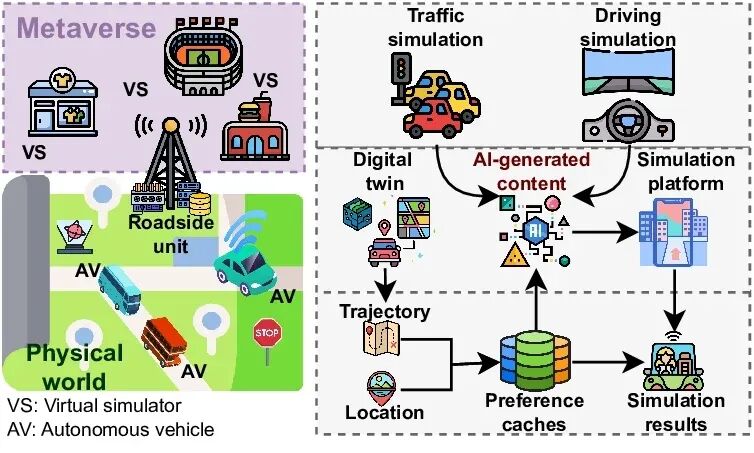
The maturity of digital twin and physical simulation technologies has shattered this bottleneck. Simulation platforms like NVIDIA Omniverse can now construct highly realistic virtual physical environments—accurately replicating light reflection, material properties, friction, gravitational acceleration, and even extreme conditions like rain, fog, and intense sunlight. AI can train continuously in simulation environments, completing years' worth of real-world mileage in a single day and testing countless scenarios deemed too risky for reality.
More critically, the maturation of 'domain randomization' technology addresses the simulation-to-reality gap. The primary issue with past simulation training was that perfect performance in simulators often failed in real-world conditions. Domain randomization overcomes this by randomly varying environmental parameters during simulation—such as object colors, lighting intensities, and friction coefficients—forcing models to ignore irrelevant disturbances and grasp core physical principles. This significantly boosts the success rate of virtual-to-real transfer.
Third, comprehensive hardware cost reductions have finally made physical 'bodies' affordable.
No matter how advanced AI algorithms become, they must ultimately land on hardware carriers. Over the past few years, hardware costs related to physical AI have experienced across-the-board declines.
The most notable example is LiDAR. A decade ago, mechanical LiDAR units cost hundreds of thousands of yuan, representing the largest cost barrier to autonomous driving commercialization. Today, solid-state LiDAR costs have dropped to the thousand-yuan level, with volumes small enough for vehicle integration and performance multiplied several times over. Besides LiDAR, costs for core sensors like cameras, millimeter-wave radars, and IMU inertial measurement units are declining at 20-30% annually.
Even more industrially significant is the proliferation of 'factory-installed mass production' models. Take autonomous buses as an example: The industry initially relied on post-production retrofitting—modifying mass-produced vehicles by adding sensors and computing units. This approach involved high customization, elevated per-unit costs, and delivery cycles extending to several months. Factory-installed mass production integrates autonomous driving systems into vehicle architectures during the design phase, using standardized platforms and leveraging automotive industry supply chains to amortize costs. This model reduces per-vehicle delivery costs by over 40% while shortening delivery cycles by two-thirds, making large-scale commercialization economically feasible.
Physical AI represents a vast spectrum covering all real-world industries, with implementation progress varying dramatically across sectors. From current commercial maturity perspectives, three tracks have validated business models and entered scaling (large-scale) deployment stages.
Autonomous Driving: The Most Mature Physical AI Implementation
If seeking the quintessential example of physical AI, the answer must be autonomous driving.
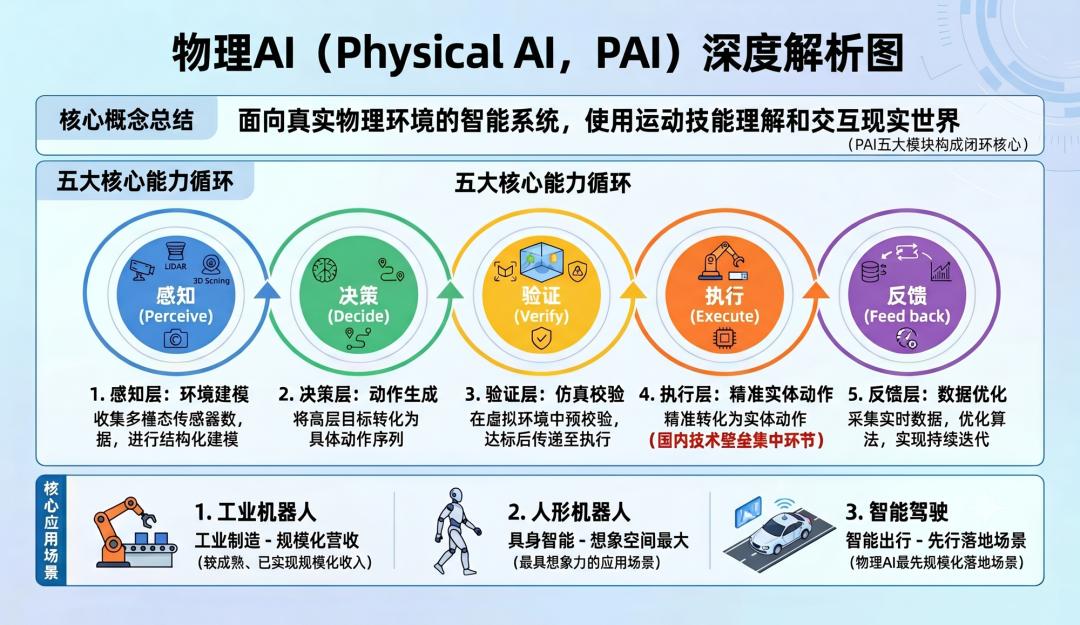
Few realize that a fully autonomous vehicle represents the world's most mature, complex, and commercially advanced physical AI entity. It must perceive 3D physical environments through multiple sensors, predict trajectories of surrounding vehicles and pedestrians, make driving decisions combining traffic rules and road conditions, and ultimately execute physical actions via throttle, brake, and steering controls—all while continuously collecting data for iterative optimization. This completely covers the physical AI closed loop of 'perception-decision-verification-execution-feedback.'
Compared to humanoid robots still stuck in demonstration phases, autonomous driving has achieved genuine large-scale commercial operations. Among these, autonomous buses, autonomous trucks, and unmanned logistics represent the most certain and fastest-landing segments—featuring fixed routes, closed or semi-closed environments, moderate speeds, and highly standardized scenarios that enable them to surpass commercialization thresholds first. Companies like Mushroom Auto, Inceptio Technology, Carl Force, Neolix, and 9D Robotics have achieved platform-based development and large-scale application of autonomous driving technologies, with shorter delivery cycles, lower implementation costs, and direct acceleration of commercial popularization.
Industrial Intelligence: The Most Stealthy Productivity Revolution
While autonomous driving dominates physical AI's visibility, industrial physical AI represents the most profitable yet under-the-radar sector. It doesn't stand in the spotlight but quietly restructures manufacturing productivity.
The core form of industrial physical AI is the closed loop of 'digital twin + intelligent decision-making.' Enterprises create 1:1 high-precision digital twins of production lines, equipment, and factories, fully replicating physical-world device states, production processes, and material flows. AI simulates, deduces, and optimizes within the digital twin environment to generate optimal production strategies, which are then executed on physical production lines. Real-time data from physical lines feeds back into the digital twin for continuous model optimization.
This model has demonstrated clear value across multiple scenarios. Predictive maintenance ranks among the most widely implemented applications: AI analyzes equipment vibration, temperature, and current data to preemptively detect component failures, enabling maintenance before unplanned shutdowns occur and avoiding substantial losses.
Beyond this, physical AI continuously penetrates production scheduling, quality inspection, and process optimization. Traditional quality inspection relies on manual visual checks, which are inefficient and prone to missed defects. In contrast, AI-based machine vision inspection offers superior speed, precision, and the ability to learn and identify increasing defect types through continuous training. Unlike consumer applications, industrial clients demonstrate strong payment willingness and clear ROI metrics—once technologies meet standards, commercialization proceeds smoothly.
Specialized Robots: From 'Performance' to 'Practical Work'
Humanoid robots represent the most imaginative direction for physical AI but also the furthest from large-scale commercialization. The first wave of commercial success belongs to specialized robots designed for specific scenarios.
For extended periods, robots have impressed the public with dancing displays while failing at practical tasks. Traditional industrial robots operate through pre-programming, capable only of repeating fixed actions in highly structured environments and ceasing function with environmental changes. Physical AI endows robots with environmental adaptability and autonomous learning capabilities, enabling them to handle certain unstructured scenarios.
Currently, the most commercially mature specialized robots concentrate in logistics and warehousing. AMR (Autonomous Mobile Robots) can autonomously plan warehouse paths, avoid obstacles, and transport materials, replacing manual forklifts and handlers. These scenarios feature relatively controlled environments, clear demands, and calculable ROI, entering rapid adoption phases. Additionally, inspection robots, cleaning robots, and sorting robots are quickly penetrating their respective niches.
In contrast, general-purpose humanoid robots remain in technical validation and small-batch pilot stages. Their appeal lies in 'generality'—theoretically capable of replacing humans for all physical work—but this generality also exponentially increases technical difficulty. Balance maintenance, dexterous manipulation, environmental generalization, and cost control each represent world-class challenges. The industry generally predicts specialized robots will experience explosive growth first, while large-scale commercialization of general-purpose humanoid robots may require five to ten more years of technical accumulation.
As conceptual heat rises, the industry has witnessed several one-sided interpretations of physical AI. Three common misconceptions warrant clarification.
Misconception 1: Physical AI Equals Smarter Robots
This represents the most widespread misunderstanding. While robots serve as one physical AI carrier, they certainly don't define its entirety.
Physical AI constitutes a technological paradigm where AI systems directly perceive physical environments and act upon the physical world. Its carriers can be automobiles, robots, factory production lines, port gantry cranes, urban traffic systems, or hospital surgical equipment.
Conversely, not all robots belong to physical AI. Traditional pre-programmed industrial robots and remotely operated drones merely represent automated equipment lacking autonomous cognition and decision-making capabilities. In simple terms: Automation follows preset instructions, while physical AI responds to situational changes. Robots represent the 'body,' whereas physical AI provides the 'brain capable of understanding the physical world.' A body without a brain constitutes mechanical automation; only when equipped with both does true physical AI emerge.
Misconception 2: Physical AI Will Soon Fully Replace Humans
Every breakthrough in AI technology triggers a wave of unemployment anxiety, and physical AI is no exception. However, objectively speaking, physical AI is still very far from fully replacing humans.
Currently, all implemented physical AI systems are concentrated in structured, repetitive, and rule-based scenarios, such as fixed-route autonomous driving, standardized material handling, and programmed quality inspection. These tasks share common characteristics: few environmental variables, fixed action patterns, and clear evaluation criteria—precisely the kinds of work that humans are not good at or unwilling to do.
In contrast, for unstructured tasks requiring high levels of common sense and adaptability, the capabilities of physical AI remain very primitive. For example, cooking a meal in a cluttered home environment, completing complex construction tasks on a chaotic construction site, or responding to emergencies—all these tasks demand comprehensive judgment and flexible adaptation, areas where AI still falls far short.
A more realistic scenario is 'human-machine collaboration' rather than full replacement. Physical AI will first take over '3D jobs'—Dirty, Dangerous, and Dull tasks—freeing humans from strenuous, hazardous, and repetitive manual labor to engage in more creative work that requires greater emotional intelligence and judgment. It is not here to take away jobs but to fill labor gaps and upgrade production efficiency.
Misconception 3: Simply Stacking Computing Power and Parameters Will Solve Physical AI
The success of large models has led many to develop a path dependency: they believe that with sufficient parameters, computing power, and data, stronger intelligence can be achieved. However, this logic does not hold in the field of physical AI.
The core reason is that the underlying properties of the digital and physical worlds are fundamentally different. Language is discrete, symbolic, and low-dimensional, and textual data can be acquired in vast quantities at low cost. In contrast, the physical world is continuous, high-dimensional, and full of uncertainties. Collecting real interaction data is extremely costly, making it impossible to acquire unlimited data like scraping web pages.
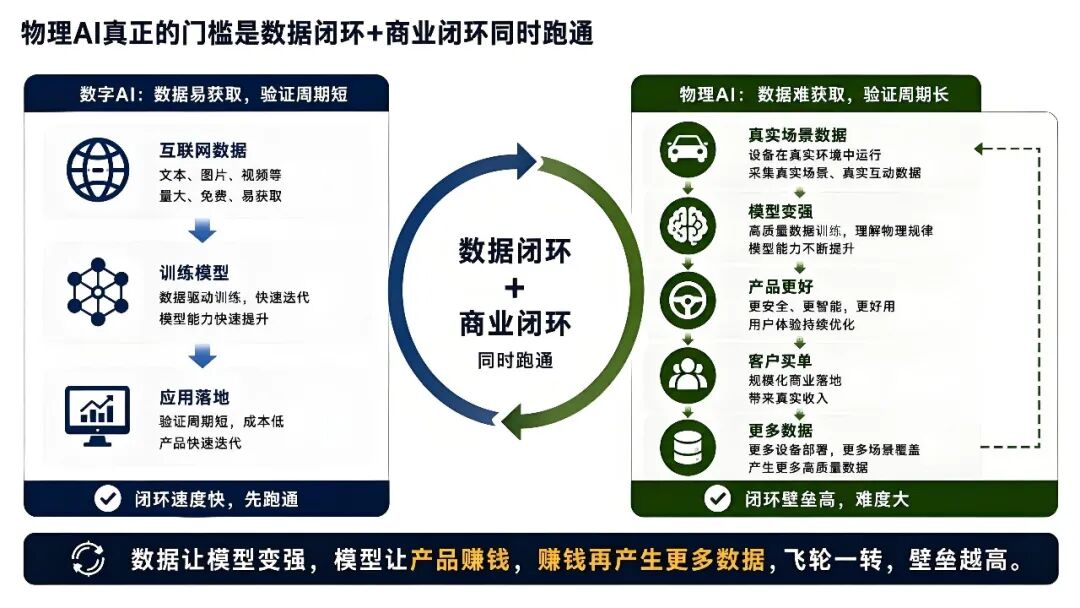
An even more challenging issue is the 'reality gap.' No matter how realistic a simulator is, it cannot perfectly replicate all the details of the real world—subtle bumps in the ground, minor air currents, tiny material differences. The accumulation of these small variables can cause perfectly optimized strategies in simulation to fail in reality. This problem cannot be solved solely by stacking computing power; it requires breakthroughs across multiple disciplines, including materials science, control theory, and sensor technology.
The competition in physical AI is not purely algorithmic but a systemic competition involving algorithms, hardware, engineering, and scenarios. It is heavier, slower, and more demanding of industrial foundations than pure digital AI, making it harder to accelerate through short-term capital infusion.
Looking ahead three to five years, the industry will exhibit three clear trends:
First, vertical scenarios will see rapid growth, while general-purpose scenarios will require more time. Vertical applications such as autonomous buses/trucks/logistics vehicles, warehousing robots, and industrial inspection robots will lead the way in large-scale adoption, while general-purpose humanoid robots will still need significant technological accumulation and should not be overestimated in the short term.
Second, front-end mass production and standardization will determine success. Whether in autonomous driving or industrial robotics, whoever can achieve standardized, large-scale front-end mass production first will be able to reduce costs to a critical threshold and unlock market potential. Customized approaches can only serve niche markets, while standardized mass production will capture the benefits of industry-wide growth.
Third, safety and regulation will become critical variables. Physical AI directly interacts with the real world, where errors can lead to property damage or even personal injury. Therefore, the development of safety standards, regulatory frameworks, and liability determination systems will be key factors determining the pace of industry growth. Moving too fast is less important than moving steadily; achieving safe and compliant implementation is the foundation for long-term, healthy industry development.
Of course, this revolution will not happen overnight. The reality gap, cost bottlenecks, safety challenges, and regulatory frameworks are all challenges that will take time to overcome. However, the direction is clear, the inflection point is confirmed, and the tide is already rising.
The first wave of AI prosperity belonged to large language models and the architects of digital world reconstruction. The second wave of AI prosperity is quietly unfolding in the physical world, belonging to all players who can make intelligence actionable and create tangible value through technology. This wave will be larger in scale, last longer, and bring about more profound changes to the world.
-
AI's Richest Person Revealed: A Native of Zhanjiang!
-
No one dares to bet big on Seres' financial report
-
Standing at a Distance, Behind Xiaomi's Phone Slowdown and Layoffs", "Xiaomi Phone, Declining Sales, Offline Stores, Product Strategy, Comprehensive Ecosystem of People, Vehicles, and Homes", "Accordi
-
![]()
ByteDance Enters Physical AI, Igniting the Second Wave of 'Feast'?
-
![]()
Phoenix Optics Forecasts a Nearly 70% Drop in First-Half Net Profit, Yet Optical Business Profit Shows Growth!
-
![]()
A Staggering 50.16% Reduction in Losses Projected! COST's Interim Report Signals a Pivotal Moment
-
![]()
Nearly 19% of National Total! Guangdong Boasts 164 Registered Large Models as New AI Personification Regulations Take Effect
-
![]()
BYD’s Baosha, Sought After by Australians, Makes a Triumphant Return to China