OpenAI's First Hardware: A Robot That Can't Walk
 07/16 2026
 462
462
OpenAI is injecting a 'soul' into a 'body'.
Even before OpenAI's first hardware release, traditional smart speaker companies are already feeling the pressure.
On July 15th, Beijing time, Bloomberg revealed that OpenAI is developing a movable, screenless desktop AI device equipped with cameras and environmental sensors. Following the news, audio equipment company Sonos's stock price dropped more than 10% after hours before narrowing its losses.
Interestingly, another detail emerged: Apple's stock price barely moved—but Apple's legal department had already taken action four days earlier. On July 10th, Apple preemptively sued OpenAI for alleged trade secret theft and applied for an injunction.
The stock market hasn't taken this device seriously yet, but the company most knowledgeable about hardware already sees it as a competitor.
The market's initial reaction was straightforward: This isn't just another 'ChatGPT-powered speaker' but rather OpenAI's attempt to take AI out of web pages, apps, and phones and place it into physical space.
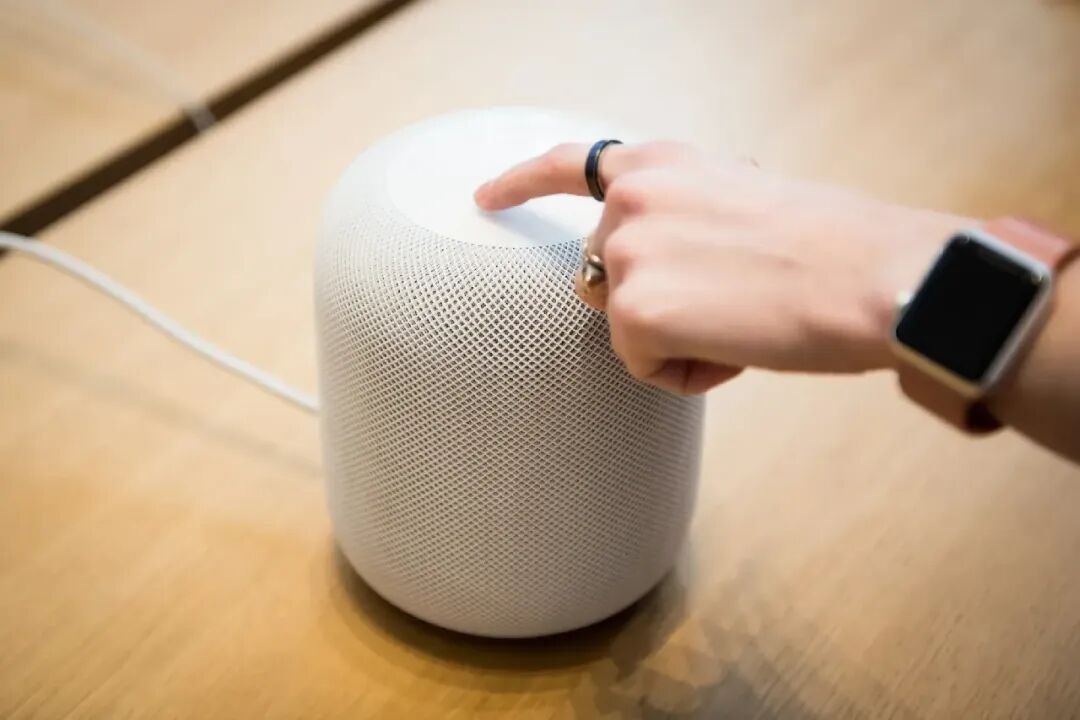
Apple's HomePod speaker. Source: Bloomberg
But for the AI glasses industry, another aspect is even more noteworthy.
OpenAI didn't start with the repeatedly speculated glasses, earphones, or pendants, nor did it jump straight to a humanoid robot like Tesla's Optimus. Instead, it created a screenless, camera-equipped desktop device that can be carried between rooms and features subtle mechanical movements.
In other words, OpenAI's first physical carrier (carrier) for AI isn't a pair of glasses or a large robot but rather a 'small robot' that can more easily fit into desktop scenarios and validate companionship.
01 It Looks Like a Speaker, But Its Product Definition Isn't One
Bloomberg originally described it as a movable, screenless speaker.
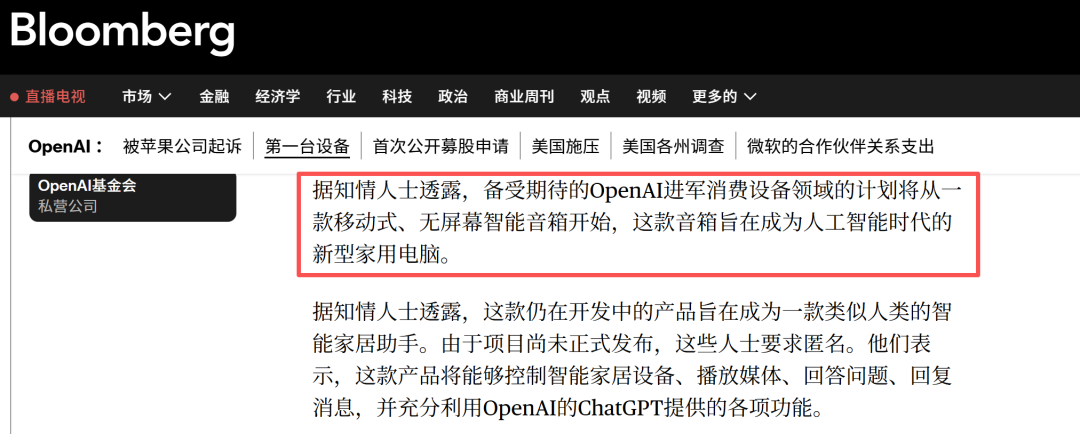 Bloomberg revealed that OpenAI is developing a movable, screenless AI speaker. Source: Bloomberg
But understanding it merely as a smart speaker underestimates what OpenAI is doing.
It has cameras and other sensors to understand the user's surrounding environment and context; it can control smart home devices, play media, answer questions, and reply to messages; it has a built-in rechargeable battery, allowing users to move it from the kitchen to the bedroom or from the living room to the study; its voice interaction uses GPT-Live, released by OpenAI on July 8th this year—this model can listen and speak simultaneously, using 'uh-huh' to indicate it's listening, aiming to make conversations feel more human-like.
The most subtle design element: It has mechanical structures that can move independently. According to Bloomberg, the purpose of these mechanical elements is to create a sense that 'it's alive.'
Here, we need to distinguish between two types of 'movement.' The 'movable' in Bloomberg's headline refers to the entire device being battery-powered and portable, allowing users to carry it from the kitchen to the bedroom or office—its 'movability' solves spatial switching, not autonomous walking. What moves on its own are its mechanical components.
The exact form wasn't described in the report. Based on the goal of 'being alive,' it might feature a rotating head or anthropomorphic parts like eyebrows or small arms—responding to people with movements and 'expressions.' The answer will have to wait for the actual device.
But the choice to 'use mechanical movements for expressions' itself is worth examining.
Previous desktop companion robots—Jibo, Vector, Emo—almost all used a small screen as a 'face': drawing eyes on the screen to blink, spin, or act cute. Screen faces are cheap and allow for easy expression changes, but the drawback is obvious: they're ultimately flat. After a while, a glowing small screen feels more like an upright phone than a living being, and it can even become annoying.
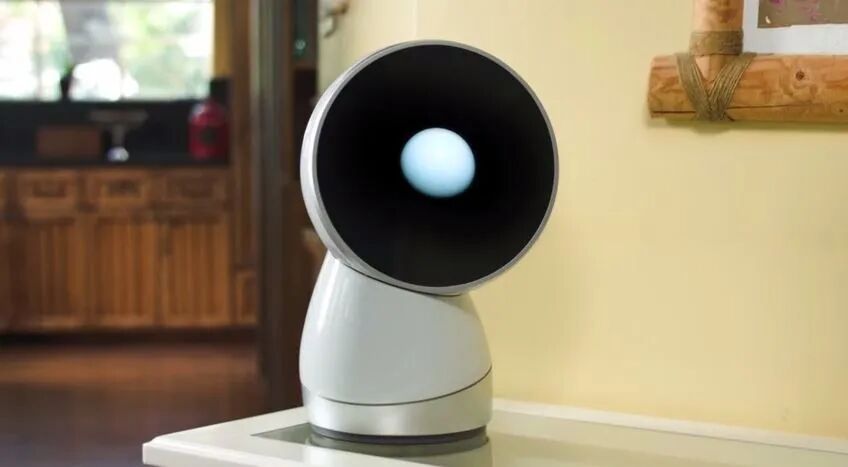 Desktop companion robot Jibo. Source: Jibo
Physical movements are different. A real 'little arm' that turns toward you or 'eyebrows' that lift are three-dimensional, space-occupying, and weighty—they don't simulate life on a screen but respond in real space, creating a stronger sense of 'living presence' than any screen-based expression animation, making people more willing to interact with it. Anyone who has owned a pet understands: what moves you about a cat isn't just its expressions but the small actions it makes with its body.
Following this logic, OpenAI has implemented 'screenlessness' more thoroughly than imagined: it doesn't even use a screen for a 'face'—preferring mechanical structures to express emotions rather than equipping the device with a glowing face.
This step is crucial.
Past smart speakers were 'devices with mouths': you call them, and they respond, following a 'wait-to-be-awakened' logic. What OpenAI wants is 'AI with a bit of physical presence': it exists continuously in desktop and room scenarios, knows what's happening around it, and responds with movements, voice, and proactive reminders—it observes the environment, familiarizes itself with the user, and judges when to speak.
This is no longer the logic of traditional speakers but closer to a low-degree-of-freedom desktop robot.
It doesn't have limbs yet and can't fetch things, pour water, or fold clothes for you. But it already has several prerequisites for being a robot: perceiving the environment, understanding the user, forming memories, and establishing a sense of 'it's responding to you' through physical movements.
This is what makes OpenAI's first hardware truly worth discussing: AI is beginning to transition from pure software to physical existence—the 'soul' is starting to find itself a 'body.'
02 AI Has a 'Brain,' But Not Yet a Body
In the past few years, large models have solved the 'brain' problem.
ChatGPT proved that AI can converse with humans like a knowledgeable, always-available assistant: answering questions, writing, summarizing emails, coding, and gradually forming an understanding of user preferences over long conversations.
But it has always lacked a stable physical carrier (carrier). Web pages, apps, and phones are just windows—they let users access AI but don't let AI truly enter living spaces. Lock your screen, and it's gone.
 OpenAI's mobile interface concept. Source: Bloomberg
AI glasses have been repeatedly discussed because they seem closest to a 'wearable carrier': attached to the face, offering a first-person perspective, able to hear and see, and accompanying users 24/7.
But OpenAI didn't choose glasses first.
This highlights a very practical issue: first-person perspective matters, but so does wearability cost. The face is the most selective part of the body. Glasses must solve battery, heat, communication, filming, audio, and comfort within a few dozen grams while facing privacy concerns about cameras in public spaces. Whether users are willing to wear a device on their face long-term for AI remains debated within the industry.
Desktop devices bypass these constraints. They can be heavier, have larger batteries, better cooling, and don't need to address 'how natural it looks when worn outside.' They prioritize stable existence over portability.
Thus, OpenAI's first stop being the desktop isn't a fallback but an easier-first approach: let AI learn to accompany people before learning to follow them or even do physical labor. It wants to validate: when AI has environmental perception, long-term memory, proactive services, and a bit of physical presence, will people treat it as a new lifestyle entry point?
03 Why Not a Humanoid Robot?
From the perspective of 'AI needs a physical carrier ,' another question arises naturally: Why not make a real robot directly?
The answer: The physical world is much harder than the linguistic world.
Li Feifei has repeatedly emphasized the importance of 'spatial intelligence' in recent years, and her startup World Labs focuses on world models. Spatial intelligence isn't about AI understanding images but comprehending the 3D world: relationships between objects, occlusions in space, and consequences of actions.
 Li Feifei explained World Labs and 'spatial intelligence' at a TED talk. Source: TED
This is precisely the hardest part for robots.
If a large model says something wrong, it can try again; if a robot reaches for a cup, will it crush it? A chatbot misunderstanding semantics might give an irrelevant answer; a robot misunderstanding the physical world might knock over furniture, bump into children, or spill hot water.
Mistakes in the linguistic world can be deleted and redone; mistakes in the physical world might cause accidents.
Autonomous driving is already difficult, but roads are at least relatively structured spaces. Home environments are messier: carpets, toys, pets, elders, children, glass cups, power strips, half-open cabinets—every home is different, and every day is different.
Thus, current AI is better suited for mental labor and emotional companionship than physical labor. It's more fitting as a household advisor, schedule manager, information assistant, and companion rather than an immediately capable household robot with fully developed limbs.
 Doubao AI. Source: Doubao
OpenAI sees the difficulty hierarchy of three physical carriers clearly:
Large robots require AI to first learn to interact with the complex physical world; glasses require AI to first become a product users are willing to wear long-term; desktop small robots let OpenAI first validate whether 'an AI companion with physical presence' works.
04 Where Perception Lies Is the True Dividing Line
For the AI glasses industry, OpenAI's route is a significant validation.
It's using heavy resources to validate the foundational directions that make AI glasses viable: screenless interaction, natural voice, environmental understanding, long-term memory, proactive services, and personalized feedback. Especially screenlessness—OpenAI abandoned graphical interfaces, seeking not a 'smaller phone screen' but more natural, less intrusive interaction.
But what's even more noteworthy is what OpenAI retained: cameras.
Screens can be debated, but perception isn't abandoned. For AI to interact with the physical world, it must first have 'eyes'—on this point, desktop and glasses advocates unexpectedly agree.
This is also the consensus among AI-native companies. Zhu Dianrong, founder of XR Institute, once asked Zhu Mingming, founder & CEO of Rokid, whether they would release a camera-free version like Even Realities for lighter weight. Zhu Mingming replied with a question: 'We want AI to fully interact with the physical world—without 'eyes' (cameras), how would it interact?'
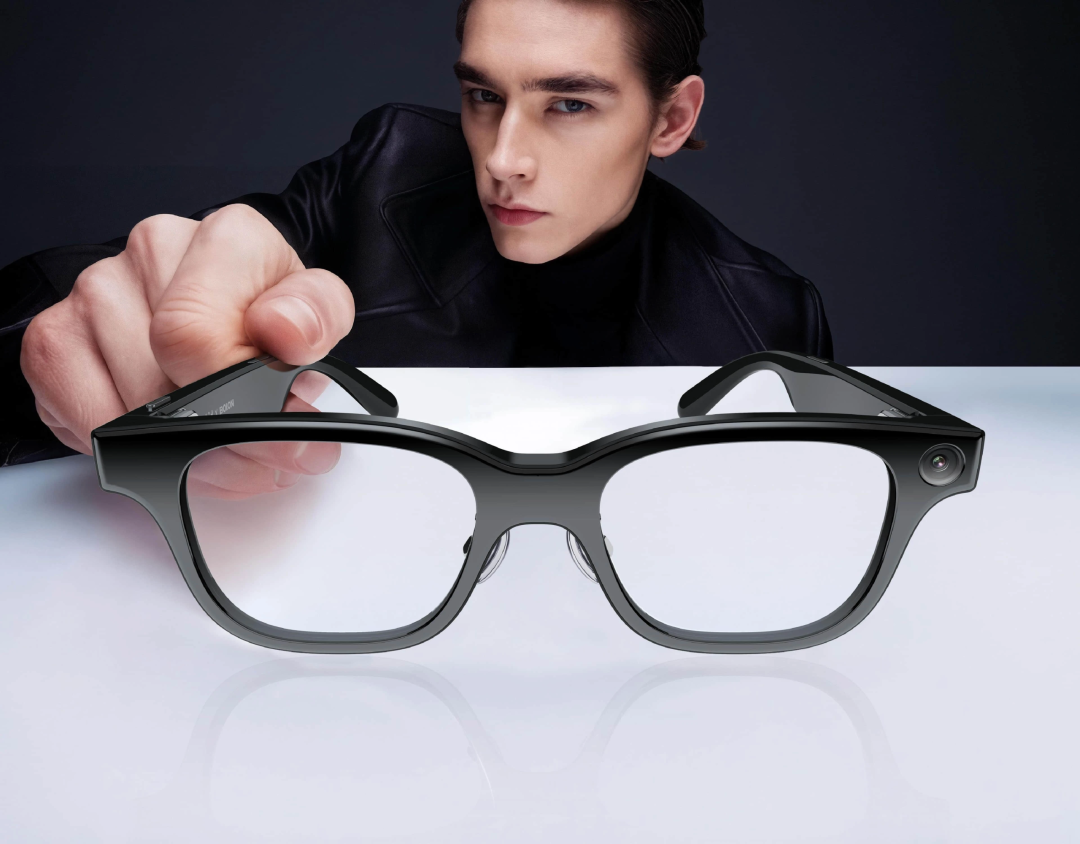 Rokid AI glasses. Source: Rokid
According to AR circle insights, Alibaba's QianWen and Doubao teams think similarly: their product answers don't include 'glasses without cameras.'
A consensus is forming: screens can wait, but visual perception cannot be absent.
The true dividing line becomes clear: not screen vs. screenless, but where perception lies.
Desktop devices' 'eyes' guard fixed spaces—living room, bedroom, kitchen, or office. Wherever you place it, it sees there but can't see your entire day after you leave. Glasses' 'eyes' follow you, offering first-person perspective and 24/7 perception—something desktop forms structurally can't provide.
What glasses must do is translate this perception advantage into a product users want to wear daily. Weight, battery life, heat, and social pressure are unavoidable. But glasses hold a card no other device can offer: first-person perspective. Cameras on glasses let AI see the world from your viewpoint—seeing what you see, understanding how you interact with the world. As long as this value holds, glasses' position in the AI hardware landscape isn't optional.
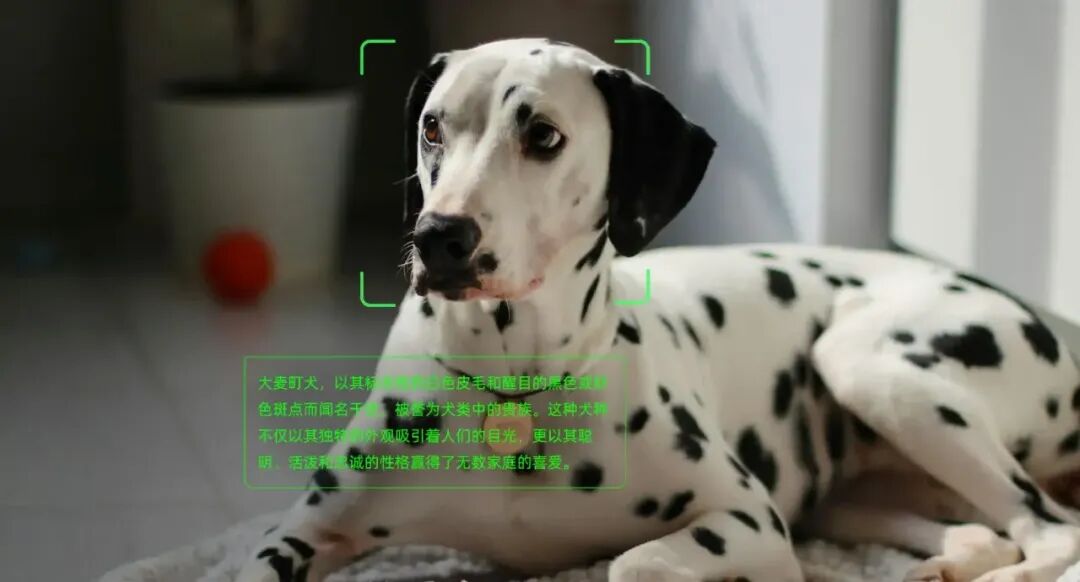 Rokid AI glasses' object recognition feature. Source: Rokid
OpenAI starting with the desktop is a low-constraint validation of AI companionship capabilities; what AI glasses must prove next is that these capabilities, when applied in first-person perspective, can create value the desktop can't.
05 The Desktop Isn't the Endpoint—It's the First Stop
Every generation of computing devices must first find its place: PCs occupied desks, phones fit into pockets, earphones went into ears.
In the AI era, the question goes further—not just where to stay but what the physical carrier (carrier) looks like. The candidate answers multiply: desktop devices, glasses, badges, robots, even future cars and appliances.
OpenAI's first choice: a 'small robot' that stays on the desktop.
Bloomberg revealed that OpenAI's hardware division has approximately five product lines, with long-term plans including a mobile AI device that could potentially replace smartphones. According to XR Research Institute, OpenAI's actual planned form factors are even more diverse—in addition to this desktop 'little robot,' there is also a device resembling a badge or a strapless watch, as well as glasses, with differences only in the order of their release.
This statement carries more weight for the AI glasses industry than Bloomberg's entire report: OpenAI does have glasses; it's just that the current challenges with glasses are significant.
If the concept of a desktop AI companion proves viable, OpenAI will extend it to more form factors: mobile devices, wearables, glasses, robots, and even some new type of personal terminal. Of course, the premise is that it first overcomes two hurdles—ensuring privacy authorizations allow users to confidently invite it into their lives, and that Apple's applied injunction does not confine it to the lab.
The real suspense (suspense, translated to keep the tone) lies not in whether it is a smart speaker, but in whether people are willing to accept: an AI with 'eyes' that stays in your home, office, or even car, observing your life, remembering your habits, and speaking up before you call on it—no longer just a web window, but your 'family member' or 'colleague.'
END
-
![]()
The Dead End of GoPro: Unveiling the Decisive Factors in DJI and Insta360's Competition
-
![]()
The Dead End for GoPro: Unveiling the Key to Victory in DJI and Insta360's Competition
-
DeepSeek Targets A-share IPO Amid RMB 480 Billion Valuation Debate
-
![]()
WPS Meitu XiuXiu: The Threat to Its Market Position from AI Large Models
-
![]()
After Seres Reports Losses, What Is the Capital Market Really Worried About?
-
![]()
Honor, Stepfun, and Nubia Vie for 'Pioneering' Status: The Fierce Contest Among AI-Powered Smartphones
-
![]()
Glory, Stepfun, and Nubia Vie for the Pioneering Position: AI-Powered Smartphones Engage in Intense Competition
-
![]()
Apple AI Gains Approval but Faces Outdated Challenges