Apple AI Gains Approval but Faces Outdated Challenges
 07/16 2026
 392
392
Apple AI and Doubao: A Gap Equivalent to 2.5 Huaweis
Author|Qingyun
Editor|Xiaobai
Cover Image|Generated by AI
Produced by|Qiangdiao Next
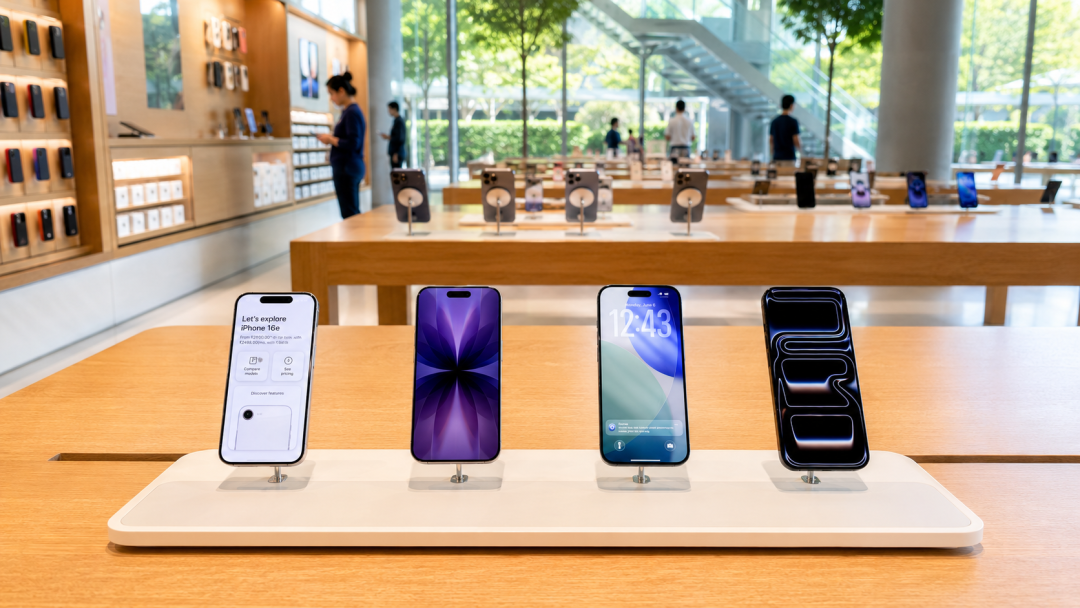
Apple's Apple Intelligence (Apple AI) has finally secured the necessary approvals to enter the market.
On July 15, the cybersecurity authority announced a new batch of approvals for on-device generative AI services, with seven products successfully passing the review: Apple Intelligence, Huawei Xiaoyi AI, OPPO AndesGPT, vivo BlueHeart On-Device Large Model, Xiaomi HyperAI, Samsung Galaxy AI, and Nubia Doubao Mobile Large Model.
Alibaba later confirmed that Qianwen would be integrated into China's version of Apple Intelligence, offering capabilities such as text and image understanding, as well as content generation. However, Qianwen is not the sole model powering Apple's AI; according to informed sources, Apple's collaboration with Baidu focuses on AI search capabilities, which will also enhance the Chinese version of the Siri voice assistant.
In essence, the current division of labor is as follows: Qianwen handles generative AI tasks, while Baidu manages search and Siri integration. It's worth noting that Baidu has been Apple's search service provider for Siri in mainland China for many years.
However, obtaining approval only addresses compliance requirements and does not signify product readiness. Reports indicate that some image recognition functions of Apple Intelligence still rely on Google's reverse image search, which is not operational in mainland China. This technical dependency necessitates further localization efforts. Thus, Apple still has a series of engineering tasks to accomplish.
More significantly, Apple now faces not only domestic smartphone manufacturers like Huawei and OPPO, whose on-device AI product penetration rates are significantly higher, but also native AI applications like Doubao and DeepSeek, as well as super apps like WeChat and Alipay. All are vying for the same prize: the next generation of service entry points.
01. This May Not Be the Same Siri Apple Unveiled in June
Apple first introduced Apple Intelligence at WWDC24 in June 2024, showcasing basic AI functions such as text rewriting, content summarization, image generation, and cross-app operations.
Just over a month ago, at WWDC 2026, Apple unveiled a completely redesigned Siri, internally dubbed Siri AI. Its underlying technology was replaced by a new model developed in collaboration with Google, derived from Gemini.
Siri AI is no longer just a voice assistant; it can understand what's displayed on the phone screen, remember recent interactions, and perform multi-step operations like writing emails, browsing old photos, and organizing itineraries. It aims to become a super entry point and service distributor.
However, at that event, Craig Federighi, Apple's senior vice president of software engineering, stated that these new Siri AI functions would not be available to mainland Chinese users in the near term due to ongoing regulatory approvals.
Therefore, the version that has likely passed approval today is still the "entry-level" version from two years ago. The features Apple itself considers "next-generation" may not have completed the approval process yet.
02. On-Device AI Is Becoming a 'Mature Business'
Upon entering the market, Apple must first navigate the competitive landscape of on-device AI.
According to QuestMobile's "2026 Mid-Year AI Application Market Insights Report," as of June 2026, the monthly active users (MAUs) of AI applications from terminal manufacturers reached 755 million, surpassing the 499 million MAUs of native AI apps.

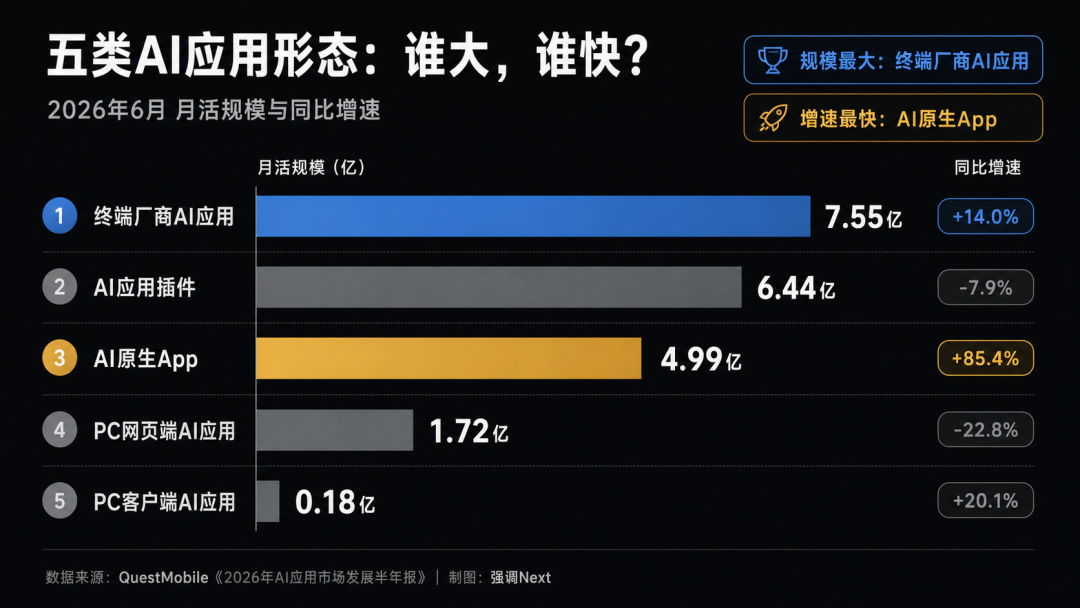
However, the average monthly usage frequency and duration per user for AI applications from terminal manufacturers were 51.4 times and 9.8 minutes, respectively, significantly lower than the 92.7 times and 183 minutes for native AI apps. The frequency is nearly half, and the duration is 18.7 times shorter.
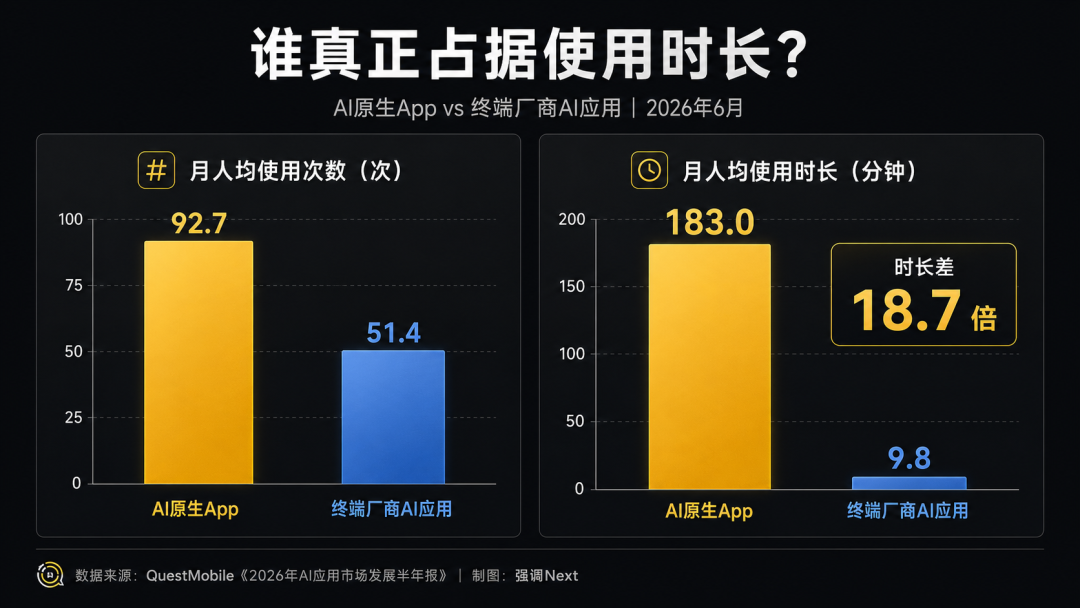
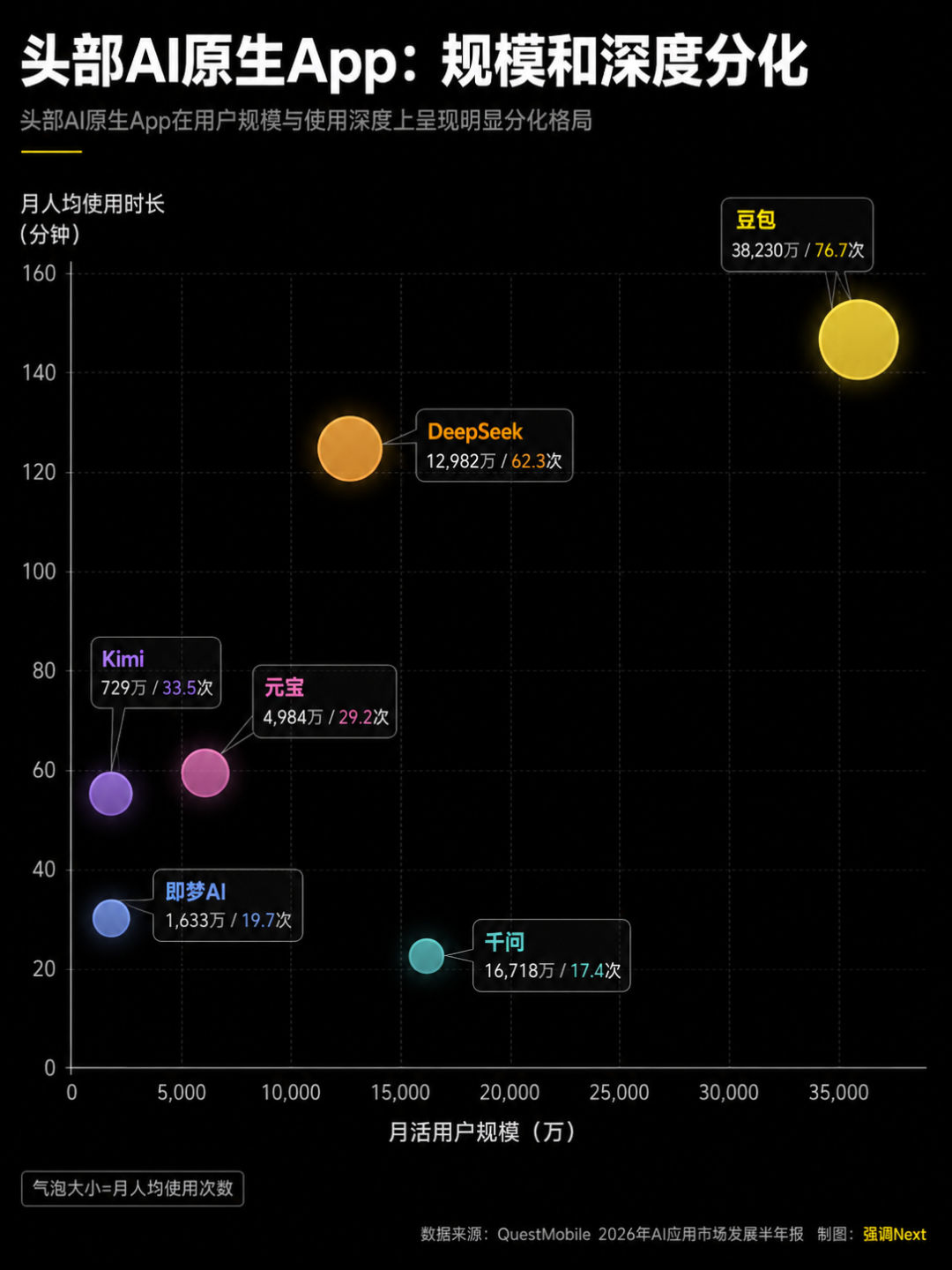
This indicates that while smartphone AI assistants achieve scale through pre-installation and device ownership, independent applications like Doubao, Qianwen, and DeepSeek handle complex tasks and long-term usage. In June, their MAUs reached 382 million, 167 million, and 130 million, respectively, with continued high growth rates.
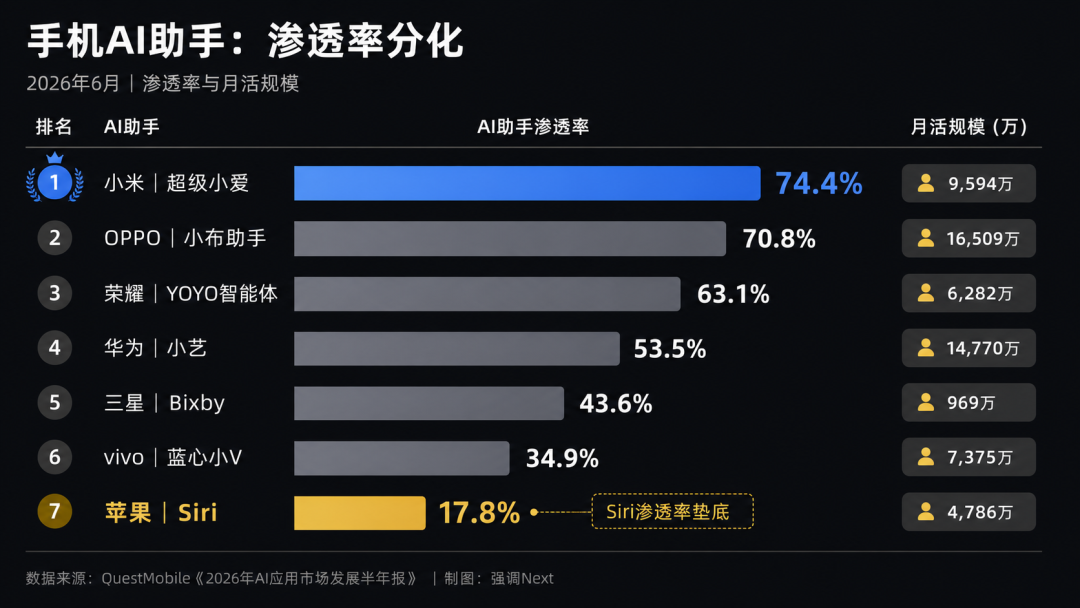
The contrast is even more pronounced when comparing AI assistants from individual smartphone manufacturers, with Siri's data being particularly weak. In June 2026, Siri's penetration rate among iPhone users was 17.8%, far lower than Xiaomi's Super Xiaoyi at 74.4%, OPPO's Xiao Bu Assistant at 70.8%, and Honor's YOYO at 63.1%. Apple's Siri had fewer than 48 million MAUs, about 1/8 of Doubao's.
Siri's average monthly usage was 3.8 times for 1.5 minutes, with usage frequency and duration declining by 15.5% and 15.9% year-over-year, respectively. In contrast, Xiaomi's Super Xiaoyi averaged 29.0 times for 7.7 minutes during the same period.
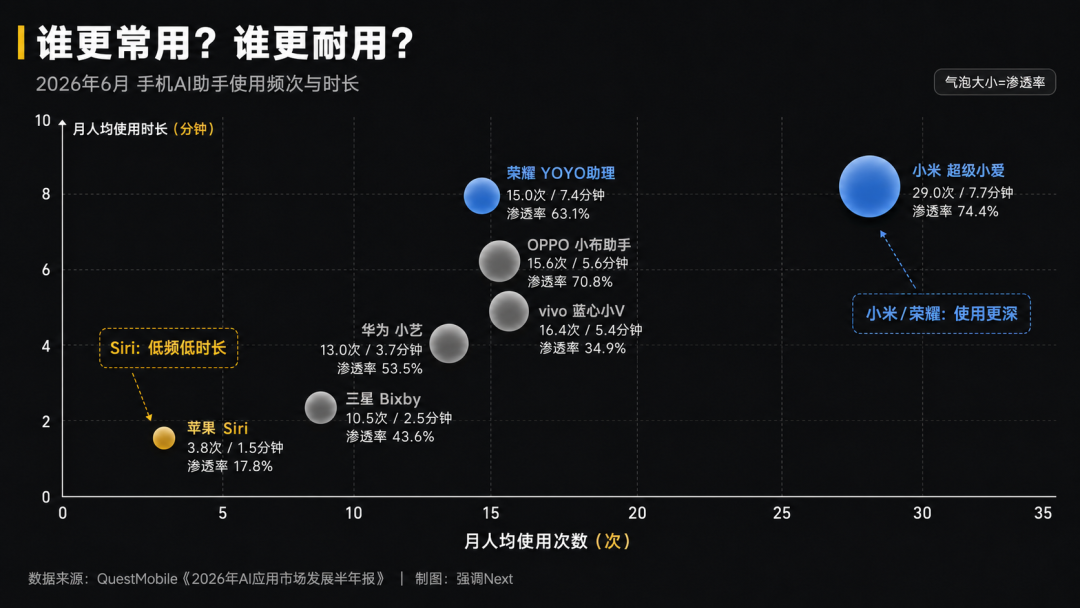
In other words, Apple must first catch up with smartphone manufacturers and then with third-party native AI apps.
Of course, the statistics mentioned above primarily reflect traditional Siri, not the next-generation Siri AI that has yet to enter the Chinese market. This does not mean Apple's AI has failed but rather that Apple faces a low starting point and the reality that device ownership does not guarantee penetration.
For Apple, this is not just about whether the AI assistant is user-friendly but also a matter of long-term strategy.
In the past, the iPhone's entry points were the home screen and App Store, with users deciding whether to open WeChat, Meituan, or Taobao. In the AI agent era, the entry point may become a natural language instruction, with AI determining what the user wants to do and which service to invoke. The AI that first captures user intent will control the next round of task distribution.
Apple's concern is not that Siri will lose to another chatbot but that Doubao, DeepSeek, or other third-party agents will gradually become the de facto entry points on iPhones. Therefore, Apple Intelligence aims to keep this layer of control within iOS.
03. The Battle for AI Agent Phones Is Intensifying
On July 17, Nubia will debut its "world's first AI agent phone" at the Shanghai World Artificial Intelligence Conference, integrating the "Doubao Mobile Assistant," which completed large model filing in the same batch.
However, claiming to be the "world's first" is no easy feat. StepFun nearly simultaneously launched its terminal brand STEPX, also calling itself the "world's first large model-native AI agent phone." The competition between the two companies for this title suggests that at least one is still in a PR-focused phase.
Major manufacturers have actually introduced similar products and actions earlier. Huawei introduced the "Agent-Affinitive System Architecture" in HarmonyOS 7, breaking down traditional apps into callable Skills and agents. Xiao Yi currently averages 3 billion daily activations, with over 2,100 system-level capabilities and more than 500 partner-selected Skills.
Xiaomi's Miclaw has entered small-scale beta testing, capable of invoking over 50 system-level tools to perform sequential actions such as reading SMS, creating calendar events, setting alarms, checking the weather, and opening transit codes. OPPO and vivo have also launched frameworks like Xiao Bu Claw and Xiao V Claw, focusing on screen understanding and simulated operations. WeChat has partnered with Huawei, Honor, Xiaomi, and other manufacturers to open the A2A protocol, allowing phone assistants to directly assign tasks to WeChat's own agents.
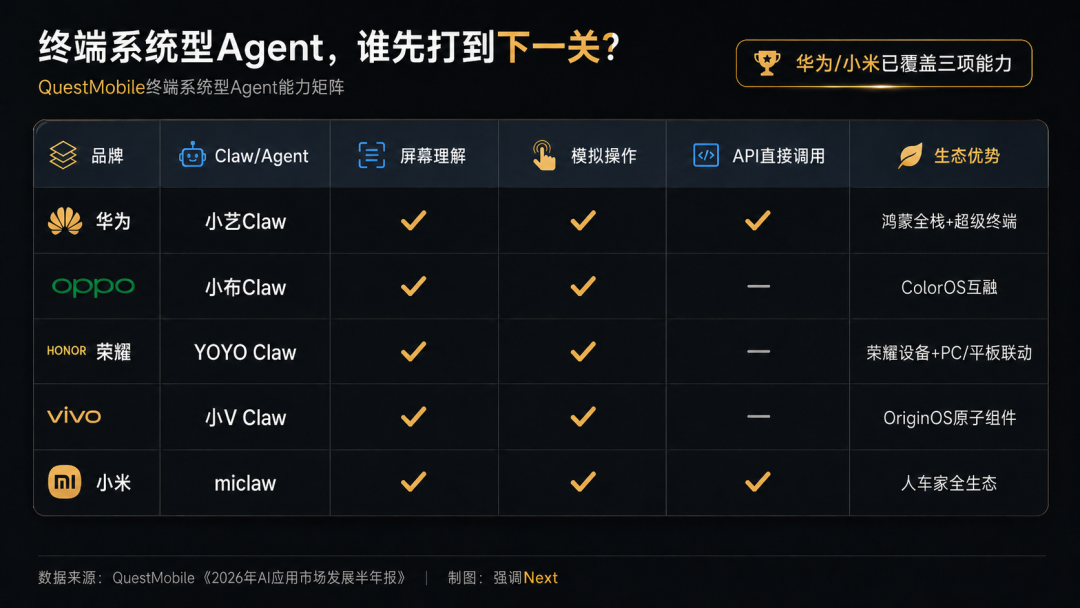
However, a reality check is needed amid the excitement. According to recent media tests of seven mobile agents—Doubao Mobile Assistant, Zhipu, Honor, Huawei, Xiaomi, OPPO, and vivo—across 70 tasks, the overall success rate was only 20%, with 39% of tasks interrupting after launch and 24% degrading to information Q&A.
The real issue is permissions. These agents typically have over 100 permissions, involving highly sensitive areas such as system control, screen control and injection, window and display management, and access to private data. Most agents rely on accessibility permissions to "read the screen," but issues like account security, platform risk control, and stability remain unresolved.
QuestMobile's report distinguishes these capabilities using MCP and Skill: MCP determines "whether a connection can be made," while Skill decides "whether a task can be completed." Domestic smartphone manufacturers have at least advanced the competition to the level of "getting things done for users."
Apple's new Siri AI is not lagging in product direction, also emphasizing screen perception, personal context, and cross-app execution. Its real challenges in China are whether the underlying model is strong enough and whether the connected services are sufficiently accessible.
QuestMobile's data shows that Qianwen lags significantly behind competitors like Doubao and DeepSeek in terms of user base and frequency, reflecting user preferences to some extent. More importantly, even if AI accurately identifies user intent, it cannot unilaterally decide which interfaces Taobao, WeChat, Douyin, Ctrip, and Meituan will open. Alibaba, Tencent, ByteDance, and Meituan are unlikely to easily surrender the assets they have accumulated over the past decade.
Of course, Apple's advantage lies in user quality and scale. Alibaba's stock price surged over 7% in after-hours trading on the U.S. stock market last night, to some extent reflecting the momentum Apple's brand brings to partners.
Apple also has sufficient incentive to concede some benefits in future collaborations. For Apple, the strategic significance of accessing these services lies in controlling the entry point.
In the past, developers competed for downloads and usage time through the App Store. In the future, app functions may be broken down into individual Skills directly callable by agents, allowing users to complete tasks like booking tickets, hailing rides, and shopping without even opening the apps. Apple needs to control this layer of task distribution and establish a new service entry point above the App Store; otherwise, it risks becoming a mere conduit.
04. But Don't Write Off Apple Just Yet
Siri's lag does not mean Apple has lost. IDC data shows that in the second quarter of 2026, smartphone shipments in the Chinese market totaled approximately 66.01 million units, down 4.3% year-over-year, marking a fifth consecutive quarter of decline.
However, amid this overall downturn, both Huawei and Apple achieved year-over-year shipment growth of around 20%. Huawei's market share rose from 18.1% to 22.6%, ranking first, while Apple's share increased to 18.1%, ranking second.
On the contrary, Xiaomi experienced a year-on-year decline of 21.7%, the worst among mainstream manufacturers.

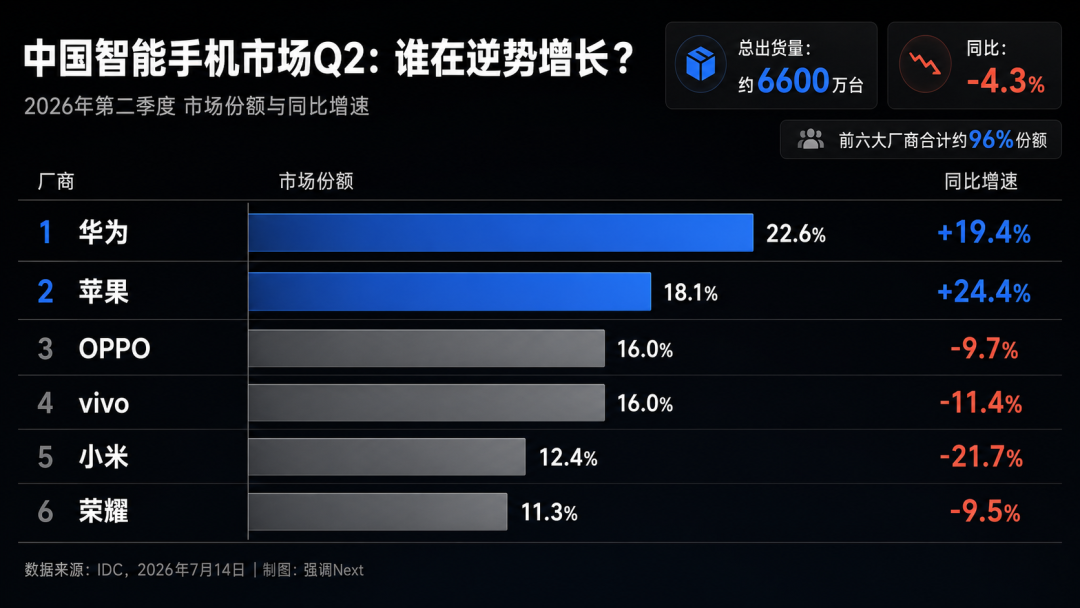
After the price hike of memory chips, Huawei and Apple did not follow suit by raising prices. Instead, they launched targeted promotions, becoming rare 'price-stable' brands. Apple's winning edge in China this time relies on 'not raising prices while others do,' which has nothing to do with whether Siri is smart or not.
However, this is precisely why Apple must urgently address its AI shortcomings. If the iPhone 18 series raises prices this fall, the market share dividend gained through 'price stability' will not last long.
In the past few years, incremental upgrades in screens, cameras, and chips have struggled to drive device upgrades alone. Apple Intelligence also shoulders a more practical task: to provide a new reason to buy the next-generation iPhone. If it can only rewrite text and generate images, it will be hard to stimulate device upgrades. Only when it can significantly reduce operational steps or even complete tasks for users will AI transition from a launch event highlight to a driver of hardware sales.
Looking further ahead, Apple is not just competing for device upgrades. If, in the future, users no longer open apps one by one but instead directly delegate their needs to intelligent agents, the most critical gateway for smartphones will shift from the home screen and App Store to understanding
This application submission is, in essence, granting Apple an entry pass into the market arena. Moving forward, the company must seamlessly integrate with local accounts, transaction processes, payment systems, and a variety of services, all while demonstrating that users are genuinely interested in staying engaged over the long term.
The same principle applies to all manufacturers who are actively promoting their 'intelligent agent smartphones.' Whether Nubia and StepFun are vying for the title of 'world's first' is relatively inconsequential; the real test lies in whether early adopters are merely dipping their toes in the water or are fully committed to the experience. A 'first' that fails to attract and keep users will ultimately serve as little more than a topic of discussion for investors.
- END -
-
![]()
The Dead End of GoPro: Unveiling the Decisive Factors in DJI and Insta360's Competition
-
![]()
The Dead End for GoPro: Unveiling the Key to Victory in DJI and Insta360's Competition
-
DeepSeek Targets A-share IPO Amid RMB 480 Billion Valuation Debate
-
![]()
WPS Meitu XiuXiu: The Threat to Its Market Position from AI Large Models
-
![]()
After Seres Reports Losses, What Is the Capital Market Really Worried About?
-
![]()
Honor, Stepfun, and Nubia Vie for 'Pioneering' Status: The Fierce Contest Among AI-Powered Smartphones
-
![]()
Glory, Stepfun, and Nubia Vie for the Pioneering Position: AI-Powered Smartphones Engage in Intense Competition
-
![]()
Apple AI Gains Approval but Faces Outdated Challenges