Enflame Technology Gains IPO Green Light: Achieves 81% CAGR in Revenue Over Three Years, With Tencent Contributing Over 80% of Its Income
 07/16 2026
 356
356
Source: Xiaocaimi
On July 9, the China Securities Regulatory Commission (CSRC) issued the "Approval for the Registration of the Initial Public Offering of Shares by Shanghai Enflame Technology Co., Ltd." (CSRC License [2026] No. 1667), officially granting Enflame Technology permission to register for its initial public offering and list on the STAR Market. This approval remains valid for 12 months from the date of registration.
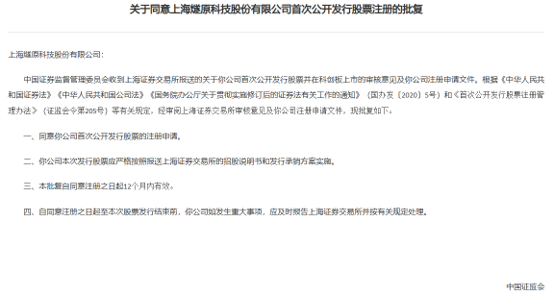
Enflame Technology's IPO journey has progressed swiftly. The company's application was accepted by the Shanghai Stock Exchange on January 22, 2026, entered the inquiry phase on February 11, passed the listing committee review on June 15, submitted its registration on June 18, and finally received registration approval on July 9. The entire process, from acceptance to registration effectiveness, took approximately 168 days. Enflame Technology intends to list on the STAR Market, with CITIC Securities serving as its sponsor.
Founded in March 2018 and headquartered in the Lingang New Area of the Shanghai Free Trade Zone, Enflame Technology positions itself as a leading chip design enterprise in the cloud AI chip sector. The company specializes in developing computing chips and solutions tailored for artificial intelligence training and inference scenarios. Over the past eight years, Enflame Technology has independently developed and iterated four generations of architectures and five cloud AI chips, establishing a comprehensive product system that includes AI chips, AI acceleration cards and modules, intelligent computing systems and clusters, as well as AI computing and programming software platforms.
At the product level, Enflame Technology boasts several representative offerings, including the first-generation cloud training chip "SuiSi 1.0," the second-generation training chip "SuiSi 2.0," and the inference chip "SuiSi 2.5." Additionally, the company offers the YunSui series AI acceleration cards (training cards T-series, inference cards i-series) based on these chips. In 2025, Enflame Technology unveiled the cloud AI chip "SuiSi 400," built on the fourth-generation GCU-CARA computing architecture, which supports multiple computing precisions, including FP8, and clusters of 10,000 cards or more. The company adopts a Domain-Specific Architecture (DSA) technical route, optimizing architectures specifically for AI computing scenarios. According to the prospectus, Enflame Technology sold 66,000 AI acceleration cards and modules in 2025, capturing approximately 1.7% of China's AI acceleration card market share.
From a financial standpoint, Enflame Technology has experienced rapid revenue growth in recent years, albeit without achieving profitability yet. From 2023 to 2025, the company's operating revenues were 301 million yuan, 722 million yuan, and 990 million yuan, respectively, boasting a three-year compound annual growth rate (CAGR) of 81.32%. During the same period, net profits attributable to the parent company were -1.665 billion yuan, -1.510 billion yuan, and -1.164 billion yuan, respectively, with cumulative losses exceeding 4.3 billion yuan over three years. Net profits after deducting non-recurring items were -1.567 billion yuan, -1.503 billion yuan, and -1.197 billion yuan, respectively. As of the end of 2025, the company's undistributed profits stood at -4.441 billion yuan.
The primary driver of these losses is substantial research and development (R&D) investment. From 2023 to 2025, the company's R&D expenses were 1.229 billion yuan, 1.312 billion yuan, and 1.135 billion yuan, respectively, with cumulative R&D investment reaching 3.676 billion yuan. R&D investment as a percentage of operating revenue reached 408.01%, 181.66%, and 114.63%, respectively. From a cash flow perspective, the net cash flow from operating activities was negative from 2023 to 2025, at -1.209 billion yuan, -1.798 billion yuan, and -965 million yuan, respectively.
In 2026, Enflame Technology's revenue scale expanded further. The company anticipates revenue of 1.06 billion to 1.15 billion yuan in the first half of 2026, more than tripling year-on-year. However, losses persist, with an estimated net profit attributable to the parent company of -577 million to -608 million yuan in the first half. The company expects to achieve consolidated profitability in 2026 or 2027.
Customer concentration stands out as a prominent feature of Enflame Technology's financial structure. From 2023 to 2025, sales to the top five customers accounted for 96.50%, 92.60%, and 96.89% of the company's operating revenue, respectively. Among them, sales to Tencent Technology (Shenzhen) surged from 33.34% in 2023 to 83.79% in 2025. Tencent is not only the company's largest customer but also its largest shareholder—before this issuance, Tencent and its affiliates held a combined 20.26% stake in Enflame Technology. During the listing committee review meeting, the stability and sustainability of the company's cooperation with major clients, as well as whether relevant risks were fully disclosed, were key areas of inquiry.
In terms of equity structure, the company's actual controllers, ZHAO LIDONG and Zhang Yalin, directly hold a combined 17.93% stake in the company and indirectly control 10.21% through two employee stock ownership platforms, totaling 28.14% control. This issuance plans to publicly offer no less than 43.0352 million and no more than 68.3499 million new shares, accounting for no less than 10% and no more than 15% of the total share capital after issuance. The planned funding amount is 6 billion yuan. The fundraising will primarily be directed toward three areas: R&D and industrialization projects based on fifth-generation AI chip series products (planned investment of 1.503 billion yuan), R&D and industrialization projects based on sixth-generation AI chip series products (planned investment of 1.197 billion yuan), and advanced AI hardware-software collaborative innovation projects (planned investment of 3.3 billion yuan).
From an industry perspective, the cloud AI chip sector, in which Enflame Technology operates, is experiencing rapid demand expansion alongside intense technological competition.
The global AI semiconductor market was valued at approximately $57.74 billion in 2025 and is projected to grow to $68.5 billion in 2026, boasting a compound annual growth rate (CAGR) of 18.6%. The global AI chipset market was about $28.08 billion in 2025 and is expected to reach $38.26 billion in 2026, with a CAGR as high as 36.2%. In the Chinese market, according to CITIC Securities' research report, the domestic AI chip market is anticipated to exceed 300 billion yuan in 2026.
In terms of shipments, according to IDC's "China Cloud AI Accelerator Market Report for 2025" released in April 2026, total deliveries of AI acceleration cards in the Chinese market reached 4 million units in 2025, with domestic manufacturers delivering 1.65 million units, capturing a 41% market share. NVIDIA shipped approximately 2.2 million units, accounting for about 55% of the market share. Enflame Technology sold 66,000 AI acceleration cards and modules in 2025, ranking among the top domestic AI chip manufacturers.
The primary drivers of demand growth stem from the training and inference of generative artificial intelligence and large models. According to TrendForce data, AI training computing power for the top five North American cloud service providers is expected to grow by 56% in 2026, while inference computing power will increase by 122%. The large model industry is transitioning from large-scale training to inference deployment, with global AI inference demand for AI acceleration cards expected to surpass training scenarios in 2026.
In terms of technological evolution, competition in cloud AI chips has expanded beyond mere computing power metrics to encompass multiple dimensions, including architectural design, software ecosystems, cluster capabilities, and energy efficiency ratios. Enflame Technology adopts a DSA architecture, attempting to bypass the competitive barriers of the general-purpose GPU ecosystem and achieve differentiated competition through specialized architectural design for AI computing scenarios. The company has established a full-stack product system ranging from chips to acceleration cards, from single cards to 10,000-card clusters, and from hardware to software platforms. In 2025, the gross margin for the company's AI acceleration cards and modules was 32.71%, lower than the average of about 55% for comparable products.
In terms of software ecosystems, competition in AI chips involves not just hardware performance but also software-hardware collaborative capabilities, including compilers, operator libraries, development tools, cluster scheduling, and model adaptation. Enflame Technology stated in its prospectus that multiple generations of its products have been commercially deployed at scale in internet AI scenarios, continuously providing AI computing power support for national-level internet applications.
In more cutting-edge technological directions, advanced packaging, high-bandwidth memory (HBM), inter-chip interconnectivity, and cluster scalability are becoming key variables in cloud AI chip competition. The domestic AI chip industry is transitioning from policy-driven to market-driven. In May 2026, the China Information Security Evaluation Center and the National Security Technology Evaluation Center included AI chips in the security and reliability certification system for the first time, with nine domestic AI chips receiving the highest Grade I certification. Goldman Sachs predicts that the market share of domestic AI acceleration chip shipments could exceed 50% in 2026.
Returning to Enflame Technology itself, the company faces both clear opportunities and challenges.
On the opportunity front, the sustained growth in China's demand for intelligent computing power represents the largest external driver. With the accelerated construction of domestic intelligent computing centers and the continuous release of AI demand from internet companies, the market space for cloud AI chips continues to expand. Cloud service providers and large enterprises advancing the localization of computing infrastructure provide import opportunities for chip design enterprises with independent R&D capabilities. Enflame Technology's technological accumulation in DSA architecture and its full-stack product system provide a basis for differentiated competition in specific application scenarios.
However, challenges are equally significant. Sustained losses are the most prominent financial reality for Enflame Technology. The company has accumulated losses exceeding 5 billion yuan since its inception. Although the magnitude of losses narrowed—from 1.665 billion yuan in 2023 to 1.164 billion yuan in 2025—the timing of profitability remains uncertain. The company also explicitly highlights in its prospectus the common risks faced by STAR Market companies, such as significant R&D investment, high operational risks, unstable performance, and high delisting risks.
Excessive customer concentration is another structural issue. In 2025, over 83% of revenue came from Tencent alone, with the top five customers contributing over 96% of total revenue. This highly concentrated customer structure acts as a growth amplifier during industry upturns but could directly impact the company's revenue if major clients' procurement strategies change. The listing committee raised inquiries about this during the review meeting.
Supply chain constraints are also a common challenge for cloud AI chip design enterprises. The capacity and availability of advanced processes, high-bandwidth memory, advanced packaging, and other links directly relate to chip R&D progress and mass production capabilities. Supply chain risks arising from international trade frictions are also risk factors explicitly mentioned in the company's prospectus.
Additionally, the overdue accounts receivable ratio reached 82.96% at the end of 2025, with the bad debt provision ratio rising to 24.76%. Some intelligent computing center project clients have long payment cycles, and concerns about asset quality have emerged.
From "registration approval" to the official listing and trading, Enflame Technology still needs to complete subsequent procedures such as issuance and underwriting. The landing of the registration approval signifies that this eight-year-old cloud AI chip enterprise is about to enter the public capital market. Against the backdrop of sustained expansion in AI computing power demand but intensifying industry competition, whether Enflame Technology can find a balance between product iteration, customer expansion, and profitability improvement will be a dimension of sustained market attention.
-
![]()
The Dead End of GoPro: Unveiling the Decisive Factors in DJI and Insta360's Competition
-
![]()
The Dead End for GoPro: Unveiling the Key to Victory in DJI and Insta360's Competition
-
DeepSeek Targets A-share IPO Amid RMB 480 Billion Valuation Debate
-
![]()
WPS Meitu XiuXiu: The Threat to Its Market Position from AI Large Models
-
![]()
After Seres Reports Losses, What Is the Capital Market Really Worried About?
-
![]()
Honor, Stepfun, and Nubia Vie for 'Pioneering' Status: The Fierce Contest Among AI-Powered Smartphones
-
![]()
Glory, Stepfun, and Nubia Vie for the Pioneering Position: AI-Powered Smartphones Engage in Intense Competition
-
![]()
Apple AI Gains Approval but Faces Outdated Challenges