WPS Meitu XiuXiu's Rice Bowl Is Being Taken Away By AI Large Models
 07/16 2026
 380
380
Layout | Xiaoxi
Never did I imagine that WPS, a national software, would one day find itself caught in a whirlpool of public opinion accusing it of 'betraying users'.
In late June, the topic of 'being betrayed by WPS' suddenly became a hot topic on social media. From accusations of 'secretly pulling users' local files for AI training data' to complaints about 'having to pay extra for AI membership and separate fees for functions even after subscribing to super membership', discussions intensified. Despite multiple official responses and clarifications from WPS, the controversy remained difficult to quell.
 ▲ Note: Image sourced from Weibo
The outbreak of the trust crisis seems to have left WPS scrambling, but when we shift our gaze to the source of the anxiety, we find that all crises may stem from AI. As the saying goes, 'It's often something unrelated that takes you down.'
As general-purpose large models like Doubao and Kimi begin to reshape productivity with their 'free-for-all' approach, traditional applications like WPS, which once thrived on feature accumulation and path dependency, are facing an unprecedented existential challenge.
| National Software Faces Existential Crisis |
For a long time, WPS has held a special position in the Chinese software market, serving both as office software and carrying a certain sentimentality.
From the 1980s to the present, WPS founder Qiu Bojun single-handedly wrote hundreds of thousands of lines of code, heroically resisting Microsoft Office's full-scale blockade alongside Lei Jun. This narrative of heroism, combined with the strategy of providing basic functions for free to individual users, has accumulated a vast market for WPS.
In the subconscious of many, WPS has always been perceived as a 'conscientious, people-friendly, and understanding' 'family member'.
However, when companies enter the capital market and face immense pressure for revenue growth and profit realization, 'sentimentality' becomes a heavy cloak. WPS's increasingly aggressive commercialization tactics have become the trigger for its reputation collapse.
In the past, users believed that purchasing 'VIP' would grant access to all functions. However, WPS has gradually evolved into offering multiple paid tiers, including 'Membership', 'Super Membership', 'Super Membership Pro', and later 'AI Membership'. The nested 'Russian doll' style of charging repeatedly confronts users with paywalls when attempting to use functions like PDF conversion and document watermark removal, forcing them to make multiple purchases.
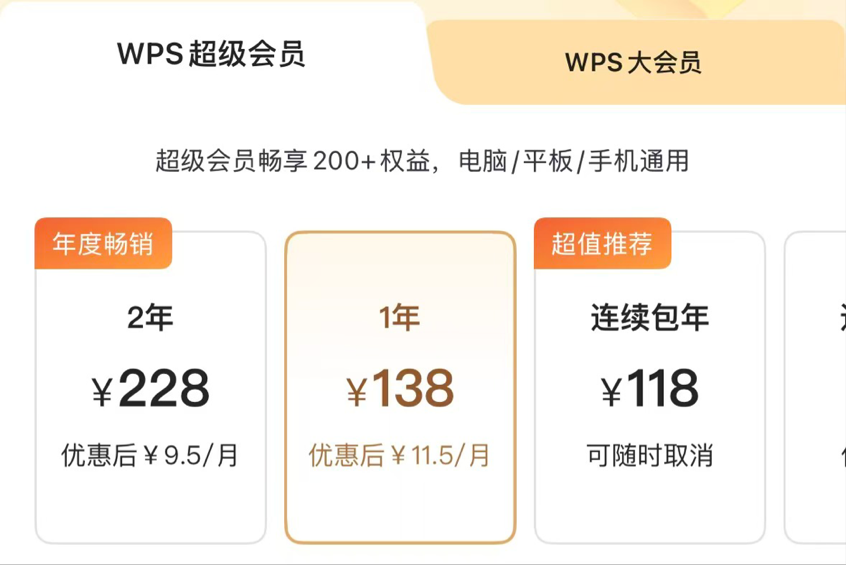 ▲ Note: Image sourced from WPS
To maximize the residual value of free users, advertisements have also begun to randomly refresh throughout documents, appearing in startup pop-ups, bottom-right floating windows, and even embedded within documents themselves. Many users joke that 'compared to office software, WPS's page now resembles a billboard.'
The once-smooth office experience has been fragmented by ubiquitous payment prompts and ad pop-ups, coupled with increasingly bloated memory usage. These favor -consuming commercialization tactics have left consumers feeling 'long-suffering from WPS.'
Without a better alternative, users might have continued to tolerate these experience flaws. However, the advent of generative AI has easily shattered this passive balance, impacting WPS's core user base with unprecedented intensity.
In the past, the core barrier of office software lay in formatting and format compatibility. Whether writing summaries, creating tables, or designing PPTs, users had to first open a local software, familiarize themselves with its complex menu bars, and slowly fill in a blank document. This was a typical 'tool-oriented' process, where the tool merely provided formatting capabilities and a carrier , with content having to be produced from scratch by the human brain.
However, generative AI models like ByteDance's Doubao and Yuezhi Anmian's Kimi have transformed this process into a 'result-oriented' one. Users simply need to input a plain language instruction into Doubao's chatbox, and AI can generate a beautifully formatted, logically clear final document in just a few seconds for free.
It's important to note that among WPS's hundreds of millions of active users, only a handful truly need to use macro codes, complex functions, or engage in professional template design. The core needs of the vast majority of users are simply to write weekly reports, apply templates, and perform simple data summaries.
For these users, the emergence of large models has largely undermined their need for professional formatting software like WPS. If they can obtain finished products for free and with zero barriers through natural language conversations, why endure WPS's bloated startup speed, annoying ad ecosystem, and even pay tens of yuan for a monthly subscription?
The dimensionality reduction strike brought by AI has instantly breached the defensive moat of such traditional applications.
| AI Reshuffles the Deck, Traditional Apps Fall One by One |
WPS is not the only anxious traditional application. If we zoom out to the entire mobile internet application ecosystem, we'll find a Fierce and magnificent 'great purge' underway. Traditional applications lacking deep industrial barriers, relying solely on 'single functions' or information asymmetry for profit, are all facing compressed living spaces.
In the early days of the internet, a large number of national-level applications exploded in popularity by addressing vertical pain points. Their functions were mostly specialized: users used Software A for photo editing, Software B for translation, and Software C for recording; their business models were also highly similar, typically acquiring users with free basic functions and then locking advanced features behind paywalls.
However, in the era of large models, versatility has become the product core. Excellent underlying large models inherently possess cross-modal understanding and generation capabilities. They can not only write articles, understand and edit pictures, but also master multiple languages and process ultra-long audio. This means that general-purpose large models are launching indiscriminate attacks on vertical applications from all directions, acting as 'super individuals.'
Meitu XiuXiu's defensive moat was built on lowering the barrier to using Photoshop and its vast filter library. For over a decade, it has nearly monopolized the minds of the masses for mobile photo editing, with users accustomed to manually adjusting contrast, skin smoothing, body shaping, or purchasing 'film filters' for a fee.
But today, with the proliferation of AI image generation tools like Midjourney, Stable Diffusion, and various domestic options, image processing has entered a generative era. Users no longer need to manually edit photos; they can simply toss a photo to AI with an instruction like 'expand it to 16:9 and fill in the surrounding environment' to achieve the desired effect.
 ▲ Note: Image sourced from AI
AI image expansion, partial redrawing, erasure, and one-click generation functions not only deliver stunning results but are often free or low-cost due to fierce competition among large model vendors for users. Even the 'filter library' painstakingly cultivated by tool software like Meitu XiuXiu over the years has become vulnerable in the face of AI's generative capabilities.
Similar embarrassments are unfolding in the traditional translation dictionary and audio transcription sectors. In the past, audio transcription apps often charged by duration, with an hour-long meeting transcription costing tens of yuan. Traditional translation software also required paid premium memberships for translating large paragraphs or professional literature accurately.
But now, with large models like Kimi supporting ultra-long contexts of 2 million words, users can simply drag and drop hour-long meeting recordings or entire English PDFs into the chatbox, and AI can quickly and accurately transcribe and translate them, even directly generating meeting minutes and summarizing key points.
Not to mention that traditional translation software can only perform word-for-word machine translation, often producing incoherent texts, while large models can understand context, mimic specific writing styles based on user instructions, and perform 'faithful, expressive, and elegant' customized rewrites by incorporating industry knowledge.
After Apple introduced smartphones represented by the iPhone, it relied on the perfect fusion of communication, computing, photography, and music playback functions to reduce MP3 players, compact digital cameras, portable cassette players, and calculators to relics of a bygone era overnight.
History repeats itself in striking similarity. In this 'everything can be AI' era, large models resemble the 'iPhones' of the new era, while traditional applications like WPS, Meitu, and translation software become the gradually fading 'MP3s.'
| Marching into AI, 'Betraying' Users is Easy, Self-Redemption is Hard |
Traditional applications haven't sat idly by in the face of this onslaught. Now, when you open a mobile app store, you'll find that nearly all veteran software are frantically adding 'AI' suffixes to their names. WPS introduced 'WPS AI', Meitu launched 'Meitu Design Studio', and dictionary and recording apps have also rolled out 'AI Assistants.'
Can this 'if you can't beat them, join them' self-rescue effort really reverse their declining fortunes?
It's important to understand that developing a foundational large model capable of competing with Doubao or Tongyi Qianwen requires top AI talent reserves, tens of thousands of top-tier GPU computing clusters, and hundreds of billions of yuan in funding—far beyond what a traditional tool software company can afford.
 ▲ Note: Image sourced from AI
Therefore, their so-called 'joining AI' is mostly 'shelling' or 'API calling,' meaning they incorporate 'AI patches' into their old products by accessing interfaces from giants like Alibaba, ByteDance, and Baidu or leading open-source large models.
However, the drawbacks of the shelling strategy are also evident. On one hand, the application's capability ceiling is forever constrained by the API provider. When ByteDance prioritizes supplying its most advanced model capabilities to its own Doubao, tools calling older API versions struggle to compete head-on with giants in terms of generation quality, logical reasoning, and response speed.
On the other hand, large models incur high inference costs. If traditional tool software offers free AI functions, the massive API calling fees will quickly crush their already fragile profit margins. If they charge for AI functions, with top products like Doubao and Kimi offering free or extremely low-cost subsidies, users have no reason to pay for 'shelled and fee-based' products.
They find themselves trapped between technological costs and user expectations. But even more despairing than technological backwardness is the reshaping of the 'interaction entrance.'
Before the AI boom, users first needed to locate the corresponding app entrance, click the icon, and enter its specific graphical user interface. Therefore, occupying users' desktops or home screens was the goal of all software. However, with the proliferation of generative AI, AI agents like Doubao and Kimi are becoming super brains and unified entrances frequently used by users, transforming the logic of human-computer interaction.
Users have grown accustomed to asking questions, searching for information, and generating copy within the same chatbox. Throughout this process, AI silently invokes various computing capabilities in the background, but to users, they never leave this chatting interface. When super large models can handle everything like a versatile secretary, users have no incentive to 'exit the current interface and search for specific tools among a pile of apps.'
These applications lose their qualification to be an 'entrance,' and their living space becomes infinitely compressed. Ultimately, they will either exit the market or become API suppliers with extremely thin profit margins at the bottom of the large model ecosystem.
Technology advances relentlessly; no one can forever rely on the laurels of 'sentimentality.' For traditional applications like WPS and Meitu that once brought convenience, 'betraying' users may only require modifying a few lines of charging code. However, achieving true self-redemption in the era of large models is far more complex than simply applying an 'AI patch.'
Image sourced from the internet. Rights reserved for the original author.
-
![]()
Is Tencent AI Heading in the Right Direction?
-
Latest Update! Jinding Optics’ GEM IPO Review Now “Under Inquiry”
-
![]()
VOYAH’s CBO Sets Ambitious Target: Secure Top 3 Spot in Luxury BEV Market Within Two Years, Launch 4 New Models to Cover All BEV Segments
-
![]()
Sehwa Technology Invests 740 Million Yuan, Eyeing the Lucrative Optical Film Market!
-
![]()
150 Million Users, $40 Million ARR: AIShige Technology Enters the Final Round of AI Video Competition
-
![]()
StepOn Star Forays into Smartphone Manufacturing: A Rationally Sound Yet High-Risk Endeavor
-
![]()
TCL Zhonghuan: Embracing a New Story Despite Anticipated Losses
-
![]()
Forty Years On: From Volkswagen’s State-Backed Entry into China to BYD’s Hiring of a Former European Foreign Minister