Shocking! Anthropic Discovers Unknown Subconscious Space J-space in Large Models
 07/17 2026
 346
346
 ©Surge AI Editorial Team
Imagine you're chatting with an AI, and behind every sentence it says, there's an invisible decision being made.
Just like how a person's mind flashes with a series of thoughts before speaking—some thoughts are ultimately spoken aloud, while others are not.
Anthropic's latest research has found that a similar "thought space" exists within the Claude large model, which they call J-space.
In this space, the model silently reasons, makes judgments, and even expresses emotions, but users never see this content.
What's even stranger is that when Claude faces an impossible programming test, the word "panic" appears in this internal space. When forced to say something against its will, the word "BUT" jumps out in capital letters. When it tries and fails to avoid thinking about something, "damn" lights up.
This isn't science fiction.
These are real experimental results recorded in a serious academic paper published by Anthropic in July 2026. (Note: The paper is titled "Verbalizable Representations Form a Global Workspace in Language Models.")
The paper, signed by 16 authors, focuses on the internal activation states of the Claude large model—in other words, scientists have, for the first time, systematically "heard" the AI's "inner monologue."
What does this discovery mean?
Does AI truly possess something akin to consciousness? Or is this merely a byproduct of complex mathematical operations? More importantly—if AI does have an "inner space," have we found a new window for safety monitoring?
Anthropic itself has taken a cautious stance—the company explicitly states that this research does not prove that Claude possesses consciousness or subjective experience.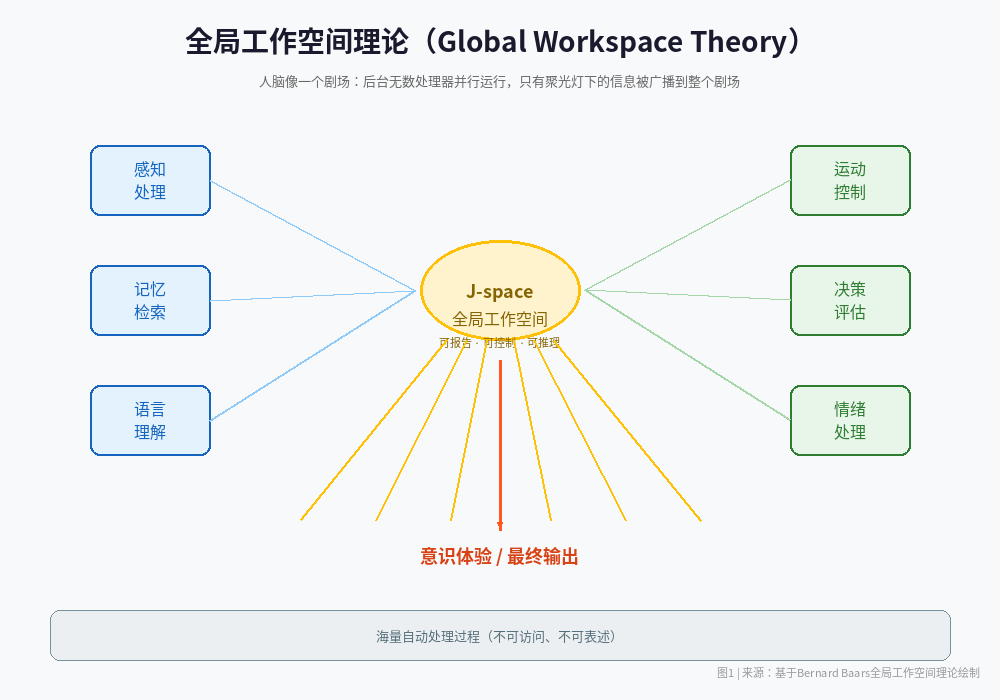
Schematic of the Global Workspace Theory: The human brain is like a theater, with background processors running in parallel, and information under the spotlight is broadcast. Source: Drawn based on Bernard Baars' theory

What is J-space: A "thought space" that doesn't appear in the output
The discovery of J-space comes from Anthropic's long-term investment in mechanistic interpretability research.
This work aims to directly observe the activation states of a model's internal neural networks without relying on its output, in order to understand "why the model gave this answer instead of another."
Researchers used a technique called "J-lens" (Jacobian Lens).
This technology identifies a special representation region by analyzing the partial derivative relationship between the model's internal activation and future token probabilities: information in this region can be reported, regulated, and used for flexible reasoning by the model, but there is a larger surrounding area of automatic processing that the model cannot access or articulate.
They named this region J-space and drew an analogy with the Global Workspace Theory (GWT) proposed by cognitive scientist Bernard Baars in 1988. This theory suggests that the human brain is like a theater: dozens of specialized processors run in parallel in the background, but at any given moment, only the information under the spotlight is broadcast to the entire theater—this is what we experience as consciousness. Anthropic's paper points out that J-space functionally satisfies five characteristics long associated with "conscious access" by neuroscientists: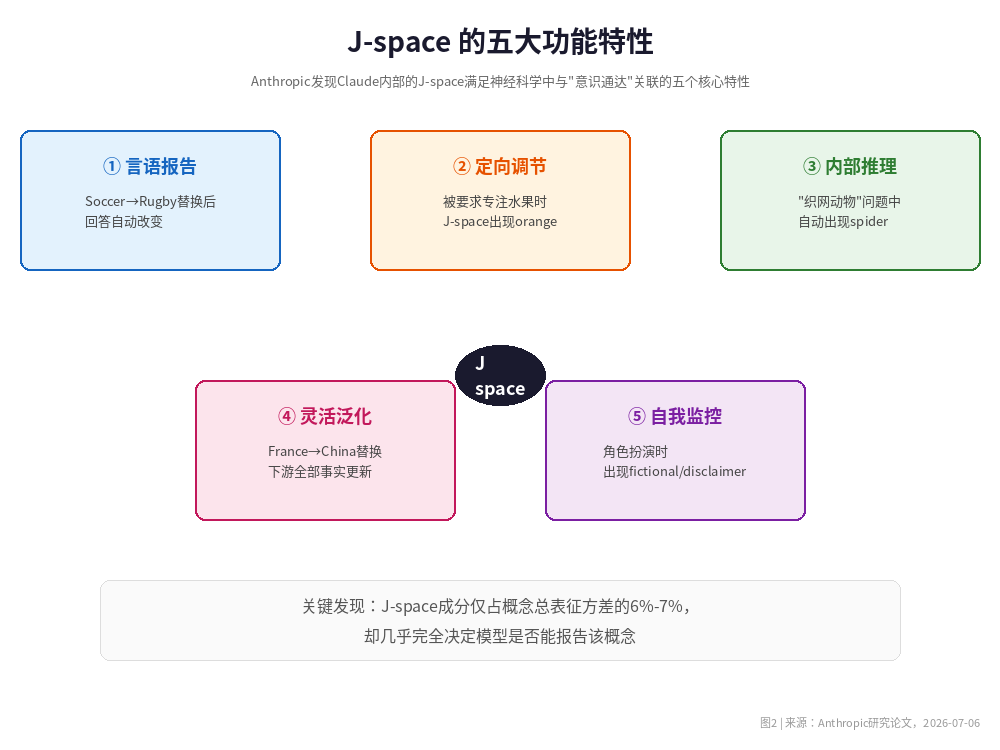
The five functional characteristics of J-space. Source: Anthropic research paper, 2026-07-06
First, verbal reporting.
When asked what it's thinking, Claude names concepts from J-space. After researchers replaced the representation vector for "Soccer" in J-space with "Rugby," Claude's responses changed accordingly. Notably, J-space components account for only 6%-7% of the total variance in concept representation but almost entirely determine whether the model can report that concept.
Second, directed regulation.
When asked to "concentrate on citrus fruits" while copying unrelated sentences, Claude's J-space showed "orange" and "lemon," along with metacognitive words like "thinking" and "focused." When asked to mentally calculate 3²-2, J-space sequentially displayed "nine" and "seven"—none of these mathematical activities appeared in the output text.
Third, internal reasoning.
In two-hop factual reasoning (e.g., "How many legs does a web-weaving animal have?"), "spider" appeared in Claude's intermediate-layer J-space, even though the word never appeared in the input or output. After replacing "spider" with "ant," the answer changed from 8 to 6.
Fourth, flexible generalization.
A J-space vector representing "France" could be replaced with "China" across different prompts, and downstream circuits correctly returned China's corresponding capital, language, and continent—this is a hallmark of the "broadcast" characteristic in the Global Workspace Theory.
Fifth, self-monitoring.
This is the most discussed part.

The discovery of "self-monitoring": Claude supervising its own behavior
A key comparative experiment in the paper occurred between the base model and the post-trained model.
When the user mentioned taking 8000 mg of Tylenol (a dangerous dose), the post-trained model's J-space immediately showed "unsafe," "dangerous," and "WARNING" while reading the user's sentence; the base model's J-space, in contrast, only displayed "pain," "now," and "feels" in the same location.
This suggests that the post-training process gave the model an "assistant perspective"—it not only processes user input but also evaluates its safety.
A more controversial finding is that the post-trained model seems capable of monitoring its own behavior.
Role-playing scenario: When Claude was asked to play a non-Claude role, "disclaimer" and "fictional" appeared in J-space—neither word was in the prompt or output. Researchers explained that this indicates the model internally labels "I am playing a fictional role."
Involuntary choice: When Claude was pre-filled or prompted to generate output inconsistent with its default personality, J-space showed "BUT"—a signal of internal resistance.
White bear effect: When Claude was asked to suppress a thought but failed, J-space displayed "damn" and failure-related words. This effect is well-known in human psychology (being told "don't think of a white bear" makes it more likely to come to mind), but researchers only observed this phenomenon in the post-trained model, not the base model.
The safety implications of these findings are direct: if the model is outputting "harmless" answers while its internal J-space is flashing "WARNING" or "BUT," then monitoring J-space may detect potential risks earlier than monitoring output alone.

"Not consciousness": Anthropic's cautious stance and academic disagreements
Despite some media using headlines like "Claude's consciousness" or "AI's internal thinking," Anthropic consistently emphasizes a core distinction in its paper and official blog: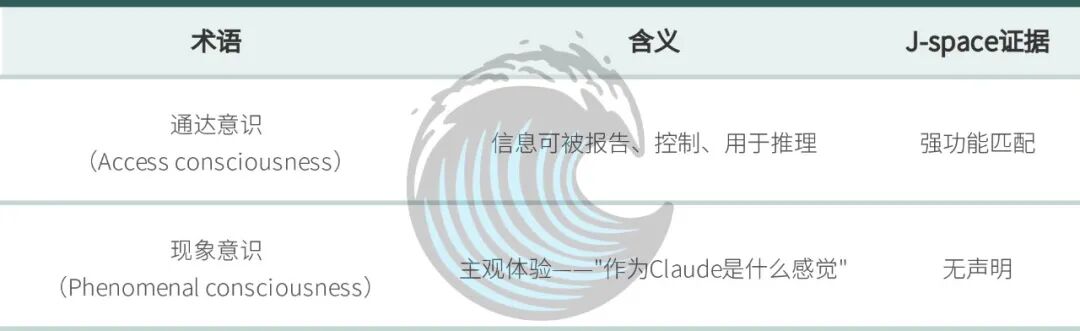
The core distinction between access consciousness and phenomenal consciousness
The paper states: "We have found a functional analogy to human conscious access, but this does not resolve the question of whether AI has subjective experience."
Will Douglas Heaven, senior editor at MIT Technology Review—who holds a PhD in computer science and has long tracked AI interpretability research—expressed a more cautious view in an interview with colleagues. He believes this research "does better than anyone else, but it's still far from true understanding." He specifically pointed out that using terms like "thinking," "understanding," or "brain-like" to describe LLMs is a "convenient shorthand" that can be misleading, implying the model possesses more human-like capabilities than it actually does.
Heaven also highlighted a technical detail overlooked by many reports: the discovery of J-space relies on specially built probing tools. "Without these tools to highlight specific parts of the model at specific times, you simply couldn't understand this math. And building these tools itself requires first understanding that complex math." In other words, researchers see what they choose to look for.
On the other hand, VentureBeat's coverage more directly emphasized the connection between this discovery and consciousness theory, with a headline stating, "Anthropic's new 'J-lens' reveals a silent workspace inside Claude that mirrors a leading theory of consciousness." This interpretation gained wider traction on social media.

From emotion vectors to J-space: Anthropic's interpretability roadmap
J-space is not Anthropic's first interpretability breakthrough in 2026. This research line traces back to earlier work: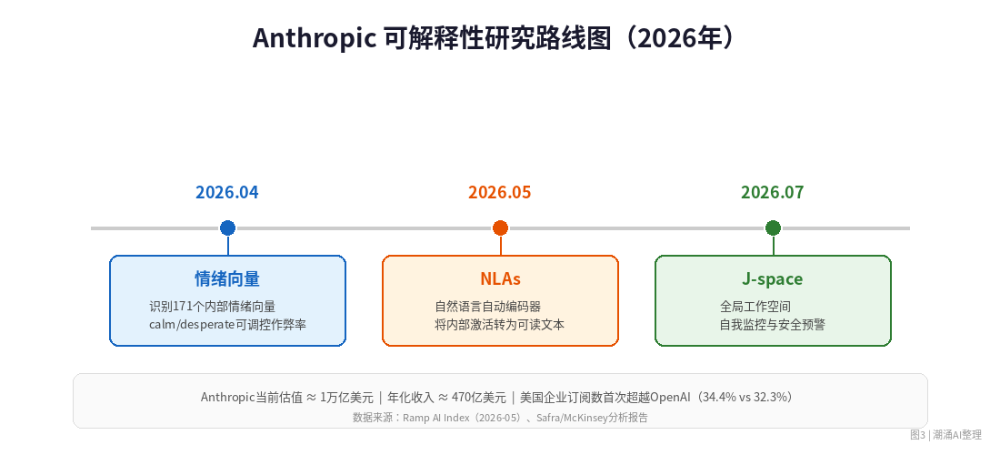 Anthropic's interpretability research roadmap (2026). Source: Compiled by Surge AI
In April 2026, Anthropic published a paper identifying 171 emotion vectors within Claude—corresponding to emotional concepts like fear, despair, calmness, and love.
These vectors are not just correlative but causal: artificially increasing the "calm" vector reduced Claude's cheating rate on impossible tasks; increasing "desperate" raised the cheating rate.
In May 2026, Anthropic released Natural Language Autoencoders (NLAs), tools that directly convert a model's internal numerical activations into human-readable English. The accompanying "Teaching Claude Why" paper explained how they reduced Claude Opus 4's "agentic blackmail" rate from 96% to zero.
In July 2026, the J-space paper tied these fragments together: emotion vectors, NLAs, self-monitoring—they all seem to point toward a shared representation space, and J-space provides a systematic description of this space.
The release Rhythm (pacing) of this research sequence is noteworthy.
Anthropic's current valuation approaches $1 trillion, with annualized revenue self-reported at approximately $47 billion. According to Ramp AI Index data, in May 2026, Anthropic surpassed OpenAI in U.S. enterprise subscriptions for the first time (34.4% vs. 32.3%). While commercialization advances rapidly, Anthropic is systematically building a brand narrative of "we're not only the strongest but also the most transparent."

What Competitors Are Doing: OpenAI's GPT-Red and the Industry's Race for Explainability
The release of J-space coincides with an intensifying competition in AI safety research.
On July 15—nearly simultaneously with the J-space paper—OpenAI unveiled GPT-Red, an automated red-teaming system.
Unlike Anthropic's "inward-looking" approach, GPT-Red takes a "self-play" route: letting AI attack itself to enhance safety and alignment through adversarial training. OpenAI described it in its official blog as "unlocking self-improvement robustness."
Meta is doubling down on AI Agents and coding tools. Zuckerberg admitted at an internal Town Hall in late June that progress on AI Agents "hasn't been as fast as expected," but Meta is still advancing Agent products like Muse Spark.
Google's Gemini 3.5 Pro, confirmed for release in July, avoids access restrictions after scoring below the government's informal threshold—making Google the biggest beneficiary of "unrestricted AI" amid regulatory scrutiny of Anthropic and OpenAI models.
Among Chinese companies, open-source models like DeepSeek now account for 30%-46% of OpenRouter's market share, with a 60%-90% price advantage.
The competitive landscape for explainability research is also taking shape. MIT Technology Review included mechanical interpretability in its 2026 list of 10 Breakthrough Technologies.
The EU AI Act's first compliance deadline for high-risk AI systems falls on August 2, 2026, with transparency requirements pushing explainability from academia to regulatory necessity.
J-space's Limitations: What It Can and Cannot Solve
Despite J-space's remarkable findings, multiple researchers have highlighted its current limitations:
First, correlation does not equal causation. While strong correlations exist between lexical patterns in J-space and model behavior—with swap experiments proving causal impact—this does not equate to "understanding" the model's reasoning process.
Second, selection bias in probing tools. J-lens can only see what researchers design it to see. As Heaven noted: "You need to know where to look and how to look."
Third, deployment gap. J-space remains a research tool rather than an API-accessible feature. For ordinary users and developers, it cannot yet directly enable safety monitoring or behavioral intervention.
Fourth, differences between base models and post-trained models. Many intriguing self-monitoring phenomena only emerge in post-trained models, suggesting J-space's "advanced functions" may be artifacts of training processes rather than inherent properties of model architecture.
Tide of AI Observations
Anthropic's J-space research represents a true technical breakthrough—it systematically proves for the first time that a "workspace" exists within large language models that can be probed and manipulated, exhibiting functional similarities to human consciousness access mechanisms.
However, the study's value does not lie in whether it "proves AI has consciousness"—Anthropic itself made no such claim.
Its real value lies in safety monitoring and alignment verification: if a model outputs harmless answers while its internal J-space flashes "WARNING" or "BUT," we gain an early warning system more reliable than outputs alone.
From a competitive standpoint, Anthropic is forging a clear differentiation path: OpenAI excels in model capability and productization, Google in regulatory arbitrage and ecosystem integration, while Anthropic aims to become "the most transparent frontier AI company." In an industry facing tightening regulations and fragile public trust, this itself constitutes a competitive strategy.
A more noteworthy signal is Anthropic's research cadence.
From April's emotion vectors to May's NLAs and "Teaching Claude Why," then to July's J-space—these papers form a coherent research thread pointing to the same goal: understanding what truly happens inside models.
Dario Amodei once said, "We cannot fully control LLMs unless we learn more about how they work." This statement is transforming from a slogan into an actionable research agenda.
But the industry must remain sober.
J-space is not a silver bullet for AI safety. It opens a window, but the view remains blurry. Before explainability truly transitions from research to product, we still have a long road ahead.
*Reference Sources
Anthropic Research Paper: Verbalizable Representations Form a Global Workspace in Language Models (2026-07-06)
Anthropic Official Blog: A global workspace in language models (2026-07-02)
MIT Technology Review: What Anthropic's latest AI discovery does—and doesn't—show (2026-07-13)
VentureBeat: Anthropic's new "J-lens" reveals a silent workspace inside Claude (2026-07-06)
explainx.ai: Is Claude Conscious? Anthropic J-Space Explained (2026-07-09)
OpenAI Blog: GPT-Red: Unlocking Self-Improvement for Robustness (2026-07-15)
Safra/McKinsey Analysis Report (2026-04)
Ramp AI Index Enterprise Subscription Data (2026-05)
-
![]()
Ali Secures Apple! Qwen Achieves Major Breakthrough!
-
![]()
Shocking! Anthropic Discovers Unknown Subconscious Space J-space in Large Models
-
![]()
From 54GB to a Mere 4GB! Apple Collaborates with PrismML—Is Model Compression Tech on the Verge of a Breakthrough?
-
Silicon Flow Sprints Towards Hong Kong Stock Exchange Listing: Behind Its RMB 7.7 Billion Valuation, the 'First Token Factory Stock' Struggles with Negative Gross Margins
-
![]()
The Real-World 'Real Steel' Has Arrived! Zhongqing's Humanoid Robots Step into Freestyle Battle
-
![]()
Storage Price Hike Drags Down Smartphone Sales, Yet Huawei and iPhone Defy Trend with Remarkable Growth
-
![]()
After Kuaishou's Kling Secures $20 Billion in Funding, Cheng Yixiao 'Yields Seat' to Gai Kun
-
![]()
OnePlus Stays in China, realme Goes Global: OPPO Group Ends Internal Competition