Storage Price Hike Drags Down Smartphone Sales, Yet Huawei and iPhone Defy Trend with Remarkable Growth
 07/17 2026
 394
394
Behind the No-Price-Hike Strategy: Robust Supply Chain Management
The dramatic surge in storage costs has cast a pall over the smartphone industry. Recent data from market research firms IDC and Omdia on Q2 domestic smartphone shipments for this year reveal an expected decline in overall smartphone sales, with most leading brands witnessing substantial drops in shipments.
However, Apple stands out as an exception, experiencing a surge in sales against the trend and further expanding its market share, joining Huawei as the only two brands to achieve sales growth.
How did Apple accomplish this feat? Leitech (ID: leitech) posits that a crucial factor is the iPhone's price stability and even de facto price reductions. Yet, as a tech behemoth fixated on high-profit margins, Apple is not truly acting as a 'benevolent player' amidst the price hikes. Lately, most of Apple's hardware products and services have seen price increases, with only the iPhone's price remaining constant. It appears that Cook is playing a long-term game.
Let's first delve into the comprehensive sales data released by IDC and Omdia. The top 5 brands remain familiar names: Huawei, Apple, OPPO, vivo, and Xiaomi. Among these five, only Huawei and Apple achieved sales growth against the trend. According to Omdia's data, Huawei's shipments reached 15.2 million units in Q2, capturing a 23% market share, up 25% year-on-year. Apple's shipments hit 12.4 million units, with a 19% market share, up 24% year-on-year.
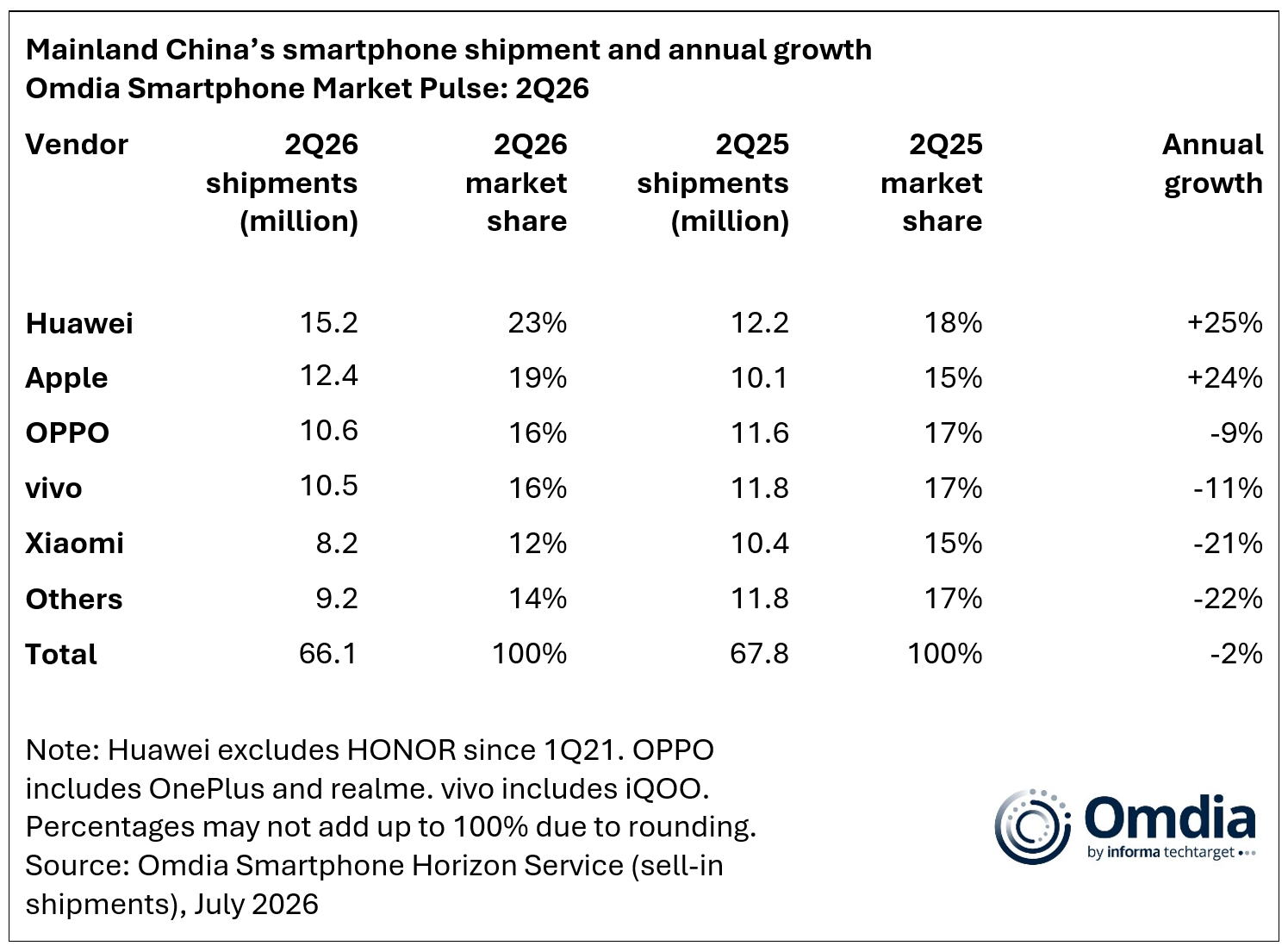
(Image Source: Omdia)
The sales growth of Huawei and Apple underscores their triumph in the premium market. Since late last year, the prices of DRAM and NAND storage components in the global supply chain have soared, exerting immense pressure on the mid-range and entry-level smartphone markets. Starting in March this year, Android brands were compelled to raise product prices or maintain profits through covert configuration downgrades. This directly dampened consumers' willingness to upgrade, rendering this year's 618 shopping festival even more lackluster than before.
In contrast, Huawei and Apple, focusing on the premium market, were less impacted. Huawei's robust return to the top of the domestic smartphone market in Q2 was largely attributed to the full-scale production ramp-up of the Mate 80 series and the explosive success of the Pura 90 series. Huawei's core strategy is clear: maintain price stability amidst industry-wide high costs, leveraging brand strength and the HarmonyOS ecosystem to withstand the price surge.
Apple, ranked second, adopts a slightly different approach but essentially uses price stability to solidify its position in the premium market. With the underperformance of the iPhone Air, Apple's main shipment drivers are the three models in the iPhone 17 series. Not only did they resist the price hike trend, but they also offered discounts during promotions like 618. Coupled with significant upgrades over the previous generation, the iPhone 17 series remained highly competitive in Q2.
Moreover, with persistent rumors of across-the-board smartphone price hikes in the second half of the year, many consumers who were previously hesitant chose to make purchases earlier, directly propelling Apple's Q2 shipments to an all-time high.
There are no miracles in the business world. The iPhone's price stability does not imply that Apple bears all the escalating supply chain costs. Cook's calculations are precise: stabilize the iPhone ecosystem as the foundation, then recoup profits elsewhere. The June price hikes were not the end; Apple's next round of price increases came swiftly.
Firstly, AppleCare+ quietly became more expensive. On July 15, Apple officially raised AppleCare+ prices for Macs and iPads. In the Chinese mainland market, the original price of AC+ for the entry-level iPad and iPad mini 7 was 549 yuan, now increased to 649 yuan, a nearly 20% rise. Other iPad models saw varying AC+ price increases, all by 100 yuan.
For Macs, whether desktops or laptops, Air or Pro, AC+ prices increased by 150 yuan. Except for the already expensive Mac Pro, all Apple computers now have more expensive official accident protection plans. Currently, the cheapest Mac mini M4 costs 799 yuan for a three-year AC+ plan.
Prior to this, Apple had systematically raised hardware prices for iPads, Macs, Vision Pro headsets, HomePod smart speakers, and even TV set-top boxes. Apple's strategy is clear: high-priced non-core products boost profit margins, while the core iPhone drives user acquisition and retention.
Secondly, Apple's back-to-school promotion this year saw a significant reduction in benefits, effectively a backdoor price increase.
Apple's back-to-school promotions have long been renowned for offering free AirPods with computer or tablet purchases, regarded by countless students as the best deal of the year. However, the promotion launched on July 16 this year was far less generous. Notably, Apple announced most hardware price hikes in late June, making it hard to believe there was no consideration to 'block' the back-to-school promotion.
This year's back-to-school promotion changed to an '849 yuan promotional credit,' eliminating the free earbuds. If users want freebies, they can only choose to redeem a set of AirTags (four-pack) for 0 yuan. For AirPods 4, users must pay at least a 150 yuan difference; for AirPods Pro 3, the difference is a hefty 1050 yuan.

(Image Source: Apple)
Meanwhile, popular entry-level products like the MacBook Neo and iPad mini 7 were excluded from the promotion. Additionally, due to Apple's official rules, government subsidies cannot be combined with this back-to-school educational discount. This combination of moves significantly reduced the promotion's appeal.
Apple's strategy here is truly shrewd. The iPhone's market share ensures a vast number of high-value users are locked into the iOS ecosystem. Once users are accustomed to the synergy of Apple's product ecosystem, they become less sensitive to prices for iPads, Macs, AC+, and iCloud. Apple is using accessory and service price hikes to offset profit losses from the iPhone's price stability.
After stabilizing its position with new pricing strategies, Apple achieved its most significant victory in the Chinese market this year on July 15—AI compliance approval. The latest batch of seven mobile-side generative AI service filings released by the Cyberspace Administration shows that the 'Apple Intelligence' large model, developed by Apple Technology (Shanghai) Co., Ltd., has officially passed approval. This means that after two years of localization negotiations and technical restructuring, the China-version iPhone's generative AI services have finally obtained legal deployment qualifications in the Chinese market.
Previously, constrained by data compliance and computing power layout, there were widespread concerns that the China-version iPhone would see AI capabilities crippled, becoming a half-baked product. After all, in Q2 this year, domestic AI models like Huawei's Xiaoyi, Xiaomi's Xiao Ai, OPPO's Xiao Bu, and vivo's Blue Heart had already deeply integrated into system layers, while the China-version iPhone's Siri was still mocked as 'artificially stupid.'
But now, Apple's AI localization strategy has finally materialized. It has partnered with Alibaba and Baidu to bridge the iPhone's AI gap. In this collaboration, Alibaba's Tongyi Qianwen large model serves as the core AI capability integrated into 'Apple Intelligence,' handling heavy AIGC tasks on China-version iPhones, such as long-text generation, complex context understanding, email summarization, and image generation. Meanwhile, Baidu, leveraging its absolute strength in local search, enhances search functions and improves the China-version Siri, ensuring it can accurately understand localized Chinese life service requests and complex contexts.
This localized collaboration model, leveraging each partner's strengths, allows Apple to catch up quickly. With the filing complete, the iPhone 18 Pro series, set to release this fall, can finally address the AI gap in time.
This naturally leads to a key question: Will the iPhone 18 series, equipped with full-fledged Apple Intelligence, see a price hike?
From a supply chain perspective, the pressure to raise prices is substantial. The constant operation of on-device AI large models demands higher memory from smartphones. To run local large models smoothly, the iPhone 18 series must be equipped with 8GB or even 12GB of memory. With global memory chip prices still high, this material cost surge is real.
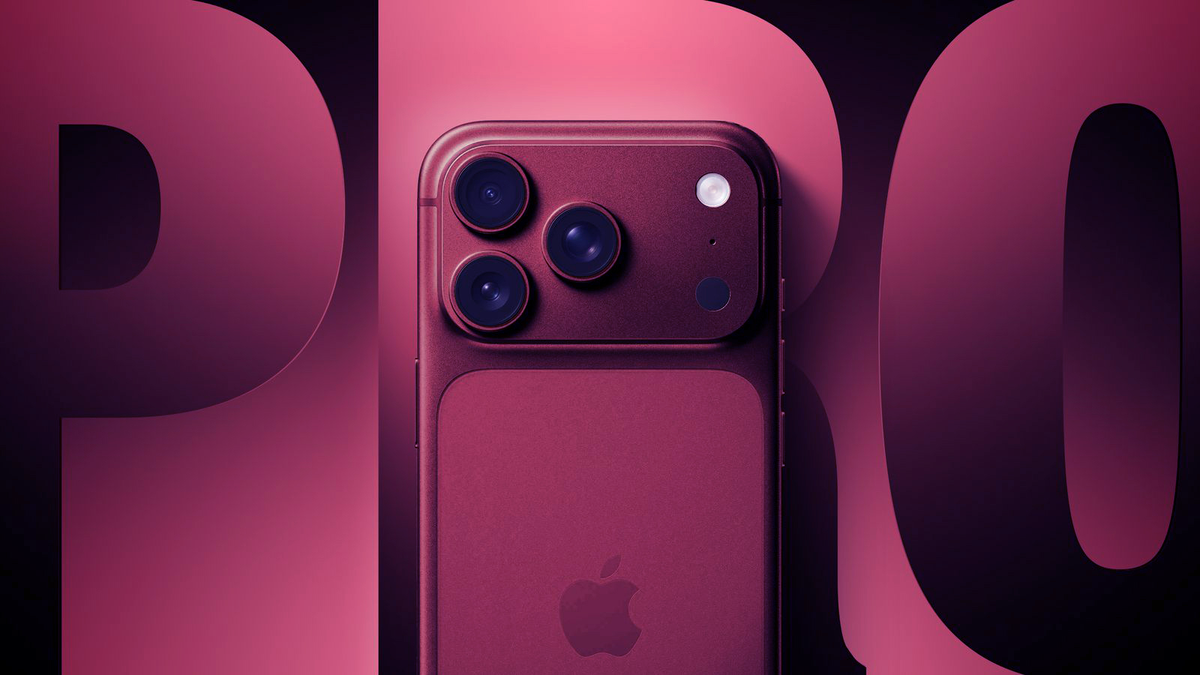
(Image Source: X)
However, Leitech (ID: leitech) believes Apple will likely adopt a more nuanced pricing strategy. Firstly, the iPhone 18 standard model, delayed until early next year, will probably maintain its starting price of 5999 yuan. Of course, this comes at the cost of Apple cutting corners elsewhere. According to previous leaks, the iPhone 18's screen will downgrade, using inferior luminescent materials, while its memory will use six 1.5GB chips to piece together 9GB.
As for the iPhone 18 Pro series, Apple's absolute shipment driver this year, it cannot afford to fail. Therefore, we believe it will likely not directly raise prices but maintain high profits through more subtle means. For example, reviving the 128GB storage version to maintain a no-price-hike starting price, or reserving advanced AI features exclusively for the Pro series, leveraging 'AI premium' to encourage high-end users to spend more.
Overall, Apple's pricing strategy in 2026 has been full of twists and turns. For most of Q1 and Q2, Apple resisted storage price hikes, making its hardware products more competitive against rivals. The iPhone achieved strong sales in the first half of the year, largely outperforming most competitors.
However, Apple eventually succumbed to pressure, significantly raising prices for products and services outside the iPhone, revealing its profit-maximizing nature. With Alibaba and Baidu's AI capabilities now integrated into China-version iPhones, Apple has made its final preparations for the high-end market battle in the second half of the year. Apple's strong supply chain control and ecosystem moat continue to aid this giant's commercial harvest.
Nevertheless, with domestic brands poised for a full-scale counterattack in the second half and the arrival of AI agent smartphones, the smartphone industry's battle over pricing and AI dominance has only just begun. Whether Apple can once again break through remains to be seen.
The World Artificial Intelligence Conference 2026 (WAIC 2026), themed 'Intelligent Partners · Co-creating the Future,' is about to open.
The AI narrative has shifted from model parameter stacking to agent productivity deployment. Heterogeneous collaboration and photonic computing continue to push computational limits. Embodied AI accelerates applications, with robots entering homes and factories, making physical AI a reality.
Leitech's WAIC exploration team has arrived in Shanghai to witness the annual peak moment of AI industrialization deployment!
Apple, iPhone, iPhone 18, AI, Apple Intelligence
Source: Leitech
Images in this article are from the 123RF licensed image library. Source: Leitech
-
![]()
Ali Secures Apple! Qwen Achieves Major Breakthrough!
-
![]()
Shocking! Anthropic Discovers Unknown Subconscious Space J-space in Large Models
-
![]()
From 54GB to a Mere 4GB! Apple Collaborates with PrismML—Is Model Compression Tech on the Verge of a Breakthrough?
-
Silicon Flow Sprints Towards Hong Kong Stock Exchange Listing: Behind Its RMB 7.7 Billion Valuation, the 'First Token Factory Stock' Struggles with Negative Gross Margins
-
![]()
The Real-World 'Real Steel' Has Arrived! Zhongqing's Humanoid Robots Step into Freestyle Battle
-
![]()
Storage Price Hike Drags Down Smartphone Sales, Yet Huawei and iPhone Defy Trend with Remarkable Growth
-
![]()
After Kuaishou's Kling Secures $20 Billion in Funding, Cheng Yixiao 'Yields Seat' to Gai Kun
-
![]()
OnePlus Stays in China, realme Goes Global: OPPO Group Ends Internal Competition