When AI Sets Its Sights on the Sun's Free Energy in Space | WAIC Observations ①
 07/20 2026
 494
494
Huasheng Says
Some might ask: Is the U.S. being forced into space due to a lack of land and approvals? With China's cheap electricity prices and surplus capacity in the 'East Data, West Computing' initiative, and given that it's not profitable in the short term, is this necessary?
Huasheng's stance is clear: Yes, it is necessary.
In the long run, demand for computing power is growing exponentially. Constraints on land, energy, and transmission on the ground are rigid. If we wait until resources are insufficient before making arrangements, the prime orbital slots and radio frequencies in low-Earth orbit will already be snapped up.
Computing power is the electricity of the new era, and space computing power is the ultra-high voltage of the next generation. Infrastructure always precedes demand; we must lay the roads before we can drive the cars. Waiting until the last minute will be too late.
Shanghai Aims to Build a Data Center in Space with a Network of 1,000 Satellites.
On the second day of WAIC on July 18th, while the entire venue was chasing humanoid robots—drumming, dancing, folding clothes, with dazzling lights and sounds—this overlooked announcement deserves more attention.
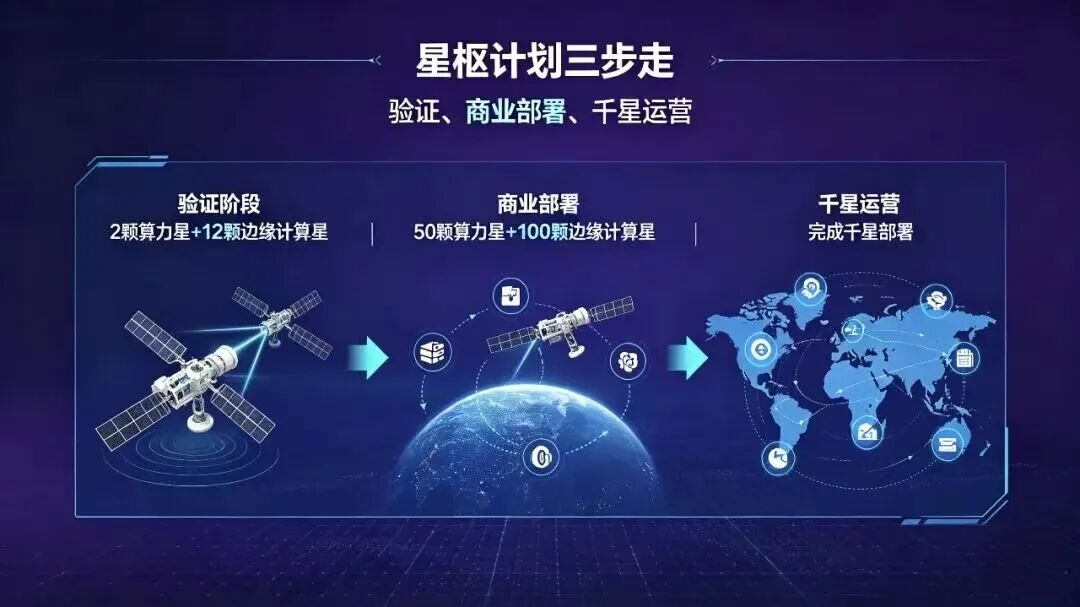
Shanghai officially launched the 'Xingshu Plan,' a flagship space computing power project with a long-term goal of networking a thousand satellites to create a globally covered computing network in low-Earth orbit.
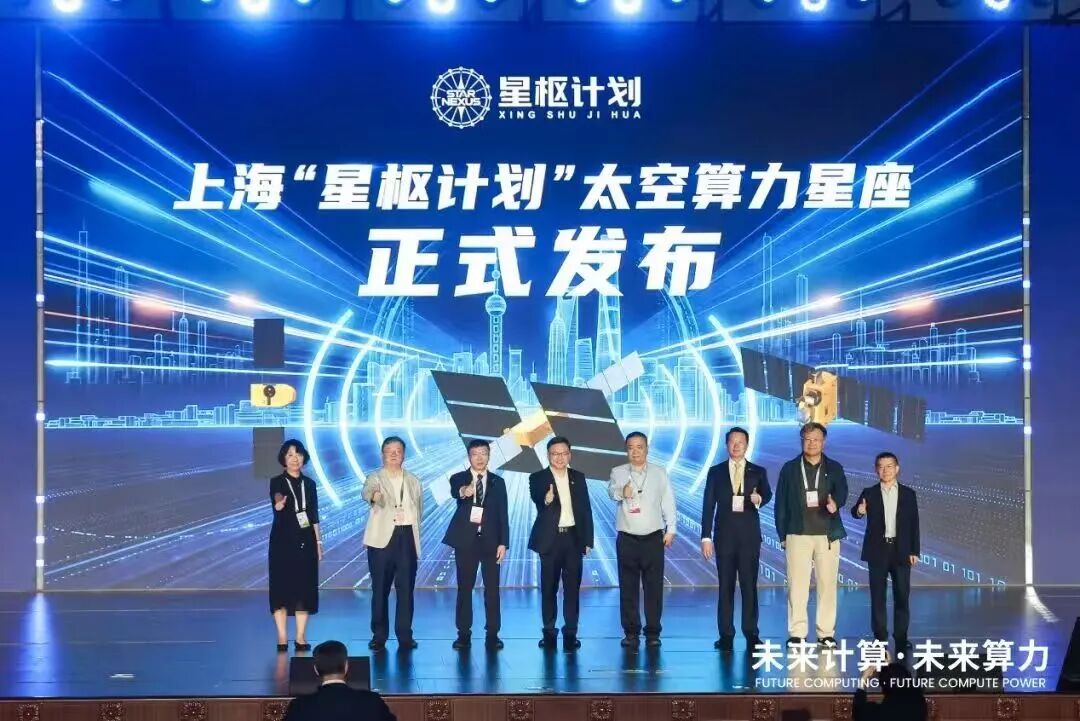
The initial validation constellation adopts a 'one primary, two auxiliary' approach: one primary computing satellite acts as the brain, supported by two 'eyes'—a meteorological satellite and a remote sensing satellite—with all three satellites interconnected via laser links.
Why must computing power go to space? Why the sudden acceleration? Who are the players in the industry? Is this just another round of hype, or is it a new starting point for digital infrastructure?
Ground-Based Computing Power is Hitting Physical Limits

AI's appetite is growing exponentially, but the supply of ground-based computing power can't keep up.
Demand is skyrocketing. According to JPMorgan Chase, the number of large model token calls increased 20-fold year-on-year in June this year; Goldman Sachs predicts that global monthly consumption will rise another 24-fold by 2030.
On the supply side, bottlenecks are everywhere. The International Energy Agency reports that 40% of global data center energy consumption is used for cooling; securing electricity quotas, water allocations, and land approvals has led to conflicts affecting livelihoods.
New York State and Virginia in the U.S. have already imposed moratoriums on data center construction, with local electricity prices rising by 60% over three years and industrial water supplies under severe strain.
Domestically, the 'East Data, West Computing' strategy has been adopted, relocating computing power to the energy-abundant western regions, alleviating some of the energy pressure.
However, ground-based computing power still faces two challenges: latency and loss from long-distance transmission, and blind spots in full coverage.
Space computing power offers two key advantages: first, energy is free. Satellites deployed in sun-synchronous dawn-dusk orbits fly along the day-night boundary, receiving nearly constant sunlight year-round. Powered by flexible solar arrays, they can continuously generate electricity without peak-valley fluctuations or competition for grid quotas.
Second, heat dissipation is convenient. In the extremely low-temperature environment of space, heat can be dissipated through thermal radiation without the need for massive water-cooling systems or additional electricity for cooling—two of the most significant cost items for ground-based data centers are naturally resolved in space.
Additionally, a satellite-based network can theoretically provide real-time computing power to any corner of the Earth without base station blind spots.
Why the Sudden Acceleration?
Space computing power is not a new concept. Conversations with industry insiders last year suggested it was still far off; early this year, government departments spoke vaguely about initiating preliminary research and moderate deployment. Unexpectedly, in the past two months, the technology has shifted from laboratory research to engineering implementation.
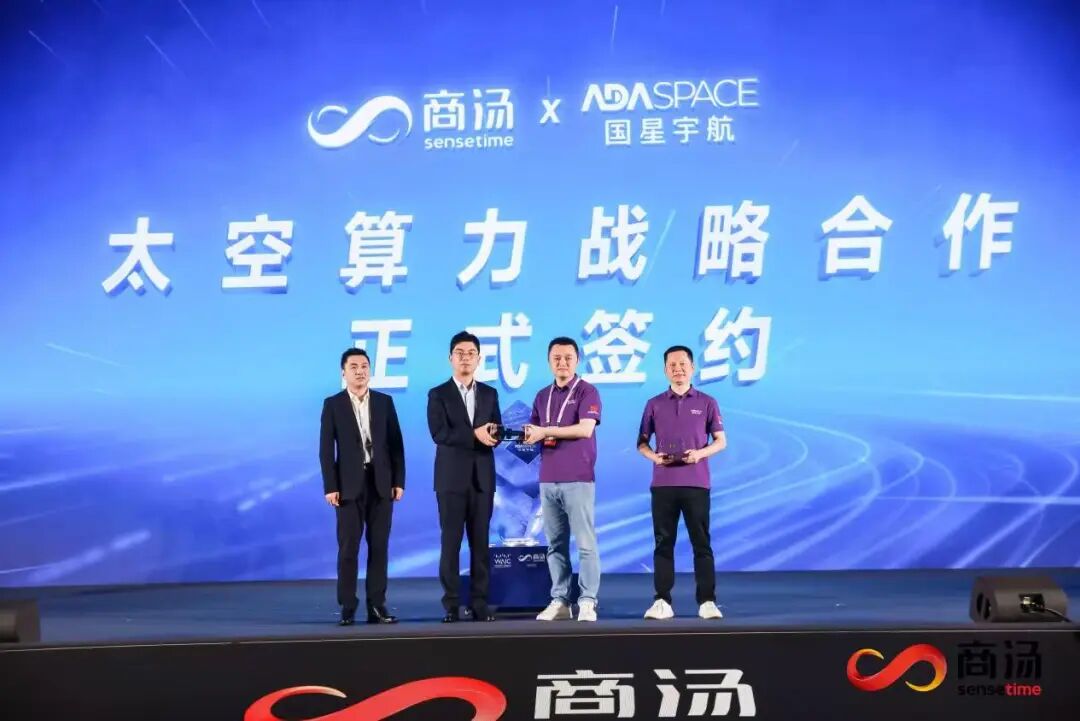
At the AI Conference, SenseTime partnered with ADASpace to announce the joint construction of the 'SenseTime Computing Constellation,' aiming for a scale of a thousand satellites and petaflops of computing power, with an initial network launch in 2026. UCloud, in collaboration with the University of Shanghai for Science and Technology, unveiled a prototype space computing system, reportedly overcoming engineering challenges related to chip cooling in microgravity. On the same day, the Space Computing Service Committee under the Ministry of Industry and Information Technology was established to facilitate the entry of small and medium-sized enterprises, with the entire industry chain rapidly developing.
Yang Fan, co-founder of SenseTime and president of its Large-Scale Infrastructure Business Group, stated that the value of space computing power lies not only in breaking through capacity limits but also in serving as infrastructure to support the global reach of China's AI capabilities, potentially significantly increasing the coverage of domestic AI services overseas.
Three factors explain this sudden shift in direction:
First, demand is urgent. The AI computing power gap is widening faster than expected, with numerous constraints on ground-based expansion, necessitating new sources of supply. Simultaneously, new scenarios such as low-altitude economy, autonomous driving, and global remote sensing are emerging, creating a clear demand for globally available, low-latency computing power.
Second, cost expectations are improving. Rapid iterations in reusable rocket technology are underway, with several domestic private rocket companies striving for successful landings. Once launch costs drop to the thousand-yuan-per-kilogram range, the economic viability of space computing power will rapidly approach that of ground-based data centers. Pathways for cost reduction through satellite-rocket integration and industrialized supply chains are also becoming clearer.
Third, resources are finite. Orbital slots and radio frequencies in low-Earth orbit are allocated on a 'first-come, first-served' basis under international regulations. Delaying layout (layout) will leave no room for positioning. This is a competition for strategic resources.
Additionally, it is said that this technology has received endorsement from relevant decision-makers and is seen as a direction for major power deployment.
Thus, demand, cost, and strategic factors have converged, bringing space computing power to the brink of industrialization. 'Space computing power is becoming the new infrastructure for the space-based intelligence era,' Gao Hui, deputy chief engineer at GalaxySpace Research Institute, told Huasheng. The supply bottleneck of ground-based computing power due to resource constraints, combined with the massive demand for on-orbit data processing in space, has jointly given rise to the new proposition of sending computing power into space. Satellites and space-based intelligence will gradually evolve, and in the future, space will be a service.
Who is Doing It? How?
Space computing power cannot yet move entire data centers into space, but real-world scenarios can still be implemented, namely 'data processed in space, data generated in space.'
Mao Jishu, general manager of the Aerospace Satellite Communications Business Division at Long lift (LongQing), told Huasheng that AI can directly process data on satellites without full transmission to the ground, significantly improving efficiency.
He gave an example: Satellite images of the ground are like strips of paper that must be transmitted to the ground and pieced together to discern information. However, in emergencies such as wildfires, earthquakes, and floods, this process is too slow. AI can automatically generate maps in the air and even directly identify disaster data, greatly improving efficiency.
Currently, there are three domestic technological routes, each with trade-offs:
Satellite-rocket integration, represented by the 'Alaya Consciousness' constellation by Qianyi Aerospace. The rocket's second stage remains in orbit without separation, directly transforming into a computing module, eliminating redundant structures. A single satellite can reach 80kW of power, approaching the level of a small space station. This approach is bold and offers significant cost reduction potential but presents the highest engineering challenges.
'Rocket companies entering the satellite field have a natural advantage,' explained Yang Siyang, market operations manager at Qianyi Aerospace, to Huasheng. This allows for autonomous control over launch schedules and enables the second-stage rocket to directly become a computing module through satellite-rocket integrated design, accommodating larger solar arrays and heat sinks, carrying more functional payloads, and enhancing structural radiation resistance.
Optical computing route, represented by Oriental Sky Computing. Using photons as the computing medium, this approach naturally resists space radiation and offers low power consumption, bypassing the bottleneck of radiation-hardened chips. This technology takes a unique path but is still transitioning from laboratory research to engineering implementation.
Star cluster architecture, the approach adopted by Shanghai's Xingshu Plan. One primary computing satellite is accompanied by two perceptual auxiliary satellites, enabling a fully closed-loop on-orbit process and saving bandwidth. This practical, incremental approach prioritizes rapid implementation in edge scenarios but has limited scalability per cluster.
For heavy computing demands like large model training, the ground will remain the primary option in the short term, with space serving as a supplementary and elastic expansion backup.
To be honest, current single-satellite computing power still lags behind a single ground-based server rack. Large-scale training will have to wait until constellation scales up.
The core value of space computing power at this stage is to fill ground-based blind spots rather than replace ground computing power outright.
The development of space computing power requires a more open approach and mindset. Earlier at the Mobile World Congress, Geespace announced the world's first full-stack open-source ecosystem plan for low-Earth orbit communication constellations.
Wang Yang, CEO of Geespace, told Huasheng in an exclusive interview that 95% of the Earth's surface lacks ground network coverage, but historically, the barriers to building satellites and constellations have been too high for most industry players. By disaggregating the entire satellite communications chain into five layers—terminal hardware, communication modules, chips, protocols, and constellation resources—and licensing them layer by layer, companies can access what they need without building satellites from scratch, collectively expanding the market.
In Huasheng's view, this is a mutually beneficial approach: a richer ecosystem accelerates scenario implementation, increasing the value of the underlying constellation. On the day of the announcement, over 200 ecological partners expressed cooperation intentions.
Entering Now is About Securing a Spot
The direction of the space computing power track is now clear, and players are entering, but significant distance remains before true commercialization.
Domestic deployments have formed a echelon ( echelon : tiered structure): locally led flagship projects are advancing, private aerospace is fully engaged, industry chain support is mobilizing, and supply chains are transitioning from aerospace-grade to industrial cost reduction.
However, the entire industry is still in a very early stage, with short-term commercial returns unlikely.",
-
![]()
Final Verdict: The Strategic Importance of GAC Honda’s Early Joint Venture Renewal
-
![]()
SpaceX's Stock Price Falls 30% from Peak! Musk Warns Short Sellers: Your Survival Probability is Extremely Low
-
![]()
100,000 Steps at WAIC! 10 Questions to Understand the Next Phase of the AI Industry: From Chatting to 'Embodied' Work
-
Image Stabilization Motor Leader’s Second Attempt at Hong Kong IPO: Shinco Motor’s Rise, Challenges, and Ties to O-film Tech
-
![]()
Personnel Shuffle: Independent Director Mi Xuming Steps Down from OFILM
-
![]()
Net Profit Anticipated to Skyrocket by 103%: What Gives This Optical Company a Competitive Edge?
-
In Just One Year, China Unveils Unicorns Valued at 10 Trillion Yuan!
-
![]()
6 Park Companies Shine at WAIC: How Hong Kong Science Park Bridges AI from Research to Industry