Net Profit Anticipated to Skyrocket by 103%: What Gives This Optical Company a Competitive Edge?
 07/21 2026
 423
423
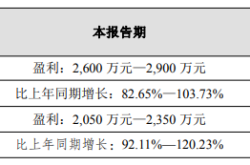
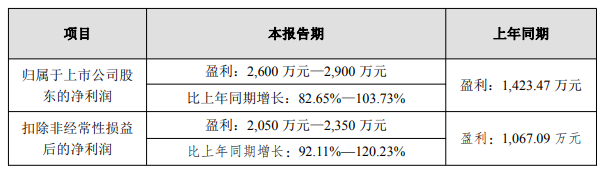
On the evening of July 20, Wavelength Opto-Electronic unveiled its semi-annual performance forecast for 2026, projecting a net profit attributable to shareholders ranging from RMB 26 million to RMB 29 million for the first half of the year. This represents an impressive year-over-year (YoY) increase of 82.65% to 103.73%. The non-recurring net profit is expected to fall between RMB 20.5 million and RMB 23.5 million, marking a YoY surge of 92.11% to 120.23%.
This remarkable performance sets Wavelength Opto-Electronic apart among A-share semiconductor supply chain companies that have already released their performance forecasts. The day following the announcement, the company's stock price soared by over 7% in early trading, reflecting a positive market reaction to its role as an "AI upstream enabler."
According to the announcement, the company's robust performance is primarily attributed to its ongoing commitment to the "Optics Plus" strategy and its focus on the semiconductor and pan-semiconductor core sectors. Driven by advancements in AI technology, downstream industries and customers have witnessed rapid growth in domestic market demand and business expansion. As an upstream entity in the supply chain, Wavelength Opto-Electronic directly benefits from this demand surge.
The transmission chain is clear-cut: the expansion of AI computing power fuels advanced packaging and high-end PCB production, which, in turn, boosts the procurement of key components such as optical lenses and parallel light source systems. Positioned as an upstream optical device supplier for photolithography, packaging, and metrology equipment, Wavelength Opto-Electronic is naturally poised to reap the benefits of this technological cycle.
A quarterly analysis reveals an accelerating performance trend. In the first quarter of 2026, the company reported revenue of RMB 97.8887 million, a slight YoY decrease of 1.36%, with net profit attributable to shareholders at RMB 6.4732 million, roughly flat YoY. However, non-recurring net profit witnessed a 46.38% YoY increase, indicating an early recovery in core profitability.
The midpoint of the H1 forecast, RMB 27.5 million, suggests a Q2 net profit attributable to shareholders of approximately RMB 21 million, representing a sequential increase of over 220% and signaling significant growth momentum.
In terms of business structure, the semiconductor and pan-semiconductor businesses have been the focal point of the company's strategic transformation over the past two years. In the full year of 2025, revenue in this segment reached RMB 75.9711 million. The PCB segment performed exceptionally well, generating RMB 43.059 million in revenue for the full year of 2025, up 96.63% YoY. This growth was primarily driven by technological breakthroughs in high-density flexible miniaturized PCB precision laser micro-machining lenses, enabling successful import substitution.
Fueled by AI, high-end PCB industries such as advanced packaging, HDI boards, IC packaging substrates, and flexible boards are shifting towards integration, miniaturization, and high-speed operation. Based on its order backlog and shipment status, the company anticipates that the PCB business will account for an even larger share in 2026.
In the semiconductor segment, products encompass mature-node parallel light source systems, advanced-node photolithography equipment optical lenses, and metrology equipment laser collimation and beam-splitting polarizers. Benefiting from prior process capability development and R&D investment, the company expects a continued increase in the semiconductor revenue share this year.
Beyond semiconductors, the infrared imaging optical business generated RMB 143 million in revenue last year, up 38.02% YoY. This growth stems from the iteration of uncooled infrared imaging products towards miniaturization and lightweight design, widely applied in civilian scenarios such as drones, outdoor night vision, and smart home devices. The company's self-developed infrared chalcogenide glass materials offer low cost, lightweight design, and ease of moldable mass production, precisely meeting the incremental market demand.
In the consumer-grade optical business, full-year 2025 revenue reached RMB 20.1786 million, up 71.99% YoY. Key contributors include VR Pancake optical modules and AR optical engine modules and components. With the stable operation of thousand-level/hundred-level cleanroom production lines, products are gradually entering the scaled delivery stage, further solidifying the company's production capacity for deepening its presence in the VR/AR and consumer electronics optics markets.
Globally, the company is in the early stages of preparing and advancing its capacity layout in Malaysia, adjacent to Singapore. The Singapore-Malaysia region is expected to form a synergistic "front-shop, back-factory" development model in the future. However, capacity release and performance contributions will take some time, with overseas operations poised to create new growth drivers.
The AI-driven industrial wave is still in its infancy. As a core upstream optical device supplier, Wavelength Opto-Electronic stands at the forefront of this technological cycle. The formal disclosure of its semi-annual report will serve as a critical litmus test of its performance. The future looks bright.
-
![]()
Personnel Shuffle: Independent Director Mi Xuming Steps Down from OFILM
-
![]()
Net Profit Anticipated to Skyrocket by 103%: What Gives This Optical Company a Competitive Edge?
-
In Just One Year, China Unveils Unicorns Valued at 10 Trillion Yuan!
-
![]()
6 Park Companies Shine at WAIC: How Hong Kong Science Park Bridges AI from Research to Industry
-
![]()
Wang Wenjing’s Third Act: Can Yonyou Reinvent Itself in the AI Era?
-
![]()
Performance Coupe Entry Threshold Reduced to 170,000 Yuan: Assessing the 2027 Exeed ES's Prospects
-
![]()
Battery "Crisis" for 4 Million New Energy Commercial Vehicles
-
【Focus】Fluorinated Photosensitive Polyimide (FPSPI): A High-End Subdivision of PSPI with Great Potential in High-Tech Industries