Sugon 8000 Achieves Full Utilization in Its Debut Week, Transcending Industrialization Barriers
 07/20 2026
 391
391
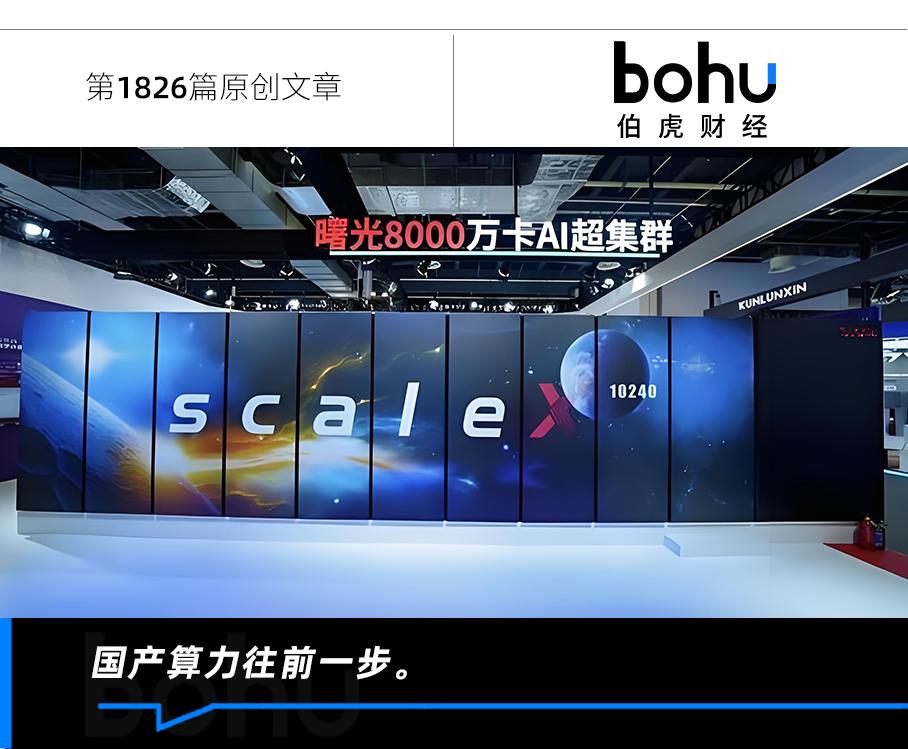
At the 2026 World Artificial Intelligence Conference, robots may have stolen the spotlight as the most eye-catching exhibits, but the Sugon 8000, hailed as a "crown jewel" of the showcase, underscored a more profound and pivotal industrial shift: the AI race is transitioning from model innovation to infrastructure development.
As China's inaugural fully domestically produced AI supercluster boasting 100,000 computing cards, the Sugon 8000's scale and technical prowess are undeniably impressive. Yet, what truly stands out is not merely the "100,000 cards" but its remarkable achievement of full utilization within its first operational week, processing over 500,000 tasks daily at peak capacity.
China is no stranger to ambitious computing power initiatives. In recent years, intelligent computing centers have mushroomed across the nation, prompting market skepticism about whether these colossal investments are translating into genuine utilization.
Against this backdrop, the Sugon 8000's full utilization in its debut week transcends mere popularity; it serves as a resounding endorsement of the demand for domestic 100,000-card AI infrastructure from the end-user perspective. It underscores that the market is not starved of computing needs; rather, what is scarce is computing power that is accessible, reliable, and user-friendly.
01 New Paradigm: Utilization Trumps Construction
A persistent paradox in large-scale computing endeavors is the disconnect between escalating supply and perceived scarcity among users.
The crux lies in the fact that computing power does not automatically translate into usability once deployed in data centers. Large model pre-training demands massive parallel computing, inference operations prioritize high concurrency and cost-efficiency, while industrial simulations, innovative drug discovery, and meteorological forecasting hinge on high-precision scientific computing.
These diverse tasks impose vastly different demands on chips, networks, storage, and software ecosystems. Without robust application adaptation and scheduling mechanisms, even a vast array of computing cards can languish in underutilization, with resources idling despite long queues.
The Sugon 8000 has undertaken over 300 AI-HPC integration application optimizations, spanning more than 20 domains including large models, robotics, automotive, innovative pharmaceuticals, new materials, quantum computing, and astro-meteorology. Over 70 applications have achieved 10,000-card scalability. Building on this foundation, its full utilization in the first week represents a concentrated release of pent-up user demand and application adaptations.
This milestone signifies that the Sugon 8000 has successfully bridged the gap from "equipment deployment" to "effective supply." The 100,000 cards are no longer just a symbol of asset scale but are now actively engaged in real-world scientific research and industrial tasks.
02 100,000 Cards: A Quantum Leap in Complexity
Scaling a cluster from 10,000 to 100,000 cards is not merely a linear increase; it entails a non-linear surge in system complexity.
As card counts soar, challenges related to communication conflicts, hardware failures, data congestion, and energy consumption control become increasingly daunting. Even minor network delays can render computing cards idle; inadequate storage can halt training tasks midstream; and scheduling systems unable to harmonize diverse workloads can significantly erode resource utilization.
Thus, the true technical hurdle for a 100,000-card system lies not in the physical installation of cards but in orchestrating them into a cohesive, stable entity.
The Sugon 8000 adopts an "AI-HPC integration" architecture, supporting full-precision computing from FP64 to INT8 within a unified system. It encompasses scientific computing, large model training, AI inference, and industrial simulations, integrating key components such as domestic chips, computing, networking, storage, liquid cooling, scheduling, and application services.
Its full utilization in the first week serves as a rigorous stress test of this systems engineering prowess. Processing over 500,000 tasks daily at peak capacity confirms that the system can handle not just a few large training jobs but also a massive influx of tasks varying in scale, precision, and duration.
This real-world testing scenario is far more revealing than peak performance metrics touted at product launches. It assesses whether networks can maintain stable connections, storage can sustain read-write operations, scheduling can balance loads, and whether the system can swiftly recover from failures.
From this vantage point, the Sugon 8000's full utilization represents a collective engineering validation of domestic chips, high-speed networks, distributed storage, liquid cooling equipment, and foundational software at the 100,000-card scale.
03 From Equipment Delivery to Computing Power Operation
Another layer of significance in the Sugon 8000's full utilization lies in marking the computing power industry's accelerated transition from "construction logic" to "operational logic."
Historically, computing power companies have relied heavily on revenue from server, storage, and data center project deliveries, with system completion often signaling the end of transactions. However, after integrating with the National Supercomputing Internet, the Sugon 8000 provides computing power services to universities, research institutions, enterprises, and developers, functioning more like a continuously operating "computing factory."
Under the equipment sales model, the market focuses on procurement volumes, installation scales, and theoretical performance; under the computing service model, the true metrics are resource utilization, effective task volume, unit computing cost, task delivery time, and customer retention rates.
The Sugon 8000's full utilization in its first week sends a clear signal: substantial effective demand has emerged for domestic large-scale computing power. Leveraging the National Supercomputing Internet to aggregate cross-regional users is expected to break the path dependency of some intelligent computing centers on local projects and top-tier clients, driving their deep transformation from "resource supply" to "service operation."
Notably, Dawning Information Industry has already embarked on research and construction of a second fully domestically produced 100,000-card AI-HPC integrated computing system in collaboration with the Beijing Academy of Artificial Intelligence.
The completion of the first system proves feasibility; full utilization in the first week confirms demand; and the launch of the second system begins to test scalability.
Of course, first-week full utilization alone does not guarantee the long-term viability of the business model. Future validation must focus on four key dimensions: sustainability of high-load operations, actual computing utilization levels, competitive advantages in per-task costs, and the proportion of sustainable scientific research and commercial tasks in the demand mix.
Nevertheless, the Sugon 8000 has propelled domestic computing power past a critical inflection point: industry evaluation criteria are shifting from "how many cards and peak performance" to "whether it can operate stably, whether it is being utilized, and whether it can continuously create value."
The completion of a 100,000-card system represents the fulfillment of an engineering feat; filling it with real tasks in its first week signifies the project's genuine integration into the industrial ecosystem. The latter is far more consequential than the former.
The copyright of the article's cover image and accompanying pictures belongs to their respective owners. If the copyright holders deem their works unsuitable for public browsing or free use, please contact us promptly, and our platform will make immediate corrections.
-
![]()
Final Verdict: The Strategic Importance of GAC Honda’s Early Joint Venture Renewal
-
![]()
SpaceX's Stock Price Falls 30% from Peak! Musk Warns Short Sellers: Your Survival Probability is Extremely Low
-
![]()
100,000 Steps at WAIC! 10 Questions to Understand the Next Phase of the AI Industry: From Chatting to 'Embodied' Work
-
Image Stabilization Motor Leader’s Second Attempt at Hong Kong IPO: Shinco Motor’s Rise, Challenges, and Ties to O-film Tech
-
![]()
Personnel Shuffle: Independent Director Mi Xuming Steps Down from OFILM
-
![]()
Net Profit Anticipated to Skyrocket by 103%: What Gives This Optical Company a Competitive Edge?
-
In Just One Year, China Unveils Unicorns Valued at 10 Trillion Yuan!
-
![]()
6 Park Companies Shine at WAIC: How Hong Kong Science Park Bridges AI from Research to Industry