WAIC Has Changed | Stepping Out of the Parameter Race, AI Starts to Get Its Hands Dirty in Practical Applications
 07/20 2026
 493
493
As WAIC enters its ninth year, AI has started to talk about money.
The artificial intelligence (AI) industry is no longer lacking in impressive technological displays; what is truly scarce are real-world scenarios where people are willing to pay for them.
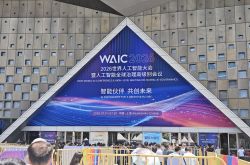
This year, the WAIC exhibition area has exceeded 100,000 square meters for the first time, with over 1,100 companies filling the venue to capacity. When you piece together the most dynamic companies at the venue, you'll find that the essence of China's AI is shifting from 'science fiction' to 'business acumen.'
At the conference, Huashang Taolue visited a group of representative companies across various sectors. Distributed in different fields, they demonstrate a common trend: either they have successfully transformed AI into commercial value, or they are actively exploring feasible paths for AI commercialization, with engineering capabilities becoming more important than ever.
From the computing power infrastructure to humanoid robots, from large models to beauty industry giants, the concentrated presence of these companies exactly (coincidentally) pieces together a genuine progress report on China's AI industrialization.
【01 The Battle for Computing Power: From 'Chip Building' to 'System Building'】
In the past, discussions about domestic computing power often focused on whether a particular chip could match a certain generation of products from international giants. At this year's exhibition, computing power companies are almost unanimously conveying the same message: the performance competition of individual chips is a thing of the past; system-level efficiency is the key to the future. From 100,000-card clusters to 'computing power containers' in offices, the form of computing power is rapidly diversifying.
Sugon directly unveiled a 'museum piece'—the dawn 8000 (Shuguang 8000, 'Ascent'). This is China's first fully domestically produced 100,000-card AI supercluster. What does 100,000 cards mean? It's not just a number but an extremely complex systems engineering feat. The entire system involves the precise coordination of 3 billion components, with installation accuracy at the millimeter level at the endpoints. If all its computing power were used for inference, it would be China's largest Token factory, capable of handling 5% to 10% of the country's Token access volume.
Since advanced manufacturing processes are constrained, why not stop obsessing over single-card performance? Sugon connects thousands of cards, relying on its self-developed scaleFabric lossless interconnection technology and phase-change immersion liquid cooling to stack up computing power. This is a typical 'brute force' approach to overtaking on a curve. Now, this system has been deployed in Zhengzhou; it's said that when you open a certain AI app on your phone, the computing power behind it might just come from a data center in Zhengzhou.
As one of the representative domestic GPU companies, Mu Xi (Maxwell) set up an open-source zone at the exhibition, attracting the participation of PyTorch, a global mainstream AI open-source framework. This subtle shift in the host-guest relationship reflects the transformation Chinese chip manufacturers are undergoing from 'seeking an ecosystem' to 'building an ecosystem.' The rise in ecological discourse power is even as significant as catching up in chip performance.
Supercomputing Convergence has simply turned computing power into 'home appliances.' Their TokenBox™ enterprise Token production platform moves supernodes from data centers into offices. This device offers the performance of an intelligent computing server, library-level silence through liquid cooling technology, and can support the local operation of models with extremely large parameter counts. Its emergence fills the market gap between cloud APIs and self-built data centers, precisely meeting the needs of medium-sized financial, government, and enterprise sectors with high requirements for data privacy.
Moore Threads founder Zhang Jianzhong proposed a 'Three AI Factories' framework at a WAIC sub-forum—model training, token production, and intelligent agent factories— series connection (linking) the entire chain of AI from training to implementation. Its Kua E (Kua'e) 10,000-card cluster can already support the training of 236B parameter models. The MTT S5000 achieves the same inference performance as international mainstream products with about half the hardware specifications, further boosting throughput by achieving '3 S5000s plus 2 international mainstream cards equal the performance of 9 cards' through heterogeneous inference. The MUSA ecosystem is fully integrated with mainstream frameworks like PyTorch and Triton, and its self-developed MusaCoder outperforms Claude Code in KernelBench evaluations, lowering the barrier for developers to migrate to nearly zero.
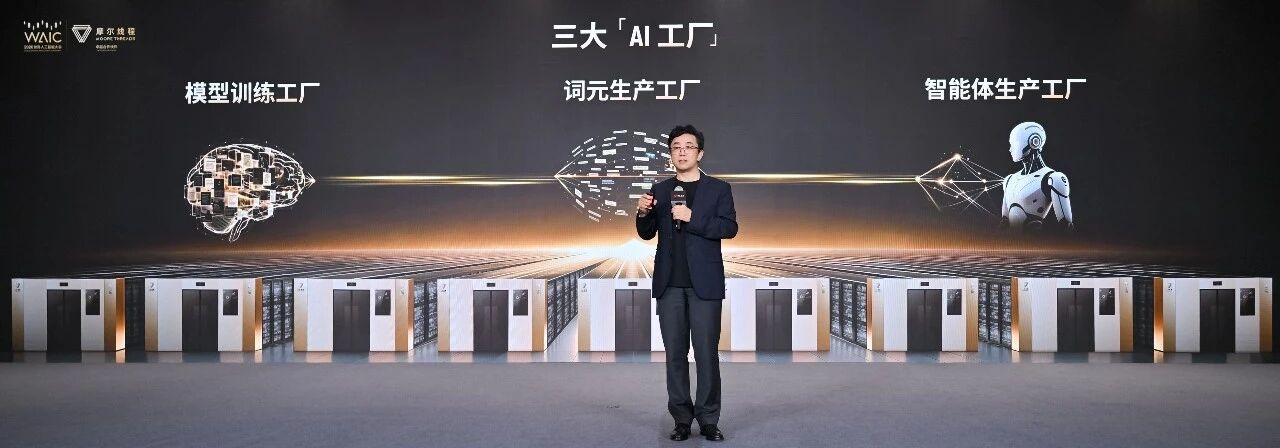 Moore Threads founder, chairman, and CEO Zhang Jianzhong delivers a speech
Lenovo is the exhibitor with the broadest span at this WAIC—spanning from computing power infrastructure to the FIFA World Cup. Its Wanquan Heterogeneous Intelligent Computing Platform V5.0 and Wentian Supernode form the foundation for token production, with a single node capable of housing 40 GPUs. Beyond computing power, the Qingtian AI Engine embeds intelligent agents into the entire 'research, production, supply, marketing, and service' process of enterprises, with the enterprise super-intelligent agent 'Lexiang' boasting 7 million monthly active users and cumulative sales exceeding 5 billion yuan. On the terminal side, 42 products have passed the AI Terminal National Standard L3-level testing, with Tianxi AI 4.0 driving 80% of token consumption to be completed locally.
【02 The Second Half of Large Models: Not About Parameters, But About Implementation】
The main theme of the large model track has shifted. Last year, the industry was still enthusiastic about competing on parameter scale and benchmark scores; this year, large model companies are almost all discussing how to translate models into actual products and revenue. The standard of competition is shifting from 'making it' to 'selling it.'
Alibaba showcases not just the technical capabilities of its Tongyi large model but also the complete chain of 'model + computing power + e-commerce scenarios.' The biggest challenge in monetizing large models lies in finding scenarios where people are willing to pay, and Alibaba's advantage lies in its vast e-commerce ecosystem. The Tongyi large model can be directly embedded into the operational scenarios of Taobao and Tmall, from product understanding to intelligent customer service and marketing creativity, achieving seamless integration of technology and commercial scenarios.
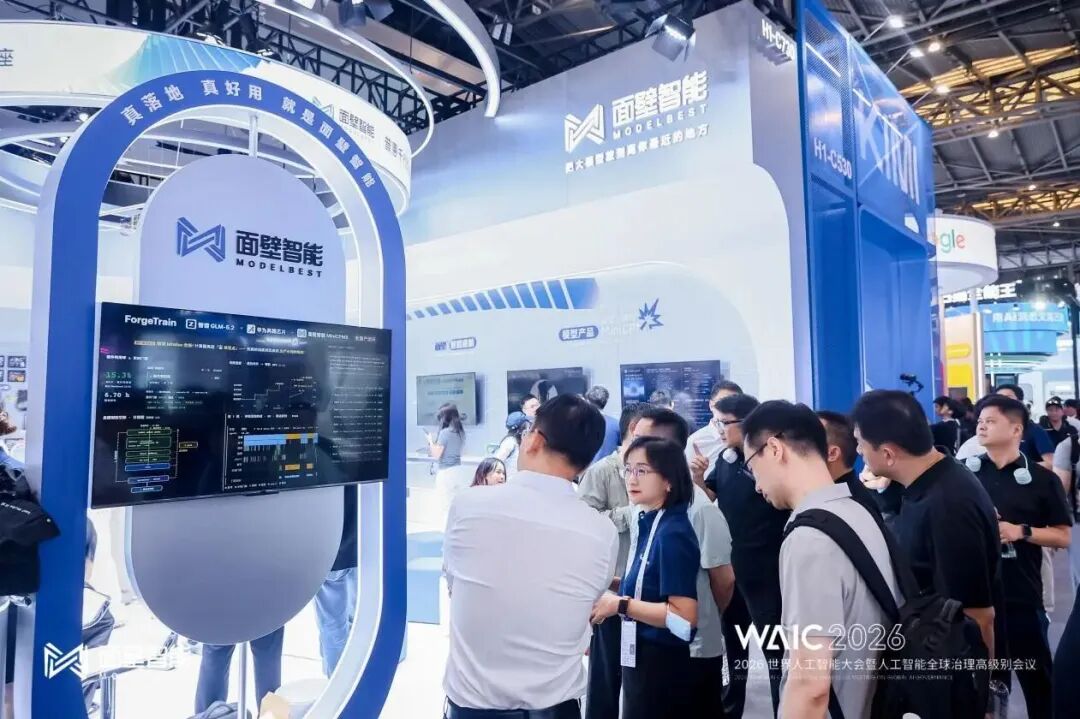
As the leading domestic large model unicorn in terms of valuation, Moonshot AI (Kimi) faces the core challenge of commercialization. The Kimi intelligent assistant has a massive daily active user base, but how to translate its ultra-long context processing capabilities into actual revenue is key to its next stage of development. Monetizing large models is not simply about accumulating users; it requires validating truly valuable paid scenarios.
SenseTime's SenseCore large infrastructure is experiencing a shift in computing power from training to inference. Through a comprehensive layout of the Journey large model, AI infrastructure, visual AI, and embodied intelligence, SenseTime is trying to prove that it is not just a large model company but a full-stack AI service provider.
Minimax is focusing on edge-side large models. While other companies compete to pursue hundred-billion-parameter models, Minimax chooses to make models smaller, enabling them to run locally on devices like smartphones, robots, and in-car systems. The advantages of edge-side models in terms of cost-effectiveness and privacy protection hint at a broad prospect for the 'era of small models.'
Tencent's Hunyuan large model is deeply embedded in the ecosystems of national-level applications like WeChat, Tencent Meeting, and Tencent Docs. While other large model companies are still searching for scenarios, Tencent's scenarios are already built into its models. Additionally, Tencent has launched the AI programming tool CodeBuddy, directly competing with GitHub Copilot, attempting to seize an entry point in the developer tools track. The competition among large models is shifting from 'whose parameters are larger' to 'whose entry points are more numerous.'
JD showcases the deep implementation of its Yanxi large model in retail, logistics, and financial scenarios, but what deserves more attention is its 'world's largest embodied intelligence data collection center'—accumulating over 10 million hours of real robot operational data. This means JD is not just building large models but also stockpiling data fuel for the robot era. While most companies are still discussing 'where data comes from,' JD's answer is simple: from its own warehouses.
【03 Embodied Intelligence: From Demo to Delivery, Robots Start 'Working'】
At this year's WAIC, hundreds of robots demonstrated simultaneously, creating a lively scene. However, the most noteworthy aspect is not how difficult the actions robots can perform but who can truly achieve large-scale delivery and stable operation.
The approval of Unitree Technology's Sci-Tech Innovation Board IPO, with a planned fundraising of 4.2 billion yuan, proves the enormous commercial potential of the robotics industry. Its 'robot unmanned factory' sandbox display hints that manufacturing-end automation is moving toward a new stage of 'using robots to build robots,' an important marker of industrial maturity.
As a new unicorn in the embodied intelligence track, Galaxy General directly starts with general-purpose humanoid robots that combine operational and mobility capabilities. Although the path is more challenging, it also implies a higher ceiling for development.
Zhiyuan answers the question 'Can it be manufactured?' with a set of harder numbers. To date, Zhiyuan Robotics has rolled off 15,000 units, with a flexible delivery capacity exceeding 100,000 units annually. Founded by Zhihui Jun (Peng Zhihui), this team follows an industrialized route of 'mass production first, then iteration.' In the track of embodied intelligence, which is filled with demos and conceptual stories, Zhiyuan is one of the few companies that can speak in terms of 'units rolled off' rather than 'demo videos.'
Qiyuan Robotics, a consumer-grade embodied intelligence brand under SWANCOR, unveiled the world's first deformable personal robot—Qiyuan T1—at WAIC 2026. It adopts a Transformer cross-morphology integrated architecture, operating indoors in a wheeled-legged humanoid form for quiet and flexible movement; when encountering complex terrains like grass, gravel, or steps, it automatically switches to a quadrupedal form for stable passage. The entire morphology switching process is autonomously completed by environmental recognition without human intervention. The T1 also deeply integrates with action cameras, supporting voice-followed shooting and trajectory-based camera movements, extending the functional boundaries of personal robots from 'companionship' to 'mobile image creation (image creation).' While most humanoid robot companies are still competing in industrial scenarios, Qiyuan has chosen a differentiated path—bringing robots into ordinary people's living rooms and outdoors.
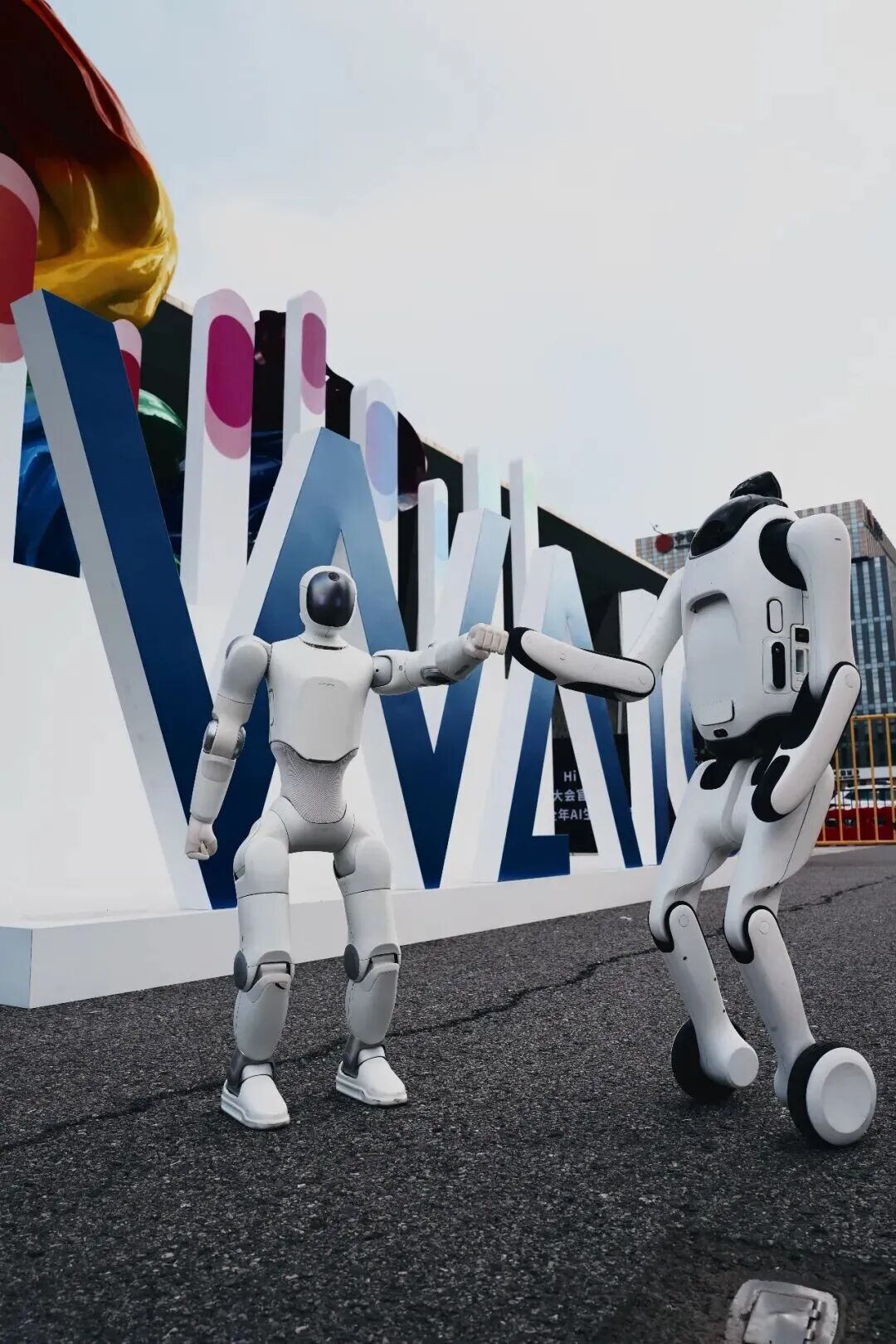
Leju Robotics is one of the earliest domestic companies to deploy open-source humanoid robots. Its Kuafu series humanoid robots have now iterated to the fourth generation. Leju has chosen a differentiated path of 'open-source to build an ecosystem, ecosystem to promote mass production'—by open-sourcing hardware designs and motion control algorithms, it attracts participation from the developer community, then feeds mass production with the community ecosystem. While all humanoid robot companies are competing for financing and delivery, Leju attempts to answer another question with the 'Android moment for humanoid robots': Who can define industry standards?
As a global leader in warehousing and logistics robots, Geek+ has long tested its products in real warehousing environments. This stable operation in real business scenarios is the most favorable proof of robot commercialization.
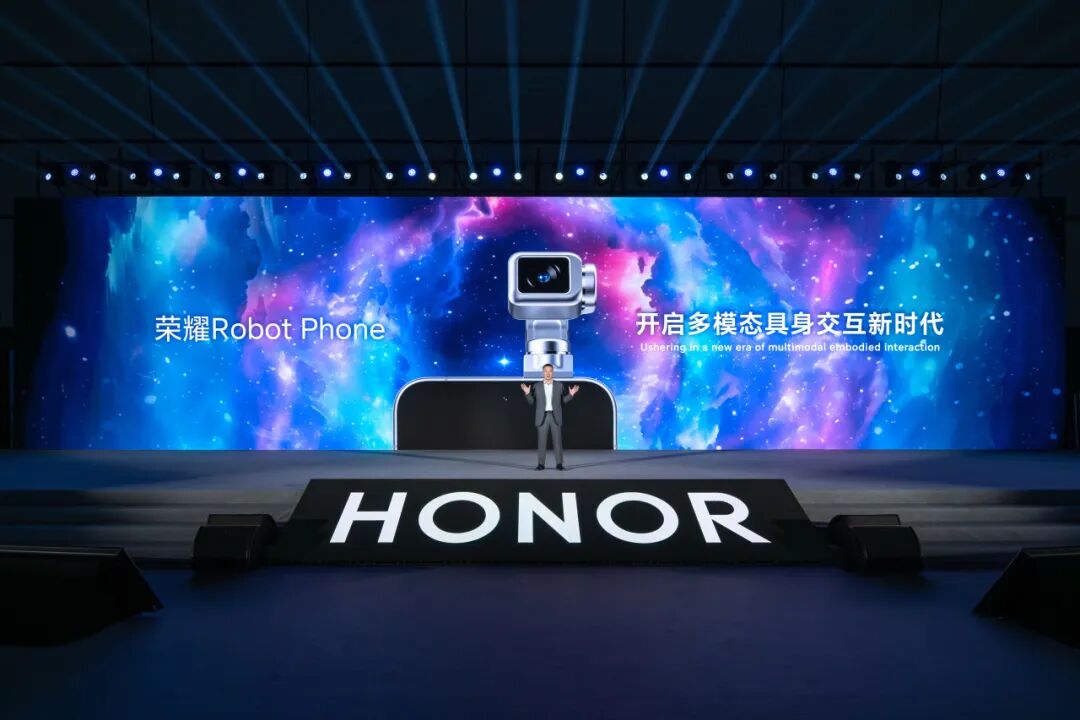
Honor's global first robot phone, the Robot Phone, integrates the industry's most precise four-degree-of-freedom gimbal system into its body, evolving the gimbal system into an intelligent agent actuator through the OpenClaw open platform, capable of autonomously completing cross-application continuous tasks like ordering cakes and hailing rides. Honor has upgraded MagicOS to the industry's first partner-type multimodal intelligent agent operating system, Agentic OS, while proposing that the evolution of the future intelligent world of all things will present a new architecture of 'one primary, multiple specialized, three-end collaboration.' CEO Li Jian mentioned in a dialogue with Kevin Kelly that innovation will shift from digital screens to the physical world, and China's engineering capabilities in integrating software and hardware, the world's richest production and living scenarios, and an open and collaborative ecosystem with global partners will become unique environmental advantages for China's tech industry to lead the next wave of transformation.
Infinite Intelligence targets the 'data desert' of the robotics industry—embodied intelligence requires high-quality interactive data from the physical world but has long been trapped in the 'impossible trinity' of authenticity, scalability, and low cost. Its Real2Sim2Real full-link closed loop doesn't take sides; starting from real collection, going through simulation generalization, and then returning to the real world for verification, it has achieved a 70% efficiency improvement and a 90% cost reduction, holding hundreds of millions of yuan in orders. Having built the largest embodied intelligence data collection and training ground in the Yangtze River Delta in Deqing, Zhejiang, the Wuyin platform is supplying 'data fuel' to partners like Horizon, Tstone Intelligent Navigation, and Lingxin Qiaoshou.
【04 AI Penetrates All Industries: Traditional Giants Deeply Embrace AI】
The most profound industrial transformations often occur among traditional industry giants that deeply integrate AI into their core businesses. When leading companies in industries like industrial manufacturing, beauty, and telecommunications begin to seriously apply AI, it means that AI's penetration has broken beyond the boundaries of the tech circle.
At the Hikvision exhibit, a series of large model software and hardware products and vertical large model applications answer this question—large models not only equip machines with intelligent perception of the physical world through 'eyes, ears, nose, tongue, and body' but also evolve cognitive abilities to understand intentions, achieving a leap from passive response to proactive service: multi-modal intelligent cameras can switch to 'working' mode with a single sentence, becoming all-weather 'safety officers' that proactively detect abnormalities and raise alarms; industrial large models delve into manufacturing frontlines to help improve product yield rates; various intelligent agents make complex business processes efficient and worry-free with 'one sentence'... All these mark AI's accelerated landing in the physical world, truly becoming an intelligent partner for all industries.
As a global beauty industry giant, L'Oréal showcased practical applications of AI skin quality detection, AI-assisted formula research and development, and generative AI marketing creativity at WAIC. This indicates that AI has transformed from a mere marketing gimmick into a substantive productivity tool for the beauty industry.
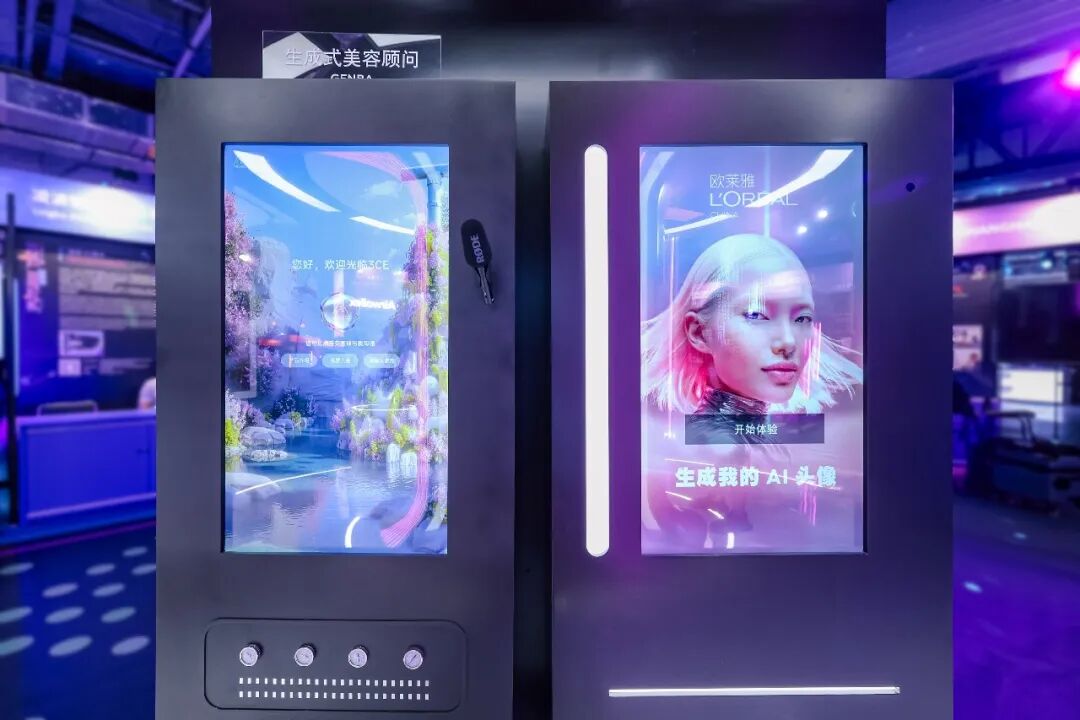 L'Oréal exhibits the 3CE GENBA generative beauty advisor
China Mobile showcased its grand layout in the computing power network field. As the world's largest mobile communications operator, China Mobile is committed to transforming its nationwide network and data centers into core infrastructure for AI, driving AI from the cloud to the edge.
China Telecom, with Tiany Cloud as its foundation, showcased the implementation of the "Xingchen" large model series in scenarios such as government affairs, emergency response, and industry. The logic of operators engaging in AI differs from that of internet companies—they do not pursue the advancement of the model itself but rather use AI as an incremental capability for cloud services, bundling it and selling it to existing government and enterprise clients. This "infrastructure + AI" model, while not particularly flashy, offers extremely strong revenue certainty.
China Unicom, on the other hand, introduced its "Yuanjing" large model and industrial internet platform, focusing on smart manufacturing and smart cities. The collective appearance of the three major operators at WAIC sends a clear signal: the infrastructure of AI is not just a matter for cloud providers but also a key battleground for operators. Whoever controls the physical nodes of the computing network will hold the distribution rights in the AI era.
Looking back at these participating companies, we can clearly see four cross-sections of China's AI industrialization:
The first layer consists of companies that "build infrastructure," such as Dawning Information Industry and MetaX, which are addressing issues of computing power supply and ecosystem construction.
The second layer includes companies that "build brains," such as Alibaba and SenseTime, which are dedicated to translating the capabilities of large models into practical commercial implementation scenarios.
The third layer comprises companies that "build bodies," such as Unitree Robotics and Geek+, which are driving robots from the demonstration stage to large-scale delivery and practical applications.
The fourth layer involves companies that "use AI," such as Supcon and L'Oréal, representing the deep transformation and empowerment of traditional industries through AI technology.
These four layers are intertwined, collectively forming a complete cross-section of China's AI industrialization in 2026. AI is no longer just a cutting-edge technology floating in the air but a complete industrial chain spanning from computing infrastructure to model capabilities, then to hardware carriers and industry applications. In this process, technology is shedding its halo and truly becoming a new engine driving economic development.
——END——
Welcome to follow [Huashang Taolue] to learn about influential figures and read legendary strategies.
All rights reserved. Unauthorized reproduction is prohibited.
Some images are sourced from the internet.
If any infringement is involved, please contact us for deletion.
-
![]()
Final Verdict: The Strategic Importance of GAC Honda’s Early Joint Venture Renewal
-
![]()
SpaceX's Stock Price Falls 30% from Peak! Musk Warns Short Sellers: Your Survival Probability is Extremely Low
-
![]()
100,000 Steps at WAIC! 10 Questions to Understand the Next Phase of the AI Industry: From Chatting to 'Embodied' Work
-
Image Stabilization Motor Leader’s Second Attempt at Hong Kong IPO: Shinco Motor’s Rise, Challenges, and Ties to O-film Tech
-
![]()
Personnel Shuffle: Independent Director Mi Xuming Steps Down from OFILM
-
![]()
Net Profit Anticipated to Skyrocket by 103%: What Gives This Optical Company a Competitive Edge?
-
In Just One Year, China Unveils Unicorns Valued at 10 Trillion Yuan!
-
![]()
6 Park Companies Shine at WAIC: How Hong Kong Science Park Bridges AI from Research to Industry