China's Large Model Companies Face Their First Verdict: Lifting of Lock-up in the Same Week Brings Different Fates for Zhipu and MiniMax
 07/20 2026
 388
388

By Bishan
Source: Bowang Finance
On July 8, Zhipu's stock rose by 13.35% on the day its lock-up expired. The next day, MiniMax's stock fell by 17.98% on its lock-up expiration day.
Within two days, two Chinese large model companies faced the reality of "listing discipline" for the first time. The capital market's attitude was reflected in the stock prices: one smiling face, one crying face.
This was no coincidence. It marked a historic turning point as China's large model industry shifted from "fundraising narratives" to "listing discipline." No longer would anyone simply discuss model parameters—they would only ask about gross margins, break-even timelines, and whether lock-up shareholders would sell.
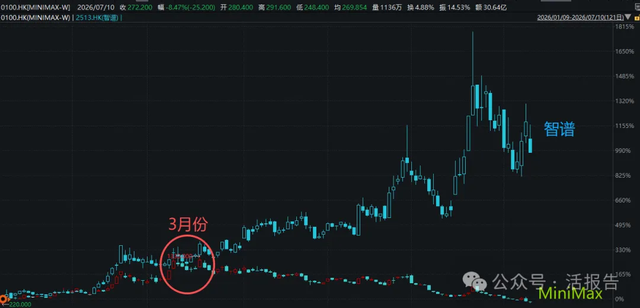
Comparison of Zhipu (blue line) and MiniMax (red line) stock price trends from January to July 2026: Significant divergence after March (Source: Huobao Report/Futu Quotes, July 10, 2026)
01 Two Contrasting Faces in the Same Week
Zhipu's lock-up expiration was set for July 8, with 25.68 million shares (5.76% of total equity) released—a moderate scale.
The market remained stable that day, closing up 13.35% at HK$1,825. The next day, it rose another 11.34% to HK$2,032. All lock-up shares were absorbed within two days, with no sign of panic selling.
The key lay in its shareholder structure. Most of Zhipu's lock-up shareholders were state-backed and industrial capital, such as the Beijing AI Industry Investment Fund. These institutions had already committed to holding their shares, with 70% of the unlocked shares pledged to remain locked. This reassured the market: "We won't dump shares."
On July 9, Zhipu completed a HK$31.4 billion large-scale placement. Successfully raising funds at this juncture signaled institutional confidence in its long-term logic. JPMorgan Chase reiterated its "overweight" rating with a target price of HK$2,000.
MiniMax faced an entirely different scenario.
On July 9, MiniMax unlocked 146 million shares (46.44% of total equity), causing its free float to surge from 5% to 50% overnight. Selling pressure overwhelmed the market, with the stock closing down 17.98% at HK$297.4, pushing its market cap below HK$100 billion.
The sell-off continued. The stock fell another 9.68% the next day and 17.13% on July 13. By July 16, it closed at HK$256, down over 30% from HK$362.6 the day before the lock-up expired.
The shareholder structures differed vastly. MiniMax's lock-up list included venture capital and private equity firms like Hillhouse and Sequoia. With limited fund lifespans, these investors rushed to sell after years of waiting. With 46.44% of shares flooding the market, who would buy them?
In the same week, one stock rose while the other fell. Superficially, it seemed like luck, but in reality, it was a clash of two valuation logics—the capital market had labeled the two companies differently with real money.
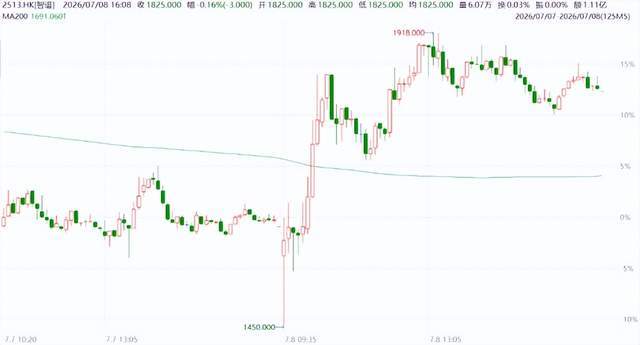
Zhipu AI closed at HK$1,825 on July 8, up 13.35% on its lock-up expiration day (Source: Wall Street See/Quotes Software, July 8, 2026)
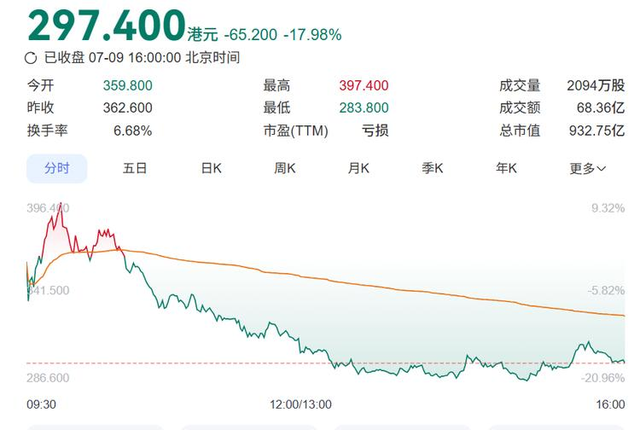
MiniMax closed at HK$297.4 on July 9, down 17.98%, with a total market cap of HK$93.275 billion (Source: NetEase Finance/Quotes Software, July 9, 2026)
02 Faith-Based Valuation vs. Financial Reporting Valuation: The Capital Market Categorizes Large Model Companies
What is Zhipu trading on? Faith.
On its January 8 debut, Zhipu priced at HK$116.2, nearly breaking below its IPO price, with a market cap of around HK$55.5 billion. The IPO price wasn't cheap, and the first-day performance was unremarkable. But the market gradually caught on—the company had completed three model iterations in six months, raised API prices by 83%, and seen usage surge 400%. With 4 million registered users across 218 countries and annual recurring revenue of HK$1.7 billion (up 60x in 12 months), the numbers spoke volumes: major clients were willing to pay more, and usage kept climbing. This signaled a technological moat.
By June 22, Zhipu's stock soared to HK$2,980, pushing its market cap above HK$1.07 trillion. How could a company with just HK$724 million in 2025 revenue, HK$4.718 billion in net losses, and HK$3.18 billion in R&D spending be worth HK$1 trillion?
Through faith. Faith that it would become China's large model infrastructure, that it was on the path to artificial general intelligence (AGI), and that it could secure continuous financing to fuel iterative development. As long as this faith held, its market cap could defy gravity.
MiniMax, however, was scrutinized from the start through a financial reporting lens.
In 2025, its revenue reached $79.038 million, up 158.9% YoY. Impressive, right? But losses ballooned to $1.872 billion, up 302.3% YoY. Adjusted net losses stood at $251 million, with cumulative losses hitting $2.679 billion (~RMB 18.4 billion).
More glaring was its gross margin. The consumer segment operated at just 4.7%, while the enterprise segment hit 69.4%. What did this mean? For every $1 earned from consumers, MiniMax lost $3.17. Its burn rate was unsustainable.
On its January 9 debut, MiniMax priced at HK$165, surging 109% on the first day to a market cap of ~HK$106.7 billion. The market was still in "hype mode"—large model companies were rare, so investors piled in. By March 18, the stock hit HK$1,330, pushing its market cap to HK$410 billion, briefly surpassing Baidu. During the bubble phase, who cared about financials?
But the July 9 lock-up expiration burst the bubble. With the free float expanding to 50%, short-selling mechanisms kicked in. Discussions shifted from model technology to shareholder structure, lock-up pressure, and gross margins. This was "listing discipline"—every financial statement and metric was scrutinized under a microscope.
MiniMax became the first Chinese large model company to face a full trial. Its products, users, revenue, lock-up expiration, and short-selling were all examined by the capital market without mercy. Zhipu's verdict day hasn't arrived yet—on January 8, 2027, over 402 million shares (90% of total equity) will unlock. That will be the real flood.
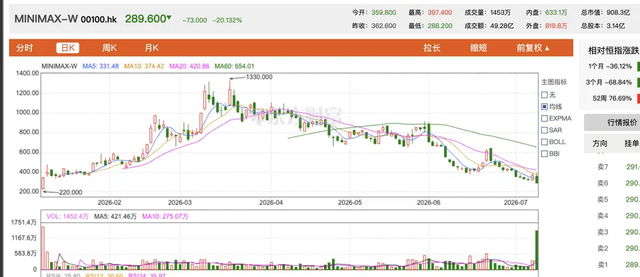
MiniMax daily K-line chart: From a March high of HK$1,330 to HK$289.6 on July 9, a drop exceeding 78% (Source: NetEase Finance/Quotes Software, July 9, 2026)
03 How MiniMax's HK$410 Billion Bubble Burst
From its March high of HK$1,330 to HK$256 on July 16, MiniMax's stock plummeted over 80%. Its market cap shrank from HK$410 billion to ~HK$72–77 billion, evaporating over HK$300 billion.
What does HK$300 billion represent? It's equivalent to losing two-and-a-half Baidus. A company once hailed as "China's star large model firm" was reduced to its original state in less than six months.
How did the bubble burst? A stack of negative catalysts crushed confidence.
The first blow was gross margin. The consumer segment's 4.7% margin revealed that MiniMax's overseas user growth was subsidy-driven. Spending to buy users, daily active users, and engagement looked impressive on paper, but every transaction bled money. Annual recurring revenue reached $150 million (as of February 2026), but cash burn accelerated faster.
The second blow was Disney's $75 million copyright claim. The financial hit was significant, but the bigger concern was systemic flaws in MiniMax's content safety mechanisms—it wasn't about the compensation amount but whether the business could operate safely.
The third blow came when overseas products were delisted in Japan and the U.S., causing monthly revenue to drop 41%. With over 73% of revenue from overseas markets, this was a mortal wound.
The fourth blow was a developer exodus after MiniMax raised prices for its third-gen model. Ranked eighth globally in programming capabilities, its technology wasn't bad, but developers balked at the price hike. This exposed MiniMax's lack of ecosystem stickiness—if you're not cheap, I'll leave.
The fifth and deadliest blow: 146 million shares unlocked simultaneously. Venture capital and private equity firms like Hillhouse and Sequoia, facing fund expiration, had to sell. With 46.44% of shares flooding the market, who would buy them? On July 10, MiniMax raised HK$16 billion through a placement (35.6 million shares + HK$6.5 billion in convertible bonds), claiming 7x oversubscription, but the stock kept falling. The market had lost faith.
Yan Junjie, MiniMax's CEO, sent an internal letter around the lock-up expiration, offering zero salary and pledging 5% of shares (~HK$4 billion) to align with the company. In plain terms: "I'm betting everything I own. Don't run." But the stock kept falling. His letter contrasted sharply with Tang Jie's (Zhipu's CEO) "The Giant Wave Is Here"—one focused on personal sacrifice, the other on technological roadmaps.
JPMorgan Chase set a HK$300 target price on July 8, while Goldman Sachs had given a HK$860 target on July 3. Two top-tier investment banks valued MiniMax nearly three times apart. MiniMax had signed a coaching agreement with CITIC Securities to relist on the A-share market on May 29, but given its market cap collapse, would the A-share market save it? The A-share market isn't a lifeboat—it's another exam.
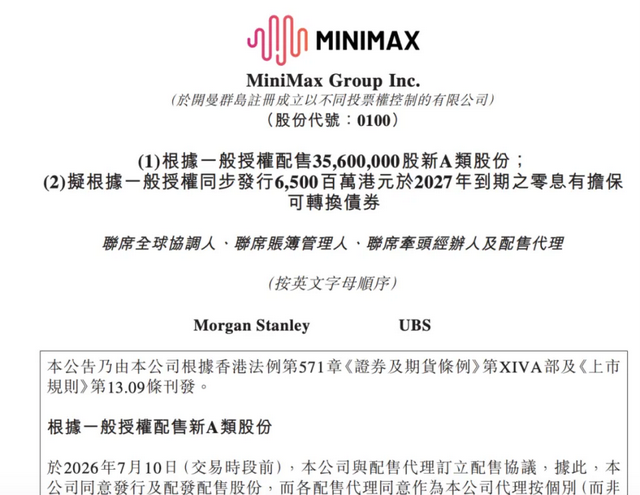
MiniMax announced on July 10 it had raised HK$16 billion through a placement (35.6 million shares + HK$6.5 billion in convertible bonds) (Source: HKEX Announcement/Tencent News, July 10, 2026)
04 How Long Can Zhipu's HK$1 Trillion Market Cap Last?
Don't celebrate for Zhipu just yet. Its problems are no less severe.
By July 11, its stock had dropped from HK$2,032 to HK$1,640, with its market cap shrinking from HK$1.07 trillion to HK$731.2 billion—a pullback exceeding 30%. This suggested that after the short-term excitement from the lock-up expiration faded, the market was reassessing its fundamentals.
What was being reassessed? The basics.
In 2025, Zhipu reported HK$724 million in revenue (+132% YoY). Not bad, but net losses hit HK$4.718 billion. R&D spending stood at HK$3.18 billion, meaning revenue couldn't even cover a fraction of R&D costs. How could HK$724 million in revenue support a HK$731.2 billion market cap? Its price-to-sales ratio exceeded 1,000x—a faith-based valuation by any global standard.
On July 11, Tang Jie sent an internal letter titled "The Giant Wave Is Here," emphasizing a "peak-reaching plan" to prioritize AGI over short-term monetization. In plain terms: "We're not rushing to make money now; we're aiming for technological supremacy." This was a classic "buy time for space" narrative. The question was: How much time could he buy?
Zhipu survived this lock-up expiration due to two factors. First, the lock-up scale was small (5.76%), far smaller than MiniMax's 46.44%. Second, its shareholder structure was robust, dominated by state-backed and industrial capital with no short-term exit pressure. The Beijing AI Industry Investment Fund and others pledged to hold their shares, locking up 70% of the unlocked equity—a reassurance to the market.
But the real test comes on January 8, 2027, when over 402 million shares (90% of total equity) unlock. Can Zhipu's fundamentals justify its valuation then? Can it narrow its HK$4.718 billion loss? Can its annual recurring revenue of HK$1.7 billion keep growing 60x? Can API price hikes sustain a 400% increase in usage?
If these questions go unanswered, January 2027 will be Zhipu's "MiniMax moment."
JPMorgan Chase set a HK$2,000 target price, leaving room above the then-current HK$1,640. But as you know, investment banks adjust target prices with the wind—up when stocks rise, down when they fall. Don't take it too seriously.
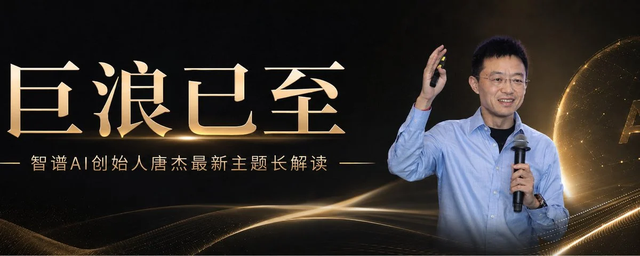
Zhipu AI founder Tang Jie released an internal letter on July 11, 2026, announcing a "peak-reaching plan" to prioritize AGI over short-term monetization (Source: PANews/Zhipu AI, July 11, 2026)
05 A-Shares and H-Shares: Two Different Escape Routes
Both companies moved in lockstep: less than six months after listing in Hong Kong, they rushed to relist on the A-share market.
MiniMax signed a coaching agreement with CITIC Securities on May 29 to pursue an A-share listing. Zhipu moved faster, completing coaching and planning to raise HK$15 billion on the A-share market.
Why the rush to relist on the A-share market? Two reasons.
First, Hong Kong's valuations for loss-making tech firms are unforgiving. MiniMax's fate proved that—peaking at HK$410 billion, it crashed to HK$70+ billion in six months. Dominated by institutional investors, the Hong Kong market dislikes unclear tech stories and resorts to short-selling. The A-share market, with its retail investor base, is more receptive to "large model" and "AI" concepts, potentially offering higher valuations.
Second, the Shanghai Stock Exchange revised its rules in June, allowing large model firms to list under the STAR Market's fifth set of criteria. This set permits unprofitable companies to list with lower revenue thresholds—essentially, a green light for loss-making AI firms.",
The two paths of A-shares and Hong Kong stocks are essentially two different financing channels. However, financing is not the goal, but a means. What should be done when the money raised is spent? That is the ultimate question.
On July 8th and 9th, China's large model industry completed its first real 'disciplinary training for listed companies.'
The answer from the capital market is harsh: companies trading on faith can rise by 13%, while companies trading on financial statements can fall by 18%. The same technological wave, two different valuation fates.
Zhipu has temporarily won this round, but it holds a ticking time bomb—in January 2027, 90% of its equity will be unlocked. MiniMax suffered a heavy (severe) defeat, but at least it paved the way for the entire industry: after a large model company goes public, every number will be placed under a microscope.
From now on, no one will ask only about the size of your model; they will only ask when you will start making money.
This trial has only just begun.
-
![]()
Final Verdict: The Strategic Importance of GAC Honda’s Early Joint Venture Renewal
-
![]()
SpaceX's Stock Price Falls 30% from Peak! Musk Warns Short Sellers: Your Survival Probability is Extremely Low
-
![]()
100,000 Steps at WAIC! 10 Questions to Understand the Next Phase of the AI Industry: From Chatting to 'Embodied' Work
-
Image Stabilization Motor Leader’s Second Attempt at Hong Kong IPO: Shinco Motor’s Rise, Challenges, and Ties to O-film Tech
-
![]()
Personnel Shuffle: Independent Director Mi Xuming Steps Down from OFILM
-
![]()
Net Profit Anticipated to Skyrocket by 103%: What Gives This Optical Company a Competitive Edge?
-
In Just One Year, China Unveils Unicorns Valued at 10 Trillion Yuan!
-
![]()
6 Park Companies Shine at WAIC: How Hong Kong Science Park Bridges AI from Research to Industry