Why Are Automakers Flocking to Humanoid Robots? Can They Make It Happen?
 07/20 2026
 427
427
Why Are Automakers All Embracing Humanoid Robots?
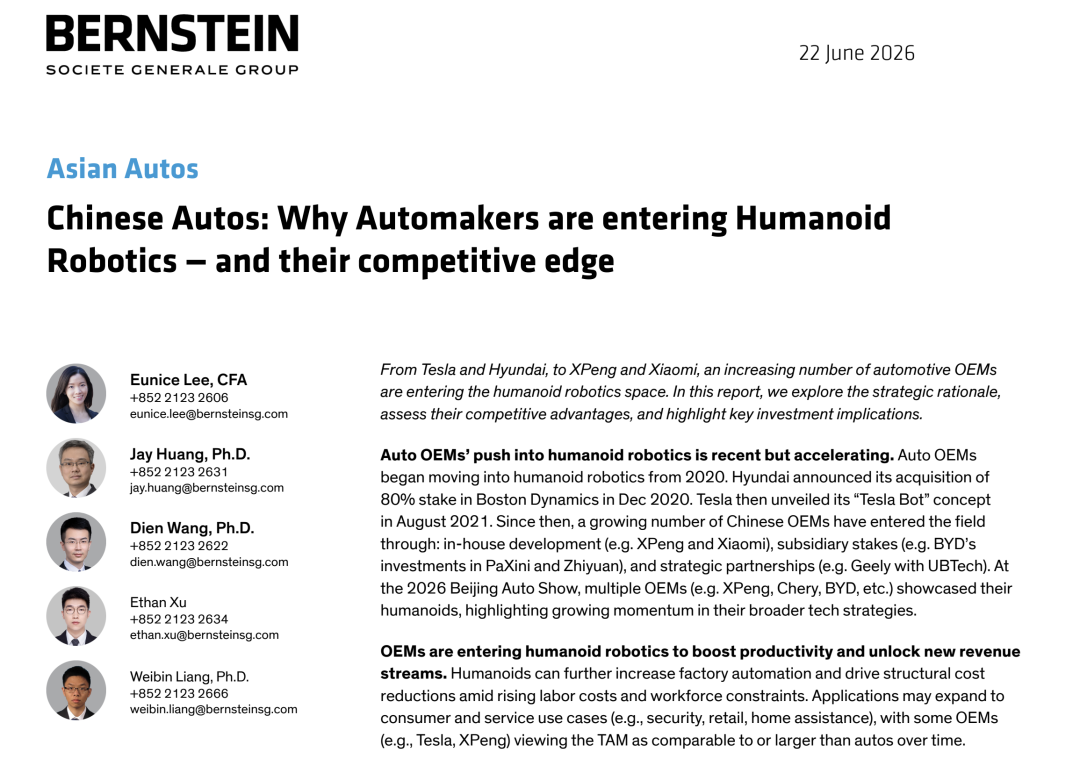
Tesla's Optimus is set for mass production by 2027. XPENG's Iron is poised to roll off the production line by the end of the year, and Xiaomi has open-sourced the 4.7 billion-parameter embodied model behind CyberOne.
Hyundai has secured an 80% stake in Boston Dynamics. BMW has brought Figure into its workshops, and Toyota is using Agility's Digit for logistics operations.
From Hyundai's strategic move in 2020 to a lineup of robots at the 2026 Beijing Auto Show, in just six years, nearly all automakers have ventured into this domain.
Globally, profits in the automotive manufacturing and parts sectors are on the decline. Automakers are responding to this trend by leveraging their core strengths, integrating manufacturing capabilities, supply chains, and embodied intelligence.
01
Why the Shift? Two Key Considerations
● The first consideration revolves around reducing labor costs, particularly due to the high expenses associated with overseas workers.
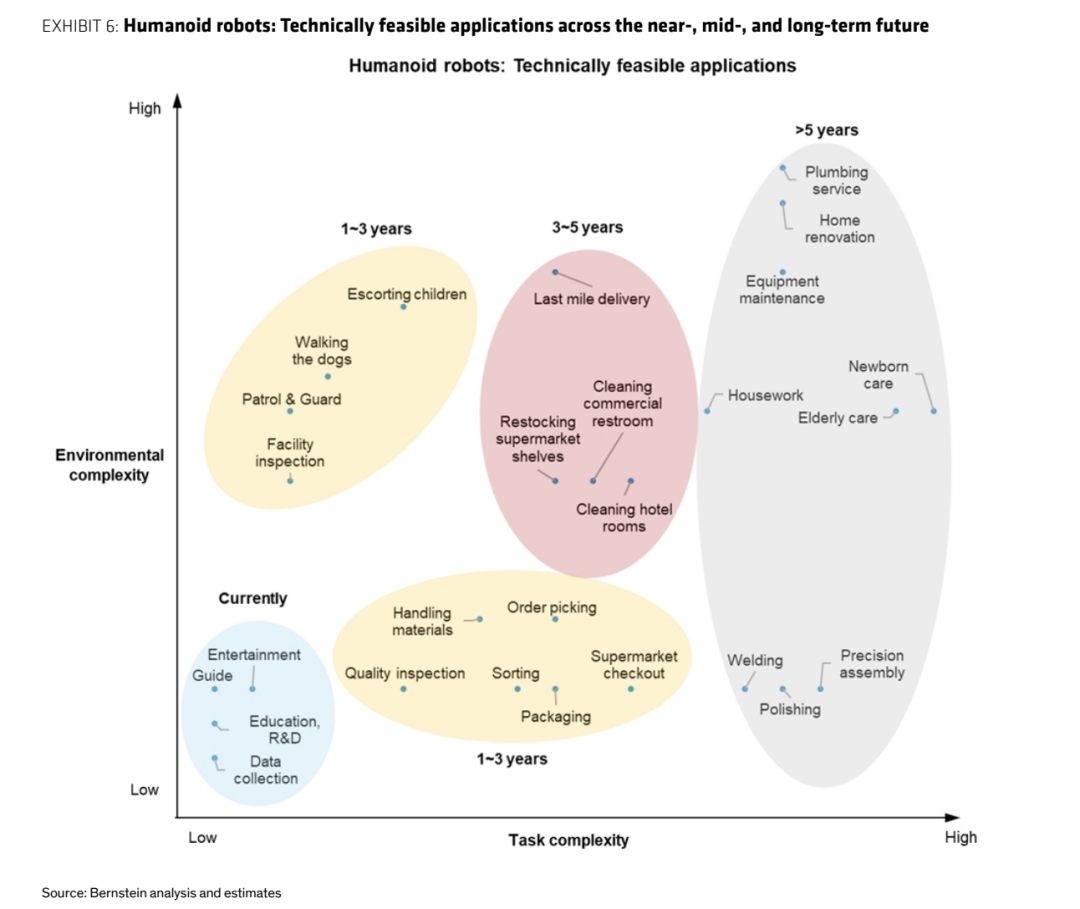
Stamping, welding, and painting workshops have long been dominated by automated machinery. However, final assembly and in-plant logistics still heavily rely on human labor. Material handling, precision assembly, quality inspection, and testing are tasks with high injury rates that struggle to attract workers during peak seasons.
With an aging population and escalating labor costs, automakers are eager to fill this void. Humanoid robots, capable of navigating narrower passages and more complex workstations, offer a solution to bridge the automation gap.
Why humanoid robots and not robotic arms? Robotic arms are fixed to workstations and become outdated with production line changes. Humanoid robots, on the other hand, can walk, grasp, and adapt, eliminating the need for new equipment with each model change.
On the final assembly line, tasks involve moving, screwing, and inspecting—tasks that robotic arms cannot perform. Automakers are making strategic, long-term decisions, not merely chasing after novelty.
● The second consideration is about generating external revenue streams.
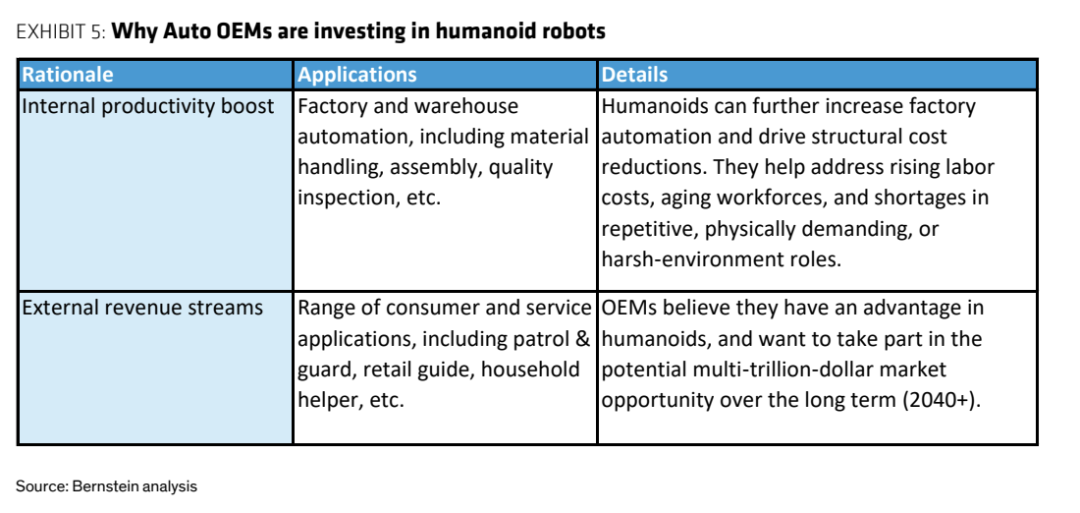
Tesla and XPENG envision the humanoid robot market to be as vast, or even larger, than the automotive market itself. Applications range from factory floor guides to patrol security and home care, expanding layer by layer.
The allure for automakers lies not just in entering a potentially vast new market but also in transferring their expertise in large-scale manufacturing, supply chains, software, perception, and control to this new product category.
Automakers believe they possess structural advantages in this new arena, and this belief is not without merit.
After enduring round after round of price wars in the domestic auto market, gross margins have been squeezed to razor-thin levels. Automakers are seeking a second growth curve, and robots represent one of the few directions that can leverage their manufacturing capabilities while offering independent growth potential. The external revenue consideration is, in a way, insurance for their primary business.
02
What Paths Are They Taking?
There are three main approaches, with each company adopting a different strategy.
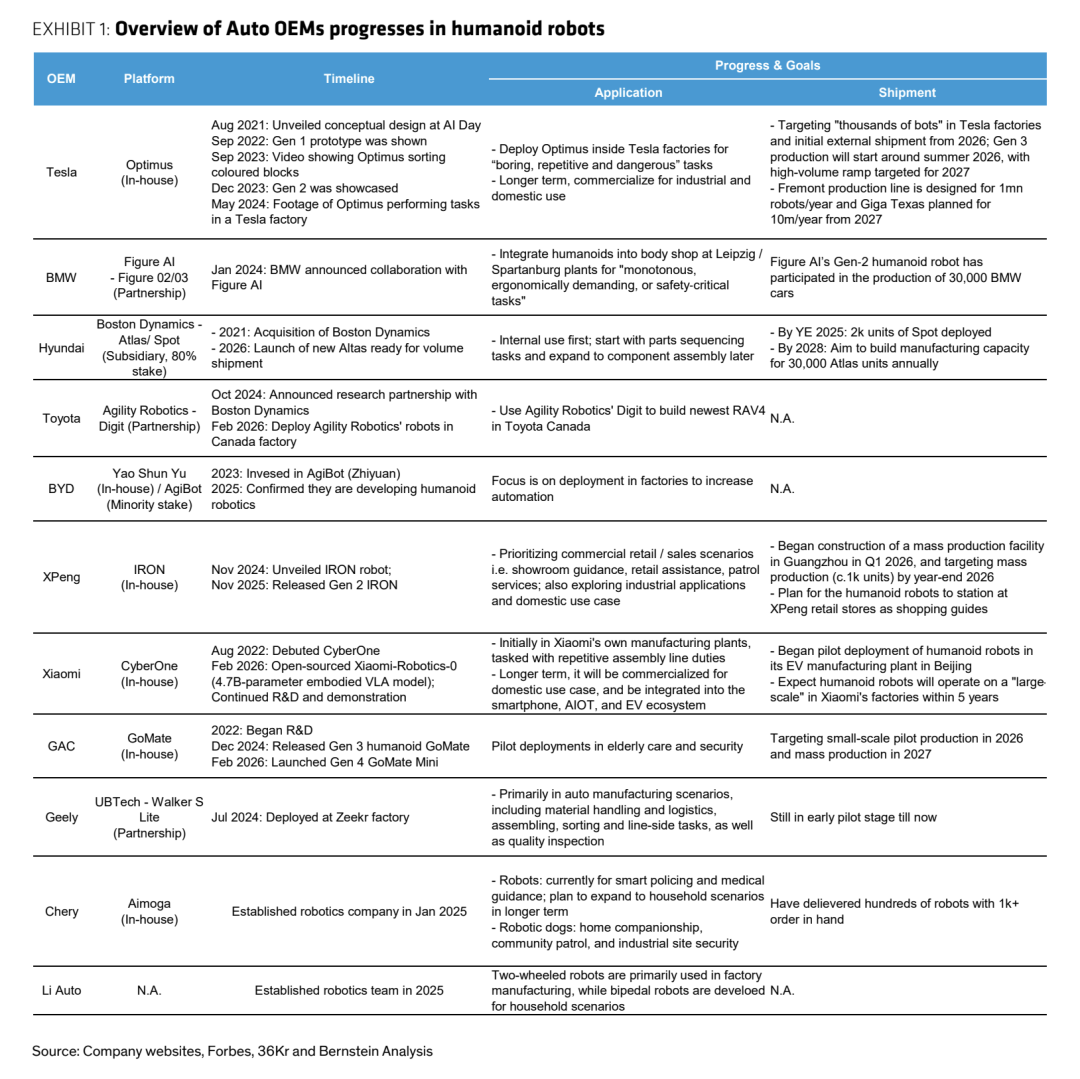
◎ In-house Research and Development: Tesla's Optimus has evolved from Gen1 in 2022 to Gen2 and Gen2.5 in 2025. The Fremont production line is designed for annual production of 1 million robots, with the Texas factory planning for 10 million units starting in 2027.
XPENG's Iron made its debut at the 2024 AI Day, walking so naturally that it became a social media sensation. Gen2 was released in 2025, with the Guangzhou production line commencing construction in the first quarter and aiming for annual production of about 1,000 units by the end of the year, intended for use as in-store guides.
Xiaomi began its journey in 2020, unveiled CyberOne in 2022, and open-sourced its embodied model in 2026. Robots are already performing repetitive assembly tasks on the production line at its Beijing factory.
BYD's internal project, codenamed "Yao, Shun, Yu," was launched in 2022, partnering with the Hong Kong University of Science and Technology to establish an embodied intelligence lab, with vertical integration extending to batteries, motors, semiconductors, and precision manufacturing.
◎ Acquiring Stakes is the second approach. Hyundai acquired about 80% of Boston Dynamics in late 2020, transitioning Atlas from R&D to factory deployment, with a production capacity target of 30,000 units by 2028, deploying over 25,000 in its own factories. BYD has invested in Zhiyuan's PaXini and Zhiyuan, leveraging external expertise to complement its own capabilities.
◎ Partnerships represent the third approach.
Geely's Zeekr partnered with UBTECH's Walker S for material handling, assembly, and sorting in factories. BMW teamed up with Figure, with Figure's robots already involved in producing over 30,000 vehicles at the Spartanburg plant. Toyota adopted a lightweight approach, using Agility's Digit in a Robot-as-a-Service (RaaS) model for logistics at its Canadian factory.
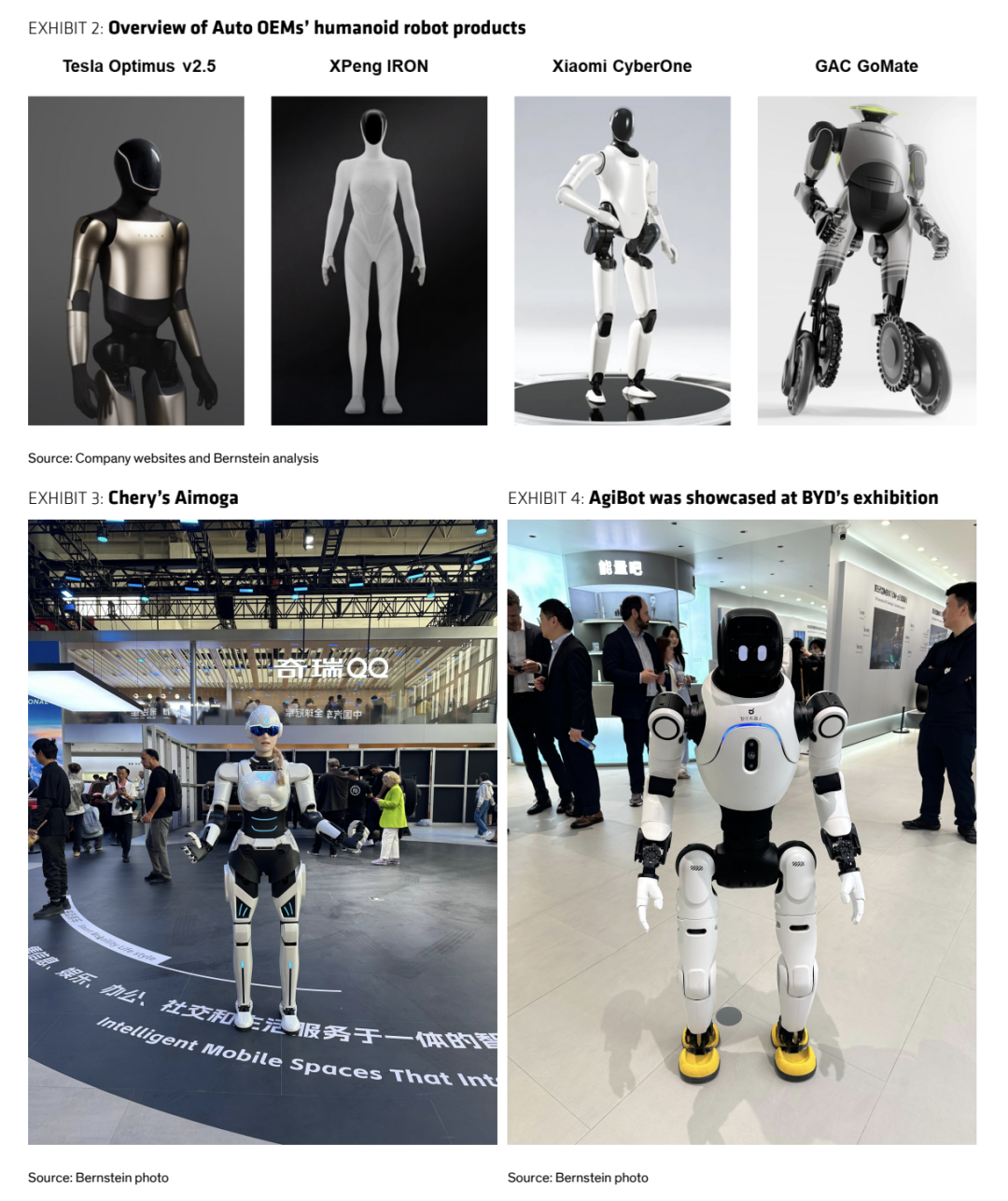
◎ Chery is among the fastest movers, having delivered 220 Moyin units in 2025 at a unit price of 285,800 yuan, available on JD.com, with deployments in public scenarios such as policing and medical guidance. Chery also developed robotic dogs for home companionship, community patrols, and industrial security, holding over 1,000 orders.
GAC's GoMate has reached its fourth-generation Mini, testing applications in elderly care, security, and industry, differentiating itself with a wheel-leg hybrid mobility structure. It has spun off its robotics business into an independent subsidiary to pursue commercialization with a more market-oriented approach.
Changan and Seres are also transitioning from pilot projects to early-stage scale deployment.
Li Auto is taking a different path, framing robots under the broad concept of "spatial robots," with wheeled models for factories and bipedal models for homes. In 2025, it established a dedicated robotics team, heavily investing in the Mind GPT large model to integrate robots into vehicles, wearables, and smart ecosystems.
BMW has progressed from pilot projects to actual production lines, with Figure's robots already involved in producing over 30,000 vehicles at the Spartanburg plant and planning to expand to Leipzig in the summer of 2026 for battery assembly and in-plant logistics.
The technology stack accumulated over a decade of intelligent driving development has just matured, and the cost curve for humanoid robots has just reached an inflection point. Venturing into this field five years earlier would have been unsustainable due to immature algorithms and supply chains; delaying by five years would have left no room at the table. The timing is impeccable.
03
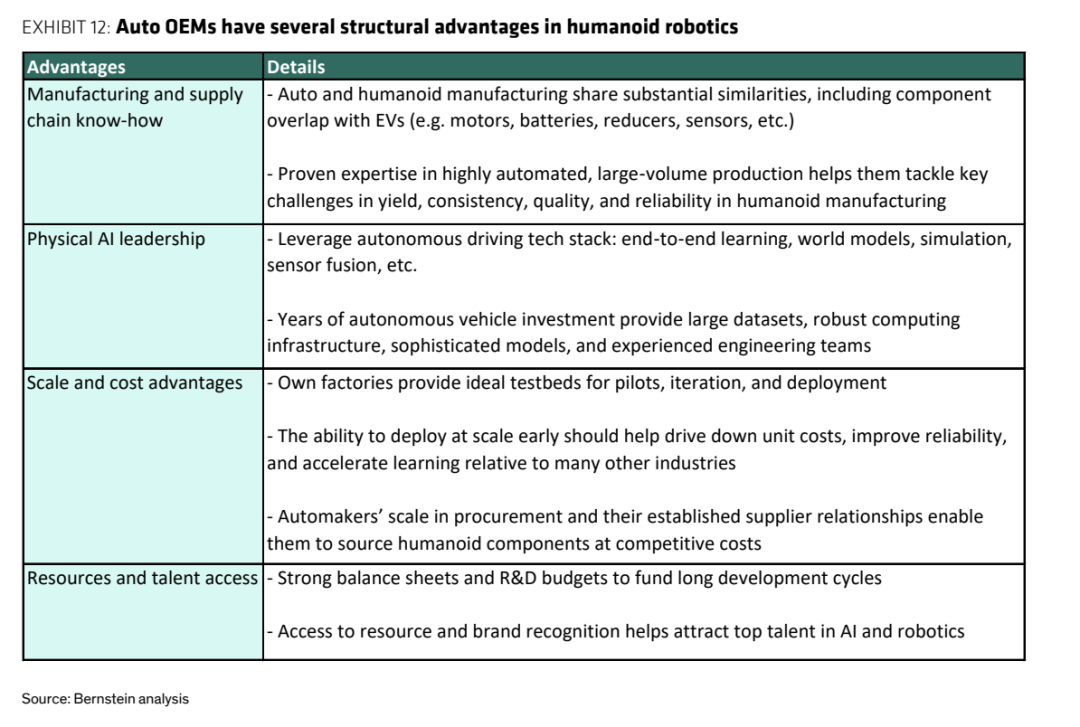
Why Do Automakers Believe They Can Succeed: Four Key Strengths
● The first strength lies in manufacturing and supply chain expertise.
The hardware overlap between vehicles and robots is striking. Motors, batteries, reducers, LiDAR, and cameras are all components shared by both. The experience automakers have accumulated in highly automated, large-scale production is directly applicable to solving the most challenging issues in humanoid robots: yield, consistency, quality, and reliability.
Xiaomi's factory tests show that robots achieve over 90% success rates in assembly tasks, though dexterous hand precision is still catching up. This is a task that startups might find daunting.
● The second strength is leadership in embodied intelligence.
Software and autonomous driving are interconnected. VLA models, world models, end-to-end learning, simulation systems, and multimodal perception fusion are applicable to both robots and intelligent driving. Automakers have invested in intelligent driving for a decade, accumulating vast amounts of data, a solid computational foundation, and capable engineering teams.
Many humanoid robot endeavors are natural extensions of their intelligent driving technology stacks. XPENG's leadership in intelligent driving underpins its embodied intelligence, not just as rhetoric but because its technology stack is rooted in autonomous driving. Few startups possess this foundation; they excel in algorithmic creativity but lack access to real-world driving data.
● The third strength is scale and cost efficiency.
Factories and warehouses are the initial landing spots for robots, and automakers' own workshops serve as ready-made testbeds.
They can test and iterate rapidly in their own factories before deploying globally across their production networks. Large procurement volumes and stable supplier relationships enable component costs to be driven lower than competitors.
Tesla's ambition is the most straightforward, with the Fremont production line designed for annual production of 1 million robots and the Texas factory planning for 10 million units starting in 2027.
No startup can match this production capacity. This early-stage scalability helps drive down unit costs and improve reliability.
● The fourth strength is resources and talent.
Compared to most robotics startups, established automakers have stronger balance sheets, larger R&D budgets, and greater global brand recognition. They can withstand long-term cash burn and attract top AI and robotics talent.
Compared to star startups like Figure and Agility, automakers have deeper pockets and stronger brands, allowing them to sustain cash burn over the long term without panic. Startups rely on financing to survive, while automakers fund R&D through vehicle sales, operating on a different level of confidence.
With these strengths revealed, a dose of reality is needed. Advantages do not guarantee victory.
Startups lead in innovation, while automakers excel in industrialization and commercialization. Bringing robots to market is fundamentally an engineering and integration challenge, not about breakthroughs in a single area.
In China's fiercely competitive environment, laboratory leadership is fleeting. Hard engineering and mass-producibility are what sustain lasting competitive advantages. Having strengths is not enough; the numbers must add up.
Bernstein provides a clear calculation: A robot costs about $50,000, while the annual salary of an entry-level production line worker in China is about $13,000. Under current assumptions, payback takes 7 to 8 years. They argue that payback must be reduced to within 5 years for true attractiveness.
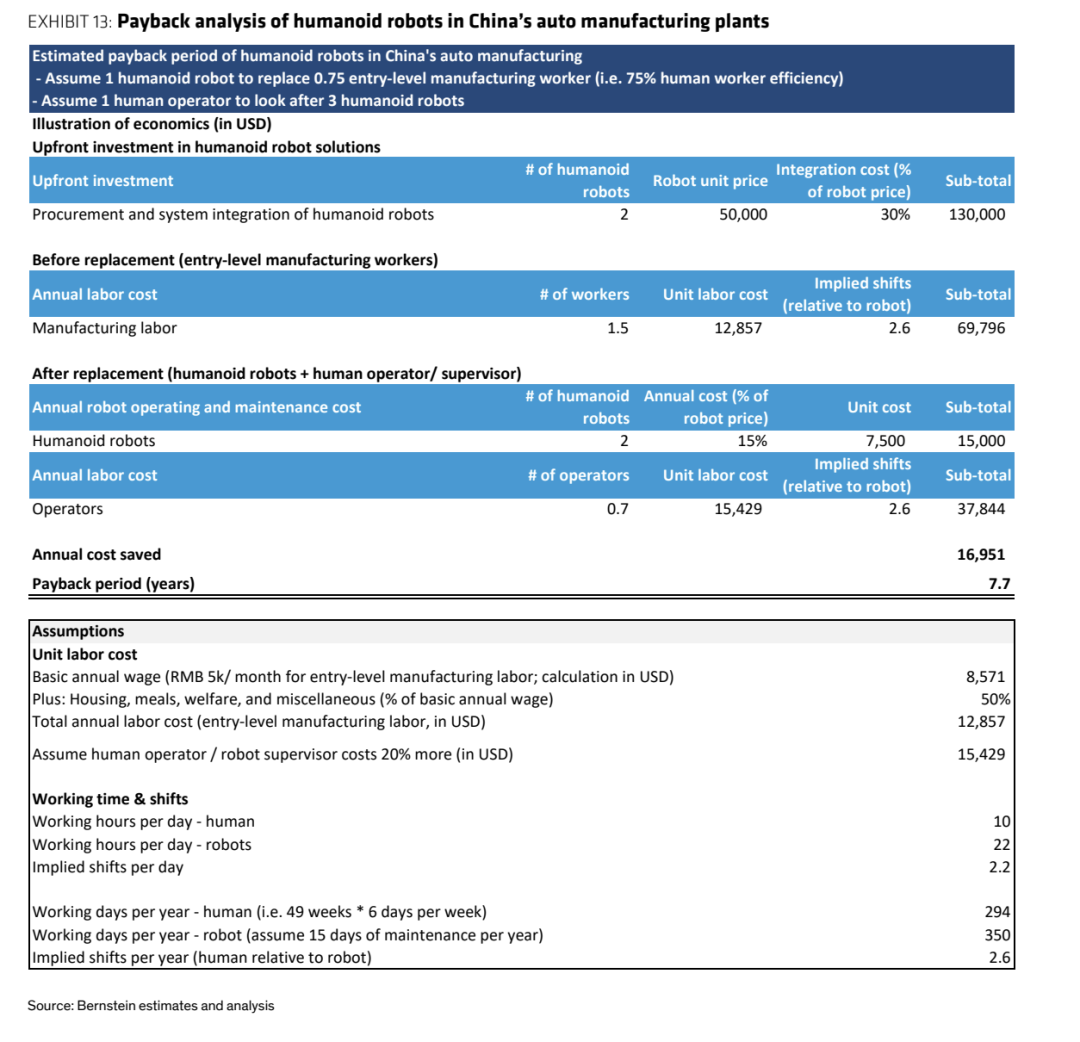
The baseline scenario is detailed.
Two robots replace 1.5 workers, operating at 75% efficiency, with one operator supervising three robots. Robots work 22 hours a day, 350 days a year, while workers work 10 hours a day, 294 days a year.
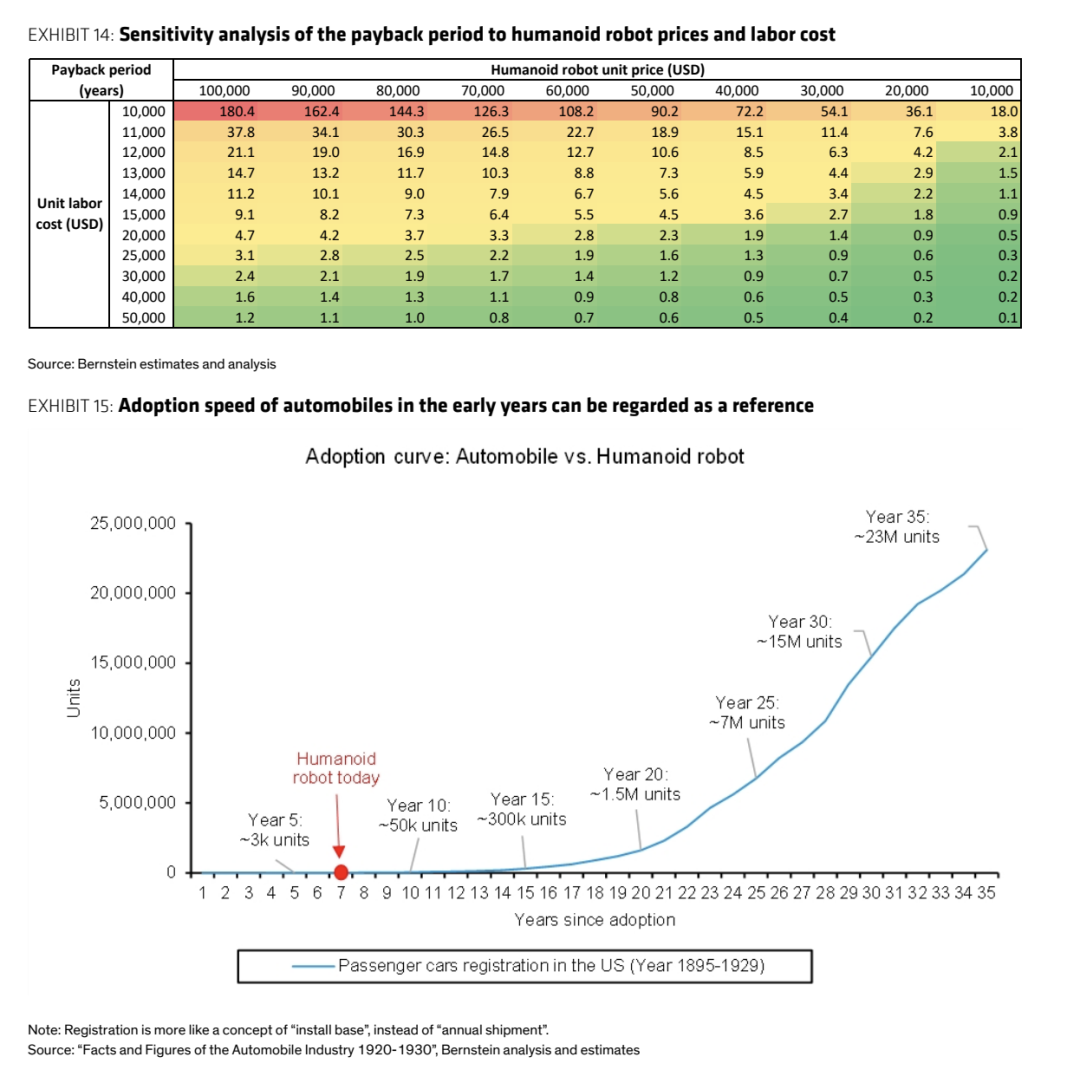
This results in annual savings of about $17,000, with payback at 7.7 years. If robot prices drop to $40,000 and worker salaries rise above $14,000, payback falls to within 5 years. Each price reduction significantly steepens the cost curve. The trend is moving in a positive direction.
Over the next 3 to 5 years, if robot costs fall below $40,000 and labor costs rise above $14,000, the ROI calculation becomes more favorable, and adoption will accelerate significantly.
Where are the real bottlenecks? Dexterous hands.
Even Tesla admits that dexterous hands are the current primary bottleneck. No matter how smooth the system-level integration, without functional hands, deployment is impossible. Other challenges include general intelligence, safety, and cost.
The gap between "almost there" and "success" is narrow, but the direction is correct. Automakers have a seat at the table, but the cards have not been fully revealed. The key to pulling ROI across the threshold lies in dexterous hands. Tesla acknowledges this as the current primary bottleneck. The gap between model-predicted grasping and real-world feel (tactile sensation) remains significant.
2027 will be a watershed year, with Tesla's promised mass production, XPENG's in-store deployment, and Hyundai's 30,000-unit capacity all facing scrutiny. The promises made will then be put to the test.
◎ XPENG appears most aligned with consumer and home applications. Iron's humanoid design explicitly targets in-store guides and home care, with emotional companionship offering the potential for structural gross margin improvements. It plans to deploy about 1,000 robots as in-store guides by the end of 2026, with its intelligent driving and embodied intelligence accumulations providing endorsement.
◎ Xiaomi is taking a different path, viewing robots as the physical embodiment of its "human × vehicle × home" ecosystem, connecting phones, AIoT, and mobility. With such a large device base, its distribution and data advantages are unmatched.
◎ BYD boasts the deepest vertical integration, handling batteries, motors, semiconductors, and precision manufacturing in-house, with a global distribution network that could monetize future scenarios.
◎ Chery's path is the clearest, progressing in three steps from companion robots to public services and then into homes, already testing the waters in consumer channels. Changan plans to enter homes with mass production before and after 2028.
Automakers' main businesses are still engaged in fierce battles.
Robots are a distant hope, with factory efficiency improvements being immediate, while external monetization remains far off. Mastering their own production lines is more reliable than rushing to sell robots externally.
From an industry perspective, whether robots will become automakers' next battery or next intelligent driving technology is too early to conclude. However, one thing is clear: Those willing to tackle the hard problems in their own factories are closer to success than those who only release conceptual videos.
Will the automakers' entry into the field of robotics follow the same path as their ventures into smartphones and chips—generating much buzz but ultimately yielding few enduring participants? This question remains unanswered. The intelligent driving wave was similarly marked by heavy asset investments, long development cycles, and substantial cash burn, leaving only a handful of survivors. Opportunities exist, but the ability to capitalize on them hinges on engineering prowess rather than mere product launches.
Summary
The automotive industry's foray into humanoid robots is firmly rooted in reality, with a well-defined trajectory. Success will not be determined by who achieves the milestone of making a robot walk first, but rather by who can effectively tackle issues of cost, reliability, and scalability.
At present, the return on investment (ROI) is not yet fully realized, but the overall trend is favorable for automakers. The development of dexterous robotic hands will serve as a crucial milestone—whoever overcomes this challenge first will gain a significant advantage. Automakers have secured a place at the table, but the time to reveal their strategies has not yet arrived.
-
![]()
Final Verdict: The Strategic Importance of GAC Honda’s Early Joint Venture Renewal
-
![]()
SpaceX's Stock Price Falls 30% from Peak! Musk Warns Short Sellers: Your Survival Probability is Extremely Low
-
![]()
100,000 Steps at WAIC! 10 Questions to Understand the Next Phase of the AI Industry: From Chatting to 'Embodied' Work
-
Image Stabilization Motor Leader’s Second Attempt at Hong Kong IPO: Shinco Motor’s Rise, Challenges, and Ties to O-film Tech
-
![]()
Personnel Shuffle: Independent Director Mi Xuming Steps Down from OFILM
-
![]()
Net Profit Anticipated to Skyrocket by 103%: What Gives This Optical Company a Competitive Edge?
-
In Just One Year, China Unveils Unicorns Valued at 10 Trillion Yuan!
-
![]()
6 Park Companies Shine at WAIC: How Hong Kong Science Park Bridges AI from Research to Industry