Computing Power Supplier Bags Orders Worth Over 600 Million Yuan, Yet Receives Only 4.5 Million Yuan in Actual Payments!
 07/31 2026
 400
400
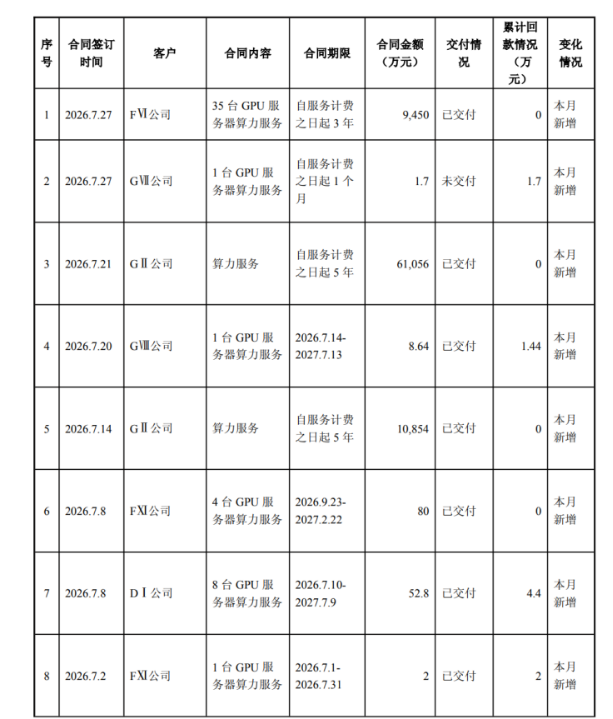
On the evening of July 30, Lianhua Holdings released an announcement stating that this month, the company had secured new contracts for delivered computing power servers worth approximately 114 million yuan. Additionally, it signed a five-year computing power service contract with GⅡ company, valued at 611 million yuan, with the services already rendered.
Nowadays, Lianhua Holdings consistently discloses its progress in the computing power sector on a monthly basis. However, this regularity is not due to a booming business but rather a regulatory requirement. In November 2023, shortly after Lianhua announced its entry into the computing power market, the Henan Securities Regulatory Bureau issued a warning letter, citing four key issues: the release of information through non-statutory channels, inaccurate and misleading disclosures, failure to adhere to deliberation procedures, and non-compliant registration of insider information. The regulatory authorities viewed the initial hype surrounding the 'Monosodium Glutamate King Venturing into Computing Power' as an attempt to 'stir up market sentiment.' Consequently, as part of the rectification measures, Lianhua was mandated to continuously disclose the true progress of its computing power business.
High Capital Expenditures and Tight Cash Flow
Judging by the recent disclosures from several domestic computing power companies, there has been a general upsurge in procurement and orders within the sector. However, this is accompanied by high capital expenditures and low payment collections, resulting in strained cash flows. According to the announcement, Lianhua secured 114 million yuan in procurement this month and signed a service order worth 611 million yuan. Nevertheless, as of July 29, 2026, based on the computing power service contracts and software service contracts previously signed by Lianhua Zixing, Xinjiang Lianhua Zixing, and Zixing Exploration, the total payments received this month amounted to only 4.4868 million yuan.
This is not the first instance where Lianhua has faced the predicament of 'large contracts but small payments.'
On an annual basis, Lianhua's net operating cash flow plummeted from 652 million yuan in 2024 to 220 million yuan in 2025, marking a year-on-year decrease of 66%. As the computing power business expands, the main business's ability to generate cash is being severely compromised. This is because purchasing computing cards requires substantial upfront investments, while rental income remains elusive.
Despite these challenges, Lianhua Holdings remains resolute in its pursuit of success in the computing power business. At the mid-year summary meeting this year, CEO Zeng Yanshuo emphasized that in the first half of the year, the company continued to advance its 'Consumer + Technology' dual-drive strategy. It consolidated and expanded its main business advantages while solidly developing computing power technology-related businesses, maintaining a generally stable and improving development trend.
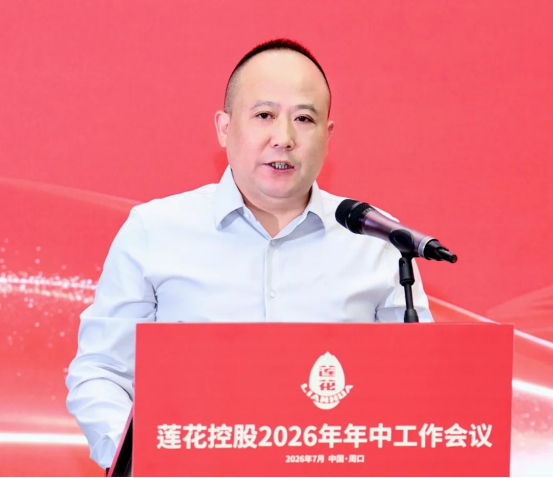
Lianhua Vice Chairman and CEO Zeng Yanshuo
Can Overseas Models Offer a Viable Solution?
Players in the computing power leasing market across the Atlantic operate in a starkly different manner.
Take CoreWeave, for instance. It began as a GPU cloud provider, but its core strength does not lie in the sheer number of cards it possesses. Instead, it excels in securing long-term leases with reputable clients such as Microsoft and OpenAI. CoreWeave then leverages these leases as collateral to obtain bank loans, issue bonds, and raise funds to purchase additional cards. For CoreWeave, contracts are valuable assets that can be utilized to engage financial institutions.

In contrast, computing power contracts in the domestic market often resemble compliance documents, primarily used to respond to regulatory inquiries and reassure the market that 'we are indeed making progress.'
Lianhua serves as a prime example. In 2025, Lianhua terminated large sales contracts totaling 575 million yuan, accounting for 82.67% of its total annual sales contracts. This included a 555 million yuan computing power service contract with a Shanghai state-owned enterprise that mysteriously vanished. Would banks dare to accept such contracts as collateral?
The crux of the difference between the two models lies in whether contracts can be effectively converted into cash. CoreWeave's clients are creditworthy entities like Microsoft, which pose a low default risk, thereby rendering their contracts highly valuable. In contrast, Lianhua's clients remain unclear, and payment collections are uncertain, reducing their contracts to mere pieces of paper.
A research report by CITIC Securities, citing data from SemiAnalysis, stated that by April 2026, overseas H100 lease prices had surged by 40% over five months. While computing power prices are indeed on the rise and demand remains strong, whether we can capitalize on this price surge remains to be seen.
-
![]()
Computing Power Supplier Bags Orders Worth Over 600 Million Yuan, Yet Receives Only 4.5 Million Yuan in Actual Payments!
-
Alibaba Is Just Five Months Away from Securing Two Consecutive AI Coding Titles
-
![]()
Less Investment Isn't Apple's Get-Out-of-Jail-Free Card
-
![]()
The 'King of Africa' Tecno Mobile: What Is the Market Hesitating About After Its 'V-shaped' Rebound?
-
![]()
ByteDance Restructures Feishu, What Signals Does It Send?
-
![]()
ByteDance Overhauls Feishu: What Strategic Signals Are Being Sent?
-
![]()
Pay $39 a Month with Apple Upgrade: Apple's New Business, Your Old Wallet
-
![]()
The Open-Source Debate Dividing Silicon Valley