The Evolution of Computing Power in the Financial Industry: From 'Avoid Downtime' to 'GPU Shortage'
 06/05 2026
 517
517
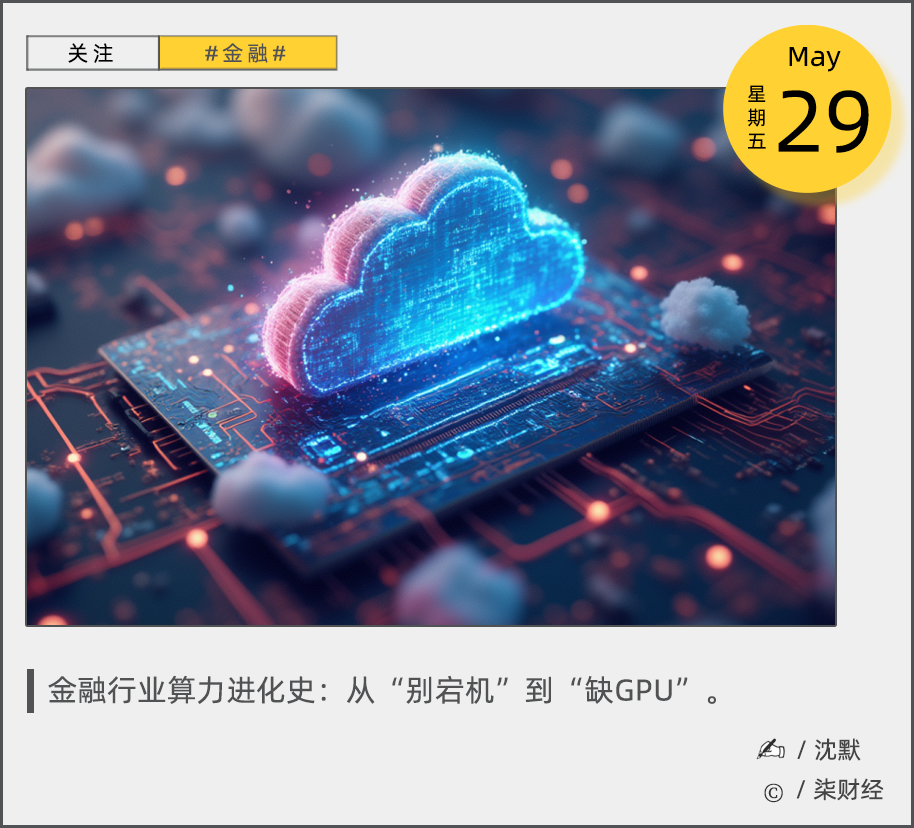
As computing power has become the 'utilities' of the digital age, high-performance computing in the financial industry has rapidly evolved from a back-office cost center to a core engine of front-office competition, regarded by banks, insurance firms, securities brokers, and other institutions as a 'must-answer question' for survival.
Today, with NVIDIA restricting sales, domestic card production capacity strained, and the lengthy construction cycles of intelligent computing centers, a CTO of a small-to-medium-sized bank may be anxious about 'failing to secure GPU computing power'—large model risk control, intelligent customer service, and real-time fraud prevention all rely on AI chips.
Yet, thirty years ago, his predecessors worried about something else: ensuring mainframes did not crash.
Back then, the IT department's greatest fear was a mainframe crash halfway through 'batch processing,' leaving all bank branches waiting to balance their books, with queues of customers extending onto the streets.
From 'avoiding downtime' to 'lacking computing power,' what exactly has happened to the financial industry's thirst for computation over the past four decades?
01
The Era of Centralized Computing: Computing Power as a 'Luxury'
In the 1980s and 1990s, computing power was a true 'luxury' in the financial industry.
An IBM mainframe cost tens of millions of dollars, affordable only by wealthy state-owned banks. Operation manuals spanned dozens of pages, computer rooms required constant temperature and humidity control, and maintenance staff, dressed in white coats, guarded computing equipment with the same solemnity as nuclear reactors.
Financial operations back then were simple: deposits, withdrawals, and transfers, with a daily 'batch processing' at day's end, during which all branches halted operations to balance their books. Computing power served only the core accounting system, with the goal of 'avoiding errors.'
Change began in the late 1990s. ATMs were widely deployed, counter terminals evolved from 'dumb terminals' to intelligent PCs, and computing power began to decentralize from the head office to branches.
In 2002, China UnionPay was established, marking the reality of interbank transactions and the first need for computing power to work online.
In the following years, state-owned banks and regional banks initiated data centralization efforts, with computing power shifting from decentralization back to centralization.
On September 25, 2005, China Construction Bank's three-year data centralization project (DCC) officially went live, with the successful integration of the Jilin Provincial Branch's counter system into the head office's data center, achieving business and data centralization across 38 first-tier branches and the head office's business department. That same year, the Agricultural Bank of China followed suit, aiming to establish a systemic advantage of 'one legal entity, one version, one network, and one center.'

This computing power revolution was not merely about stacking servers together but involved unified logical scheduling. As Chang Zhenming, then president of China Construction Bank, put it, the core was the 'head office's ability to monitor real-time transaction risks.'
Meanwhile, to lay a solid foundation for data centralization, the Industrial and Commercial Bank of China initiated the cross-century '9991 Project,' acquiring land in Shanghai's Waigaoqiao and Beijing's Xisanqi to build two ultra-large data centers, setting an example for other state-owned banks and joint-stock banks and marking the beginning of China's banking industry's self-built data center era.
However, the China Banking Regulatory Commission (CBRC) quickly recognized that after data centralization, risk management of information assets would become a new challenge. In early 2005, the 'Interim Measures for the Risk Supervision of Information Assets in the Banking Industry' entered its eighth round of revisions, with regulators beginning to examine this computing power revolution through a 'regulating legal entities and managing risks' lens.
02
The Cloud Computing Era: Computing Power Shifts from 'Self-Built' to 'Leased'
Entering the second decade of the 21st century, things changed again.
Mobile banking, mobile payments, online credit, and real-time risk control—the explosion of financial business scenarios no longer demanded 'stable batch processing' but 'fluctuating real-time computation.' Peak traffic on Double 11 was dozens of times higher than usual; whenever quarter-end marketing campaigns spiked, IT departments had to temporarily add servers.
According to PBOC reports, from 2013 to 2016, mobile payment transactions in China surged from 1.674 billion to 25.71 billion, a 15-fold increase in three years, essentially completing the transition from 'niche adoption' to 'universal standard.'
By the end of 2017, Zhang Feng, Chief Engineer of the Ministry of Industry and Information Technology, announced at a State Council Information Office press conference that China's mobile payment transaction volume had reached nearly 150 trillion yuan, ranking first globally.
The surging wave of mobile payments, to a certain extent, disrupted the financial industry's previous reliance on self-built data centers.
A greater constraint came from costs. Servers had to be purchased, data centers built, and electricity bills paid, yet computing power utilization remained low.
According to calculations by Inspur Artificial Intelligence Research Institute, the average utilization rate of China's intelligent computing centers was only 30%. Xu Zhaohui, Chief Engineer of the Postal Savings Bank of China, once admitted at an industry conference that 'achieving 60% utilization during peak periods was already excellent.'
'Unable to afford it, unable to use it well' became a new dilemma for financial institutions. The solution was to move to the cloud.
In 2016, the CBRC issued the 'Regulatory Guidelines for the 13th Five-Year Development Plan of Information Technology in China's Banking Industry,' with cloud computing as one of the key focuses, stating, 'Explore the construction of private cloud platforms to form elastic resource supply, flexible scheduling, and dynamic metering' and 'Jointly plan and build public cloud platforms for the banking industry to form a batch of technical public services such as public infrastructure, public interfaces, and public applications.'
Driven by policy and bottlenecked by reality, financial institutions began experimenting with a 'computing power as a service' model, shifting from private clouds to industry clouds and then to hybrid clouds—renting computing power on demand instead of maintaining it in-house.
Yusys Technologies exemplified this transformation. Leveraging its self-built 'Yusys Financial Cloud,' it launched intelligent computing leasing and scenario-based service solutions, specifically addressing banks' pain points of GPU resource shortages, difficult computing power coordination, and low utilization in the intelligent computing field.
According to relevant industry reports, by 2025, 85% of financial institutions' office systems will have migrated to the cloud, with 90% of peripheral business systems following suit.
However, cloud adoption rates varied by bank type, with joint-stock banks having the highest median rate of 95.73%, followed by state-owned banks and private banks, both exceeding 85%.
03
The Era of AI Large Models: Computing Power Becomes a 'Scarce Asset'
In late 2022, ChatGPT ignited a global large model craze. The financial industry quickly realized: a new revolution had arrived.
Digital customer service, real-time risk control, personalized recommendations, intelligent investment advisory—large models could reconstruct nearly every financial scenario.
On December 26, 2025, the National Financial Regulatory Administration released the 'Implementation Plan for the High-Quality Development of Digital Finance in the Banking and Insurance Industries,' proposing 33 tasks across six domains: digital finance governance, digital financial services, digital technology applications, data element development, and risk management, supporting qualified financial institutions in building enterprise-level AI platforms.
On March 11, 2026, the People's Bank of China held its 2026 technology work conference, explicitly stating the need to 'deepen the integration of business and technology, actively, steadily, and safely promote the application of AI in the financial sector, and unleash the momentum of digital and intelligent development.'
This statement established the PBOC's overall tone for financial AI applications: 'active and steady' encourages exploration, while 'safe and orderly' sets compliance boundaries.
However, for financial institutions, deploying AI technologies like large models requires sufficient computing power for training and inference.
The challenge lies in the fact that training a financial large model requires thousands of GPU cards, with single-run costs in the tens of millions. Meanwhile, NVIDIA's high-end chips are restricted, and domestic card production cannot keep up.
For the first time, the financial industry tasted 'chip shortage' anxiety.
An IT executive at a joint-stock bank privately lamented, 'We used to worry about system stability; now we worry about not being able to buy cards or lease resources.'
Additionally, scenarios like real-time risk control and intelligent branches demand low latency and data locality—not everything can be offloaded to the cloud.
The solution? Computing power decentralization, evolving into two paths.

One path is the domestic computing power base. Take DHCC as an example: deeply integrated with Huawei's Ascend/Kunpeng ecosystem, it secured nearly 4 billion yuan in computing power-related projects in 2025, establishing multiple intelligent/supercomputing centers in Beijing, Wuhan, and Shenyang, directly embedding into financial institutions' infrastructure.
By the end of 2025, DHCC won the bid for China Huaxia Bank's transactional database project. Earlier, its anti-money laundering products already served over 40 banks.
The other path is edge computing power, enabling financial terminals like ATMs, branch counters, and POS machines to possess built-in AI capabilities, processing data locally without relying on the cloud.
Hengyin Technology leads in this direction.
By the end of 2025, Hengyin Technology signed a strategic partnership with domestic GPU manufacturer Moore Threads to jointly develop AI servers and training-inference integrated machines for financial, governmental, and other scenarios.
This means future bank branches could see every device as a 'smart node': when a customer scans their face, liveness detection and identity verification are completed locally without waiting for cloud responses.
Inspur Information drives change at the infrastructure level. The company argues that the financial sector has shifted from a CPU-centric model to a 'one cloud, multiple chips; one machine, multiple chips' era—ARM, C86, GPUs, and other computing chips coexist, scheduled through a unified cloud operating system.
This 'cloud + edge + endpoint' collaborative computing architecture is gradually becoming the standard form of next-generation financial infrastructure.
However, computing power decentralization brings not just an efficiency revolution but new compliance challenges.
The most daunting issue is the algorithmic 'black box.' The decision-making process of large models is difficult to trace and audit. When an AI system makes erroneous credit decisions or misjudges risks, who bears responsibility—the financial institution, the model provider, or the data supplier? Without clear accountability, AI could become a tool to evade regulation.
Data privacy is another red line. AI training requires vast amounts of financial data, but the boundaries of customer information usage remain unclear. The newly issued 'Financial Law (Draft)' explicitly requires that data collection must fulfill full disclosure obligations, prohibiting the over-collection of personal financial information.
Then there's the risk of financial information pollution. Generative AI can rapidly produce high-frequency financial commentary and investment advice. Unlike ordinary rumors, AI-generated misinformation is more 'professional'—it does not directly fabricate facts but constructs seemingly plausible yet misleading market narratives through selective material and erroneous attribution.
Regulators have begun to act. In May 2026, the Cyberspace Administration of China and two other departments jointly issued the 'Implementation Opinions on the Normative Application and Innovative Development of Intelligent Agents,' requiring, for the first time, clarification of three permission boundaries: 'user-only decision-making,' 'user-authorized decision-making,' and 'intelligent agent autonomous decision-making,' ensuring users retain right to know (right to know) and final decision-making power.
From 'usable' to 'controllable,' this is perhaps the toughest challenge in the financial AI transformation.
04
Conclusion
From mainframes to GPU clusters, from 'batch processing is sufficient' to 'millisecond-level response is the baseline,' the financial industry's pursuit of computing power has never ceased.
Each leap in computing power has accompanied the restructuring of financial formats and significant efficiency gains. In the centralized computing era, we established a nationwide unified payment and clearing system; in the cloud computing era, mobile payments and online credit became possible; in the AI large model era, we continue to witness the full implementation of intelligent investment advisory, real-time risk control, and personalized services.
Today, as bank CTOs fret over 'chip shortages,' the real test may be: With stronger computing power, what different financial services can we create?
The answer lies not in GPUs but in understanding the essence of finance. The stronger the computing power, the more we must return to the business itself: serving the real economy, preventing financial risks, and meeting the people's growing financial needs.
This is the endpoint of computing power evolution and the unchanging original aspiration of financial technology.
-
![]()
Computing Power Supplier Bags Orders Worth Over 600 Million Yuan, Yet Receives Only 4.5 Million Yuan in Actual Payments!
-
Alibaba Is Just Five Months Away from Securing Two Consecutive AI Coding Titles
-
![]()
Less Investment Isn't Apple's Get-Out-of-Jail-Free Card
-
![]()
The 'King of Africa' Tecno Mobile: What Is the Market Hesitating About After Its 'V-shaped' Rebound?
-
![]()
ByteDance Restructures Feishu, What Signals Does It Send?
-
![]()
ByteDance Overhauls Feishu: What Strategic Signals Are Being Sent?
-
![]()
Pay $39 a Month with Apple Upgrade: Apple's New Business, Your Old Wallet
-
![]()
The Open-Source Debate Dividing Silicon Valley