China Secures Global Spotlight with Vehicle-Road Coordination Safety Standards
 06/25 2026
 569
569

This marks the 76th original article from the Thinking AI Society.
Comprising roughly 1,380 words, this piece offers an estimated reading time of 4 minutes.
In early June, the International Telecommunication Union (ITU) convened a pivotal meeting in Geneva, Switzerland.
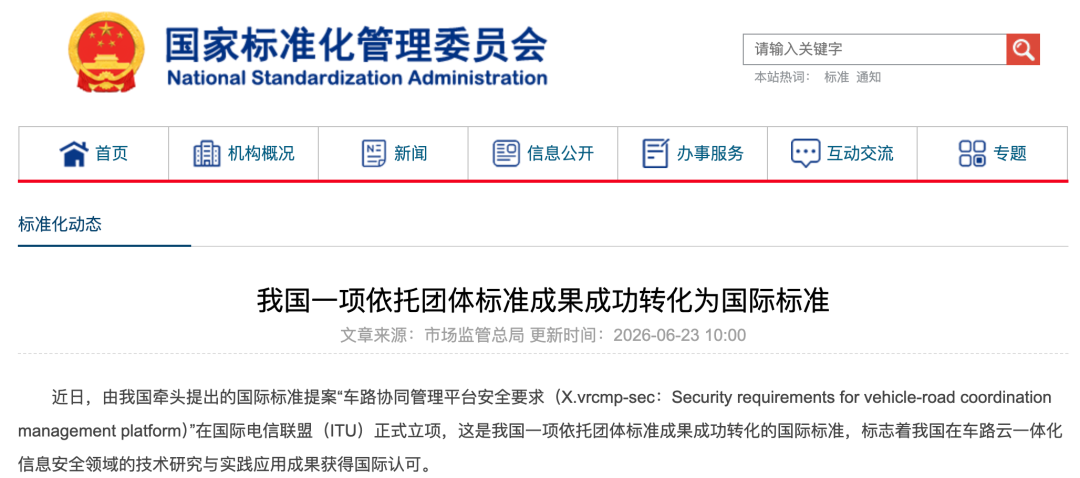
During this gathering, an international standard proposal spearheaded by CAERI, titled "X.vrcmp-sec: Security Requirements for Vehicle-Road Coordination Management Platform," was formally approved for establishment. Its full Chinese title translates to "Security Requirements for Vehicle-Road Coordination Management Platform."
While it may seem like just another line of text, the implications it carries are profound.
What exactly is X.vrcmp-sec?
Let's first delve into the concept of the "vehicle-road coordination management platform."
Those well-versed in the vehicle-road-cloud integrated architecture will recognize that the cloud control platform serves as the "brain" of the entire system. Roadside devices transmit data, while vehicle-end sensors upload perception results. All this information converges on the platform, which then issues instructions back to the vehicles.
The navigation of vehicles, timing of lane changes, and coordination of intersection signals are all computed in the cloud.
But what if this platform were compromised?
Data could be manipulated, instructions forged, and the information received by vehicles could be false.
Imagine receiving an instruction stating, "The intersection ahead is clear for passage," only to discover that the data has been tampered with, leading the vehicle straight into danger.
This is precisely what X.vrcmp-sec aims to prevent—by setting safety rules for this platform.
It analyzes the security threats faced by vehicle-road coordination management platforms and proposes specific protection requirements, effectively establishing a unified global standard for cloud control platforms.
This achievement marks the first time China has successfully transitioned its domestic group standard for vehicle-road-cloud information security into a formal international standard proposal under the ITU.
This "first" carries immense significance.
Are 40% of Global Patents Sufficient?
Let's consider some background data: As of now, China has initiated over 120 national and industry standards related to vehicle networking. In the field of 5G-V2X key technologies, Chinese companies hold approximately 40% of the essential patents worldwide.
While China leads globally in patent quantity, it has previously lacked influence in standard-setting.
The significance of this approval lies not in the establishment of a standard itself but in the pathway it represents—domestic validation followed by international adoption.
X.vrcmp-sec is based on the China Society of Automotive Engineers (CSAE) group standard T/CSAE 295.7—2026, "Vehicle-Road-Cloud Integrated System Part 7: Information Security Specifications." It underwent domestic validation before being exported internationally.
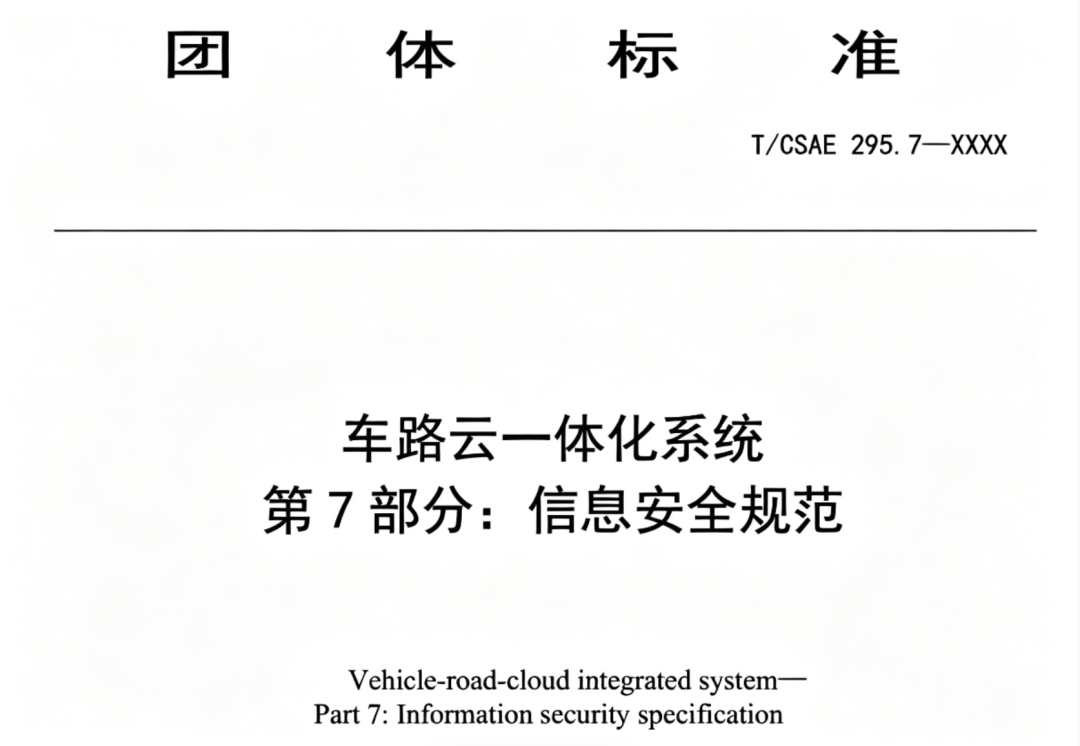
Send "Vehicle-Road-Cloud" in the background to receive it for free.
What Does This Mean for Industry Professionals?
For professionals in the field, this means that when designing safety solutions for cloud control platforms in domestic vehicle-road-cloud projects, there is now an additional international reference point beyond domestic standards.
For those exporting equipment overseas or participating in overseas vehicle-road coordination projects, understanding the rules of this ITU "entry ticket" in advance is crucial.
How Will This "International Card" Be Utilized?
To be candid, China's vehicle-road-cloud integrated technology has advanced rapidly in recent years.
Self-driving taxis are operating in Beijing, Shanghai, Shenzhen, and Wuhan; intelligent heavy trucks are undergoing highway testing; and traffic light recommendations at urban intersections now cover numerous road sections.
However, when expanding overseas, the lack of standard interoperability becomes a significant hurdle.
Domestically, you adhere to T/CSAE specifications, but in Europe, a different system is followed, necessitating equipment re-adaptation and project re-negotiation.
The approval of X.vrcmp-sec aims to address this challenge.
Once the standard is globally adopted, countries will refer to the same safety framework when constructing vehicle-road coordination systems.
Chinese companies can then take their domestically validated solutions abroad without having to start negotiations on technical specifications from scratch. To some extent, this provides domestic enterprises with a "standard pass."
Of course, there is still a long road ahead.
The formal release of an international standard requires multiple rounds of discussion and revision.
Nevertheless, successful approval means China now has a voice at the table on this issue.
Looking back, this signals that the competition in vehicle-road-cloud integration has shifted from "whose vehicles run more" to "whose standards are set faster."
China is no longer merely a follower in this field.
For professionals, several directions are worth monitoring: safety design specifications for cloud control platforms, standardized pathways for vehicle-road coordination overseas expansion, and further布局 (layout) in international standard development within the "15th Five-Year Plan."
These areas may hold even greater significance than today's approval itself.
Reference Article: From L3 "Certification" to Mandatory National Standards: A Comprehensive Analysis of China's Autonomous Driving Policies and Standards in the First Half of 2026.

All content is sourced from publicly available information and compiled for sharing. Written casually in spare time, representing only personal views.
-
![]()
Expert Interpretation of New Policy Combination: Activating the Trillion-Dollar Automotive Aftermarket
-
![]()
Doubao Goes 'Professional', Volcano Rolls the Snowball
-
AI: No Sign of a Bubble!
-
![]()
NVIDIA-Backed AI Unicorn Secures $1.5 Billion Funding: Revenue Soars 2000%
-
![]()
Doubao Pro is Here: How Can Seed 2.1 Be Integrated into Real Processes?
-
"PCB Juice" Sees Four Consecutive Declines: Even Computing Power Material Suppliers Can't Lift This "Old Stock"
-
![]()
Potential 'Seismic Shift' in the U.S. TV Industry: Competition Shifts from Hardware Sales to Traffic Entry Points
-
![]()
Audi A6L's Defense in the Luxury C-Class Market: Following Huawei's Smart Driving Integration, Is Large-Battery HEV the Next Move?