National Standard for Agent Interconnection Released: Why Might the Physical World Still Be Unreachable Despite Unified Interfaces?
 07/01 2026
 419
419
This is my 423rd column article.
In late June, the State Administration for Market Regulation (National Standardization Administration Committee) officially approved and released a series of seven national standardized technical documents titled 'Artificial Intelligence - Agent Interconnection.'
Source: Market Regulation Bureau - Press Conference on Standardization of Agent Interconnection
These seven parts cover overall architecture, identity codes, identity management, agent descriptions, discovery, interaction, and tool invocation. Like a precise zipper, they fully connect the closed loop of agents from 'identity identification' to 'collaborative interaction,' filling the standard gap in this domestic field.
Led by the China Electronics Standardization Institute, more than 30 entities, including Huawei, Xiaomi, Lenovo, Ant Group, and major cloud providers, participated in drafting these documents. Officially designated as an 'agile standardization arrangement during the industry incubation period,' their intent is clear: to be inclusive, reserve space for innovation and trial-and-error, and address three deep-seated industry pain points:
Breaking ecological barriers: Inconsistent interfaces and protocols among agents from different vendors create isolated islands, severely restricting large-scale collaborative applications.
Resolving trust crises: The lack of unified identity authentication and traceability mechanisms for agents poses security risks such as identity spoofing and data leakage during cross-domain interactions.
Reducing innovation costs: The absence of universal interaction and description specifications leads to redundant development by enterprises and high costs for system integration and adaptation.
Meanwhile, officials have announced plans to accelerate the development of detailed rules for agent auditing and transactions. Many media outlets have interpreted this as the 'end of information silos' and the 'full-scale initiation of the AI application grand cycle.'
However, if we examine the 'interconnection history' of the tech industry, history repeatedly offers a starkly different lesson: the establishment of standards often marks not the end of competition but the beginning of a new round of covert struggles.
Especially today, as AI accelerates its integration into the physical world, the core interests contested by giants lie not in the underlying hardware or cloud-based superbrains but precisely in the invocation protocols that translate 'intent' into 'action.'
Hardware is merely replaceable 'muscle,' and large models are 'brains in a vat' trapped in the cloud. Only these invocation protocols serve as the 'vital gateway' connecting the virtual and physical worlds.
Now, although standards have been established, the isolated islands in the history of interconnection have always resulted from mismatches in incentives and control rights. Without consensus on commercial interests, merely unifying technical interfaces cannot address the root cause.
This article will be divided into three parts to dissect the underlying logic behind this 'agent barrier-breaking':
Part 1: Expansion Test. Does interconnection create incremental value or 'homogenize' various enterprises?
Part 2: Control Rights Struggle. Why is the 'intent translation right' the true battleground in the era of agents and embodied intelligence?
Part 3: Machine Autonomy Bureau. How can the industry overcome new isolated islands to create genuine AIoT agents?
Historical Reflection: Mismatched Interests and Escaping Control Rights
The 'interconnection' of the industrial internet has been called for a decade yet remains sluggish.
McKinsey Global Institute (MGI) explicitly calculated in its classic report, 'Internet of Things: Beyond the Hype, Validating Real Value,' that, on average, 40%—and nearly 60% in some scenarios—of the total potential value releasable by the IoT can only be achieved through interoperability between systems.
However, the reality is that the root cause lies at the device level. Field networks have long been dominated by a few vendors, with incompatible industrial protocols—such as Siemens' Profinet and Mitsubishi's CC-Link—each carving out their territories and deeply coupled with equipment.
Why has progress stalled? Because the costs and risks of interconnection are borne by incumbent giants, while the benefits flow to SMEs and end-users. When incentives and commercial interests diverge, no one is willing to dismantle their own moats.
The consumer-side smart home standard Matter provides a more deceptive example.
On the surface, Matter has strong backing, endorsed by Apple, Google, and Amazon, with thousands of globally certified products. Yet, its actual implementation awkwardly remains at the 'lowest common denominator,' where parties compromise only on the most basic, undifferentiated functions to reach agreement.
The awkwardness of implementation lies here: many Matter-certified devices only stably offer basic on/off and dimming commands across platforms, while higher-order functions that truly determine product premiums and differentiated experiences (such as AI-adaptive rhythmic lighting, precise energy consumption monitoring, and complex security linkages) remain firmly locked within each giant's native apps. Even if a function is written into the Matter specification, it often takes much longer before it becomes widely available on retail devices or fully accessible within each ecosystem's app.
Fragmentation may seem reduced, but commercial competition has not ceased; instead, it has spawned new fragmentation at the 'functional layer.' Interconnection remains at the 'floor level,' while true control rights escape to the 'private layer.'
These two cases reveal a harsh truth: if interconnection touches pricing power and customer stickiness without new value compensation, incumbents will either resist or confine it to the 'floor.'
Therefore, the core test for standard success lies in the 'expansion test': does it enlarge the pie or just intensify internal competition?
TCP/IP unified the world by opening up exponentially new markets through 'bottom-layer decoupling.' Before its birth, networks were closed gardens for giants like IBM; afterward, they became standardized pipelines, fostering a no-threshold ecological surge. When TCP/IP was adopted as a standard in 1983, the total number of hosts across the network was just over 500; by around 1995, it surpassed 10 million, giving rise to a digital new continent previously unimaginable. It did not strip profits from hardware vendors but instead enlarged the hardware market pie for all.
In contrast, Matter and deep interoperability of industrial protocols are hindered because they essentially 'pipelined' and 'homogenized' enterprises.
TCP/IP standardized the 'transmission channel,' while Matter attempts to standardize 'control rights.' Once fully interconnected, the experience differences between premium brands and generic devices would be erased, instantly collapsing some enterprises' ecological moats. This interconnection does not create incremental value but merely shifts corporate profits through price wars. Faced with a demand to 'revolutionize themselves,' many enterprises, especially giants, naturally comply in word but not in deed.
So, returning to agent interconnection: will the implementation of these seven national standards spawn a thriving 'machine autonomy economy' like TCP/IP, or will it descend into a defensive quagmire where large model vendors act independently?
The key lies in whether this standard can, while breaking barriers, point the entire industry toward that 'exponentially growing new continent.'
The 'New Disease' of Embodied Intelligence: Responsibility Gateways and Data Moats in the Physical World
So, where is the 'new continent' of agent interconnection?
Theoretically, it exists in the vast blue ocean of 'machine autonomy': from adaptive collaboration among cross-production-line devices in factories to seamless multi-brand home appliance services and autonomous handovers between drones and unmanned vehicles in logistics networks. This continent promises extremely high system-level efficiency, capable of not only creating incremental value but even reshaping the entire society's production function.
However, this new continent currently remains largely speculative. Because when we attempt to measure today's 'intent execution layer' with the 'expansion test' ruler, we find it not only inherits the 'old diseases' of interconnection but also contracts 'new diseases' of the embodied intelligence era.
First, the 'old disease': the zero-sum game of control rights and pricing power.
In the agent ecosystem, superplatforms with the most entry points (such as large model vendors or terminal giants) have become new 'gatekeepers.' They will gladly accept the 'interconnection floor' set by standards but will fiercely defend their private domains above that floor, such as multi-agent orchestration logic, long-term memory banks, and complex action semantics.
Because once fully interconnected, hardware vendors risk becoming replaceable 'dumb actuators,' facing 'pipelining,' with pricing power irreversibly concentrating toward the cloud-based invocation and orchestration layers.
What truly differentiates agent interconnection from history is its 'new disease': the 'responsibility gateway' of the physical world.
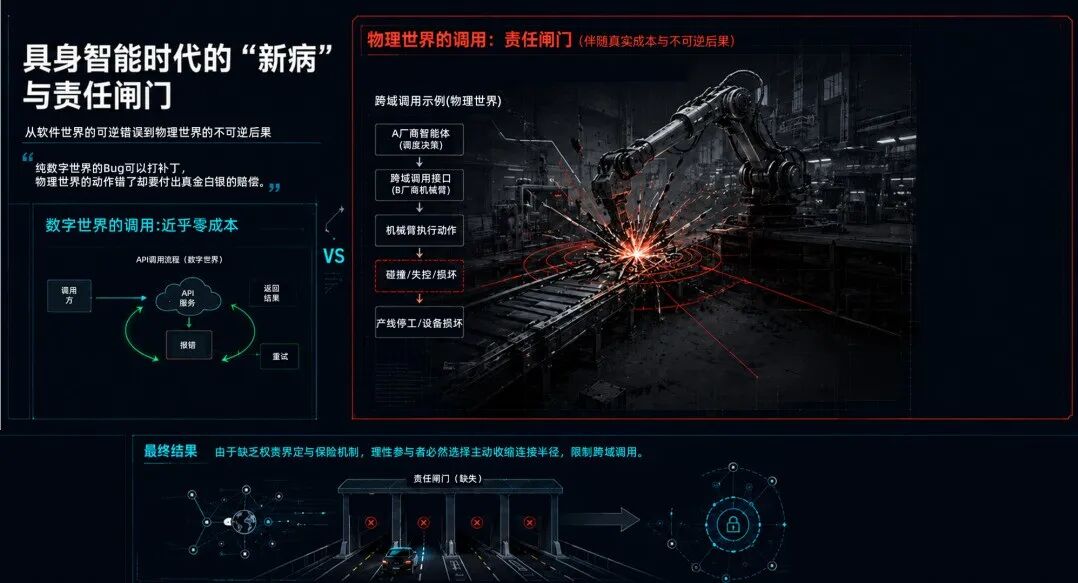
In the purely digital world, a cross-entity API invocation costs nearly nothing; if it fails, an error can simply be reported and retried.
But in the physical world, every cross-vendor machine invocation involves real marginal costs, irreversible physical consequences, and clear liability exposure.
Imagine this: an agent from Vendor A invokes a robotic arm from Vendor B to perform a high-precision action, resulting in equipment damage or production line shutdown. Who bears the blame? Was A's intent delivery erroneous, or was B's execution precision inadequate? Before clear liability delineation and commercial insurance mechanisms are in place, rational participants will proactively shrink their connection radii and restrict cross-domain invocation permissions to avoid 'physical-level' disaster risks.
Digital world bugs can be patched, but physical world actions gone wrong require compensation. This responsibility gateway facing embodied intelligence is a hard barrier never encountered in the software interconnection era.
The Decisive Factor for Breakthrough: Grasping 'Invocation Pricing Power' and Dismantling Barriers of Responsibility and Interest
Thus, the root causes of agent interconnection issues ultimately lie in mismatched incentives and absent responsibilities. Each remedy must precisely target the symptoms.
To treat the 'old disease' of mismatched incentives, the key lies in establishing a neutral pricing and clearing layer.
The breakthrough depends on making interconnection truly enlarge the pie for adopters. Once physical actions become standardizable invocations, each execution should transform into a measurable, priceable, and liquidation able (clearable) commercial event, akin to the 'API economy' in the digital world.
Only when hardware vendors' new revenues from open interfaces sufficiently cover their 'pipelining' losses can interconnection truly pass the 'expansion test.' The regulatory announcement at the press conference about advancing 'transaction and audit' standards confirms this: the underlying commercial rules determining benefit allocation are the decisive factors in interconnection.
To treat the 'new disease' of physical responsibility, the core lies in constructing a binding mechanism for responsibility and compensation.
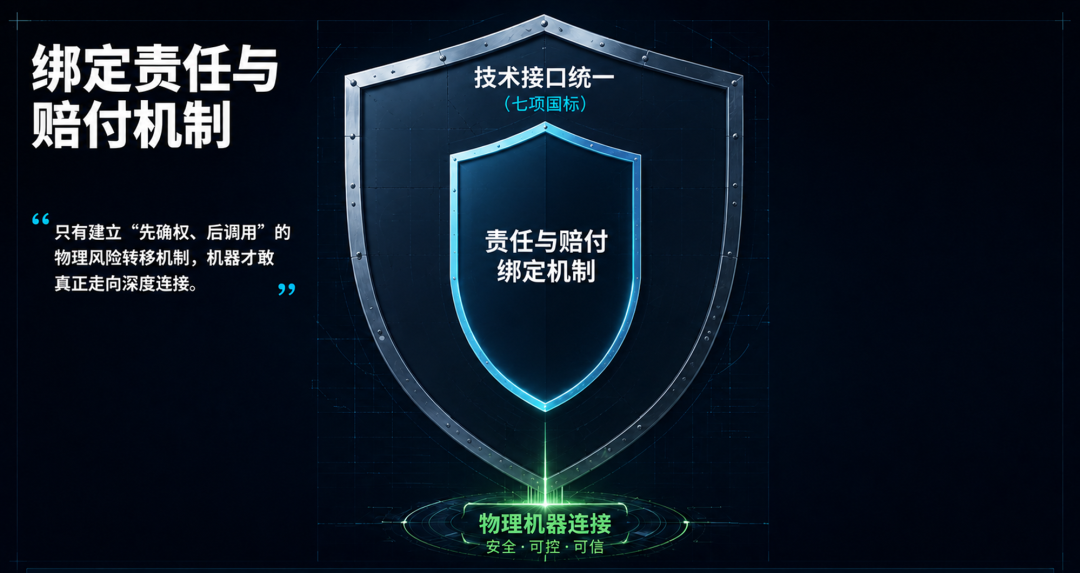
The physical risks borne by cross-domain invocations must become definable, transferable, and even coverable by financial instruments. First, dismantle that 'responsibility gateway' institutionally, ensuring rights are confirmed before invocation, so machines in the physical world dare to connect deeply.
The release of the seven national standards lays a unified 'highway' for agent interconnection—a crucial first step. However, the real issues at the intent execution layer have always lain beyond pure technical interfaces. It is like building a road, but the more daunting negotiations have just begun: what vehicles run on it, who collects the tolls, who is liable for accidents, and whether control rights belong to the entire road or are monopolized by a few toll stations.
History teaches us that industries treating standard release as the finish line often relapse into isolated islands through compromise. In the embodied intelligence journey, the urgent task is to upgrade interface unification into value flow and responsibility attribution.
Only by surmounting this barrier can AIoT agents truly step out of speculation and march toward a thriving 'intelligence economy.'
Final Thoughts
The evolution of tech history seems to endlessly cycle between 'breaking old isolated islands' and 'erecting new walls.'
Installing large models into robot bodies merely awakens monadic 'intelligence'; enabling seamless collaboration and mutual invocation among thousands of agents from different vendors in the real physical world truly raise the curtain ( raise the curtain : kicks off) the 'machine society.'
Leaping from the 'information internet' to the 'agent internet of things,' we cross not only the physical boundary between bits and atoms but also sail from mere 'data exchange' into the deep waters of 'value flow and shared responsibility.'
Ultimately, interconnection has never been a purely technical proposition. It is an infinite game of benefit allocation, risk pricing, and order reconstruction.
-
![]()
It's Kunlunxin's Turn to Play
-
![]()
Is the New Performance Peak Just the Starting Point? What Will Be Crystal-Optech's Next Destination?
-
![]()
Goertek Pours 69 Million Yuan into Elite Precision: Ramping Up Optical Precision Manufacturing and R&D Capabilities
-
![]()
Avatr Attempts HKEX Listing Again, With 20,000 Vehicles Sold in First Five Months
-
![]()
NVIDIA Announces 10-Fold Production Capacity Increase in 2 Years, Disrupting the Energy Storage Industry
-
![]()
AI Enters the Second Half: Models Are No Longer Scarce, What’s Truly Scarce Are Computing Power, Scenarios, and Trust
-
![]()
Rediscovering Momentum After Years of Obscurity: What Fuels Changhong TV's Resurgence?
-
【In-depth】Current Market Status and Key Enterprise Analysis of Confocal Fluorescence Microscopes in 2026