Is the New Performance Peak Just the Starting Point? What Will Be Crystal-Optech's Next Destination?
 07/01 2026
 620
620
Recently, Crystal-Optech's stock price has seen some volatility, with market sentiment largely centered on the short-term disruptions stemming from price adjustments by major North American clients.
However, from a fundamental standpoint, the company has demonstrated robust performance: In 2025, it reported full-year revenue of RMB 6.928 billion, marking a 10.37% year-on-year increase, and net profit attributable to shareholders of RMB 1.172 billion, up 13.84% year-on-year, both setting new records. The gross profit margin improved for five consecutive years, reaching 31.29%, while the net profit margin rose year-on-year to 16.89%.
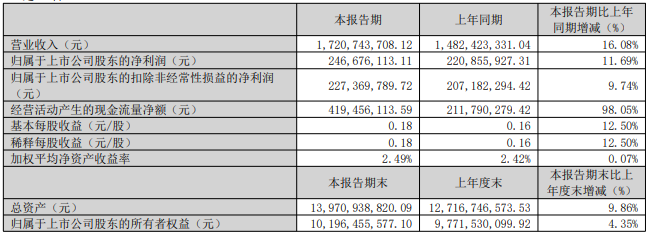
In the first quarter of 2026, the company posted revenue of RMB 1.721 billion, a 16.08% year-on-year increase, and net profit attributable to shareholders of RMB 247 million, up 11.69% year-on-year. The company's full-year operating target is to achieve a year-on-year revenue growth of 10%-30%. Management has expressed cautious optimism about meeting this target in recent communications with investors.
Breaking down the business by segment, the consumer electronics sector contributed RMB 5.892 billion in revenue in 2025, a 7.41% year-on-year increase. Meanwhile, the automotive electronics business emerged as a standout performer, with revenue surging 95.24% year-on-year to RMB 586 million, accompanied by a 13.3 percentage point increase in gross profit margin.
It is anticipated that from 2026 to 2027, the primary driver of performance growth will stem from business with major North American clients. In 2025, the company broke the long-standing monopoly of Japanese manufacturers in coating filters and successfully entered the supply chain of major North American clients, with its market share expected to continue rising during the "15th Five-Year Plan" period. Shipments of micro-prism products achieved positive year-on-year growth in the first half of the year, maintaining a stable market share.
Notably, in 2026, the company will exclusively supply new optical components for the optical innovation and upgrade of the main camera modules of two high-end models from major North American clients, which will serve as a significant contributor to performance growth this year. The company has initiated business collaborations with multiple departments of major North American clients, with new project visibility extending throughout the "15th Five-Year Plan" period. In response to market concerns about price adjustments, the company clarified that, as of now, its fundamentals remain unaffected, with no major changes in orders or pricing.
In the automotive optics sector, the company's AR-HUD products are supplied directly to OEMs as a Tier 1 supplier. According to data from Gaogong Intelligent Automobile Research Institute, from January to August 2025, the company ranked second with a 22.95% share in the AR-HUD market for projection distances over 7 meters, trailing only Huawei. In overseas markets, it is making progress with certifications from well-known European automakers, adding stability to its first growth curve.
Beyond the steady progress in its consumer electronics and automotive optics businesses, the company is positioning AR optics as its second growth curve for the longer-term technological cycle. It is collaborating with multiple overseas and domestic tech companies to explore technical routes such as reflective waveguides, surface relief gratings, and volume holographic waveguides.
Among these, reflective waveguides have been earmarked as a "Priority Project" for focused development. The term "Priority Project" specifically refers to this reflective waveguide route and does not encompass all AR technical directions. Core processes are continuously optimized and iterated, with several key process nodes successfully achieved and the establishment of an initial pilot production line for mass production.
Regarding domestic clients, a breakthrough in mass production of the VHG solution for domestic clients is anticipated in the second half of 2026. The company expects that it may take another three to five years for the AR industry to fully mature and achieve large-scale applications, meaning that significant performance contributions from the second growth curve will require patience. However, the technological positioning is largely in place.
The company is also proactively laying the groundwork for its third growth curve—AI optics—primarily focusing on two directions: optical storage and optical connectivity. The optical storage business is progressing smoothly, with samples passing qualifications and securing orders from two of the top three major clients. It is currently in the pre-mass-production verification phase. However, due to the lengthy product process verification cycle, significant business scale expansion will take time.
The optical connectivity business centers on a "3+2" product layout, encompassing filters, prisms, and lenses, along with glass substrates and waveguides. All products are highly aligned with the company's underlying technologies, including coating, semiconductor micro-nano processing, ultrafast lasers, and ultra-precision cold processing.
According to LightCounting forecasts, the market size for 100G and above pluggable optical modules is expected to expand from nearly USD 20 billion in 2025 to over USD 50 billion by 2030. Passive components such as lenses and prisms account for approximately 11% of the optical module bill of materials (BOM). Leveraging its technological accumulation in optical cold processing and coating, the company has a natural advantage in entering the optical communication supply chain.
In terms of specific mass production timelines, filter and silicon lens products are expected to achieve small-scale mass production and generate revenue in the second half of 2026. Glass substrate and waveguide products, targeting more cutting-edge technological directions, are currently in the early stages of technical collaboration.
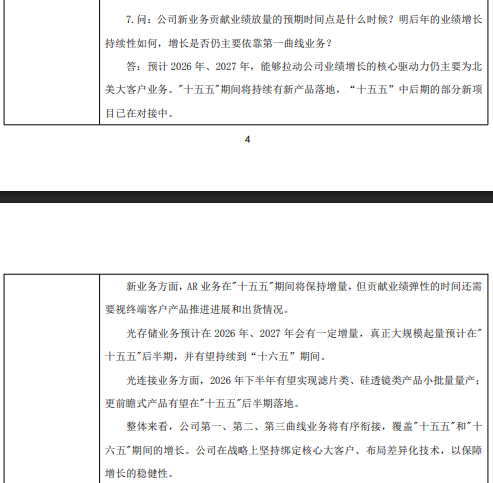
From a performance contribution perspective, the company anticipates that the core growth drivers in 2026 and 2027 will primarily remain business with major North American clients. The optical storage business will see some incremental growth during this period, but significant scale-up is expected in the latter half of the "15th Five-Year Plan" period. The performance elasticity from the AR business will hinge on the progress made by terminal clients.
Record of Investor Relations Activity for Crystal-Optech on June 29
Overall, the first, second, and third growth curve businesses will be sequentially linked, driving growth throughout the "15th Five-Year Plan" and "16th Five-Year Plan" periods. Strategically, the company remains committed to partnering with core clients and deploying differentiated technologies to ensure steady growth.
Crystal-Optech's optical landscape is gradually unfolding in layers: In the short term, the focus is on new product launches from major North American clients; in the medium term, on the growth of the AR optics industry; and in the long term, on AI optics opening up new horizons. The future appears promising.
-
![]()
Cubic Sensors and Instruments Air Quality Sensor Module: Focusing on PM2.5 for Comprehensive Cabin Air Monitoring
-
![]()
Optical Components and Assemblies Surge 45.75% Year-on-Year! Yongxin Optics Reports 564 Million Yuan in First-Half Revenue
-
![]()
Sunny Optical’s Semi-Annual Report: Mobile Phone Profits Slide by RMB 280 Million, Robotics Business Surges to Mitigate Losses
-
![]()
Performance Examination of Hong Kong Stocks: From Pop Mart to Newborn Town and Kingsoft Cloud, Market Preferences May Be Shifting
-
![]()
ARR in August Surges Past $800 Million, MiniMax's Darkest Hour May Be Over
-
![]()
Major Changes in the Mobile Phone Industry: From 'Small Profits and High Sales Volume' to 'High-Priced Game of One Phone per Person'
-
![]()
Even Sues XGIMI in U.S. Court: $1.2 Million ‘AI Glasses’ Crowdfunding Campaign Abruptly Stops!
-
![]()
The world's third largest mobile operating system was born in China! Installed on over 1.3 billion devices