Rediscovering Momentum After Years of Obscurity: What Fuels Changhong TV's Resurgence?
 07/01 2026
 540
540

Changhong TV has recently captured public attention.
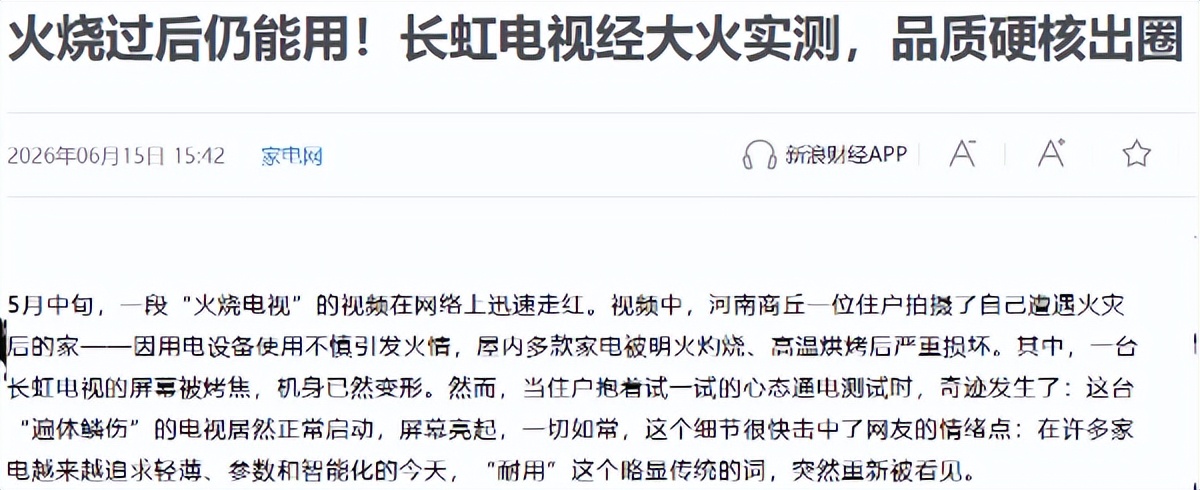
The incident unfolded in mid-last month when a fire ravaged a house in Shangqiu, Henan Province. Amidst the charred remains, a Changhong TV—exposed to intense flames for nearly four hours and with its casing severely deformed—still managed to light up once the power was restored.
This remarkable footage garnered over 300,000 likes on Douyin, thrusting the once-forgotten name "Changhong" back into the limelight. Spectators marveled at the "exceptional quality of Chinese-made products."
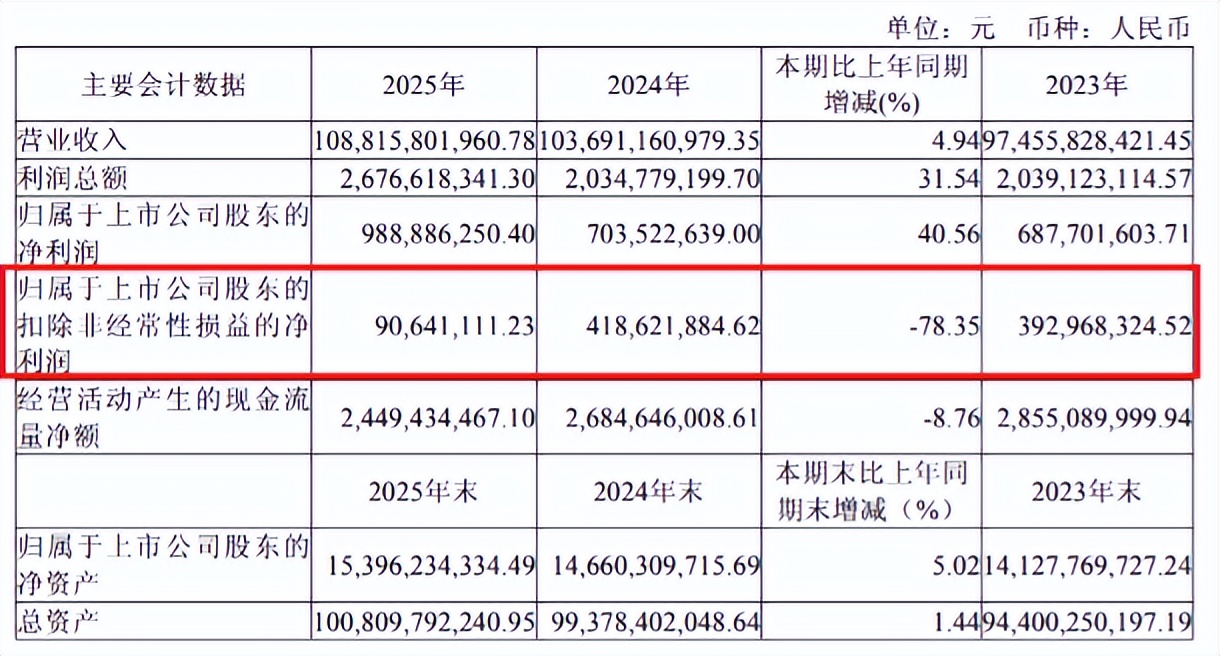
However, this surge in attention cannot obscure the very real challenges evident in Changhong's financial reports. Examining the 2025 annual report, Sichuan Changhong reported an impressive revenue of 108.816 billion yuan, yet its net profit after non-recurring gains and losses stood at less than 100 million yuan.
So, is this newfound popularity a "golden brand" or merely the last glimmer of hope for this veteran TV giant?
01 The Promise of Large Models
Changhong's confidence has never rested solely on nostalgia.
As a pioneer in China's color TV industry, having achieved mass production of the first domestically produced color TV in 1985, Changhong has consistently been at the forefront of technological innovation. Today, driven by "cutting-edge technology + humanistic care," it is redefining the essence of a superior TV.
In the realm of picture quality, Changhong has led the way in overcoming the technical hurdles of RGB Mini LED, launching the first "synchronized control of light, color, and field" TV: the Golden Label T70S.

Through AI full-link control of light, shadow, and color, it achieves unparalleled picture quality with vivid reds, pure blues, and transparent greens. Its "all-weather cooling" anti-aging system, combined with five layers of heat dissipation technology, effectively delays light and color degradation, ensuring long-lasting and stable picture quality, truly achieving "brighter for longer, more stable colors."
In the AI arena, Changhong is a trailblazer. In 2023, it unveiled the Yunfan AI large model and successfully secured national approval the following year. In 2025, Changhong introduced the industry's first "healing AITV"—the Zhiguang Q10Air, elevating AI from simply "following instructions" to "understanding emotions."
Beyond technological prowess, what is even more compelling is Changhong's emotional connection with its users.
The day after the fire, the company proactively provided Mr. Zhou with the latest Zhiguang Q10Air as a free replacement and placed the "retired" old TV in the corporate exhibition hall.
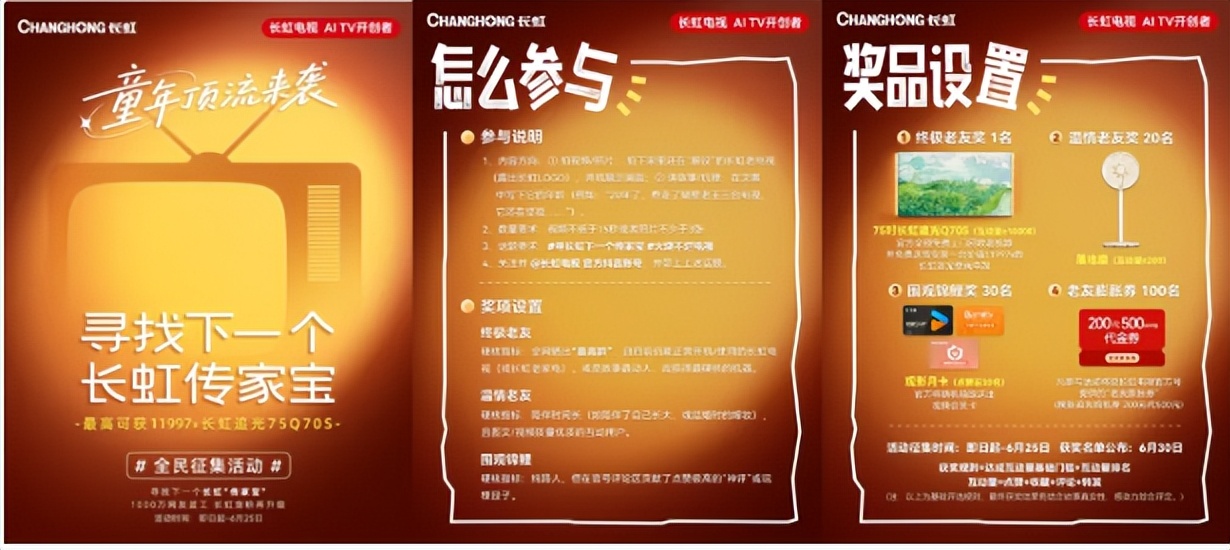
Simultaneously, Changhong launched the "Search for Changhong's Next Heirloom" campaign, inviting users to showcase their old Changhong appliances still in use at home, with the highest reward being a new TV worth nearly 12,000 yuan.
This is not merely a display of brand confidence but also an emotional resonance with users.
From its "unburnable" resilience to its "emotionally intelligent" interactions, Changhong is demonstrating through tangible actions that the ultimate goal of technology is to serve people.
However, while sentiment and quality can garner applause, they may not necessarily secure a prosperous future.
When the focus shifts from the warmth of exhibition stands to the harsh realities of the market, an unavoidable question arises for Changhong:
No matter how emotionally intelligent AI technology is, without a substantial user base to support it, to whom can this "understanding" be directed?
02 The AI Narrative: OEM Sustains Reports but Compromises the "Future"
By 2025, the global TV industry has transitioned from a growth market to a fiercely competitive inventory battle, with formidable competitors.
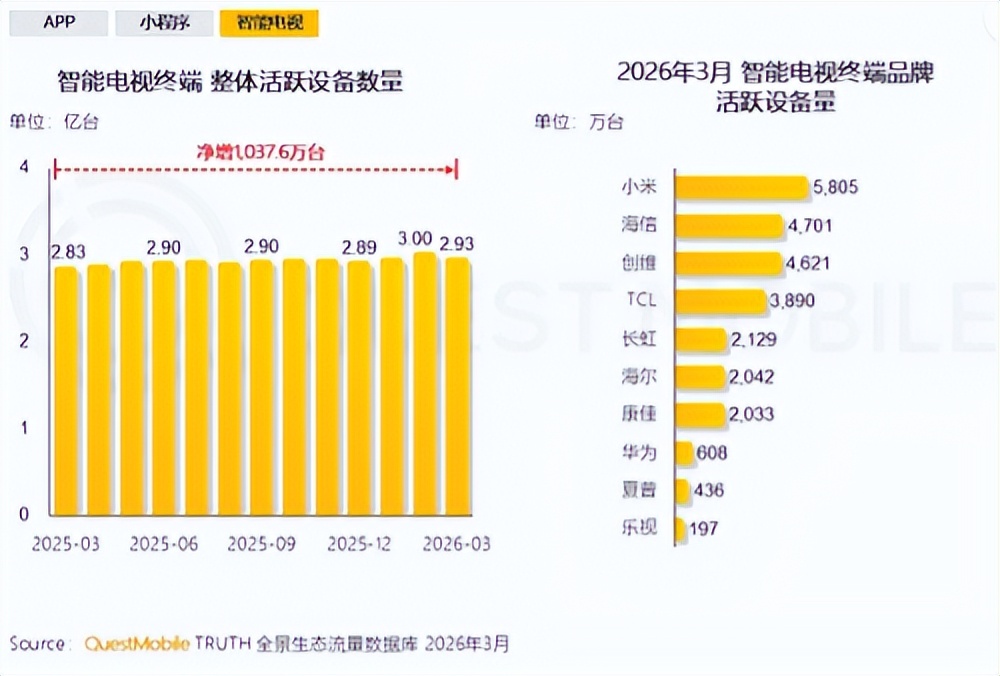
Hisense Smart TV boasts 47.01 million monthly active users, reaching 58.4 million households worldwide through its internet platform "Gokand." Its VIDAA operating system has been integrated into over 50 million smart TV devices globally.
(Image source: QuestMobile)
Xiaomi TV leads the industry with 58.05 million monthly active users, and its Xiao Ai assistant has 160 million monthly active users, forming an ecological closed loop of "smartphone traffic generation-TV retention-service monetization."
What about Changhong?
By the end of 2025, Changhong TV's market share for its own brand had dwindled to just under 5%, with only around 20 million monthly active users.
With further contraction in domestic TV sales, Changhong is being pushed into a dilemma: AI that no one uses is technically impressive but ultimately of little value.
The competitive logic of AI TVs has fundamentally shifted. After all, algorithms can be open-sourced, and computing power can be procured.
However, high-quality, contextual interaction data—such as when users fast-forward, when they abandon a program, or which phrases they struggle with—can only be "nurtured" by a large user base.
The more users, the richer the data, the smarter the AI, and the better the products sell. Changhong's Yunfan large model is stuck at the starting point of this virtuous cycle.
Even more critically, the OEM business is exacerbating this loss of control.
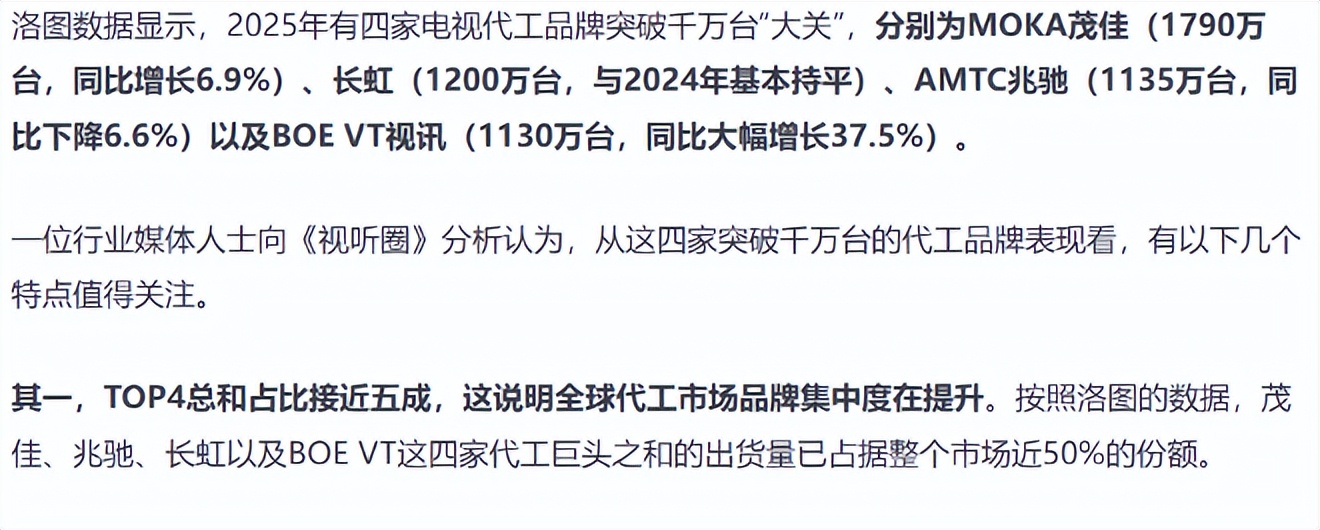
In 2025, Changhong's OEM TV shipments reached 12 million units, surpassing Zhaochi to become the world's second-largest TV OEM.
However, under the OEM model, the data belongs to the brand owner. Xiaomi TVs run on the MIUI system, with Xiao Ai as the voice assistant.
Every word users speak to the TV and every program they watch, from "this movie is boring, change it" to being woken up at 11 PM to turn off the lights, all data flows to Xiaomi's servers to train Xiaomi's AI.
With 12 million OEM TVs generating billions of user data points annually, Changhong is helplessly watching as it hands over the "food for nurturing AI" to others.
Xiaomi has already established its own home appliance factory in Wuhan, and Changhong has long been an OEM for Xiaomi's air conditioners. The trend of major OEM clients building their own production capacity is evident.
Moreover, even if Xiaomi does not fully withdraw orders in the short term, the profit margins of the OEM model itself are extremely low. In 2025, Sichuan Changhong's gross margin was only 9.42%, a historic low, while Midea, Gree, and Haier's comprehensive gross margins were around 26%-30%. The gap is stark.
The OEM model is revealing its most brutal hidden cost in the AI era.
03 The Internal Struggle Between B2B and B2C
OEM sustains revenue but compromises the future. This is vividly reflected in Changhong's financial reports.
First, there's the billion-yuan revenue yet barely a profit. Sichuan Changhong's total revenue in 2025 was 108.8 billion yuan, up 4.94% year-on-year. Net profit after non-recurring gains and losses was 90.64 million yuan, a staggering 78.35% year-on-year drop.
(Image source: Sichuan Changhong 2025 annual report)
The difficulty of this business model needs no further explanation. As early as 1998, Sichuan Changhong's profit scale had already reached 2 billion yuan. Twenty-seven years later, with revenue more than tenfold, profits are now a fraction of what they were. This is because the billion-yuan revenue is not supported by truly profitable businesses.
Breaking down the business segments, TV revenue was about 14.747 billion yuan, but with a gross margin of only 9.86%, and TV sales down 8.04% year-on-year. Refrigerator revenue was about 9.527 billion yuan, down 6.55% year-on-year.
The real revenue driver, ICT products and services—essentially distribution and procurement—generated about 40.643 billion yuan in revenue but with a dismal gross margin of only 3.43%.
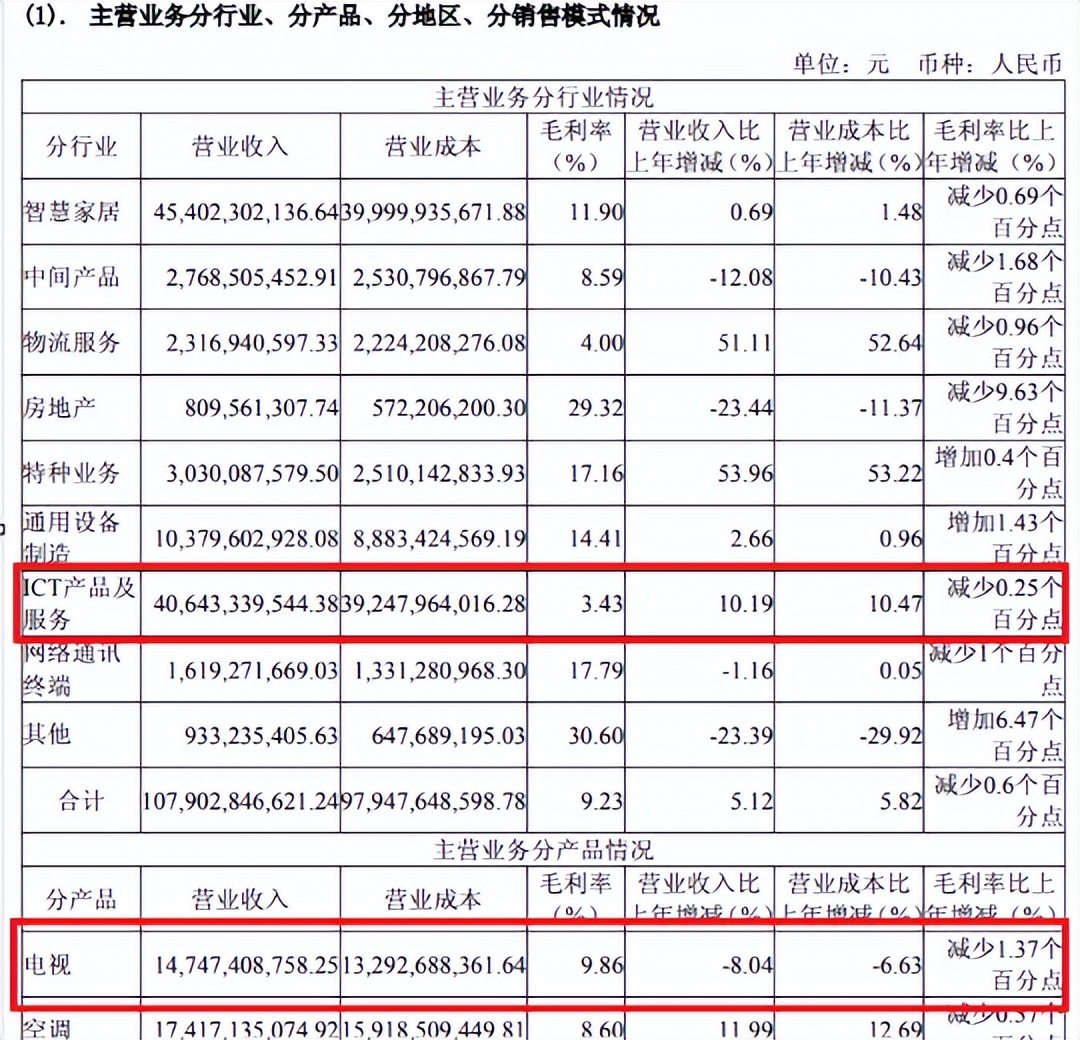
(Image source: Sichuan Changhong 2025 annual report)
Although air conditioner revenue grew 11.99% year-on-year to 17.417 billion yuan, its gross margin was even lower at 8.60%.
The first quarter of this year was even worse. Sichuan Changhong's revenue was 27.276 billion yuan, up 1.64% year-on-year, but net profit plunged 71.50% to 98.48 million yuan. Net profit after non-recurring gains and losses dropped even further by 78.08% to 30.33 million yuan, with the gross margin falling to 8.42%.
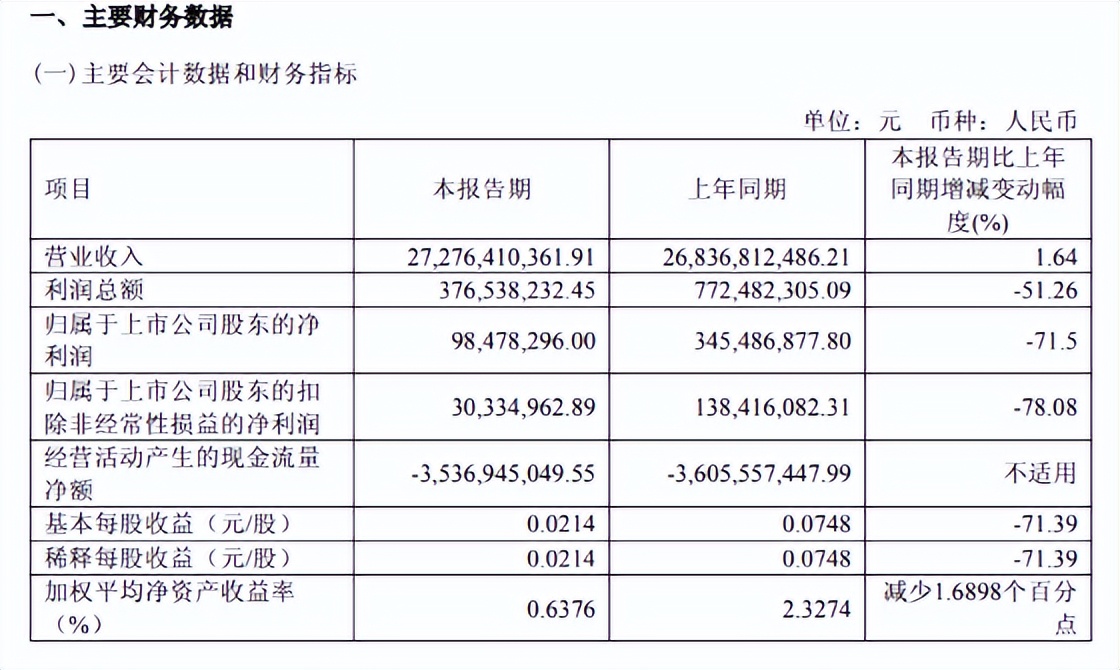
(Image source: Sichuan Changhong Q1 2026 report)
On the surface, Changhong is pursuing a "dual-track strategy": using OEM and distribution to stabilize production capacity and cash flow while using the AI TV narrative to sustain its B2C brand presence.
But this "have it both ways" approach, when put into practice, becomes an irreconcilable internal conflict.
After all, B2B KPIs prioritize "low cost, high turnover, and no mistakes," while B2C demands "high prices, compelling stories, and brand premium."
For current management, facing intense market competition, the first instinct when client fluctuations occur is not to strengthen B2C brand premium weaknesses but to quickly find another B2B major client to fill the production lines.
-
![]()
Market Share Dilemma: DJI vs. Insta360—Is It '40-40' or '60-30'?
-
![]()
Market Share Dilemma: DJI vs. Insta360 – A '40-40 Split' or '60-30 Split'?
-
![]()
It's Kunlunxin's Turn to Play
-
![]()
Is the New Performance Peak Just the Starting Point? What Will Be Crystal-Optech's Next Destination?
-
![]()
Goertek Pours 69 Million Yuan into Elite Precision: Ramping Up Optical Precision Manufacturing and R&D Capabilities
-
![]()
Avatr Attempts HKEX Listing Again, With 20,000 Vehicles Sold in First Five Months
-
![]()
NVIDIA Announces 10-Fold Production Capacity Increase in 2 Years, Disrupting the Energy Storage Industry
-
![]()
AI Enters the Second Half: Models Are No Longer Scarce, What’s Truly Scarce Are Computing Power, Scenarios, and Trust