NVIDIA Announces 10-Fold Production Capacity Increase in 2 Years, Disrupting the Energy Storage Industry
 07/01 2026
 541
541
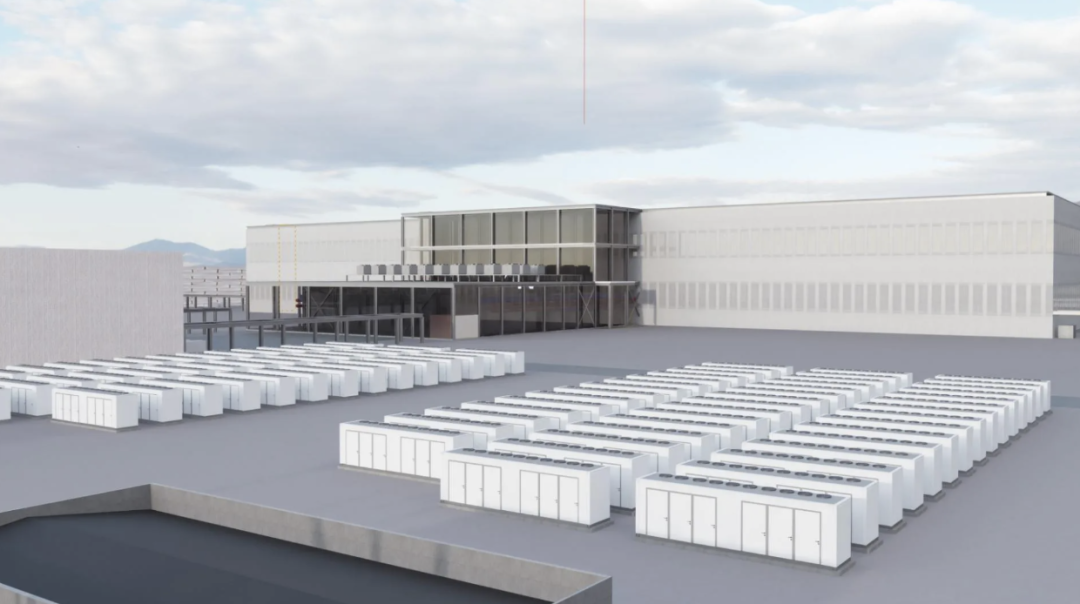
A Global First! NVIDIA Unveils AIDC Energy Storage Qualification Guidelines, with PCS Taking Center Stage
By Wang Jing, Edited by Yang Qian
Source: Terawatt Energy Storage
Terawatt Energy Storage reports that NVIDIA has recently officially released its 'BESS Self-Qualification Guidelines,' marking the first systematic establishment of technical admission standards for battery energy storage systems (BESS) tailored specifically for AI data centers.
NVIDIA explicitly states in these guidelines that BESS are no longer just emergency backup power sources but are now recognized as core 'grid assets.'
The most groundbreaking aspect of these guidelines is their departure from the traditional energy storage industry's evaluation criteria, which typically focus on cell capacity, battery chemistry, and fire safety. Instead, the guidelines emphasize that battery capacity is not a determining factor for qualification certification, thus eliminating the practice of 'stacking battery capacity' to meet requirements. Instead, the focus is redirected towards the dynamic stability of PCS (Power Conversion Systems) under extreme conditions, such as weak grid scenarios, current limiting, and mode switching.
In essence, the competition is no longer about 'how large the battery is,' but rather about 'how intelligent and reliable the control system is.'
The guidelines outline a PCS performance certification framework centered around AC terminals, encompassing five key scenarios: low voltage ride-through, AI load buffering, demand response, grid-connected/islanded switching, and black start. These scenarios are underpinned by rigorous 'technical clearance forms,' which include 10 core requirements and 12 quantitative tests. This marks the formal recognition of power storage as an engineering standard of equal importance to computing power in AI infrastructure construction.
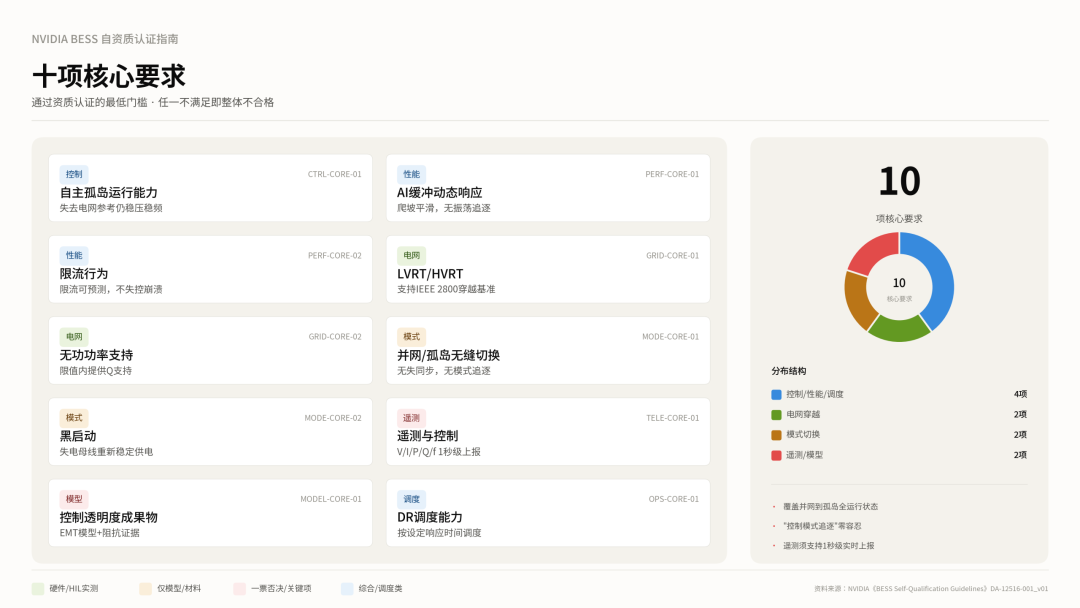 Click to enlarge or save for a detailed view
For instance, verification is required under extremely weak grid conditions, with an SCR (Short Circuit Ratio) as low as 2.0, using an EMT model (ElectroMagnetic Transient model). 'Control mode hunting' is explicitly listed as a disqualifying factor.
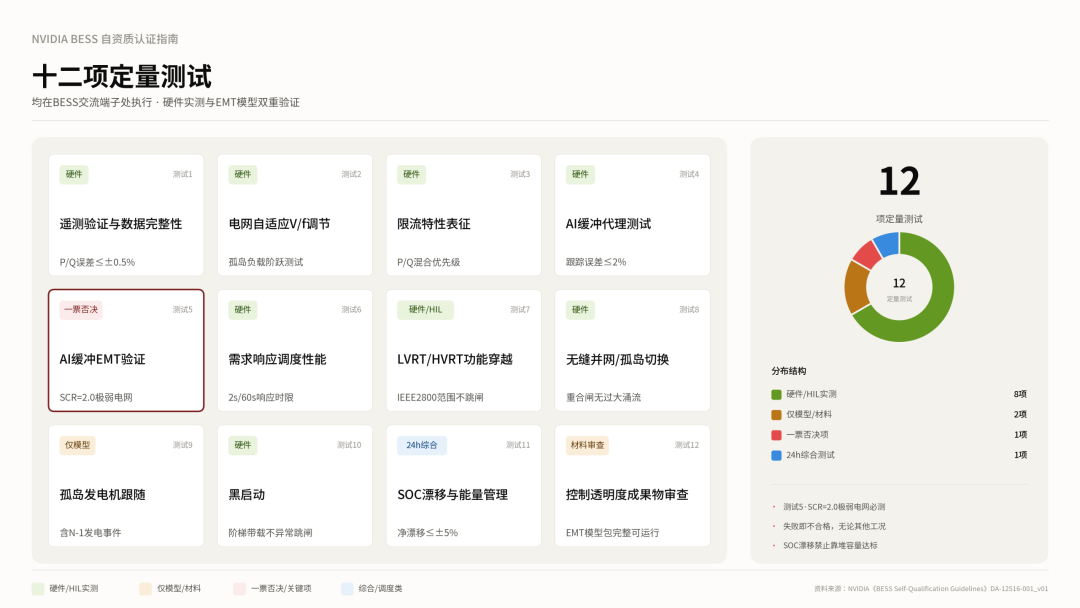
Click to enlarge or save for a detailed view
The extremely stringent technical thresholds effectively establish a 'credit endorsement' mechanism for energy storage vendors, ensuring trustworthiness across the entire AI infrastructure ecosystem. This is achieved through a four-party division of labor model involving partner self-testing, independent laboratory verification, NVIDIA's final review, and customer final acceptance, which guarantees both efficiency and technical credibility.
Notably, in addition to technical certification, partners must also demonstrate their credibility in supporting AI scale deployment timelines. The guidelines mandate disclosures regarding PCS manufacturing throughput (MW/year), a 10-fold PCS production capacity increase plan within 24 months, and supply chain resilience. It explicitly states that 'lack of historical delivery data is considered business disqualification, regardless of technical performance.'
This design directly addresses the common industry pain point of 'meeting standards in the lab but failing in mass production,' compelling suppliers to possess both technical prowess and scalable delivery capabilities simultaneously.
From a macro industry perspective, the endpoint of AI computing power is electricity, and the key solution for electricity management is energy storage.
Industry estimates project that global data center electricity demand will exceed 1,000 terawatt-hours by 2026, doubling from 2023 levels. The power demand for a single AI 'factory'-scale campus has reached 100 to 750 megawatts, with a single NVIDIA Blackwell GB200 NVL72 rack consuming 120 to 140 kilowatts, far surpassing the traditional data center's single-rack design limit of 10 to 15 kilowatts.
This has triggered a global surge in AIDC (Smart Computing Center) energy storage demand, with mainstream projections for 2030 ranging between 300-350 GWh, representing a nearly 20-fold increase over the 2025 baseline of approximately 15 GWh, and a compound annual growth rate exceeding 60%.
However, the challenge lies in the millisecond-level, GW-scale power fluctuations characteristic of AI training and inference loads. Their 'pulsed' electricity consumption patterns pose unprecedented challenges to grid stability, a gap entirely overlooked by traditional energy storage standards.
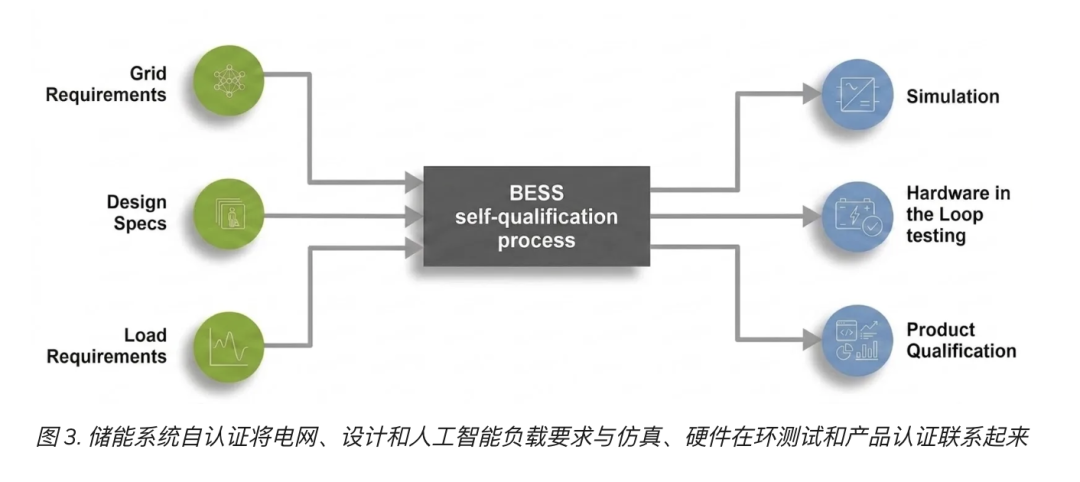
NVIDIA points out in its technical blog that AI factories are redefining the role of data center infrastructure. The power system is no longer a 'background facility' but a core variable determining whether computing power can be stably output. The energy storage verification framework aims to ensure that BESS solutions can support AI-specific needs such as load buffering, fault ride-through, telemetry, and operational flexibility, while also considering the manufacturability, scalability, and reliability required for large-scale production infrastructure. This forces energy storage vendors to transition from 'selling batteries' to 'refining control.'
The standard has swiftly garnered industry chain response following its release. NVIDIA is collaborating with the LG Group to build an AI factory, covering businesses such as robotics, autonomous driving, data center technology, and GPU cloud services. LG Energy Solution has explicitly stated that it will collaborate with NVIDIA on 800V DC data center energy solutions in accordance with the BESS self-qualification guidelines to match the power demands of next-generation GPU platforms.
Industry analysts believe that as global AI data center construction enters the gigawatt-scale competition phase, the ability of energy storage systems to stably support power fluctuations on the grid side will directly determine the physical ceiling for AI computing power expansion.
NVIDIA's intervention in energy storage standard-setting through 'qualification certification' rather than a mere technical white paper also suggests, to some extent, that computing power giants are extending their roles from chip suppliers to AI infrastructure system integrators.
Undoubtedly, energy storage is emerging as a new critical variable in the global computing power race.
· END · Welcome to follow
-
![]()
Market Share Dilemma: DJI vs. Insta360—Is It '40-40' or '60-30'?
-
![]()
Market Share Dilemma: DJI vs. Insta360 – A '40-40 Split' or '60-30 Split'?
-
![]()
It's Kunlunxin's Turn to Play
-
![]()
Is the New Performance Peak Just the Starting Point? What Will Be Crystal-Optech's Next Destination?
-
![]()
Goertek Pours 69 Million Yuan into Elite Precision: Ramping Up Optical Precision Manufacturing and R&D Capabilities
-
![]()
Avatr Attempts HKEX Listing Again, With 20,000 Vehicles Sold in First Five Months
-
![]()
NVIDIA Announces 10-Fold Production Capacity Increase in 2 Years, Disrupting the Energy Storage Industry
-
![]()
AI Enters the Second Half: Models Are No Longer Scarce, What’s Truly Scarce Are Computing Power, Scenarios, and Trust