China’s Computing Reaches New Heights: From LingSheng to Shuguang 8000
 07/13 2026
 402
402
When cutting-edge problem-solving capabilities combine with a networked computing power infrastructure, the next chapter in China’s computing narrative will begin to take shape at every research and industrial hub that harnesses computing power.
A closer look at the computing power market over the past two years reveals a growing roster of buyers. Beyond traditional users of high-performance computing, such as meteorology, energy, and aerospace, large language model companies, autonomous driving teams, pharmaceutical R&D firms, financial institutions, and even content platforms have now entered the ranks of computing power purchasers and renters.
Computing power is evolving from a specialized tool reserved for select high-tech scientific tasks into a daily production resource for a wide range of industries.
When demand shifts, the system’s design inevitably adapts.
Examining the recent unveilings of two domestic systems through this lens—LingSheng, which has risen to the global forefront in traditional high-performance computing, and Shuguang 8000, positioned as China’s first fully indigenous 100,000-GPU AI supercluster—paints a clearer picture: the former excels at solving classic challenges, while the latter must address both legacy and emerging challenges on a single platform. This is not about one system replacing the other, but rather a transition between two stages in China’s computing evolution.
01 Two Tasks, Two Systems
Traditional high-performance computing tasks can be distilled into “tackling tough challenges.”
Weather forecasting requires calculating finer grids within tight timeframes, material R&D involves simulating atomic-scale interactions, and aerospace demands high-fidelity engineering simulations. These tasks have clear goals: deploy as much computing power as possible to solve the most difficult problems. Systems designed for these purposes prioritize peak performance, precision, and reliable operation, resembling heavy-duty research equipment in national laboratories.
LingSheng represents the pinnacle of this tradition. Built on the CPU architecture and classical scientific computing paradigm, it pushes system engineering, software optimization, and large-scale operational capabilities to new heights. Achieving such results leaves no shortcuts; every component—chips, architecture, interconnects, scheduling, software adaptation, and engineering delivery—must reach maturity to support it. As such, it serves as a concentrated test of the entire domestic computing industrial chain’s maturity. For scientific computing tasks like meteorology, physics, and engineering simulations, such systems remain indispensable today, marking the zenith of national computing capability.
In contrast, the new tasks introduced by artificial intelligence revolve around “supply.”
Large language model training demands tens of thousands of accelerator cards running in parallel for extended periods, inference services require stable power output year-round, scientific research increasingly incorporates AI methods, and industries like manufacturing, finance, and life sciences hope to treat computing resources as on-demand production factors. Individually, these tasks may not be the world’s most complex, but their sheer volume, diversity, and continuity test a system’s ability to supply computing power sustainably, reliably, and cost-effectively over the long term.
Tackling tough challenges requires heavy-duty tools; supplying computing power demands infrastructure. The true test for the next generation of computing foundations is whether they can excel at both—solving the hardest problems while meeting everyday demands.
02 The 100,000-GPU Threshold: Not in Numbers, But in Organization
The most prominent label on Shuguang 8000 is “100,000 GPUs.” However, the number itself is not the milestone; the real challenge lies in organizing 100,000 accelerator cards into a unified, efficient whole.
Large-scale AI training has an unforgiving characteristic: a single training run often lasts weeks, and any fluctuation in any component can force the task to restart. At the 100,000-GPU scale, hardware failures become statistically normal rather than exceptional; networks must maintain high bandwidth and low-latency communication across massive nodes, storage must keep pace with data throughput, scheduling systems must allocate different task types appropriately, and software stacks must adapt to vastly varying real-world applications. Every step up in system scale exponentially increases the difficulty of these engineering challenges.
Building a 100,000-GPU cluster is one thing; ensuring its long-term, efficient operation and smooth user experience is far more demanding.
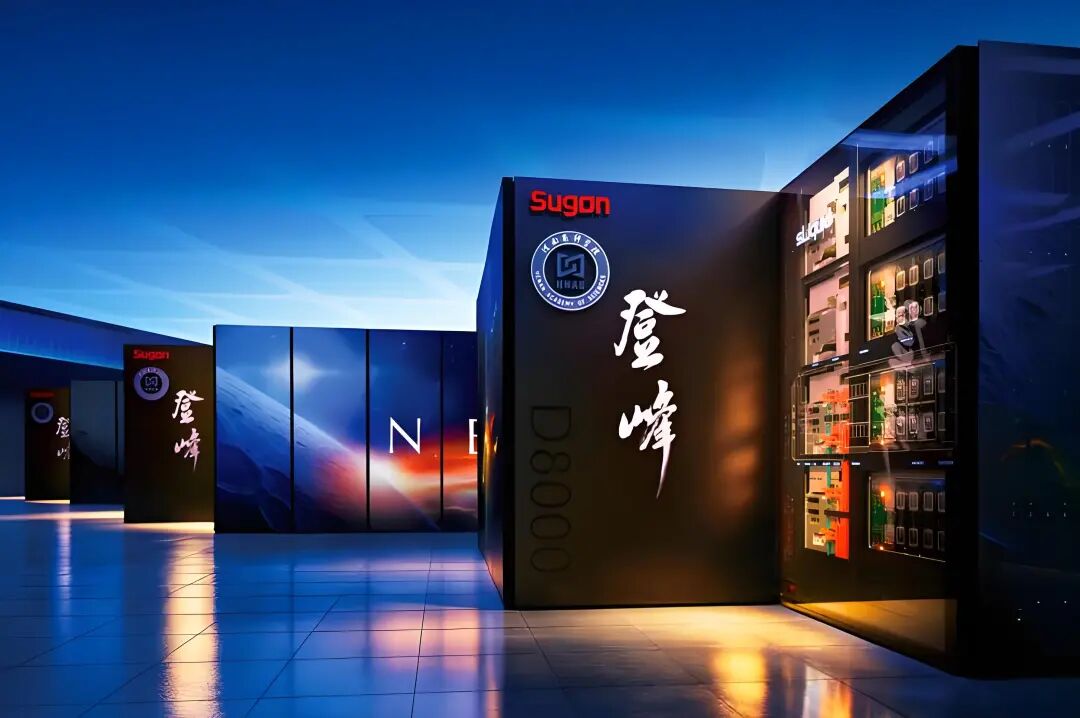
Shuguang 8000 adopts a CPU+GPGPU heterogeneous architecture, known in the industry as a “hyper-intelligent fusion” design. In simpler terms: the high-precision capabilities needed for scientific computing and the large-scale mixed-precision capabilities required for AI are integrated into a single foundation. This means that while LingSheng can handle classical scientific computing tasks like meteorology, materials, and engineering simulations, Shuguang 8000 can do the same while also taking on new tasks like large language model training, inference services, AI4S (AI for Science), and industry applications. This design reflects the converging nature of tasks—material R&D, drug screening, and weather forecasting now incorporate large language model methods, while AI training becomes increasingly embedded in scientific and engineering workflows.
A foundation skilled only in single-task types will continually encounter demands beyond its reach; integrating both capabilities into one system truly earns the term “infrastructure.”
03 Grid Connection: From a Single Power Station to a Power Grid
Another easily overlooked but potentially more transformative move by Shuguang 8000 is its connection to the core nodes of the National Supercomputing Internet.
The history of the electrical power industry offers a fitting analogy. Over a century ago, electricity’s value was initially proven by iconic power stations; however, what truly transformed production methods was grid connection—electricity became a readily available public utility, enabling all industries to rebuild their processes atop it.
Computing power is following a similar trajectory. Isolated, powerful systems prove “we can build it”; only after network integration does computing power become a schedulable, operable, and sustainably serviceable resource, entering the daily workflows of research institutions, model enterprises, and industrial users.
The power grid analogy also highlights another aspect: without individual power stations, the grid would be an empty framework. System capabilities serve as the foundation for service capabilities; it is because systems like LingSheng continually push the boundaries that the computing network gains the strength to connect and deliver. Peaks and networks have always mutually reinforced each other.
04 One Wave Lifting Another
Placing LingSheng and Shuguang 8000 in the same context reveals the two tiers of China’s computing evolution. LingSheng has proven that on the mature path of high-performance computing, China possesses world-class problem-solving capabilities; Shuguang 8000, while retaining such scientific computing prowess, further answers the supply proposition of the AI era—it can handle the same tasks as LingSheng while also embracing AI training, inference, and industry applications beyond LingSheng’s scope. Through larger scale, more complex coordination, and more open service models, it brings computing power to more application scenes.
The preceding wave pushes capabilities to new heights; the following wave leverages this altitude to open new spaces. In the past, China’s computing needed to prove “we can compute” to the world; going forward, China’s computing power must enable all industries to discover “we can use it too.”
When cutting-edge problem-solving capabilities combine with a networked computing power infrastructure, the next chapter in China’s computing narrative will begin to take shape at every research and industrial hub that harnesses computing power. This is the true meaning of “one wave lifting another.”
-
![]()
Why Hasn’t AI-Driven Payment Flourished Despite Tech Giants’ Push?
-
![]()
Intensify Efforts in the High-End Optoelectronic Semiconductor Sector! Aipu Dingchun and Jiangsu Meidong Forge a New Joint Venture
-
![]()
From Endoscopes to Optical Interconnects for AI Computing Power: A Veteran Optical Company's Strategic Shift
-
![]()
Behind the Scenes of Token Factories' Rise as a Capital Market Sensation
-
![]()
What Does MaaS Ultimately Bring to Chinese Cloud Providers? | In-Depth Industry Analysis
-
![]()
China’s Auto Resale Value Report Unveiled: AITO M9 Electric and Hybrid Variants Dominate Rankings
-
![]()
Dialogue with Huang Yangming: On the Eve of the Physical AI Boom, the Value of Data Infrastructure Begins to Materialize
-
![]()
The Experience is a Bit Unusual! Logitech G Cloud Review: Great Feel, but Not Ideal for Cloud Gaming