Google: Is AI Going to Collapse? A Savior Has Arrived
 07/23 2026
 384
384
Amid recent shifts in AI narratives and weakening investor confidence in the industrial chain, Google, as the first major AI buyer to release earnings, has its financial report (especially focusing on Capex, cloud Backlog, and cash flow) capturing the attention of investors across the AI industry. Without further ado, let's dive in:
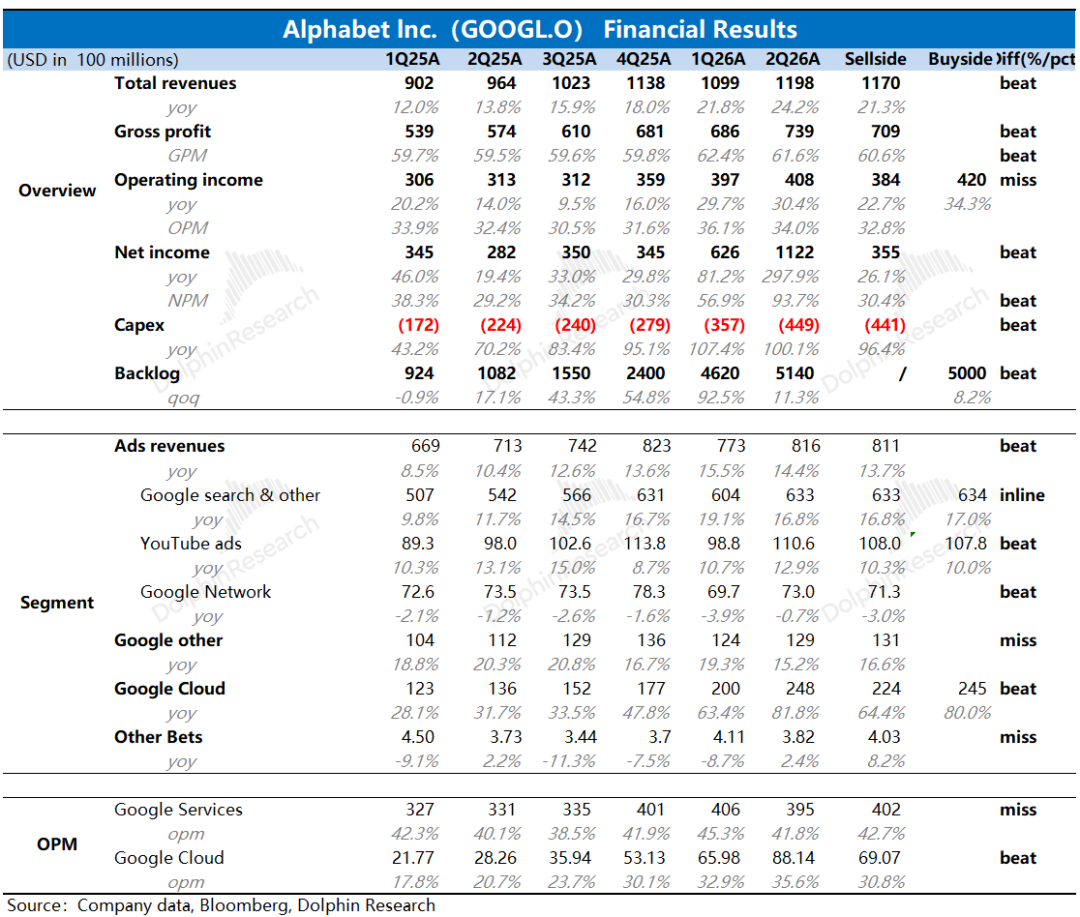
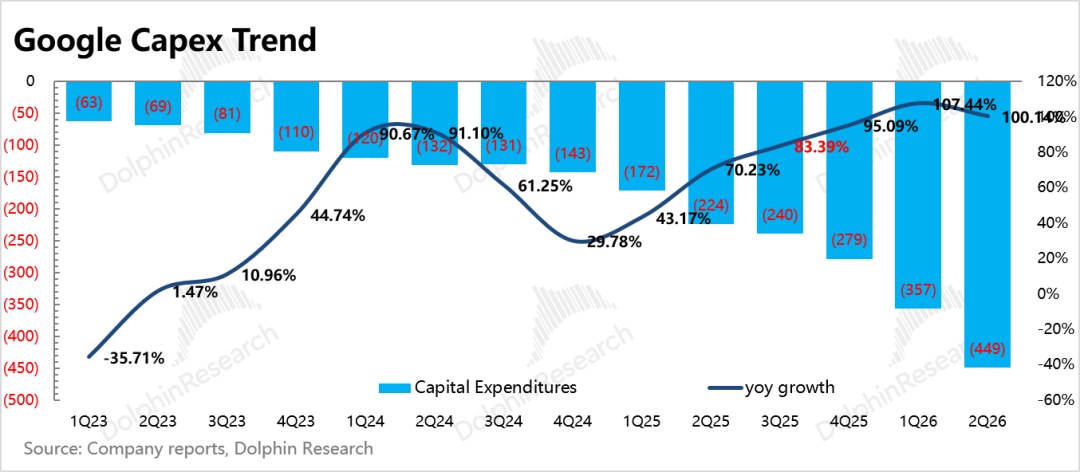
1. Capex investment for the current period reached $44.9 billion, doubling year-over-year. During the earnings call, it was pointed out that the full-year guidance for this year has been raised from $180-190 billion to $195-205 billion, a net increase of $10 billion, with continued significant growth (increase significantly) expected by 2027, aligning with buyer expectations (due to rising storage costs, investors anticipated a $50-100 billion increase in Capex this year, with expectations for next year ranging around $300-400 billion).
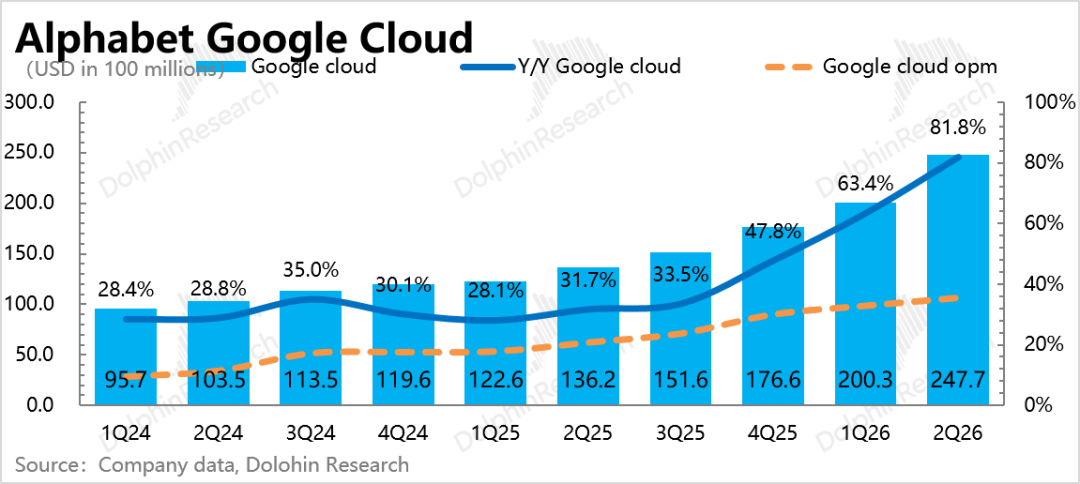
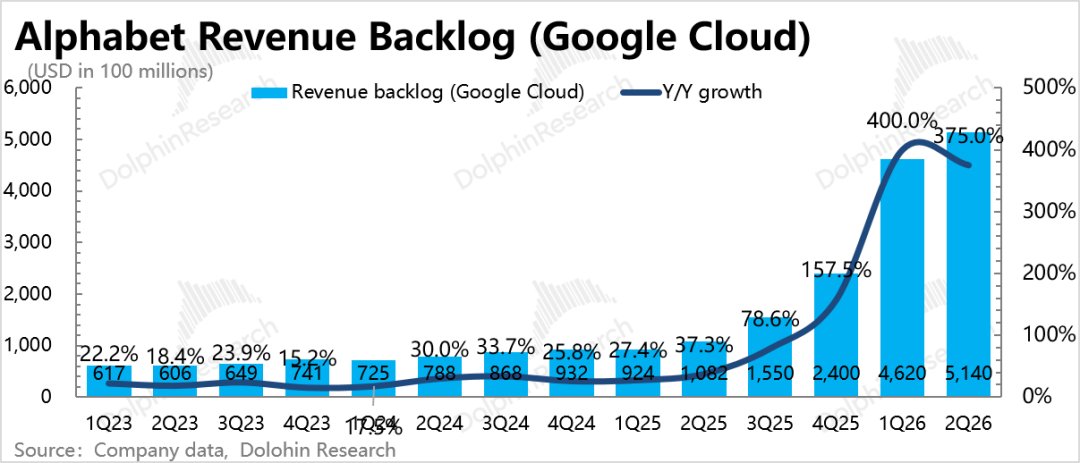
2. Google Cloud grew by 82%, slightly exceeding buyer expectations (75%-80%). Note that this includes revenue from TPU hardware sales, though confirmation details were not disclosed. The remaining contract Backlog amounted to $514 billion (with over 50% expected to be recognized as revenue within the next 24 months), meeting investor expectations of $500 billion.
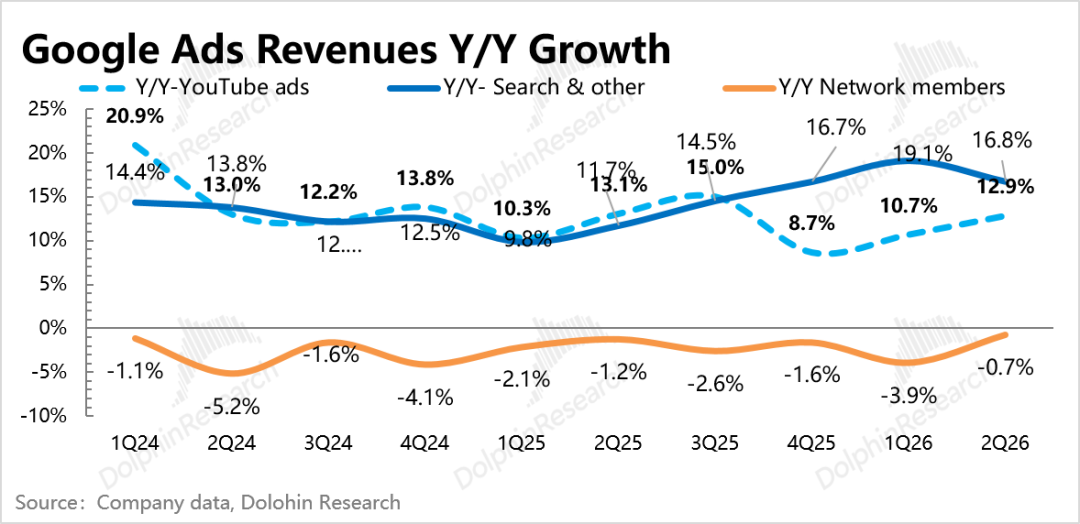
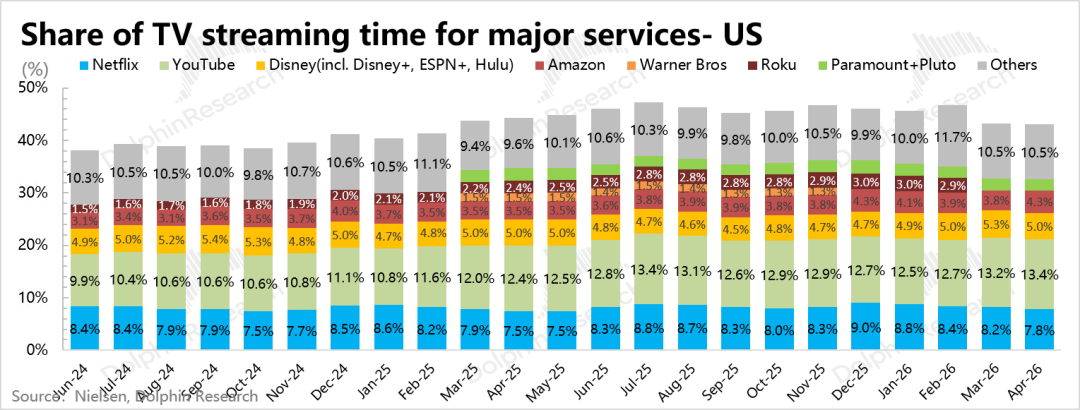
3. The core advertising business slightly exceeded expectations, with search ad growth at 17%, demonstrating expected strength, and YouTube ad growth at 12%, showing a slight recovery from the previous quarter. Nielsen data indicates that YouTube's viewership share has been steadily increasing. Additionally, the contribution of Shorts ads within this may also be growing.
4. The group's overall operating profit slightly missed expectations. With significant expansion in investment, free cash flow turned negative (-$5.8 billion). EPS grew by 294%, primarily driven by the valuation gains from investments in SpaceX and Anthropic, which somewhat "distorts" the direct description of Google's fundamentals.
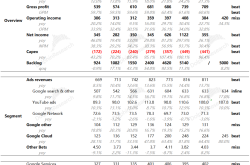
5. Comparison of Key Indicators vs. Expectations
Dolphin Research's Viewpoint
Overall, Google's earnings report follows a script that is "favorable to the industrial chain." Due to strong demand, management remains very positive about AI investments. This largely holds up against relatively high market expectations for Capex, allowing investors in the industrial chain to breathe a sigh of relief for now.
However, Google's aggressive investments will accelerate the deterioration of its own fundamentals (profit and cash flow) in the short term. Especially during the current "weak faith" phase, where Gemini iterations are not progressing smoothly, key talent is leaving, and the growth base of the core business is set to rise, despite the cloud business performing impressively in our view, as long as the core Gemini model continues to underperform (with no strong statements from management during the earnings report and call to dispel doubts about Gemini's iteration progress), it is not surprising that investors will scrutinize the prematurely negative cash flow issues, affecting the long-term logic of "investment for growth."
Similarly, if the future performance of Gemini 3.5 pro or 4.0 is strong, investor sentiment towards high AI investments could reverse by 180 degrees, and the narrative of full-stack AI could resurface. Additionally, Dolphin Research believes that attention should be paid to management's comments during the earnings call regarding the recent departures of key team members. It is necessary to confirm whether this indicates organizational issues that could have long-term impacts.
Nevertheless, based on our trust in Google's systematic R&D capabilities and the current trend of narrowing competitive gaps in large models, we remain optimistic about Google's future moves.
Detailed Earnings Report Analysis Below
I. Google Overview
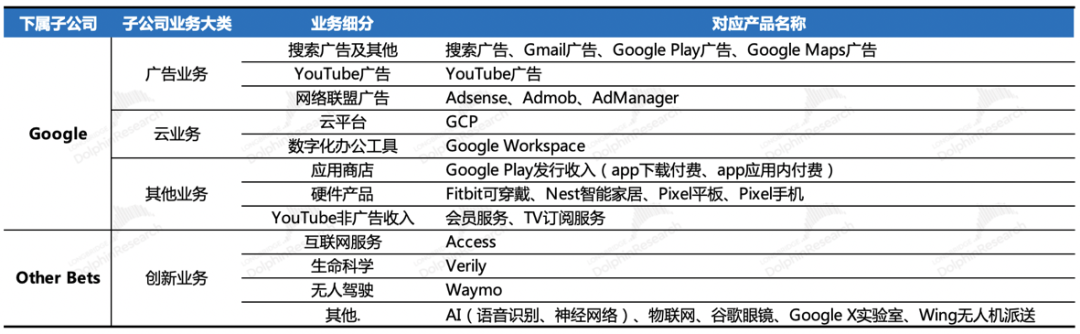
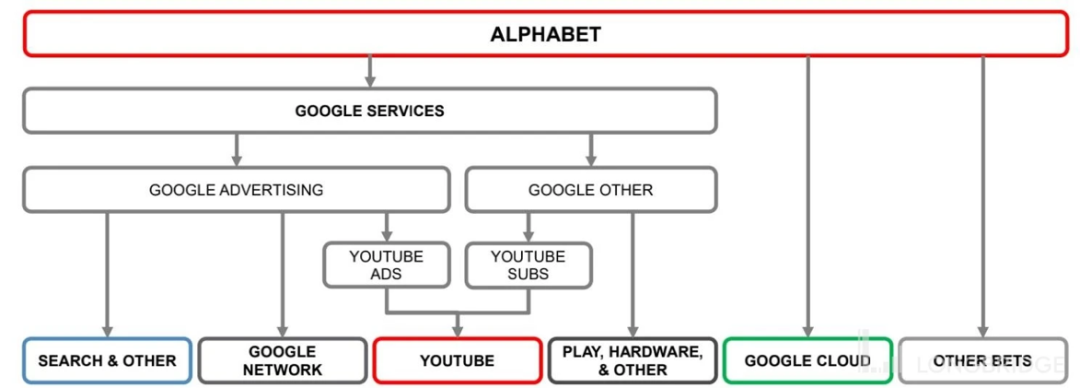
Google's parent company, Alphabet, has a diverse range of businesses, and its financial reporting structure has undergone multiple changes. Those unfamiliar with Alphabet can first review its business architecture.
Briefly outlining the long-term logic of Google's fundamentals:
a. The advertising business, as the main revenue contributor, drives the company's primary profits. Search ads face the medium- to long-term risk of being eroded by information feed ads, with the high-growth streaming platform YouTube stepping in to compensate.
b. The cloud business, including TPU hardware sales, has become the company's current primary growth driver and narrative, as well as the most direct beneficiary of AI.
II. Advertising: Strong Search Performance, YouTube Recovery
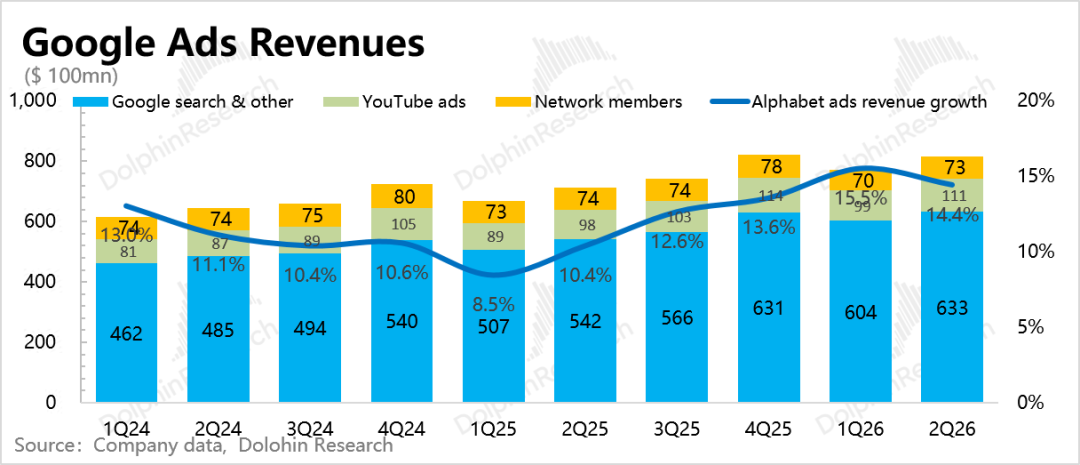
Q2 advertising revenue reached $81.6 billion, up 14% overall. Search ad revenue grew by 17%, maintaining strong momentum; YouTube ad revenue grew by 12%, continuing to recover from the previous quarter's growth rate.
The overall advertising industry performed well in Q2, with macroeconomic resilience and the gradual digestion of geopolitical impacts in April. Additionally, events like the World Cup and e-commerce (with reduced tariff disruptions leading to a return of North American advertising budgets for Temu and Shein, showing significant year-over-year growth) drove advertising demand.
Furthermore, AI-driven product innovations are helping major platforms secure incremental advertising budgets. According to a William Blair survey, Google benefits from stronger conversion rates and better user targeting capabilities brought by AI search tools, with search traffic still increasing. Although AI Overviews may reduce the number of clicks per user, the improved experience has temporarily attracted some users back to search and increased engagement and stickiness among existing users. As a result, some advertisers are also increasing their budgets to test the conversion effectiveness of AI Overviews.
YouTube maintains a stable leading position in growth on TV screens but continues to face the challenge of balancing user migration between paid subscriptions and ad placements. We believe that YouTube's ad recovery in Q2 may be related to the World Cup, while long-term growth opportunities still lie with Shorts.
III. Cloud: Accelerated Revenue Growth, Backlog Expansion
The cloud business is a key pillar in Google's AI revaluation, with market attention increasingly focused on the growth of backlog orders from a forward-looking perspective.
Q2 cloud business performance was impressive, slightly exceeding relatively optimistic buyer expectations. A key sentiment indicator—the remaining backlog of orders to be fulfilled—accumulated to $514 billion, with a net increase of approximately $50 billion quarter-over-quarter (indicating new contract additions of $100 billion). Based on the Q1 structure, over half of the backlog is expected to be recognized as revenue within two years.
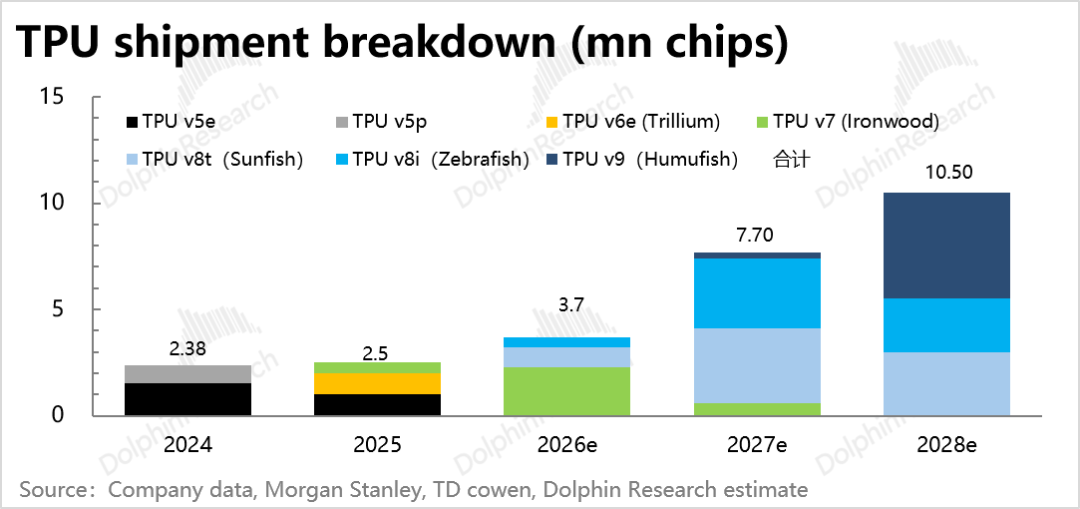
In the short term, with increased production and shipments of TPU v7 in the second half of the year and the upcoming mass production (mass production) of 8i/8t next year, cloud revenue is expected to continue growing rapidly. However, the iteration speed of the Gemini large model lags significantly, with limited competitiveness in several minor updates in the first half of the year compared to leading models.
The newly launched Gemini 3.6 Flash yesterday primarily optimizes output Token consumption, making output speed its core selling point. However, it lacks advantages in intelligence and actual cost-effectiveness (cost per task) compared to competitors. With Anthropic and OpenAI engaging in back-and-forth advancements and Chinese large models like Zhipu and Kimi taking turns in the spotlight, Gemini has been overly "silent" in the first half of the year.
Previous reports indicated that Gemini is tightening computing power for Meta, leading Dolphin Research to speculate that computing power was prioritized for clients in the first half of the year, constraining Gemini's internal development. Computing power shortages even led to temporary rentals of xAI computing power at extremely high premiums. Meanwhile, frequent turnover of team talent may also impact R&D progress.
Demand for AI remains explosive, with the company disclosing that the Gemini model can now process 22 billion Tokens per minute, a 42% increase from the 16 billion disclosed last quarter. Currently, Gemini has 950 million MAUs, with a net increase of 50 million this quarter.
IV. Other Businesses: Mediocre Growth
This segment's revenue primarily consists of YouTube subscriptions (ad-free memberships, TV, music, etc.), Google Play, Google One, hardware (Pixel phones and smart home appliances like Nest), etc.
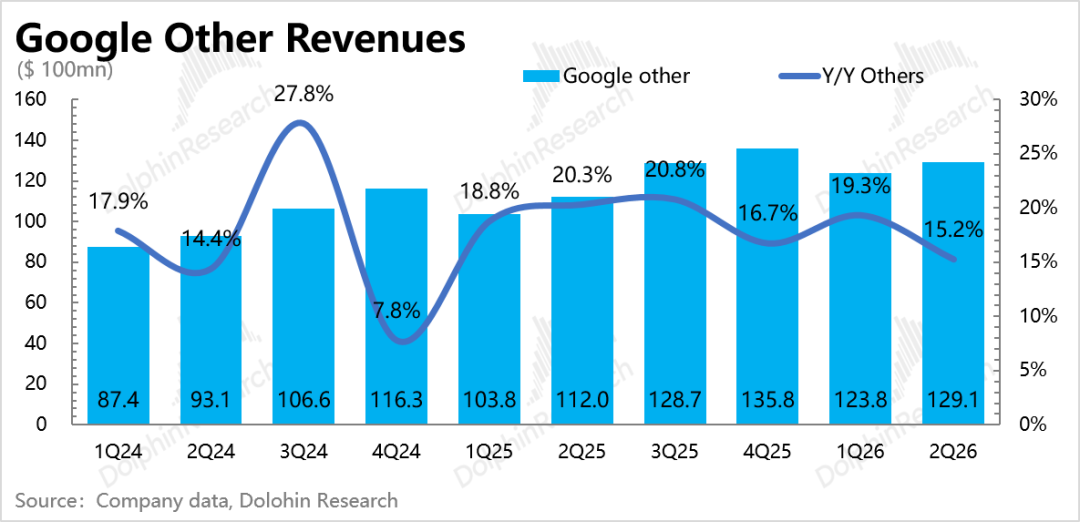
Q2 other revenue reached $12.9 billion, up 15% year-over-year, slightly below expectations. Growth was mainly driven by YouTube TV subscriptions, but channel fee reductions may lead to adjustments in revenue expectations for other businesses like Google Play.
Nielsen data suggests that YouTube CTV and Google One subscription revenue growth were the main drivers.
V. Impact of Continued High Investments on Profits and Cash Flow
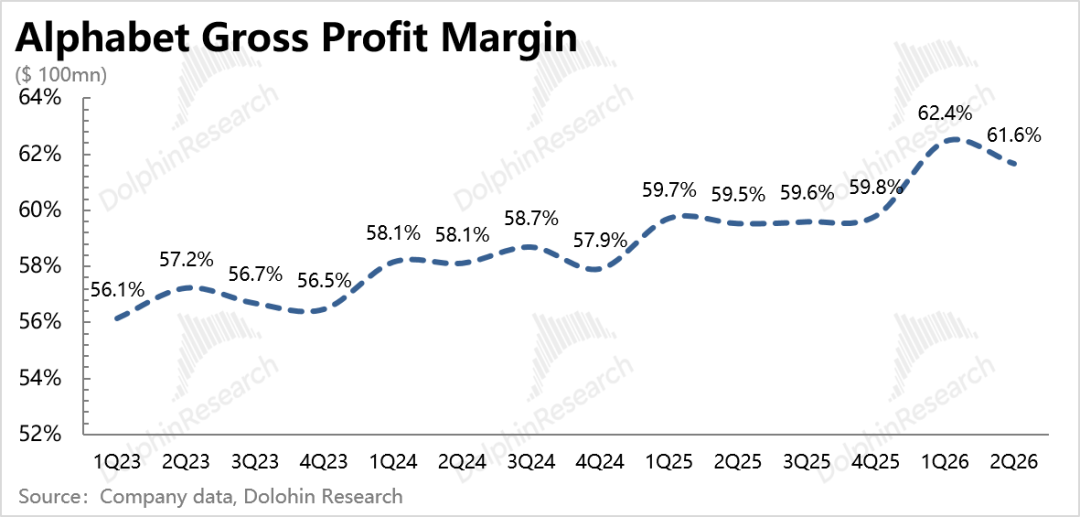
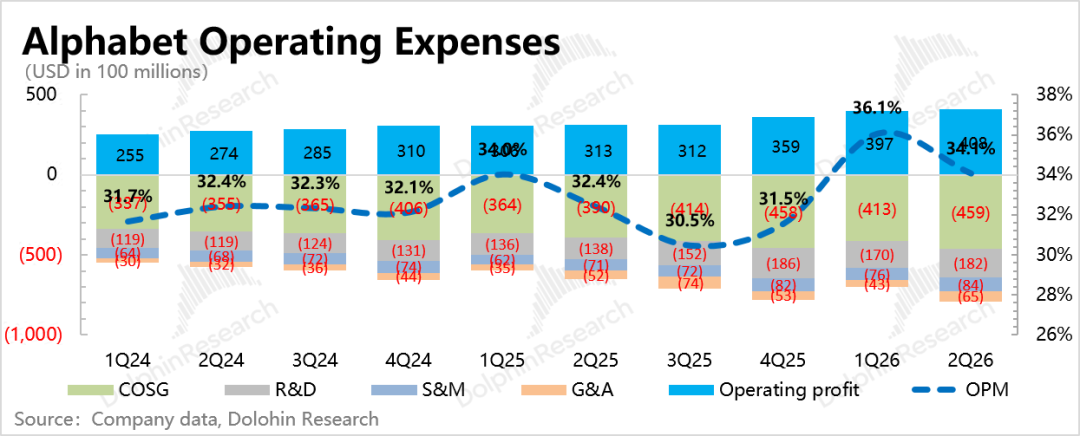
Q2 operating profit for the core business was $40.8 billion, with a profit margin of 34%, below buyer expectations. Dolphin Research believes that investors may have extrapolated linearly from last quarter's performance, but we previously stated that this profitability boost was due to a mismatch in depreciation timing from past investments, with accumulated pressure on depreciation costs from high investments over the past two years gradually being felt.
Dolphin Research expects that depreciation costs will drag on profit margins by an additional 5 percentage points over the next five years, necessitating cost reductions in other areas, such as operating expenses, to offset this.
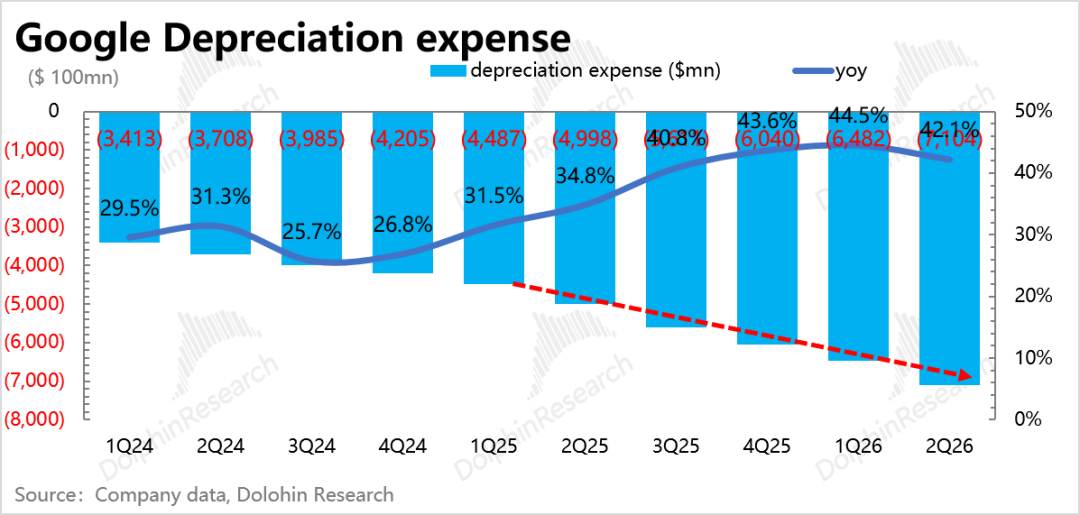
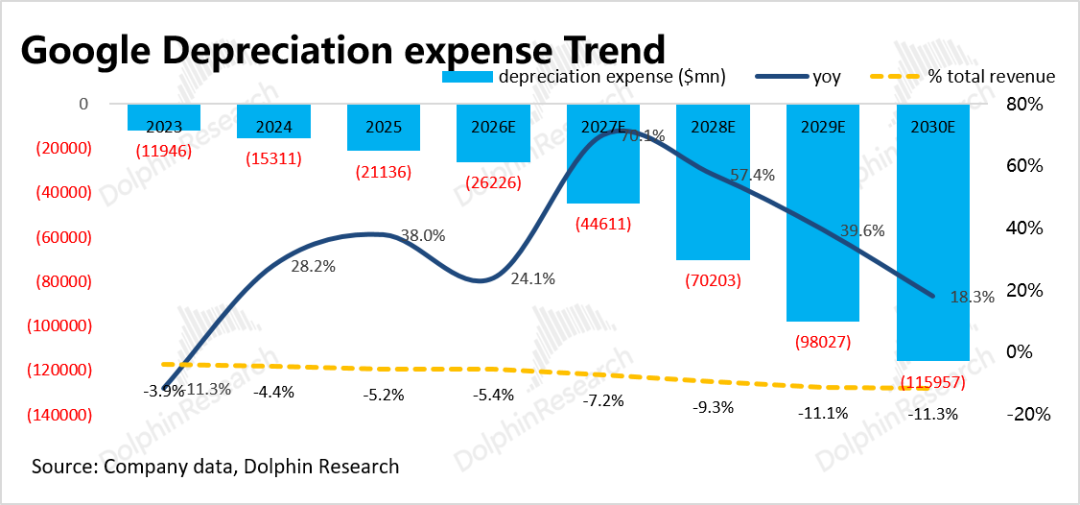
As a result, the profit margin declined marginally to 34% this quarter. Based on the base effect, pressure from high investments on short-term profits is expected to become apparent starting in the second half of the year.
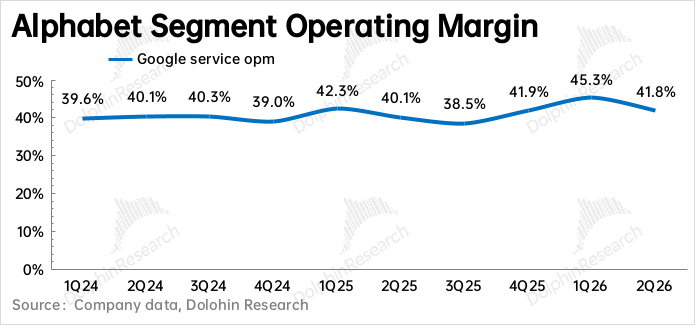
By business segment, Google Services experienced seasonal declines, while the cloud business's profit margin further improved to 36%, exceeding market expectations.
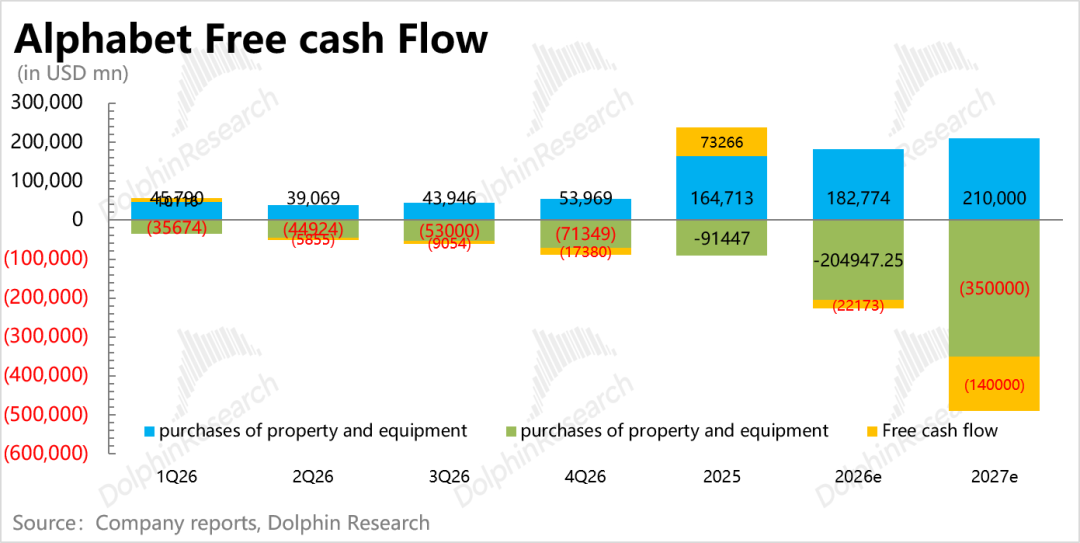
Capex directly impacts short-term cash flow. The company raised its Capex target range for the year by $10 billion, while maintaining expectations for significant growth in 2027. Here's a simple calculation by Dolphin Research:
In the first half of the year, Google announced over $80 billion in financing, with $49.6 billion already executed. Starting in Q3, the remaining $40 billion in additional issuances will proceed. Assuming OCF of $250 billion next year, combined with current cash and short-term investments of $240 billion and $40 billion from staged future issuances, totaling $540 billion in broad cash, it can still support the buyer's aggressive expectation of $350 billion in Capex for 2027.
The excess of nearly 200 billion can cover temporary investment or input needs, as well as the portion of long-term debt that gradually matures and needs to be repaid. However, managing such cash exposure is still not easy in practice, so it cannot be entirely ruled out that Google may have plans for additional financing beyond its current plans in the future.
- END -
// Reprint Authorization
This article is an original work by Dolphin Research. Reprinting requires authorization.
// Disclaimer and General Disclosure Notice
This report is intended solely for general comprehensive data purposes, designed for general viewing and data reference by users of Dolphin Research and its affiliated institutions. It does not take into account the specific investment objectives, investment product preferences, risk tolerance, financial situation, or special needs of any individual receiving this report. Investors must consult with an independent professional advisor before making any investment decisions based on this report. Any person making investment decisions using or referring to the content or information mentioned in this report does so at their own risk. Dolphin Research shall not be liable for any direct or indirect responsibility or loss that may arise from the use of the data contained in this report. The information and data contained in this report are based on publicly available sources and are provided for reference purposes only. Dolphin Research strives to ensure, but does not guarantee, the reliability, accuracy, and completeness of the relevant information and data.
The information mentioned or the views expressed in this report shall not, in any jurisdiction, be regarded or construed as an offer to sell securities or an invitation to buy or sell securities, nor shall they constitute advice, solicitation, or recommendation regarding securities or related financial instruments. The information, tools, and materials contained in this report are not intended for distribution to, or use by, any person or resident in any jurisdiction where such distribution, publication, provision, or use would be contrary to applicable laws or regulations or would subject Dolphin Research and/or its affiliates or associated companies to any registration or licensing requirements in that jurisdiction.
This report merely reflects the personal views, insights, and analytical methods of the relevant creators and does not represent the stance of Dolphin Research and/or its affiliated institutions.
This report is produced by Dolphin Research, and the copyright is solely owned by Dolphin Research. Without the prior written consent of Dolphin Research, no institution or individual may (i) make, copy, reproduce, duplicate, forward, or create any form of copies or reproductions in any manner, and/or (ii) directly or indirectly redistribute or transfer them to any other unauthorized persons. Dolphin Research reserves all relevant rights.
-
![]()
Gemini Slips From Global Top 10: What Lies Ahead for Google's AI Dominion?
-
![]()
Exclusive | Interview with Wu Yongjian, Vice President of Tencent Cloud: The Intelligent Agent Market Has Yet to Enter a Bubble Phase, Though Some Sectors Are Becoming Saturated
-
![]()
Profits Plunge by 57%: China’s Auto Price War Takes a Toll on Tesla
-
![]()
Google: Is AI Going to Collapse? A Savior Has Arrived
-
![]()
The Proxy War Between Uber and Meituan
-
![]()
30 Acres! Another Aerospace Unicorn Secures Land in Yizhuang to Establish a 'Satellite Factory'
-
![]()
A Rocket Soars from the East China Sea: Orient Space Embarks on Dual Solid-Liquid Long-Haul Journey
-
![]()
Baidu Becomes "Younger"