AI Giants Start Borrowing to Fuel Computing Power
 07/31 2026
 363
363
On the evening of July 29, Meta's Q2 earnings report unveiled a stark contrast in figures: Q2 revenue reached $60.801 billion, up 28% YoY. Operating cash flow hit $31.862 billion, a 25% YoY increase. However, capital expenditures surged to $31.078 billion during the same period, leaving free cash flow at just $784 million, a 91% YoY decline.
Meta also narrowed its 2026 capital expenditure guidance from "$125 billion to $145 billion" to "$130 billion to $145 billion." At the start of the year, this range was "$115 billion to $135 billion." The company's long-term debt rose from $58.744 billion at the end of 2025 to $83.664 billion, with net bond financing reaching $24.91 billion in Q2.
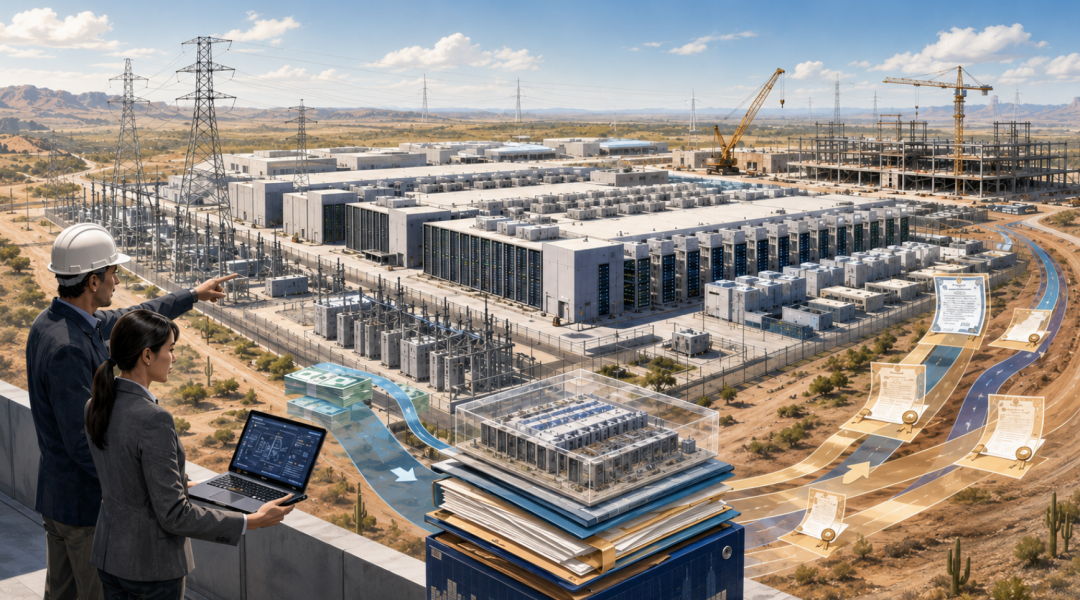
These earnings figures explain why Meta transferred its El Paso, Texas, data center into a joint venture the previous day. The project's total development cost is approximately $14 billion, with BlackRock's fund holding an 80% stake and Meta holding 20%. Of this, $12.5 billion will be financed through project debt. Meta will continue to oversee construction and management and lease the entire campus upon completion, with this 1-gigawatt project expected to go live in 2028.
Meta also provided an initial residual value guarantee of around $13 billion, which will gradually decrease over time. The initial lease term is four years, extendable up to 20 years after four renewals. If Meta exits within the first 16 years and the asset value falls below the threshold, the company may need to cover the shortfall.
In 2025, Meta adopted a similar approach for its Hyperion data center in Louisiana: the project's development cost is approximately $27 billion, with Blue Owl holding an 80% stake and Meta holding 20%. Meta leases the entire facility and provides a residual value guarantee for the first 16 years of operation.
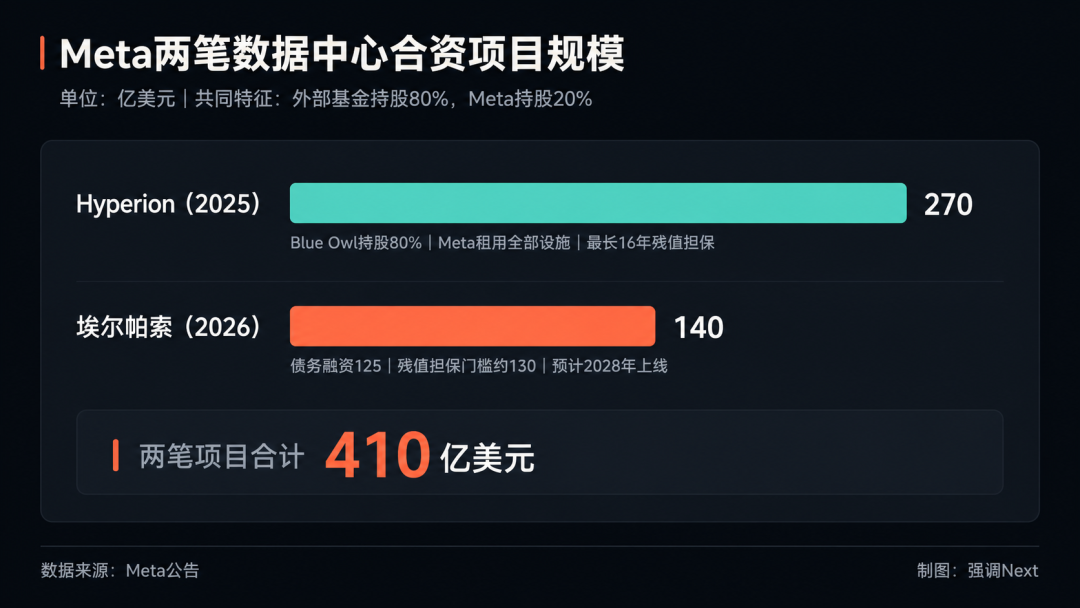
The two transactions total $41 billion. Meta retains a minority stake but maintains control over construction, operation, and usage rights. The trade-off is transforming one-time capital expenditures into multi-year rent, guarantees, and contractual obligations.
This is not merely a case of "running short on cash." As of late June, Meta still held $90.26 billion in cash, cash equivalents, and marketable securities, with its advertising business experiencing rapid growth. More accurately, the scale and construction timeline of current AI investments have become so substantial that even Meta is unwilling to rely solely on current operating cash flow to cover costs. By placing data centers into project companies, long-term leases, credit guarantees, and future usage demands serve as financing foundations, with bond markets now advancing computing power construction costs for tech firms.
01. Even Cash Cows Need to Borrow
Meta is not alone.
According to LSEG data, Amazon, Alphabet, Meta, and Oracle had issued approximately $194 billion in bonds by July 7 this year, a 79% increase from the total for all of 2025. Goldman Sachs projects that, including Microsoft, the five hyperscale cloud providers could issue $250 billion in bonds this year, rising to $400 billion by 2027.
Funds can still be raised, but at a higher cost. The median credit spread for 2- to 4-year bonds issued by these companies relative to risk-free rates has risen from 30 basis points in 2025 to 40 basis points. For long-term bonds with maturities exceeding 20 years, the median spread has increased from 108.5 basis points to 118.5 basis points. Meanwhile, the oversubscription ratio has dropped from nearly 5x in February to below 2x in July. Credit expansion is not without limits; the more bonds are issued, the higher the financing costs large firms will pay for their next data center.
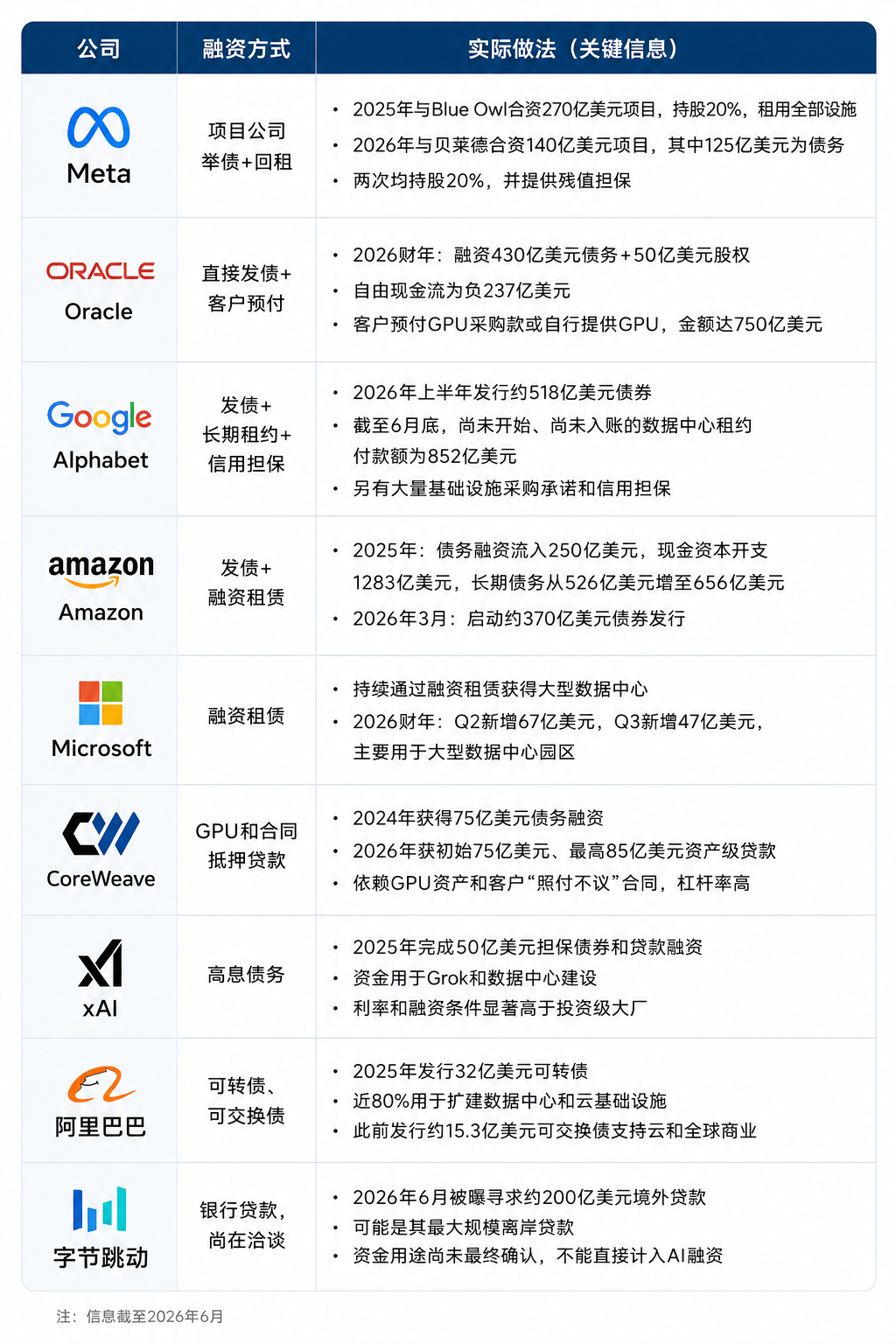
Amazon initiated approximately $37 billion in bond issuance in March this year and raised another $25 billion in July. Oracle financed $43 billion in debt and $5 billion in equity in FY2026. Despite generating $32 billion in operating cash flow, its free cash flow turned negative at -$23.7 billion. The company anticipates needing to raise approximately $40 billion in additional financing in FY2027.
On July 9, S&P downgraded Oracle's rating from BBB to the lowest investment-grade rating of BBB-, with a stable outlook. The reason was not a lack of orders but the significant upfront investments and long-term leases driving up leverage and sustaining negative free cash flow. Oracle's remaining performance obligations have reached $638 billion, with S&P estimating that roughly half stems from OpenAI. If clients default, Oracle may still be stuck with non-transferable data center leases. As a result, Oracle became one of the first major tech firms to face an explicit rating downgrade in this round of AI infrastructure expansion.
Alphabet's approach is more multidimensional. In the first half of 2026, the company issued $51.8 billion in bonds. By late June, its long-term debt had reached $98.2 billion. Signed but not yet commenced data center lease obligations amounted to $85.2 billion, with these liabilities not yet included in existing lease obligations.
Microsoft offers another model. In Q4 FY2026, its capital expenditures reached $41 billion, a more than 70% YoY increase. Operating cash flow stood at $55.441 billion, with free cash flow remaining at $19.6 billion. Annual capital expenditures totaled approximately $145 billion.
Even larger figures are hidden in lease obligations. By late June, Microsoft had signed data center leases worth $329.1 billion that had not yet taken effect, more than tripling from $92.7 billion a year earlier. These leases will commence between FY2027 and FY2033, with terms extending up to 20 years, locking in future cash outlays.
Microsoft also extended the estimated duration of long-term data center leases from 15 to 25 years, reducing its 2026 capital expenditure estimate from approximately $190 billion to $175 billion. While this adjustment lowers reported figures, it cannot cancel signed contracts.
These companies are not short on cash, but AI infrastructure expansion has surpassed what operating cash flow can comfortably cover. Data centers require upfront commitments to land, power, and chips, while revenue generation awaits the deployment of computing power. Bond issuance is just the most visible layer; leases, finance leases, project company liabilities, and client prepayments are also locking in expenditures ahead of time.
Chinese firms are adopting similar methods. In September 2025, Alibaba issued $3.2 billion in zero-coupon convertible bonds, with roughly 80% of the funds earmarked for data center expansion, technology upgrades, and cloud services. Two months prior, Alibaba also issued approximately $1.5 billion in exchangeable bonds. The difference lies in the fact that U.S. tech firms rely more on corporate bonds, project bonds, and private credit, while Chinese enterprises still primarily use convertible bonds, bank loans, and operating cash flow.
02. Computing Power Contracts Become Collateral
The crux of AI financing expansion is that computing power has transformed from a technological product into a financial asset.
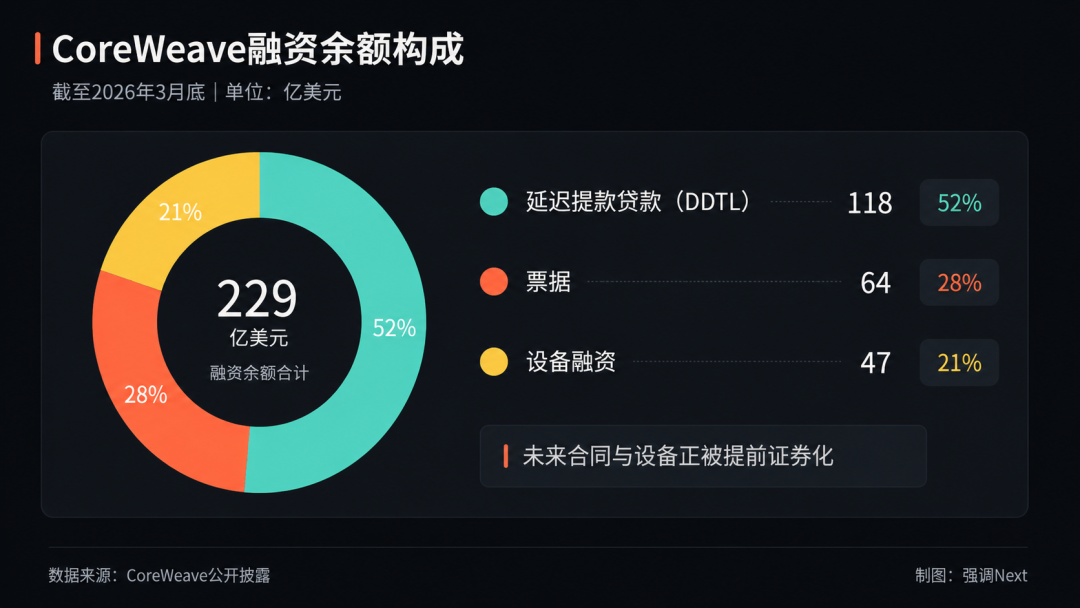
As of late March 2026, CoreWeave had $11.8 billion in delayed drawdown loans, along with $6.4 billion in notes and $4.7 billion in equipment financing. Collateral includes not only GPUs but also long-term "take-or-pay" contracts signed with clients like Microsoft. Future computing power revenue is being converted into construction funds in advance.
Oracle is also involving clients in financing. By the end of FY2026, clients had prepaid $75 billion for GPU purchases or directly provided GPUs under its large AI contracts. Cloud computing contracts are now fulfilling roles traditionally handled by bank loans.
Chip companies are also extending credit downstream. AMD provides guarantees of up to $4.1 billion for its partners' data center leases. Alphabet's lease default guarantees for third-party operators using TPUs have surged to $44 billion, up from just $6.5 billion at the end of September last year.
The Financial Times also revealed that NVIDIA may be the actual tenant of Hut 8's Texas data center, with a base contract value of $19.6 billion and potential subleasing to cloud service providers purchasing its GPUs. If true, NVIDIA's role would extend beyond chip sales to credit intermediation.
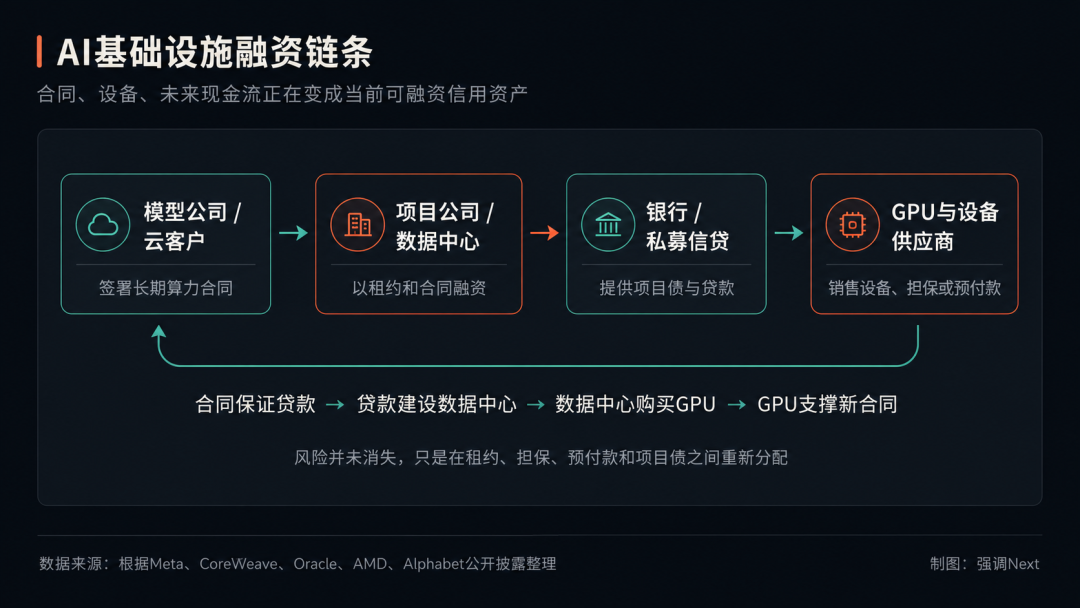
A financing chain is forming among suppliers, cloud providers, data centers, and model companies. Contracts secure loans, loans fund data center construction, data centers purchase GPUs, and GPUs support the next round of computing power contracts.
03. Bond Markets Begin Pricing AI
These financing methods alleviate funding pressure during the construction phase but do not reduce the projects' ultimate costs.
Credit ratings are just the first health check. On July 29, Oracle's five-year credit default swap (CDS) spread was approximately 200 basis points, Meta's around 93, NVIDIA's about 78, while the investment-grade company CDS index stood at roughly 53. NVIDIA's CDS briefly hit an all-time high this week.
CDS acts as breach of contract insurance for corporate bonds, with wider spreads indicating higher risk compensation. Q2 CDS trading volume related to the tech sector neared $650 million, a nearly sixfold YoY increase, as bond investors purchased more protection.
Meta's free cash flow nearing zero, Oracle's downgrade to the lowest investment grade, and NVIDIA's rising credit risk premiums reflect three issues: cash coverage, client and lease mismatches, and suppliers extending credit downstream. Bond markets are not predicting AI investment failures but are demanding higher prices for uncertain returns.
Meta's El Paso project relies on leases to support $12.5 billion in debt, with an approximate $13 billion residual value guarantee threshold. If AI demand falls short of expectations, Meta must still pay rent or cover asset value declines.
The project company holds the data center, Meta holds usage obligations, and bond investors bear the project's credit risk. While Meta no longer fully owns the asset, risks persist through leases and guarantees.
AI is already improving Meta's recommendation and advertising efficiency. The question is whether advertising growth can sustainably cover annual capital expenditures of $130 billion to $145 billion, along with subsequent depreciation, cloud service fees, and data center operating costs appearing on the income statement.
More critically, unlike Amazon, Microsoft, and Alphabet, Meta lacks a large-scale cloud business to sell excess computing power directly to external clients. Zuckerberg has proposed developing external computing power services during earnings calls, and Meta has reportedly discussed up to $10 billion in computing power leases with Anthropic. However, until these materialize, they remain supplementary explanations for massive investments.
On the same evening, Microsoft's after-hours stock price briefly surged over 8%, while Meta's fell approximately 10%. Both companies are increasing AI investments, but the difference lies in Microsoft's Azure revenue growing 43%, with commercial remaining performance obligations reaching $678 billion and free cash flow remaining at $19.6 billion. Meta's external computing power revenue has yet to scale.
Capital markets are now pricing credit expansion based on return speed, contract quality, and solvency.
The computing power race has thus added financing costs as a hurdle. Measuring AI investments requires considering not just capital expenditures but also project liabilities, long-term leases, procurement commitments, client prepayments, and supplier guarantees.
Meta is far from a liquidity crunch, but with free cash flow at just $784 million, project financing has become more than a financial tactic—it is a vital funding source to maintain construction momentum.
Oracle's rating downgrade, widening tech company CDS spreads, and declining bond oversubscription ratios indicate that while AI infrastructure can still secure financing, cheap credit is disappearing. The true differentiator will be who can first transform computing power, leases, and guarantees into sustained revenue rather than continuously covering old investments with new credit.
- END -
-
![]()
Computing Power Supplier Bags Orders Worth Over 600 Million Yuan, Yet Receives Only 4.5 Million Yuan in Actual Payments!
-
Alibaba Is Just Five Months Away from Securing Two Consecutive AI Coding Titles
-
![]()
Less Investment Isn't Apple's Get-Out-of-Jail-Free Card
-
![]()
The 'King of Africa' Tecno Mobile: What Is the Market Hesitating About After Its 'V-shaped' Rebound?
-
![]()
ByteDance Restructures Feishu, What Signals Does It Send?
-
![]()
ByteDance Overhauls Feishu: What Strategic Signals Are Being Sent?
-
![]()
Pay $39 a Month with Apple Upgrade: Apple's New Business, Your Old Wallet
-
![]()
The Open-Source Debate Dividing Silicon Valley