Tencent, Alibaba, and ByteDance Make Significant Investments in AI-Driven Office Solutions, Revolutionizing the Industry
 08/06 2026
 529
529
Source: Duke Internet Society (ID: wlyxs888)
In just half a month, Tencent, Alibaba, and ByteDance have nearly simultaneously restructured their AI office business units, putting an end to internal disorderly competition and pooling all human and computational resources for a direct attack.
On July 30th, ByteDance fully integrated its Feishu product team into Doubao. Xie Xin, the head of Feishu, now reports to Doubao's head, Zhao Qi, and the entire sales line has been transferred to Volcano Engine. Feishu has evolved from a standalone product into an application scenario for large-scale models.
On August 3rd, Alibaba's Qianwen Office officially launched its public beta, merging all three competing internal Agent product lines into a single entry point. The new CEO of DingTalk, born in 1992, tightened his control just 46 days after assuming office.
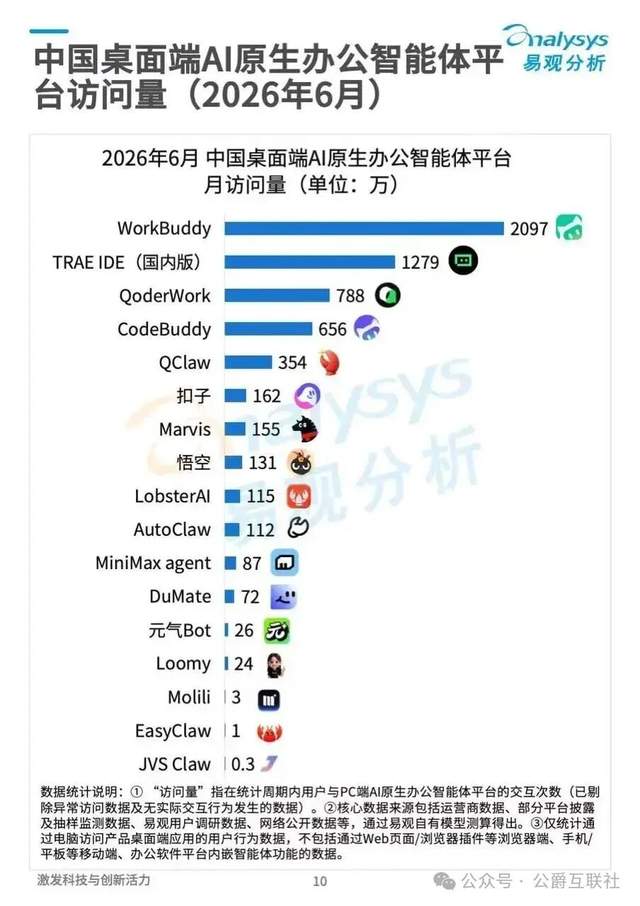
On the same day, Tencent's WorkBuddy introduced a human-machine dual-writing feature. With a monthly active user base exceeding 20 million in June, it has cemented its position as the top domestic desktop AI office agent.
The office scenario, once overlooked, has suddenly emerged as the most critical arena for AI commercialization. After years of dormancy, China's enterprise services sector is embarking on a new round of fierce competition, riding the wave of AI.
【Why AI for Office Solutions?】
The previous wave of enterprise services focused on "digitizing work."
Documents, approvals, clock-ins, and instant messaging essentially replicated offline processes online. After DingTalk, WeCom, and Feishu carved up the market, what came next? Not much.
Reaching growth limits is a very real issue. All companies that could digitize have done so, and all customers willing to pay have already paid. The business of simply selling accounts and storage space has reached its limit.
The SaaS model for enterprise services has always faced challenges in China—low customer willingness to pay, high customization demands, and stagnant renewal rates have everyone searching for a second growth curve.
AI presents the industry with an opportunity to reshuffle.
But why specifically the office scenario?
Because the office is where AI commercialization holds the highest certainty.
Consumer-end chatbots are provided free of charge, and no one is making money; industrial AI has long implementation cycles and high customization costs, with projects taking up to half a year; education and healthcare face policy barriers and are off-limits.
Only the office scenario offers high frequency, rigid demand, and a clear willingness to pay—as long as it helps companies save on manpower, costs, and time, bosses are willing to open their wallets.
More critically, office software serves as the digital gateway for enterprises.
Employees spend eight hours a day immersed in it, with all data, processes, and organizational permissions centered here. Whoever captures the AI office gateway can seamlessly penetrate subsequent financial, HR, supply chain, and CRM services, offering a full suite of enterprise solutions.
The battle for gateways has always been the most ruthless in the internet industry.
【Three Approaches: Who's the Most Ambitious?】
While all three companies are pursuing AI office solutions, their strategies differ entirely, precisely targeting different customer segments.
Alibaba: Heavy Infrastructure, Targeting Existing Market Share
Alibaba follows a "heavy infrastructure" route, with a clear goal—to capture the existing market share of traditional government, enterprises, and physical businesses.
DingTalk boasts over 20 million enterprise clients, many of which are in manufacturing, offline retail, and government agencies. These clients are characterized by fixed processes, heavy operations, and varying levels of digitalization.
Qianwen Office's solution isn't about replacing existing systems but adding a layer of AI on top of DingTalk.
AI is embedded into every fixed process, from approvals and work orders to attendance and supply chains. Low-code plus AI allows employees without technical expertise to build business processes and generate reports with a single voice command.
In essence, Alibaba is pursuing "business process intelligence," targeting traditional enterprises already using DingTalk who now want to further reduce costs.
The advantage of this approach is stability: a large base of existing customers makes AI value-added services a natural progression. The disadvantage is heaviness: each industry's processes differ, leading to high customization costs and long delivery cycles.
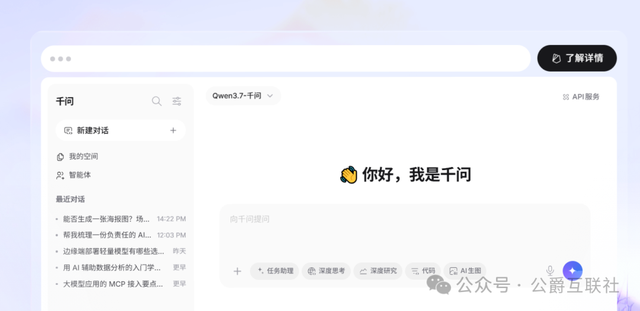
ByteDance: Ultimate Closed Loop, Targeting High-End Markets
ByteDance follows an "ultimate closed loop" route, aiming at knowledge-intensive high-end enterprises.
Feishu plus Doubao, with native integration of large-scale models, fully connects documents, meetings, multidimensional tables, and AI assistants, rejecting external fragmented access.
This approach is most friendly to high-intensity brainpower teams in internet, R&D, design, and new media. AI enables real-time collaborative design proposals, automatic meeting recaps, and intelligent project breakdowns, seamlessly connecting the entire workflow.
Feishu's original customer profile already leaned toward internet and tech companies. Now, with Doubao's AI capabilities, it's like equipping these "superbrains" with an "AI exoskeleton."
However, a closed ecosystem is a double-edged sword. The benefit is a unified experience and connected data; the drawback is poor compatibility.
Traditional enterprises' legacy systems can't integrate, and manufacturing floor workers can't use Feishu's tools. ByteDance's customer base is naturally high-end and young, with inherent ceilings.
Tencent: Lightweight and Open, Capturing Small and Medium-Sized Merchants
Tencent follows a "lightweight and open" route, capturing the vast sea of small and medium-sized merchants.
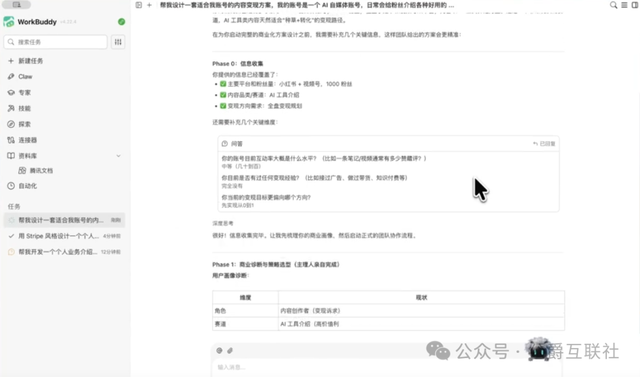
WorkBuddy doesn't force a complete replacement of existing office systems but positions itself as an "add-on AI assistant"—you don't need to replace your spreadsheets or overhaul existing processes; just integrate it into the WeCom ecosystem to use it.
Backed by WeChat and WeCom's private domain advantages, Tencent's AI office is naturally suited for small and medium-sized merchants. They need both internal office capabilities and external customer operations, and the combination of WorkBuddy and WeCom covers both.
It has the lowest entry barrier, the broadest coverage, and the most customers, but also the lowest average revenue per user.
The strategies of the three companies boil down to this: Alibaba targets existing government and enterprise market share, ByteDance attacks high-end brainpower-driven companies, and Tencent reaches down to the vast sea of small and medium-sized merchants.
They are precisely positioned, not fully overlapping, yet constantly clashing.
【What Is This Battle Really About?】
Many believe AI office competition hinges on model capabilities—whoever has more parameters or higher "IQ" wins.
Wrong.
The real competition unfolds on three levels.
The first level is scenario implementation capability.
Most AI office solutions on the market today still停留在 superficial functions like writing copy or summarizing meetings. Can they automatically verify reimbursement documents? Track project milestones? Integrate with ERP data? Not really.
Anyone can create a PPT-style AI demo; the real challenge is embedding AI into enterprises' actual business workflows to handle repetitive, tedious tasks that humans dislike.
This isn't solvable by model parameters alone; it requires industry understanding, scenario refinement, and deep customer insight.
The second level is data security and private deployment.
Enterprises' contracts, financial data, and customer information are their lifeblood.
Government and large enterprises will never upload core data to the public cloud. Whoever can deliver on-premises deployment, data isolation, and permission controls will earn the right to compete for large clients.
This is why Alibaba and ByteDance are desperately developing private deployment solutions, and Tencent repeatedly emphasizes data security in WeCom.
The third level is commercialization efficiency.
The gap between free trials and stable subscription revenue is vast.
Doubao Pro costs 68 RMB per month, WPS AI membership costs a few dozen yuan, and various AI value-added services are setting prices. But whether enterprises will keep paying is the ultimate test of a product's value.
The difficulty of SaaS in China has largely stemmed from enterprises feeling that "buying it doesn't help."
If AI office can't prove it genuinely reduces costs and increases efficiency, it will become just another "boss thinks it's great, employees don't use it" decoration.
【Not Just Three Players, Not Just Office】
While the main battle involves these three giants, other players in the field aren't idle.
Kingsoft WPS is impossible to ignore. Its massive PC-based individual user base naturally positions WPS AI to penetrate small and micro-enterprises. Document AI is its foundation, with table AI and PPT AI rolling out soon.
WPS's advantage lies in established user habits, making AI features a natural extension; its drawback is its tool-oriented nature, lacking enterprise-level process and organizational capabilities.
Vertical SaaS vendors are also scrambling to adapt. Software in tax, HR, and project management niches are embedding AI into their products.
Their advantage is industry and customer expertise, diving deep into verticals; their drawback is small scale and weak computing power, unable to keep up with large-scale models from major players, forcing them to survive in the cracks.
But my point isn't about the number of players; it's about the trend behind this war.
In the next three to five years, enterprise services will no longer sell office software but "AI digital employees."
Administrative, financial, and project assistant roles—basic and repetitive tasks—will be routinely handled by AI. Office software will evolve from a "communication tool" into an "enterprise intelligent operations hub."
This won't happen overnight. Data security issues, employee acceptance, and business adaptation each present hurdles.
But the direction is clear—AI won't replace humans, but it will replace those who only do repetitive work.
The previous round of enterprise services moved work from paper to online.
This round will move work from humans to AI.
Finally, a question: When AI can truly handle most of your work, do you want to be the one commanding the AI or the one being replaced by it?
Note: Some data in this article is sourced from publicly available online materials.
-
![]()
China's L3/L4 Mandatory Standards Have Arrived: A Practitioner's Straightforward Interpretation
-
![]()
Commercial Space Launch Pads: Why Are They Always in Short Supply?
-
![]()
Unveiling the "Three Secrets" Behind SAIC-GM's Contract Renewal!
-
![]()
An AI Unicorn is Born in the US Logistics Industry! HappyRobot Secures $150M in Series C Funding, Valuation Reaches $1.2B
-
Xingyu Shares, the 'Headlight King,' Makes Another Attempt at Listing on the Hong Kong Stock Exchange: Dividends with One Hand, Fundraising with the Other
-
Reviewing July's Plunge: Three Fates of AI Assets
-
![]()
Tencent, Alibaba, and ByteDance Make Significant Investments in AI-Driven Office Solutions, Revolutionizing the Industry
-
![]()
Challenges Ahead for Raysharp Semiconductor's IPO Amidst Controlling Shareholder's Limited Dominance