How to Leverage AI Digital Humans for Overseas Live Streaming and Key Precautions
 08/19 2026
 417
417

"The crux of AI live streaming's global expansion doesn't lie in initiating broadcasts but in comprehending the cultural taboos of the target regions."
Author|Xingyu
Produced by|Jixin Going Global
In August 2026, the digital human host at Hubei Yima Pingchuan Network Technology Company in Wuhan Optics Valley was explaining fishing bait in English. The post-95s founder, He Wei, returned to Optics Valley from Hangzhou to start his business at the end of the previous year, achieving cross-border sales exceeding US$10 million in less than a year. How did he manage this feat?
The answer, in essence, is not overly complex. They developed a system capable of real-time AI translation in over 130 languages, enabling a single operator to manage multiple live streaming rooms simultaneously, selling products live from various global locations, and gradually scaling up operations.
This also underscores the growing value of the adage, "Mastering Chinese enables global sales."
However, the longevity of an AI live streaming venture hinges not solely on linguistic communication but on a profound understanding of local culture.
Localization Challenges in AI Live Streaming's Global Expansion
Could the image of an AI digital human host offend local cultural sensibilities? For instance, the Saudi market imposes strict dress code requirements for virtual avatars, Japan embraces anime-style aesthetics, and Europe and America are highly sensitive to issues of racial and gender equality. The same AI host image might be well-received in Thailand but could violate religious norms in Indonesia and face an outright ban in Saudi Arabia, leading to vastly different outcomes across these markets.

(Image source: The New Arab)
Could AI-generated content inadvertently breach religious taboos? In Southeast Asia and the Middle East, regulatory focus is on religious and cultural sensitivities, as well as social ethics. Indonesia, Malaysia, and other regions strictly prohibit blasphemy against religion, with violators potentially facing imprisonment. A casual remark by an AI digital human host might be innocuous sales talk in China but could constitute religious blasphemy in Islamic countries, resulting in a ban and loss of access to the target market.
Will local platforms and regulators prohibit AI live streaming? In May 2026, TikTok Shop in the U.S. updated its content quality policy, explicitly banning AI-generated voices, pre-recorded audio, and static images for live streaming and shoppable videos. Live streams must involve real-time language or sign language communication by the host. Violations will incur point deductions, restricted commissions, or account bans. Shopee mandates clear labeling of all AI-generated content. The Cyberspace Administration of China issued the "Administrative Measures for Information Services of Digital Virtual Humans," prohibiting the provision of virtual intimate relationship services to minors and inducing religious belief, among other norms. This demonstrates that AI digital human live streaming, whether domestic or international, faces restrictions. How can these be mitigated?
Thus, the primary barrier to AI live streaming's global expansion is no longer language. While linguistic challenges can be readily overcome, cultural translation and compliance building demand research and consideration and cannot be simply addressed through AI.
Current Landscape of AI Digital Human Live Streaming
Platform regulation of AI content is continuously tightening. TikTok Shop removed 86 million non-compliant fake accounts in the first quarter while implementing new regulations mandating mandatory traceability labeling for AI-driven sales content. Violators will face penalties such as demotion, reduced advertising traffic, and restricted placements.
Cultural taboos vary significantly across markets. The European and American markets prioritize racial and gender equality and hate speech. Southeast Asia boasts a diverse culture intertwined with religious sensitivity. The Middle East and North Africa possess strong consumer power but enforce strict cultural taboos and regulations under Islamic law.
Domestic regulation is also evolving. In April 2026, the Cyberspace Administration of China explicitly prohibited the provision of virtual intimate relationship services to minors and inducing excessive consumption or religious belief, among other norms.
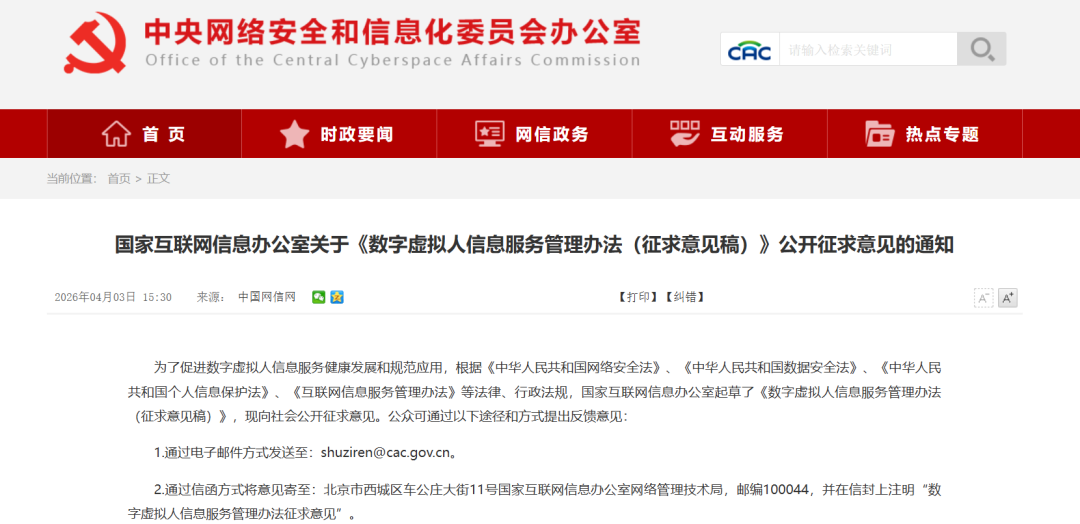
(Image source: Official website of the Cyberspace Administration of China)
These issues persist and will not vanish in the future, indicating that AI live streaming's global expansion can no longer rely on a "move fast and break things" mentality. Cultural adaptation and compliance building must be prioritized before launching.
Potential Solutions
Establish a country-specific content review system. The concept is straightforward: align different review standards with various markets, categorizing issues as severe or minor. Then, implement strict religious reviews for Middle Eastern religious countries and special strategies for minor protection in Europe and America. Before entering a new market, conduct a cultural survey, configure content review strategies, and only then allow the AI host to go live. Currently, some technology service providers offer multilingual content risk control systems that can configure differentiated strategies based on different countries and product types. Exploring cooperation with them for global expansion is advisable.
Next, embed compliance safeguards in the content generation process. For example, TikTok Shop requires AI-generated content to be clearly labeled. Article 50 of the EU AI Act's transparency clause mandates disclosure obligations for all AI materials targeting EU consumers. A more intelligent approach is to incorporate compliance rules during AI content generation, specifying prohibited words, images, and topics.

(Image source: Online material)
Establish localized content production processes. While AI translation can now address language issues, cultural, religious, and emotional expressions require human intervention. Trust can only be built between people; relying solely on AI leads to one-time transactions. Hubei Yima Pingchuan Network Technology Company has explored a model combining AI initial translation, human refinement, and local co-creation. Real-time translation in 130 languages is a technical capability, but understanding the cultural context behind each language—which words are sensitive, which phrases backfire locally—requires intervention from localized teams.
Final Thoughts and Recommendations
Returning to the original question, the statement "Mastering Chinese enables global sales" is only partially accurate.
AI has indeed surmounted language barriers, enabling bosses who don't speak foreign languages to engage in live streaming. However, cultural barriers and compliance red lines cannot be fully resolved by AI. An AI host making an inappropriate remark in Indonesia might face not just negative reviews but imprisonment. An AI image dressed inappropriately in Saudi Arabia might lead to an immediate account ban. An unlabeled AI live stream on TikTok might be demoted or even banned.
The value of the Optics Valley company's system lies in demonstrating the technical feasibility of AI live streaming's global expansion. However, what truly determines the longevity of an AI live streaming project is whether cultural adaptation and compliance building have been properly implemented in each target market.
For bosses preparing to enter the market, start by selecting a market with relatively low cultural barriers, such as Southeast Asian countries with high cultural tolerance. Conduct cultural surveys and compliance pre-reviews for the target market before going live. Establish a content production process combining AI generation with human review to ensure that every AI-generated phrase undergoes localized review.
-
![]()
Surpassing the 'Storage Storm': Xiaomi’s Pivotal Moment
-
![]()
2026 China Auto Market: A 'Major Reshuffle' — Small Cars Decline, Large Cars Flourish, Is the Era of Fuel Vehicles Over?
-
![]()
Non-Recurring Items-Adjusted Net Profit Soars by 72.59%! Dongtianwei Records 502 Million Yuan in Revenue
-
![]()
Securing 2 Billion Yuan in Financing and Supplying Inno-Light: This Optical Device Company Launches Its IPO!
-
![]()
Farewell to 'Card Stacking': 2026 Marks China's Computing Power Shift to 'Token Value Output' Era
-
![]()
Xiaomi Weathers Storage Price Surge, Q2 2026 Revenue Tops 100 Billion Yuan Again
-
![]()
Geely Bids Farewell to the 'Li Shufu Era': A Historic Power Transition in China's Auto Industry | Auto Circle
-
![]()
Baidu Prepares for Inclusion in Southbound Trading: Wall Street Reassesses the Value of 'AI ETF'