Xiaomi Weathers Storage Price Surge, Q2 2026 Revenue Tops 100 Billion Yuan Again
 08/19 2026
 559
559
On the evening of August 18, 2026, Xiaomi Group unveiled its financial results for the second quarter:
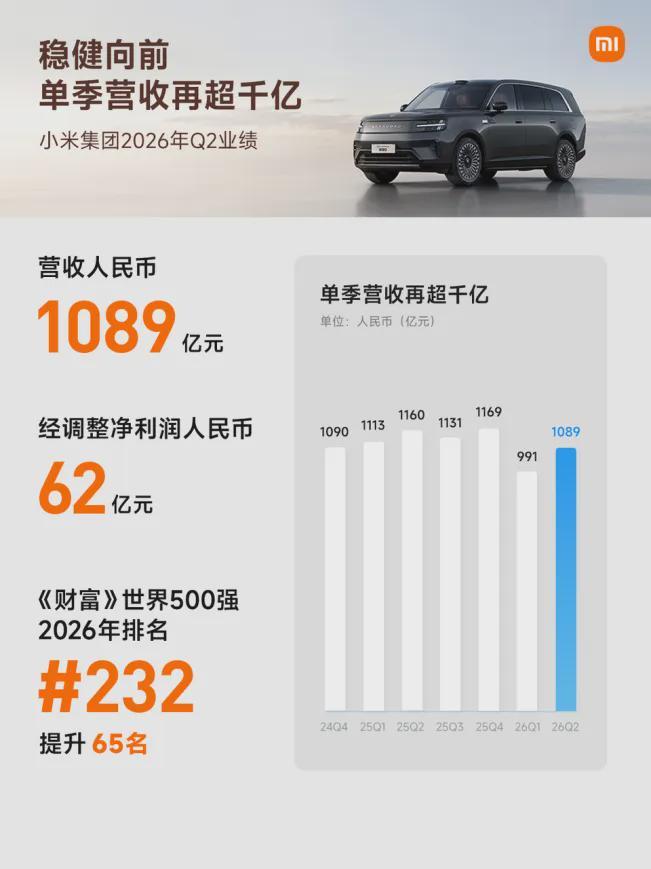
The company's revenue for the quarter soared to 108.9 billion yuan, once again breaching the 100 billion yuan mark. Its adjusted net profit stood at 6.2 billion yuan, showing a sequential uptick. Moreover, R&D investment climbed to 9.2 billion yuan, marking an 18.9% year-on-year increase.
Frankly, prior to the release of this financial report, there were concerns regarding Xiaomi's Q2 performance. After all, storage prices surged upstream throughout the quarter, significantly raising cost pressures for smartphone manufacturers.
However, Xiaomi's results have allayed market fears.

Xiaomi Stands Firm Amid Industry Challenges
The second quarter proved to be a trying period for all smartphone manufacturers.
According to third-party research agency memory price tracking, smartphone memory prices skyrocketed by over 80% quarter-on-quarter in Q2.
Omdia Chief Analyst Runa Bjørhovde highlighted that memory costs for some manufacturers have ballooned to four to five times those of a year ago. Memory and storage alone now account for over 60% of the bill of materials cost for entry-level smartphones and more than 30% for high-end models.
DRAM even surpassed SoC main control chips for the first time, becoming the most costly component in smartphones.
Social media was abuzz with jokes from netizens, noting that over the past six months, the fastest-appreciating asset wasn't gold or silver, but the memory chips in computers and smartphones.
Yet, amidst this industry downturn, Xiaomi remained steadfast.
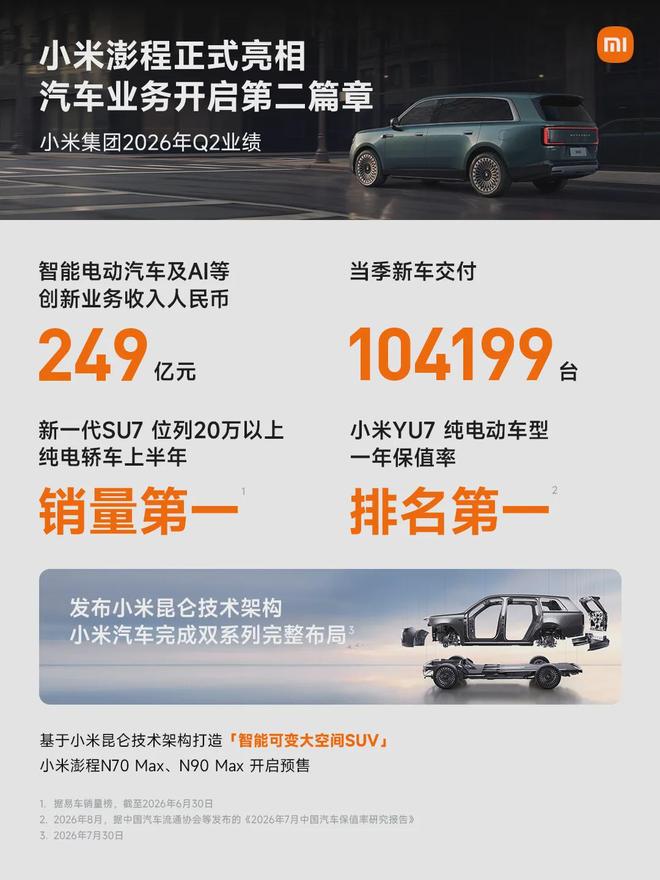
The automotive business emerged as a standout performer. In Q2, Xiaomi's innovative business segment, encompassing smart electric vehicles and AI, generated 24.9 billion yuan in revenue, achieving double-digit growth both year-on-year and quarter-on-quarter. Xiaomi delivered 104,199 new vehicles, a 28.2% year-on-year increase, with sustained robust demand.
Meanwhile, IoT and lifestyle consumer products contributed 31.3 billion yuan in revenue, a 26.7% quarter-on-quarter increase, with particularly strong performance in overseas markets. Internet services revenue reached 9 billion yuan, with gross margin rising to 76.8%, maintaining a high level. These two business segments served as 'ballast stones,' providing steady support to the smartphone business amid cost pressures.
The smartphone business, which was the primary concern externally, also demonstrated strong resilience in the global market. In Q2, Xiaomi Group's smartphone business generated 42.1 billion yuan in revenue, with global shipments of 31.2 million units, ranking among the top three globally for the 24th consecutive quarter.
The synergistic efforts of various business segments resulted in a more balanced revenue structure, enabling Xiaomi to showcase stronger resilience and flexibility in its overall financial position when individual businesses faced external shocks.

Deepening Premium and Globalization Strategies: Keys to Navigating Cycles
Behind this success lies Xiaomi's unwavering commitment to premium and globalization strategies, which have built a comprehensive system capable of withstanding cyclical fluctuations.
Amid surging storage costs, Xiaomi smartphones opted not to chase volume at low prices but instead adjusted their product mix to prioritize profitability. Consequently, the average selling price (ASP) surged by 25.9% year-on-year, reaching a record high.
This wasn't merely price hikes but a tangible shift in product mix—domestic sales of models priced above 3,000 yuan accounted for 32.1%, while overseas high-end models also set new records, both achieving historical bests.
Lu Weibing, a Xiaomi executive, assessed that while memory cost increases would slow in Q3, they would likely continue rising slowly in Q4, remaining at high levels. To adapt to storage price hikes, Xiaomi will continue adjusting its product mix in the second half of the year. However, he also stated that the industry's most difficult period has passed, with the storage sector now entering a relatively predictable and controllable phase.
The automotive business is also consolidating its premium brand momentum. In the first half of 2026, the Xiaomi SU7 maintained its position as the best-selling sedan priced above 200,000 yuan, holding the top spot in the most fiercely competitive price segment, demonstrating that Xiaomi's brand premium has been established.
If premiumization is Xiaomi's 'spear,' then globalization is its 'shield.'
According to Omdia data, in Q2, Xiaomi's smartphone shipments ranked among the top three in 53 countries and regions globally and among the top five in 67 countries and regions. It had over 640 new retail stores overseas, covering Southeast Asia, Europe, East Asia, and Latin America.
This diversified global布局 (layout) has freed Xiaomi from reliance on any single market, making it difficult for regional fluctuations to shake its overall foundation.
Even more promising is automotive globalization. Lei Jun, Xiaomi's founder, previously confirmed on social media that Xiaomi cars would enter the European market in 2027.
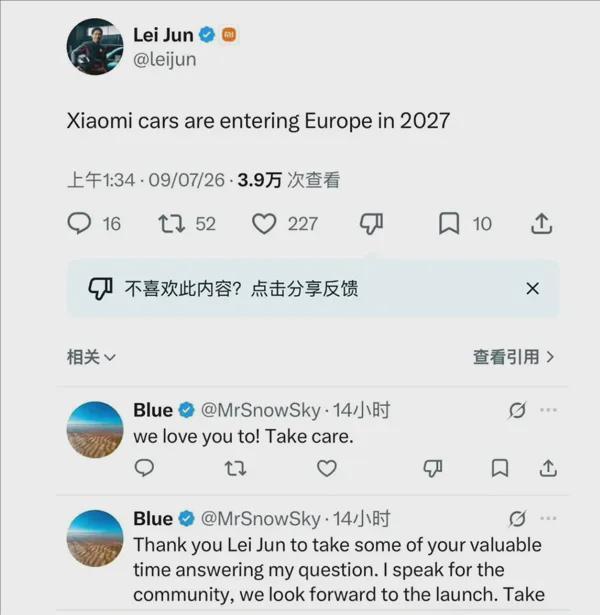
This timing is strategically chosen. According to Lu Weibing, this quarter, Xiaomi's 'Human-Car-Home Ecosystem' will make its debut at the International Consumer Electronics Fair (IFA) in Berlin, Germany, including many products like Xiaomi major appliances, which will officially enter Europe at scale. As a top-tier consumer electronics event in Europe, IFA serves as an ideal warm-up window for Xiaomi's automotive expansion overseas.
Industry insiders point out that compared to other automakers entering Europe, Xiaomi has two unique advantages: first, its widespread Xiaomi Home stores across Europe can be directly upgraded into automotive experience centers, significantly reducing channel construction costs; second, the closed-loop experience of the 'Human-Car-Home Ecosystem' is a core competitive advantage distinguishing it from other brands.
Notably, Xiaomi's brand strength has also advanced simultaneously. Xiaomi has been included on the Fortune Global 500 list for eight consecutive years, ranking 232nd in 2026, up 65 places from the previous year. It also ranked second on the '2026 Kantor BrandZ China Globalization Brands 50 Strong' list.

Firm Investment Bets on the Future, Entering a Period of Intensive Results
The industry's downturn cycle best reflects a company's long-term strategic resolve. Despite cost pressures, Xiaomi's R&D investment continued to increase.
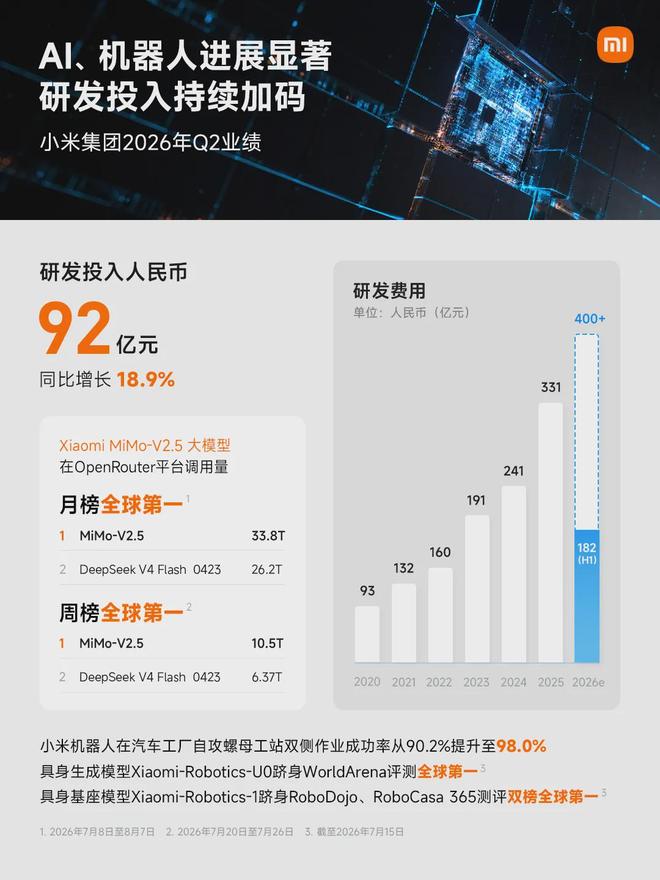
Financial reports show that in Q2, Xiaomi's R&D investment reached 9.2 billion yuan, a year-on-year increase of 18.9%; H1 R&D investment totaled 18.2 billion yuan.
This counter-cyclical investment confidence stems from Xiaomi's clear vision for the future: short-term cost pressures will pass, but once technological moats fall behind, they are hard to catch up.
And after years of high-intensity R&D, Xiaomi is entering a period of intensive results.
Lu Weibing revealed that after the Xiaomi Surge N90 Max and Xiaomi Surge N70 Max opened for pre-orders, small-order volumes exceeded previous expectations, proving very popular. Set for September launch and delivery, production capacity is well-prepared, ensuring rapid delivery speeds. He expressed 'strong confidence' in delivery.
In AI, Xiaomi's MiMo large model achieved consecutive breakthroughs in Q2: in June, the Xiaomi MiMo-V2.5-Pro-UltraSpeed mode went live, becoming the world's first trillion-parameter model to exceed 1,000 tokens/s inference speed on general-purpose GPUs, setting a new global record for fastest flagship model inference speed; in July, MiMo-V2.5 topped both the weekly and monthly charts for global large model invocation volume on OpenRouter.
HyperOS has also made new progress. It was revealed that Xiaomi MiMo will soon launch its first personal desktop application, helping users complete office and life tasks in one stop. A new generation of the MiMo model is also under training, expected to be released soon.
Not only that, but the current MiMo large model Token Plan has already started generating revenue, growing rapidly. However, Xiaomi's AI business is still in a large-scale investment phase, not primarily focused on monetization, and will continue to drive AI to reconstruct the 'Human-Car-Home Ecosystem.'
The new generation of humanoid robots is already working in Xiaomi's automotive factories, with bilateral operation success rates at the self-tapping nut assembly station improving to 98%. Two new complex workstations—central console side cover sorting and bin folding recycling—have been added, both achieving 90% success rates.
'Last year, Xiaomi launched the Xuanjie O1 chip, with cumulative shipments exceeding one million units across three terminal devices, achieving scaling validation of flagship chips. The all-new Xiaomi Xuanjie chip is also set to be released,' Lu Weibing said. He added that September will be an intensive period for new product launches, with a series of heavyweight flagship products hitting the market.
Some observers point out that Xiaomi is becoming a company where 'the chip is its own, the system is its own, and the AI is its own.' This closed-loop linkage of 'chip-OS-large model-terminal entry' distinguishes Xiaomi from mere smartphone, automotive, or IoT manufacturers and is the core support for its future valuation.

Conclusion
Earlier, Goldman Sachs noted in a research report that Xiaomi's Q2 performance this year might be the weakest of the year, with multiple catalysts expected in the following quarters.
The core logic is that short-term pressures on smartphones and AIoT have been largely reflected, the marginal impact of storage price hikes will gradually improve, while catalysts such as new automotive products, AI, and the Xuanjie chip will take over in Q3. Therefore, the focus should now be on 'recovery after the profit trough.'
Holding steady on fundamentals while opening up new spaces. Xiaomi's worst period is passing, and the true turning point will become clear in the second half of the year.
-
![]()
Surpassing the 'Storage Storm': Xiaomi’s Pivotal Moment
-
![]()
2026 China Auto Market: A 'Major Reshuffle' — Small Cars Decline, Large Cars Flourish, Is the Era of Fuel Vehicles Over?
-
![]()
Non-Recurring Items-Adjusted Net Profit Soars by 72.59%! Dongtianwei Records 502 Million Yuan in Revenue
-
![]()
Securing 2 Billion Yuan in Financing and Supplying Inno-Light: This Optical Device Company Launches Its IPO!
-
![]()
Farewell to 'Card Stacking': 2026 Marks China's Computing Power Shift to 'Token Value Output' Era
-
![]()
Xiaomi Weathers Storage Price Surge, Q2 2026 Revenue Tops 100 Billion Yuan Again
-
![]()
Geely Bids Farewell to the 'Li Shufu Era': A Historic Power Transition in China's Auto Industry | Auto Circle
-
![]()
Baidu Prepares for Inclusion in Southbound Trading: Wall Street Reassesses the Value of 'AI ETF'