Baidu Prepares for Inclusion in Southbound Trading: Wall Street Reassesses the Value of 'AI ETF'
 08/19 2026
 381
381
In the second half of 2026, the market focus of the AI industry shifts from hardware back to applications, with some anticipating the trend in advance.
In the second quarter, two major Wall Street investment funds made rare position adjustments.
According to 13F filings, the Duquesne Family Office, led by legendary investor Stanley Druckenmiller, established a position of 88,000 Baidu ADR shares. This marks its first return to Chinese stocks since clearing its Alibaba position in the fourth quarter of 2023. Around the same time, David Tepper's Appaloosa LP increased its stake in Baidu by over 600,000 shares while liquidating positions in two other Chinese stocks.
The fact that both investors targeted the same stock suggests this is not merely a case of 'bottom-fishing' Chinese stocks but reflects deeper considerations.
As the Hang Seng Tech Index transitions from a traditional internet logic to an AI-driven one, foreign investors are re-screening Chinese tech assets, with Baidu emerging as a key beneficiary of this migration.
According to Baidu's latest earnings report, total revenue in the second quarter reached RMB 31.3 billion, with general business revenue at RMB 25.2 billion. AI business revenue accounted for 50%, surpassing the halfway mark for the second consecutive quarter.
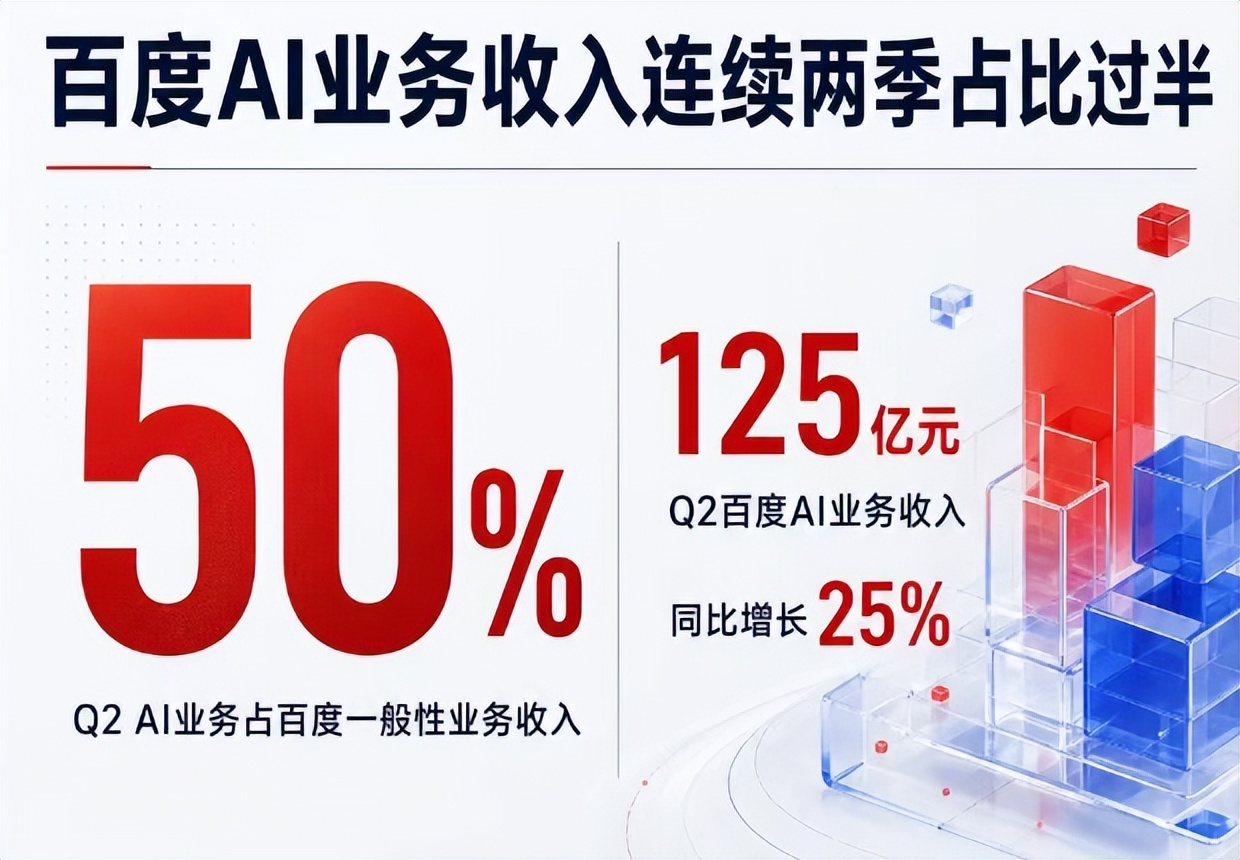
While the Hang Seng Tech Index continues to experience growing pains from the differentiation between old and new assets, Baidu has proven with two consecutive quarters of earnings data that AI has become its core growth engine.
The market is beginning to recognize Baidu as an AI-native company. What did top fund managers see when they placed their bets ahead of the earnings report?
From the actions of Druckenmiller and Tepper, three key logics for reassessing Baidu emerge: capital behavior precedes market pricing; earnings validate AI's transition from investment to commercialization; and valuation anchors are shifting from single-platform companies to AI asset portfolios.
Why is Wall Street reassessing Baidu? Capital prices China's AI in advance
Top capital is completing a shift from 'China's consumer internet' to 'China's AI infrastructure.'
They are searching for core AI assets in China.
Behind this search is the clear trend of a third leap in the global tech industry, driven by the listing surge of large AI model companies and frequent positive news about AI applications: from Web 1.0's 'information aggregation' to Web 2.0's 'information distribution,' and now to the AI era's 'task execution.'
It is within this transition that Baidu has demonstrated a rare and unique ecological niche.
Baidu is one of the few vertically integrated players globally to enter the first tier across all five dimensions: chips, models, cloud, Agent applications, and autonomous driving.
· At the chip level, Kunlunxin P800 has illuminated a 30,000-card cluster and delivered multiple 10,000-card clusters.
· At the model level, according to Omdia's '2026 Basic Model Chinese Creative Writing Ability Assessment' report, ERNIE 5.1 became the only model to exclusively achieve four top ratings.
· At the cloud infrastructure level, according to IDC data, Baidu Intelligent Cloud ranks first in market share across financial services, gaming, and embodied AI industries. Earnings show that AI cloud infrastructure revenue reached RMB 7.3 billion in the second quarter, up 50% year-on-year, with GPU cloud revenue surging 283% year-on-year.
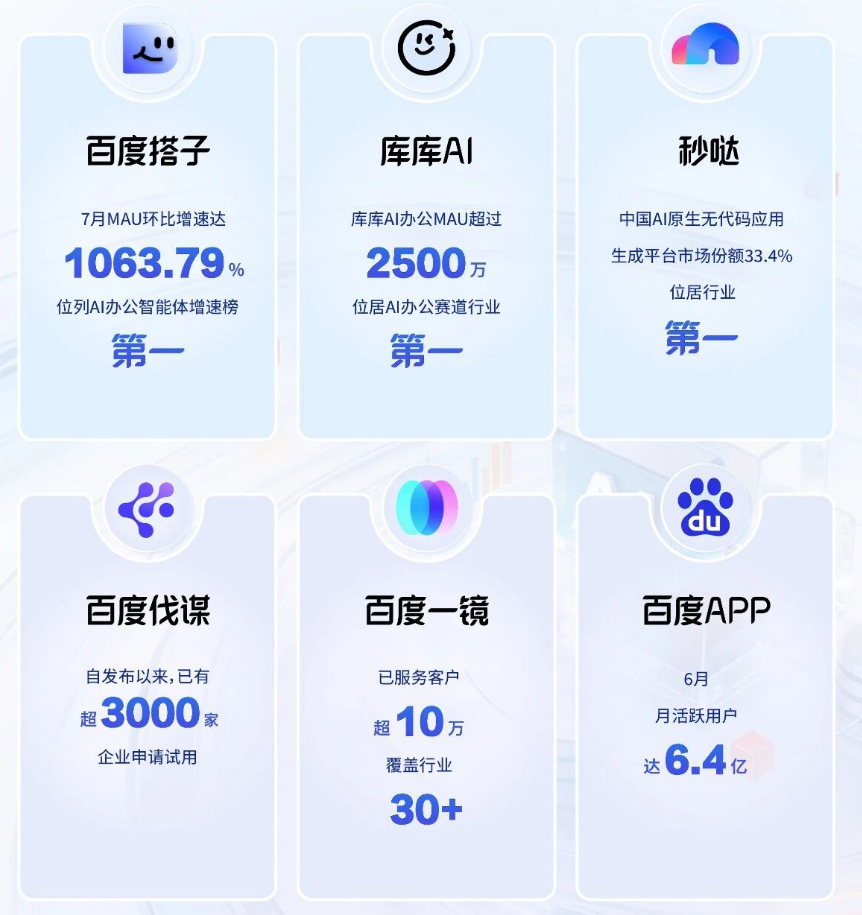
· At the Agent application level, Baidu has built a comprehensive intelligent productivity supply system covering all employment levels. Baidu Dazi is positioned as a general-purpose office Agent, Kuku AI delves deep into professional office scenarios, Miaoda focuses on no-code development Agents, Baidu Yijing focuses on digital human content production, Hogee covers enterprise marketing end-to-end as a marketing digital employee, and Famou optimizes enterprise decision-making. Baidu has essentially created a complete division of labor for Agent-based workforce.
· At the physical execution level, including solutions like Apollo Go and embodied AI, Apollo Go now covers 28 cities globally, with cumulative autonomous driving mileage exceeding 350 million kilometers. According to an IDC report, Baidu Intelligent Cloud ranks first in China's embodied AI cloud market with a 29.55% share.
By comparison, each segment of the AI industry chain is independently valued in the U.S. capital markets.
Chips correspond to NVIDIA, models to OpenAI, cloud infrastructure to Google Cloud, and autonomous driving to Waymo, with each company enjoying separate trillion-dollar or hundred-billion-dollar valuations.
In China, however, Baidu integrates these capabilities, offering the market an AI industry chain 'ETF.'
The market has long underestimated this, viewing Baidu primarily as an internet company centered on search advertising.
However, these earnings show that AI business revenue has surpassed the halfway mark for two consecutive quarters, establishing Baidu as an AI-first infrastructure group.
Information asymmetry is crucial in the market. Why do top capital movements always precede market pricing? Because most investors are still navigating with old maps.
This year, Baidu's stock performance has largely mirrored that of the Hang Seng Tech Index, with this cognitive lag creating space for reassessment.
Since the second quarter, the valuation anchor for the Hang Seng Tech Index has been shifting from consumer internet logic to AI infrastructure logic.
Druckenmiller and Tepper acute ly (keenly) recognized this shift and completed their AI infrastructure position adjustments ahead of Baidu's earnings release.
Turning Point Moment: Earnings Validate AI's Transition from Investment to Commercialization
Foreign investors' early bets in the second quarter may stem from a sense that the narrative of AI reassessment is approaching a fundamental turning point.
Earnings show that Baidu's AI business has transformed from a cost center requiring sustained investment into a predictable, scalable revenue growth engine, reshaping its overall growth curve.
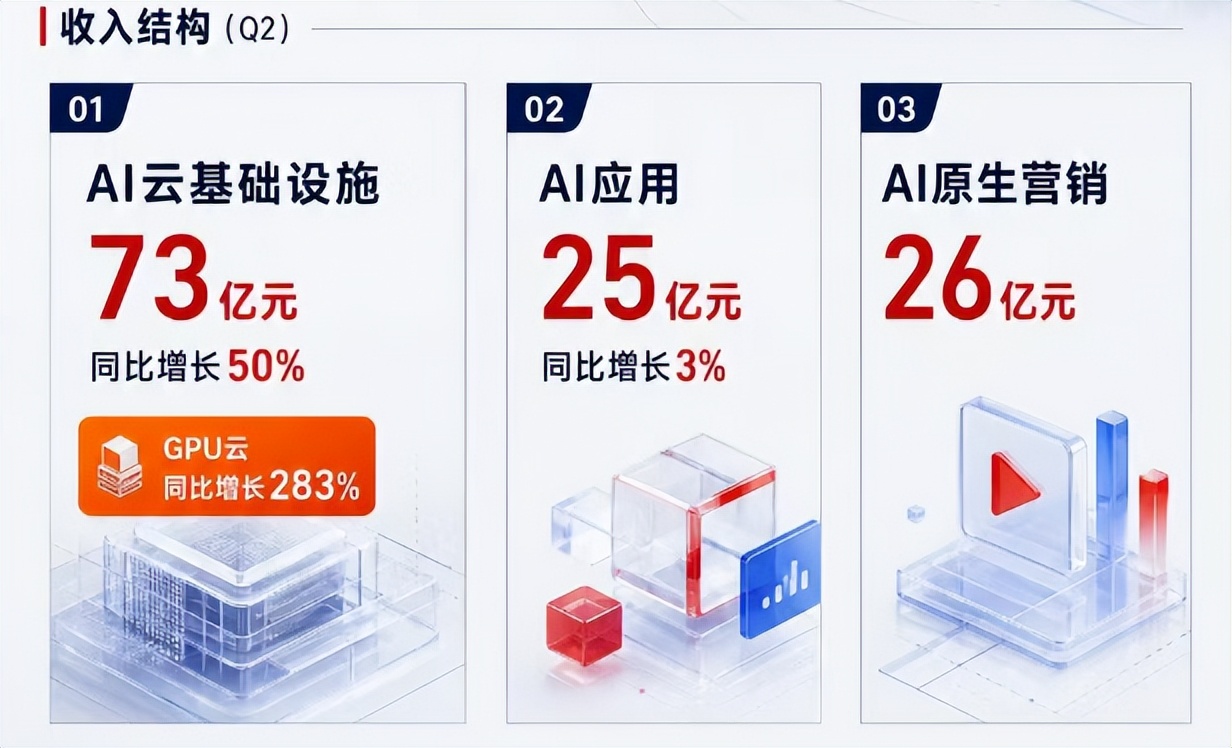
First, AI cloud infrastructure is accelerating its rollout, becoming an infrastructure-level subscription with strong locking effects.
AI cloud infrastructure revenue reached RMB 7.3 billion in the second quarter, up 50% year-on-year, with GPU cloud revenue surging 283% year-on-year and achieving triple-digit growth for four consecutive quarters.
Further acceleration from a relatively high base indicates that downstream demand for AI computing power is not conceptual but real and sustained.
More noteworthy is the demand-side structure. According to IDC industry reports, Baidu Intelligent Cloud ranks first in three high-barrier industries: financial services, gaming, and embodied AI. Additionally, Baidu has achieved 100% coverage of systemically important banks and over 800 financial institutions, with 80% of central SOEs choosing Baidu Intelligent Cloud.
This level of customer penetration significantly enhances revenue visibility and stability.
Second, at the application level, the commercialization of Baidu's AI product matrix is rapidly materializing.
AI application revenue reached RMB 2.5 billion in the second quarter, while AI-native marketing service revenue hit RMB 2.6 billion.
According to the AI Office Intelligent Agent rankings, Baidu Dazi's MAU surged 1,063.79% month-on-month in July, while Kuku AI Office's MAU exceeded 25 million. Frost & Sullivan's 'China AI-Native No-Code Application Generation Platform Market Research, H1 2026' also notes that Miaoda ranks first in the industry with a 33.4% market share.
Furthermore, according to reports from Frost & Sullivan and IDC, Baidu Yijing has secured the top spot in China's AI digital human market share and overall product strength for two consecutive years.
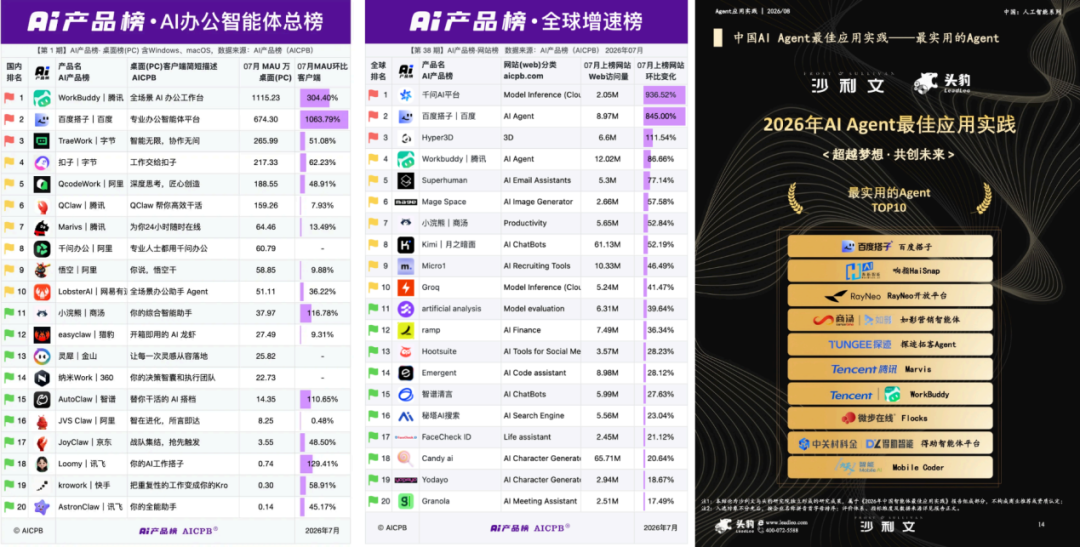
These figures demonstrate that Baidu not only has user scale in the Agent track (Agent track) but has also begun converting user engagement into revenue.
With Dazi, Kuku AI, Miaoda, and Baidu Yijing integrating into enterprise workflows, Baidu's business model has shifted from traffic monetization to productivity subscriptions, representing a fundamental change.
Even Kunlunxin, Baidu's heaviest asset, is beginning to show external commercialization capabilities.
During the earnings call, Baidu founder Robin Li stated that Kunlunxin maintained strong momentum in the second quarter, expanding into multiple industries amid robust demand, with market recognition of its stability, efficiency, and adaptability in large-scale applications continuously improving.
According to The Information, citing insiders, Tencent has now become a Kunlunxin customer. This means Baidu's self-developed chips are no longer just supporting facilities for internal training but are also being exported as independent products, generating new revenue streams.
In summary, Baidu's AI commercialization has completed the transition from storytelling to clear financial accountability.
Compared to other single-domain AI companies, Baidu has achieved a 'small loop' of industrialization, with AI cloud infrastructure providing computing power rentals, Agent applications offering productivity subscriptions, AI-native marketing delivering scenario-based services, and Kunlunxin supplying domestic computing power.
With revenue beginning to flow in at every link, Baidu has reached its turning point.
After the 'Smart Money' Makes Its Move: The Hang Seng Index Is Ready, and Baidu Shifts Its Valuation Anchor
Now that AI's accelerated commercialization has been validated by earnings, the market's focus inevitably turns to how Baidu should be priced next.
Baidu's most significant change is its transition from single-company valuation to AI asset portfolio valuation, but current pricing is far from complete.
Under this new valuation framework, Baidu should be viewed as an AI portfolio consisting of four layers: domestic computing power assets (Kunlunxin) at the base, AI infrastructure assets (ERNIE large model and intelligent cloud) in the middle, Agent assets at the application layer, and assets from solutions like Apollo Go and embodied AI at the physical layer.
JPMorgan estimates that Kunlunxin could be independently valued at $40-49 billion, with Baidu's portion ranging from $27-34 billion. Morningstar even projects Kunlunxin's valuation range as high as $51-63.8 billion.
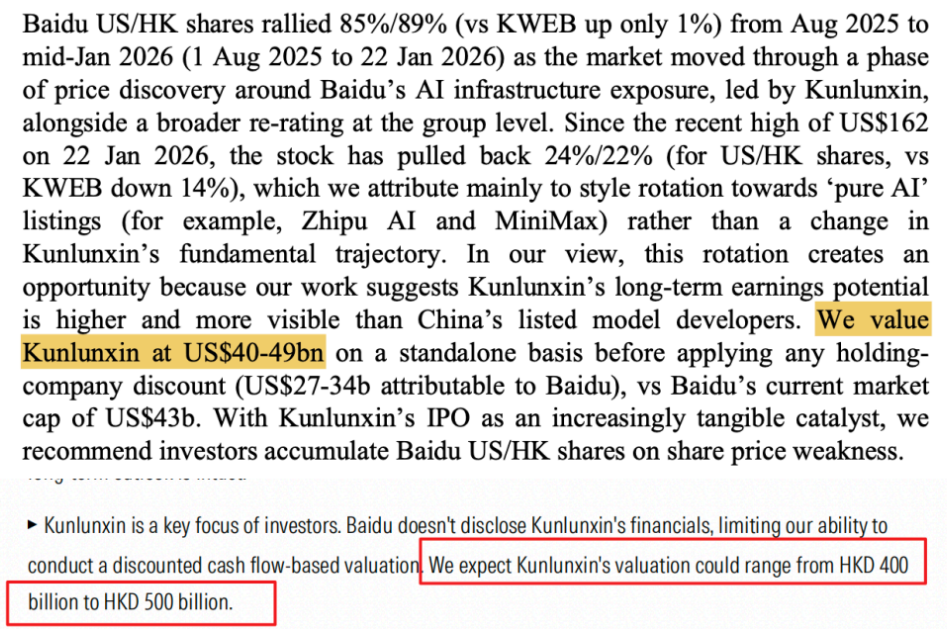
According to a JPMorgan research report, this style rotation from infrastructure to pure AI concept stocks creates an accumulation window.
In the second half of the year, as the tech theme returns, reassessment has already begun.
Foreign investors have completed a structural shift from China's internet sector to China's AI sector. With its unique ecological niche in China, Baidu has become a hard-tech company occupying a critical node in the global AI industry chain.
On the other hand, considering Baidu itself, its Hong Kong listing status was previously a secondary listing, which limited liquidity compared to dual-primary listings and failed to attract more mainland capital familiar with Baidu's business to better reflect its AI value.
Baidu stated that it plans to convert its Hong Kong listing status from secondary to dual-primary, with the conversion expected to take effect on the main board within the year and inclusion in Southbound Trading to follow as soon as possible thereafter.
Looking ahead, improved liquidity expectations, combined with earnings validation of AI commercialization, make Baidu's reassessment not a question of if but how fast it will happen.
Judging by earnings growth, this will happen faster than the market expects. Baidu's vertically integrated flywheel effect is already evident: Baidu Intelligent Cloud's data accumulation trains the ERNIE model, optimizes Kunlunxin's computing power, feeds back into intelligent cloud efficiency, and empowers Agent applications and Apollo Go.
As the flywheel gains momentum, Baidu's full-industry-chain layout is no longer a scattered business puzzle but the 'AI core asset portfolio' that Wall Street fund managers anticipate.
Now, with Southbound Trading opening the floodgates for mainland capital, the leveraged effect of reassessment is just beginning.
Source: Hong Kong Stocks Research Society
-
![]()
Surpassing the 'Storage Storm': Xiaomi’s Pivotal Moment
-
![]()
2026 China Auto Market: A 'Major Reshuffle' — Small Cars Decline, Large Cars Flourish, Is the Era of Fuel Vehicles Over?
-
![]()
Non-Recurring Items-Adjusted Net Profit Soars by 72.59%! Dongtianwei Records 502 Million Yuan in Revenue
-
![]()
Securing 2 Billion Yuan in Financing and Supplying Inno-Light: This Optical Device Company Launches Its IPO!
-
![]()
Farewell to 'Card Stacking': 2026 Marks China's Computing Power Shift to 'Token Value Output' Era
-
![]()
Xiaomi Weathers Storage Price Surge, Q2 2026 Revenue Tops 100 Billion Yuan Again
-
![]()
Geely Bids Farewell to the 'Li Shufu Era': A Historic Power Transition in China's Auto Industry | Auto Circle
-
![]()
Baidu Prepares for Inclusion in Southbound Trading: Wall Street Reassesses the Value of 'AI ETF'