Revenue and Net Profit Dip, GPU Cloud Rockets 283%: Baidu’s AI Strategy Hits Payoff Period
 08/19 2026
 365
365
By Yang Jianyong
Baidu is still grappling with operational challenges, as evidenced by a 12% plunge in its stock price following financial results that fell short of market expectations. The cumulative year-to-date decline has now reached 30%, leaving its market capitalization at a mere $30.8 billion. This performance underscores a broader shift in the industry’s valuation paradigm.
The once-dominant internet sector is witnessing diminishing returns from traditional traffic-driven models, such as advertising and e-commerce. Market valuations are now pivoting from internet applications to foundational technologies like artificial intelligence and semiconductors. Notably, computing power has emerged as a coveted asset in the age of AI large models, with Changxin Technology claiming the title of China’s most valuable company, a testament to this evolving trend.
Shifts in Information Access Channels Impinge on Baidu’s Traditional Advertising Business
In the second quarter of 2026, Baidu’s revenue amounted to 31.3 billion yuan, marking a 2% sequential decline and a 4% year-on-year drop, extending its streak of consecutive year-on-year decreases. Net profit for the quarter stood at 2.3 billion yuan, a stark 68% decrease from 7.3 billion yuan in the same period last year. Adjusted net profit also took a hit, falling 46% to 2.573 billion yuan from 4.795 billion yuan year-on-year.
Delving into the business segments, Baidu’s traditional advertising business continued to face headwinds, with online marketing services revenue reaching 13.1 billion yuan in the second quarter, a 19% year-on-year decline. Historically, Baidu’s revenue has heavily relied on advertising generated by its search engine. However, the rise of platforms like Douyin has steadily siphoned traffic away from traditional search engines.
Critically, the advent of the AI large model era is reshaping user behavior in information acquisition. Interacting with large models like Doubao and DeepSeek through Q&A sessions is gradually becoming the preferred method for users to access information.
The time users spend on content platforms like Xiaohongshu and Douyin is reshaping content ecosystems and brand marketing strategies. Simultaneously, an increasing number of users are opting to obtain information through natural language interactions with AI large models. These overlapping factors have led to a decline in Baidu’s ad impressions and click-through rates, eroding the traditional advantages of search engines. This also underscores the profound impact of changing information access patterns on traditional online marketing businesses.
GPU Cloud Skyrockets 283%: AI Fuels Baidu’s Metamorphosis from Search to AI Powerhouse
In the AI era, Baidu has positioned itself at the vanguard of the industry, with robust performance in AI-related businesses serving as a linchpin for its growth.
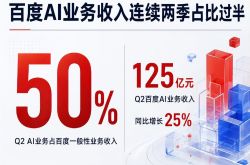
In the second quarter of 2026, Baidu’s AI business revenue surged to 12.5 billion yuan, up 25% year-on-year. Its smart cloud infrastructure, in particular, shone brightly, with revenue in this segment reaching 7.3 billion yuan, a 50% year-on-year increase. GPU cloud revenue, in particular, witnessed an astonishing 283% year-on-year surge.
These impressive figures signal that AI is reshaping Baidu, propelling its transformation from a search engine-centric internet company to an AI-driven enterprise.
Fueled by the burgeoning demand for AI infrastructure, GPUs, which provide the high-performance computing necessary for AI workloads, are reshaping the competitive landscape of AI infrastructure.
Leveraging the competitive moat built by its Kunlun Core chips, models, platforms, and public cloud infrastructure, Baidu Smart Cloud has developed full-stack technical capabilities encompassing inference, training, chips, clusters, and data centers. It boasts strong competitiveness in the domestic cloud market and has led the AI public cloud market for several consecutive years.
In Conclusion
Since the advent of generative AI, industries across the spectrum have been swiftly integrating large model services, propelling the global cloud services market into a high-growth phase.
According to data released by Synergy Research, enterprise spending on cloud infrastructure services reached $143 billion in the second quarter of 2026, marking a 43% year-on-year increase. This growth rate is the highest in the past eight years.
With the accelerating demand for AI infrastructure, Baidu, as a pioneer in China’s AI sector since 2010, has made substantial investments in AI. It has constructed AI infrastructure computing power capabilities, ranging from the underlying Kunlun Core AI computing chips to the Wenxin large model and subsequent applications. This has enabled Baidu to carve out a distinctive competitive path in the AI public cloud market, serving as a vital engine for driving business growth.
It is anticipated that in the coming quarters, AI will unlock even greater commercial value, indicating that Baidu’s AI strategy is entering a payoff period.
Yang Jianyong, a contributor to Forbes China, expresses views that are his own. He is committed to providing in-depth analyses of cutting-edge technologies, including AI large models, artificial intelligence, the Internet of Things, cloud computing, and smart home appliances.
-
![]()
Surpassing the 'Storage Storm': Xiaomi’s Pivotal Moment
-
![]()
2026 China Auto Market: A 'Major Reshuffle' — Small Cars Decline, Large Cars Flourish, Is the Era of Fuel Vehicles Over?
-
![]()
Non-Recurring Items-Adjusted Net Profit Soars by 72.59%! Dongtianwei Records 502 Million Yuan in Revenue
-
![]()
Securing 2 Billion Yuan in Financing and Supplying Inno-Light: This Optical Device Company Launches Its IPO!
-
![]()
Farewell to 'Card Stacking': 2026 Marks China's Computing Power Shift to 'Token Value Output' Era
-
![]()
Xiaomi Weathers Storage Price Surge, Q2 2026 Revenue Tops 100 Billion Yuan Again
-
![]()
Geely Bids Farewell to the 'Li Shufu Era': A Historic Power Transition in China's Auto Industry | Auto Circle
-
![]()
Baidu Prepares for Inclusion in Southbound Trading: Wall Street Reassesses the Value of 'AI ETF'