Kunlun Tech Divests Former 'Cash Cow' and Pours Resources into Marketing, Only to See Performance Suffer
 08/20 2026
 517
517
Recently, Kunlun Tech (300418.SZ), a company that has been at the forefront of embracing AI technology, made the decision to offload a 99% stake in its erstwhile 'cash cow'—Xianlai Entertainment. This asset, which the company had acquired for over RMB 3 billion, was eventually sold for RMB 750 million. The sale, which resulted in a loss, was driven by the necessity of undertaking an AI strategic transformation as well as the company's ambition to list on the Hong Kong Stock Exchange.
According to Stock Star, the company is still navigating through the growing pains associated with its transformation. Despite experiencing rapid growth in its AI short drama business, which has been fueled by aggressive 'money-burning' marketing strategies, the company continues to suffer significant losses. Since 2024, its cumulative losses have surpassed RMB 4 billion. Meanwhile, its AI browser platform, Opera, operates in an oligopolistic market with a persistently low market share, while the monthly active user base of Tiangong AI shows a declining trend.
01. Discounted Sale of Gaming Assets
The announcement disclosed that Kunlun Tech plans to transfer a 99% stake in Beijing Xianlai Entertainment Network Technology Co., Ltd. (hereinafter referred to as 'Xianlai Entertainment'), held by its wholly-owned subsidiary Kunnuo Yingzhan, to Xinglan Entertainment for RMB 750 million. This move is aimed at further focusing on core strategic directions and enhancing its competitive edge in the AI era.
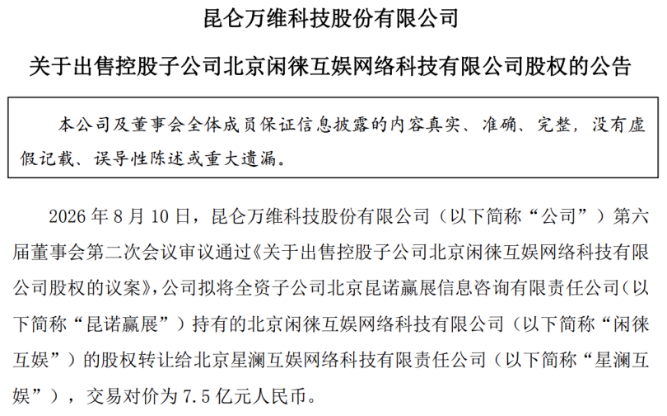
It is noteworthy that the acquiring party in this transaction, Xinglan Entertainment, is actually controlled by Xiong Liang, the current chairman of Xianlai Entertainment. Prior to the transaction, Xiong Liang held a 1% stake in Xianlai Entertainment, and upon completion, he will gain full ownership.
Stock Star points out that Xianlai Entertainment was once Kunlun Tech's 'cash cow' and a significant asset acquired for a hefty sum of over RMB 3 billion.
Since its inception in 2016, Xianlai Entertainment has focused on local-feature board and card games, with the aim of creating a localized online board and card entertainment platform. From 2016 to 2019, Kunlun Tech gradually acquired 100% of Xianlai Entertainment's equity, investing a cumulative total exceeding RMB 3.295 billion. In 2019, Xianlai Entertainment's audited net profit after non-recurring gains and losses was RMB 934 million, accounting for a substantial 74% of Kunlun Tech's net profit for the same period.
However, affected by stricter regulations in the board and card gaming industry, Xianlai Entertainment's net profit began to decline from 2021, prompting Kunlun Tech to make impairment provisions for goodwill starting in 2022. The sale announcement revealed that in 2025, Xianlai Entertainment's revenue plummeted to RMB 316 million, a nearly 80% decrease from RMB 1.517 billion in 2017, with net profit falling to RMB 72 million.
Meanwhile, Kunlun Tech's gaming business, which was once its main listed operation, has been marginalized, with the company's strategic focus now fully shifted to the AI sector. In 2025, the company's gaming business revenue was only RMB 355 million, accounting for a mere 4.33% of total revenue, down 20.07% year-on-year, marking six consecutive years of decline.
It is worth mentioning that on the same day as the announcement to sell Xianlai Entertainment, Kunlun Tech also disclosed its plan to list in Hong Kong. The announcement stated that the funds raised would be used for AI technology R&D, AI product operation and commercialization, global market promotion and user acquisition, strategic investments and acquisitions, as well as optimizing the capital structure.
Industry insiders believe that Kunlun Tech's decision to sell Xianlai Entertainment at a loss is driven by both its strategic transformation and its ambition to list in Hong Kong. As Kunlun Tech approaches the critical stage of listing on the Hong Kong Stock Exchange, it needs to quickly divest non-AI assets to demonstrate business purity to the exchange, which is a key strategic motive behind this discounted transaction.
02. High Sales Expenses Result in Losses
Stock Star observes that although Kunlun Tech has now established an AI business matrix comprising large models, search, music, social networking, and short dramas, the company is still grappling with the growing pains of its transformation. In 2024, 2025, and the first quarter of 2026, the company incurred net losses of RMB 1.595 billion, RMB 1.593 billion, and RMB 887 million, respectively, with cumulative losses exceeding RMB 4 billion.
In terms of revenue structure, the company operates three major segments: the Opera browser, Tiangong AI, and the Starmaker community. Among them, Opera, as an overseas AI Agent browser platform, contributed over 50% of the company's revenue last year through its advertising and search businesses, making it the primary revenue source.
Notably, under the oligopolistic global browser market structure, Opera's market share has been under long-term pressure. A report released by market research firm Statcounter showed that in the global desktop browser market in June 2026, Chrome held a dominant 72.24% market share, firmly in first place, followed by Edge and Firefox with 10.45% and 6.31%, respectively, while Opera's market share was a mere 1.81%.
Additionally, Tiangong AI, the company's fastest-growing business segment last year, owes its performance growth mainly to the explosion of short dramas and AI short drama platform businesses. In 2025, Tiangong AI's revenue was RMB 2.369 billion, up a staggering 251.74% year-on-year. Among them, revenue from the AI short drama platform business reached RMB 1.617 billion, up 864.92% year-on-year, with its proportion of total revenue increasing from 2.96% in the previous year to 19.73%.
However, this high business growth was achieved through aggressive 'money-burning' marketing strategies. In 2025, to drive user acquisition and growth for its short drama and AI short drama platform businesses, as well as AI music, AI SuperAgent, AI social networking, and other products, the company intensified market promotion and traffic acquisition efforts. Kunlun Tech's sales expenses reached RMB 4.182 billion, up 81.53% year-on-year, accounting for a hefty 51% of current revenue. Notably, the company's sales expenses far exceeded its R&D spending in the same period. In 2025, R&D expenses were RMB 1.676 billion, up a modest 8.6% year-on-year.
In the first quarter of 2026, Kunlun Tech's sales expenses continued to rise, reaching RMB 1.594 billion for the single quarter, up 83.49% year-on-year, squeezing the company's profit margins. During the same period, the company's R&D expenses declined, down 10.72% year-on-year to RMB 384 million.
03. Declining Revenue for StarMaker and Monthly Active Users for Tiangong AI
It is worth mentioning that following its 'AI in AGI and AIGC' strategy, Kunlun Tech upgraded to a '4+3 strategy' in March this year. This strategy uses video models, music and audio models, world models, and base text and multimodal models as technological foundations to support AI-native platforms such as AI short dramas, AI music, and AI gaming.
Some analysts also point out that Kunlun Tech's simultaneous advancement on multiple fronts, including AI video, AI music, and AI social networking, can easily lead to the dilution of internal corporate resources. Faced with the advantages of internet giants in data and computing power, the company must make significant investments to keep up with technological advancements while also spending heavily on user acquisition to maintain market share. This puts pressure on both R&D and marketing, leaving the company in a dilemma.
Stock Star notes that the company's layout in AI social networking and music has not achieved the expected results. StarMaker, a well-known overseas music social entertainment community, covers diverse entertainment scenarios such as online karaoke, voice chat rooms, music creation, live interactions, and casual gaming. In 2025, the Starmaker community generated revenue of RMB 1.059 billion, down 3.97% year-on-year.
Meanwhile, Kunlun Tech's strategic positioning for the Tiangong large model has undergone multiple adjustments. Initially developed as a general-purpose dialogue large model to rival ChatGPT, it later shifted to balancing multimodal capabilities with reasoning performance. Last year, it introduced the Tiangong Super Agent, weakening its AI search attributes and shifting focus to the AI office sector. At the time, this adjustment was already seen by the industry as a passive choice under commercialization pressure. With the prospects of AI search still unclear, entering the productivity tool market might be a more pragmatic path.
However, in the AI office/efficiency sector, there are already established players such as Kuake, Tencent Docs, WPS AI, and Baidu Wenku, making competition increasingly fierce. According to AI product ranking data, in July 2026, Tiangong AI had 2.74 million monthly active users, ranking 20th domestically, but experiencing a 10.58% month-on-month decline in monthly active users. (This article was first published by Stock Star, Author | Li Ruohan)
- End -
-
![]()
Optical Industry Chain's 'Little Giant' Faces the Listing Challenge! Yuanli Optoelectronics Set for BSE IPO Review Tomorrow
-
![]()
There's No Such Thing as a Free DeepSeek
-
Five Consecutive Quarters of Revenue Decline: Baidu Sets Sights on 'Reclaiming Top-Tier Status in Foundational Large Models'
-
![]()
Global Vehicle-Mounted Optics Leader Reports RMB 358 Million Loss in H1!
-
![]()
Global Computing Power Behemoth Nvidia Faces Emerging, Formidable Rivalry!
-
![]()
Generative AI Fuels Global Cloud Market Boom, Three Cloud Titans Amass Trillions in Pending Orders
-
![]()
Semi-annual Report | Global Large-Size Interactive Flat Panel Market Grows by 9.4% in H1 2026; Analysis of Domestic and International Brand Strategies
-
![]()
Can Tencent Still 'Buy a Ticket' Onboard with an Extra 20 Billion?