Baidu is on the Verge of Inclusion in the Southbound Trading Link: Time to Reprice Its Shares
 08/20 2026
 407
407

Preface
TrueView
Valuation represents the capital market's most honest pricing of a company, but the yardstick used for pricing can sometimes lag behind the evolution of the business itself.
For Baidu, AI revenue accounting for over half of its income for two consecutive quarters and its full-stack assets ranging from chips to autonomous driving have redefined the company's core profile. However, overseas markets still tend to view Baidu through the outdated lens of search advertising, folding the growth potential of cloud services, the scarcity value of chips, and the long-term prospects of autonomous driving into a single consolidated income statement.
On August 19, He Haijian, CFO of Baidu Group, stated that the board had approved the conversion of its Hong Kong listing status from secondary to dual primary listing. The conversion process is expected to take effect within the year, and the group is preparing for inclusion in the Southbound Trading Link after the conversion.
Baidu will convene an Extraordinary General Meeting (EGM) on August 26 to seek shareholder approval for several related matters. Jefferies views Baidu's voluntary conversion to dual primary listing as a positive signal, suggesting a potential inclusion in the Southbound Trading Link in September.
The signal is clear: Baidu's well-defined AI assets are about to embrace a new pricing framework.
This article will focus on analyzing:
1. What is the quality and resilience of Baidu's three financial revenue streams?
2. How will the full-stack layout of chips, cloud, models, and autonomous driving pass commercial scrutiny?
3. Why can't Baidu's value be fully captured in a single consolidated income statement?
4. How much upside potential does Baidu's valuation have after the dual primary listing?
Content/Jin Huan
Editor/Yong E
Proofreader/Mang Fu
After a long period of investment and cultivation, AI is no longer just a trendy label or a trial field requiring continuous capital infusion for Baidu's existing business matrix. Instead, it has truly reshaped the company's revenue base.
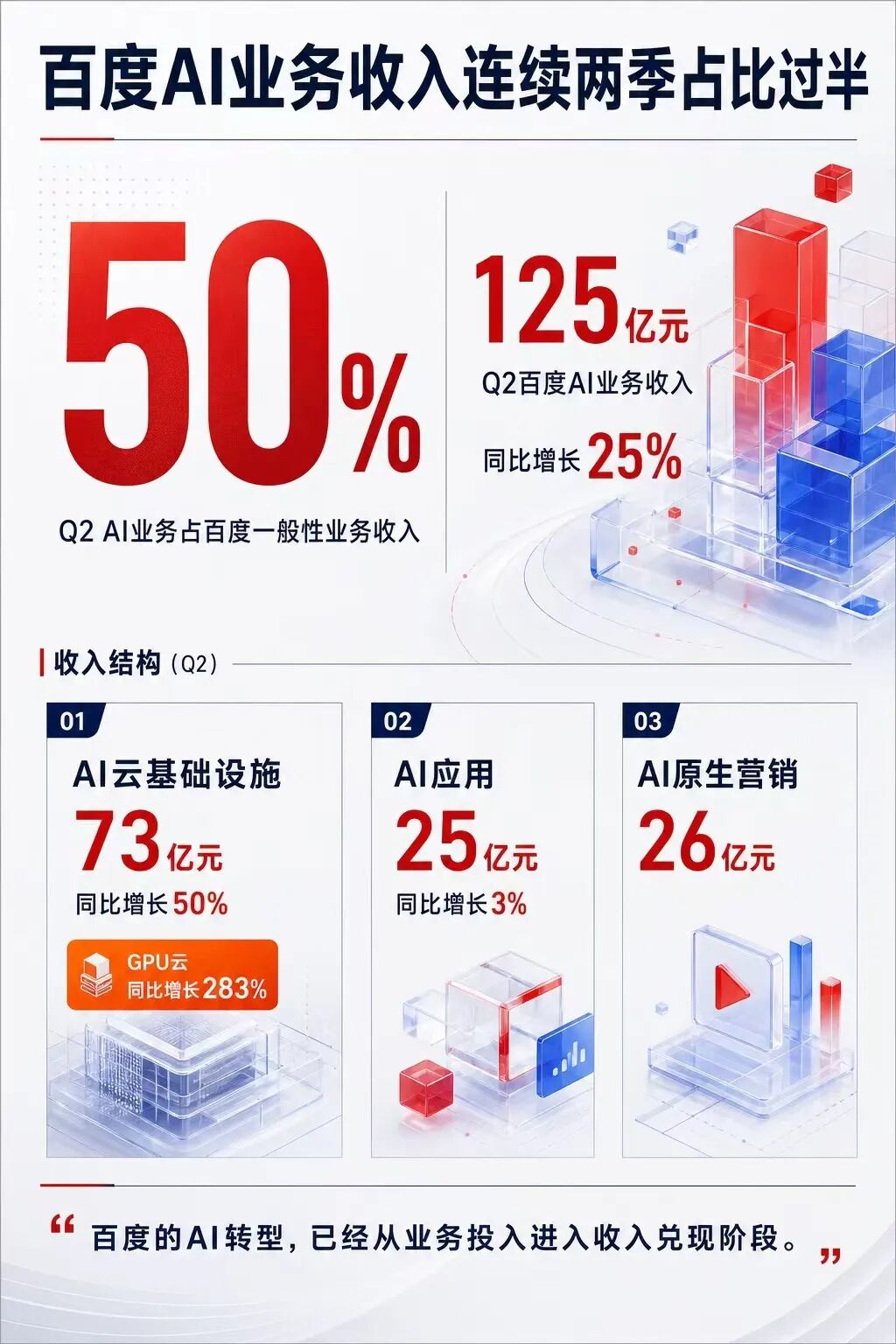
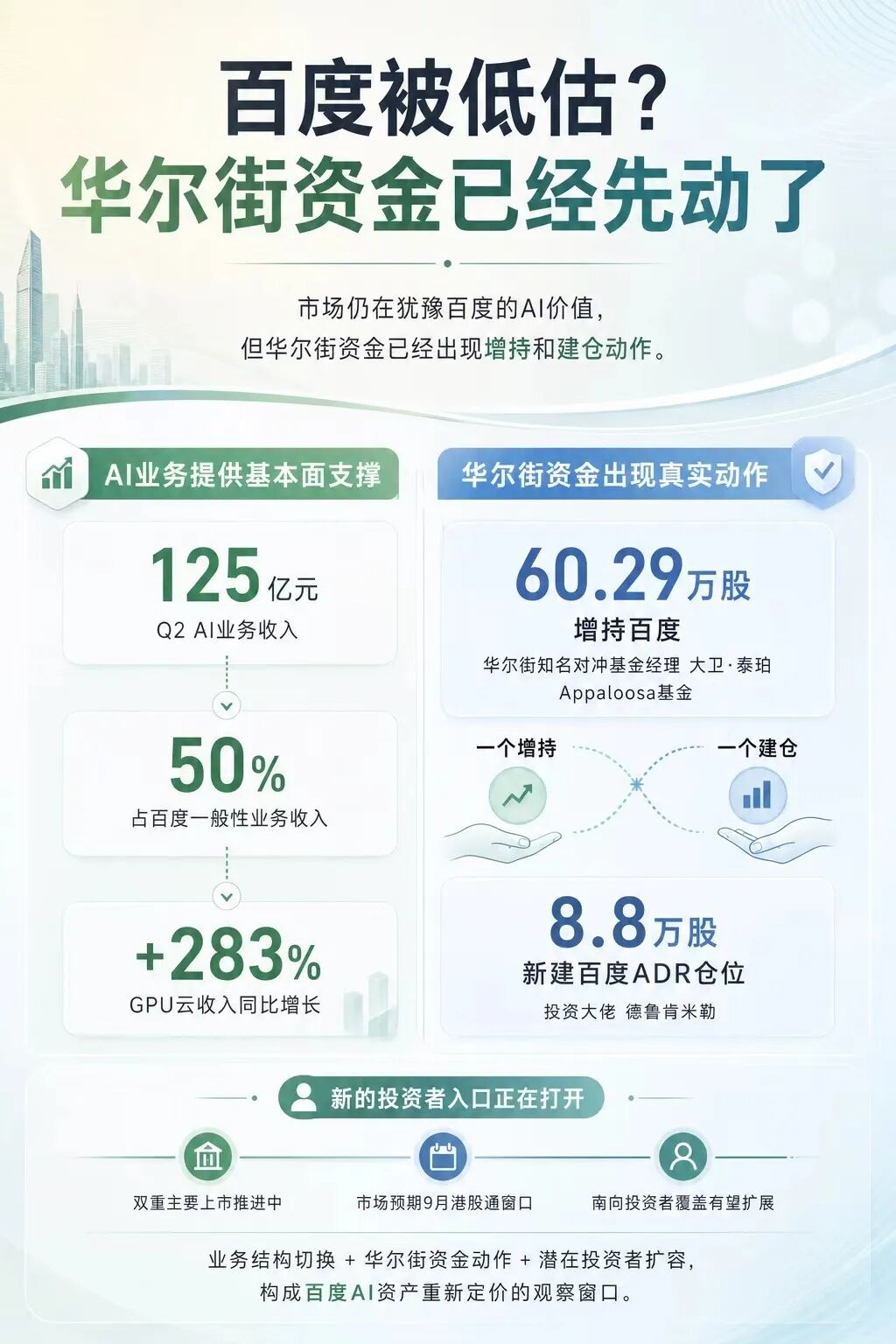
Financial reports show that Baidu's total revenue in the second quarter reached RMB 31.3 billion, with general business revenue at RMB 25.2 billion. AI business revenue accounted for 50% of the total, marking the second consecutive quarter with over half of revenue coming from AI.
More strategically significant than this figure is the reconfirmation in the financial report that Baidu will convene an EGM on August 26 to seek shareholder approval for matters related to the dual primary listing in Hong Kong, with implementation expected within the year after meeting all conditions. During the subsequent earnings call, management provided a clearer response to this move.
Standing at this critical juncture of financial report release, Baidu's action represents a new entry point for the capital market to reunderstand its value structure after AI has become a significant revenue contributor and multiple AI asset units have gradually taken shape.
When the old framework of search advertising can no longer define Baidu's true profile, the intertwining of business confidence, technological confidence, and value confidence forms the three-tiered underlying logic for Baidu's decision to advance the listing conversion and reshape its pricing system at this juncture.
Part.1
The Market is Reevaluating Baidu
A shift in the capital market's reference framework requires solid business foundations as support; a change in valuation models essentially reflects renewed trust in a company's commercial monetization capabilities.
If the AI industry was still preoccupied with parameter competitions and leaderboard rankings two years ago, today, as large models enter the deep waters of commercialization, the sole criterion for judging an AI company is whether its technology can generate real financial performance.
Baidu's Q2 financial report provides a clear answer. AI business revenue accounting for 50% of the total for two consecutive quarters means that AI is no longer a new business that needs to be separately explained in Baidu's financial reports. Instead, it has stably grown into an absolute mainstay capable of reshaping the company's entire revenue structure.
More worthy of in-depth exploration than the overall proportion is the composition of this AI revenue. Baidu's AI business does not heavily rely on a single blockbuster product or a few major clients. Instead, it has diversified into three clear financial revenue streams.
During the quarter, Baidu's AI cloud infrastructure revenue reached RMB 7.3 billion, up 50% year-on-year. AI application revenue reached RMB 2.5 billion, and AI-native marketing service revenue reached RMB 2.6 billion.
These three streams correspond to the delivery of underlying computing power and models for B2B, the software subscription SaaS logic, and traffic monetization based on Baidu App's 640 million monthly active users.
Beyond these visible financial metrics, Baidu holds two additional clear assets that have not yet been fully reflected in current revenue proportions but have well-defined profiles: Kunlunxin, representing China's core computing power assets, and Apollo Go, representing a key application of physical AI.
This demonstrates that Baidu is not forcibly fitting the large model concept into its old business to tell a new story. Instead, it is progressively building a multi-dimensional commercial transmission chain from underlying computing power and foundational models to software applications and the physical world.
This status quo, which get rid of s (breaks away from) single-path dependency and forms multi-tiered business closures, constitutes Baidu's core business confidence. AI has not only entered the income statement but also possesses strong risk resilience and sustainable profit-generating capabilities.
Part.2
Full-Stack Layout of Chips, Cloud, Models, and Autonomous Driving Strengthens the Technological Foundation
If financial statements prove the viability of business models, then industry delivery data validates the technological moat at the foundational level.
Baidu's technological confidence no longer relies on paper-based proofs from various large model leaderboard scores. Instead, it is directly built on real customer purchases, large-scale deliveries of ten-thousand-card clusters, and cross-border operations.
At the underlying computing power level, the successful deployment and large-scale delivery of Kunlunxin P800's 30,000-card cluster have not only secured major government and enterprise clients like China Merchants Bank and China Southern Power Grid but also, according to The Information, included Tencent among its clients.
From internal use to external supply, from a cost center to a profit center, Kunlunxin's asset attributes now resemble those of an AI chip company with an independent technological roadmap, large-scale delivery capabilities, and industry client validation.
Third-party agencies estimate its independent valuation to reach tens of billions of US dollars. Morningstar projects Kunlunxin's valuation between USD 51.04 billion and USD 63.80 billion, while JPMorgan estimates an independent valuation of USD 40 billion to USD 49 billion, with Baidu's share valued at USD 27 billion to USD 34 billion. However, this value has been almost entirely overlooked in past comprehensive valuation systems.
At the cloud infrastructure level, market doubts about the commercialization prospects of large models persist, but Baidu Q2's GPU cloud revenue responded with explosive growth, surging 283% year-on-year and maintaining triple-digit growth for four consecutive quarters. On this steep growth curve, Baidu Intelligent Cloud maintained its absolute industry leadership with a winning bid amount of RMB 1.385 billion in the first half of 2026. Currently, 100% of systemically important banks and over 80% of central enterprises use Baidu Intelligent Cloud.
When technology sufficiently meets financial regulators' baseline requirements for computing power security and stability, barriers become self-evident.
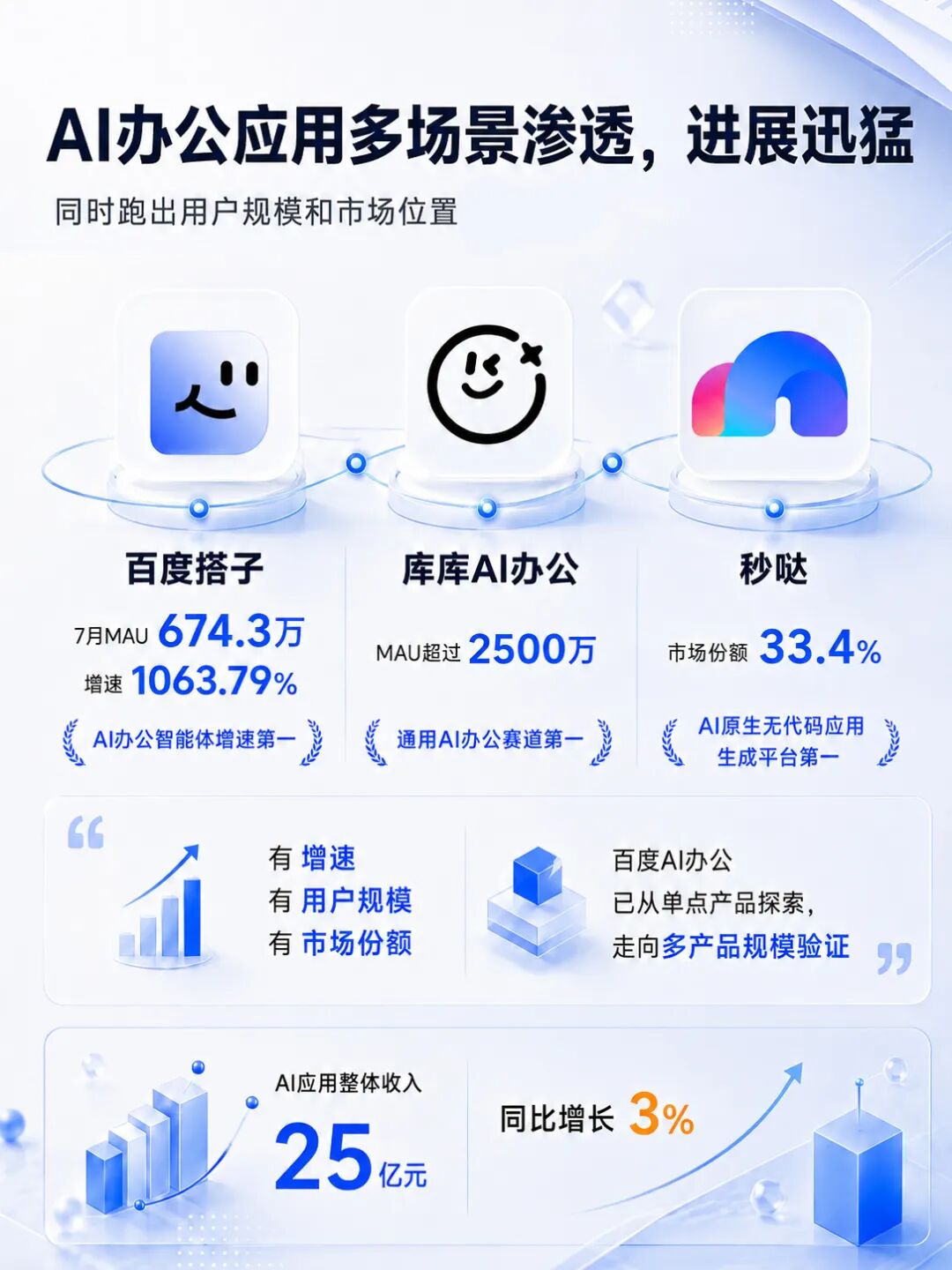
At the application level, a series of Baidu's Agents are taking over personal and enterprise workflows at an unprecedented pace. Baidu Dazi's monthly active users surged 1,063.79% month-on-month in July, becoming the fastest-growing product in its segment. Kuku AI Office's monthly active users exceeded 25 million, ranking first in the National Industrial Information Security Development Research Center's Office Agent workflow evaluation. Miaoda secured the top position in the AI-native no-code platform market with a 33.4% share. Baidu Yijing, a full-scenario digital human platform, has served over 100,000 clients, maintaining the top market share for two consecutive years.
The most evident manifestation of technological spillover effects is Apollo Go, which extends into urban physical spaces, covering 28 cities globally with cumulative autonomous driving mileage exceeding 350 million kilometers, including over 240 million kilometers in fully driverless mode.
Commercially, Apollo Go has launched fully driverless commercial operations in Dubai and integrated with Uber, initiated road tests in London in partnership with Uber and Lyft, secured the first batch of right-hand-drive fully driverless testing licenses in Hong Kong, and plans to enter Central Asia and Switzerland. This demonstrates Baidu's autonomous driving system's global generalization capabilities across countries, traffic regulation systems, and vehicle models.
At this point, "chips, cloud, models, and autonomous driving" are no longer just a promotional slogan but a fully stacked validation system refined by real-world scenarios. Kunlunxin provides underlying computing power, Intelligent Cloud encapsulates computing power and Wenxin models for delivery, the application layer embeds AI capabilities into workflows, and Apollo Go extends AI's reach into urban physical spaces.
This data and commercial flywheel, where upstream and downstream components mutually reinforce and feed each other, forms a technological confidence foundation that no single application vendor or chip company can replicate.
Part.3
Smoothing Out the Fold: Seeking a New Coordinate System for China's AI
With AI accounting for over half of the business volume and achieving a full-stack technological closure, the ultimate question facing Baidu is how these massive AI assets should be fairly priced in the current capital market.
For a long time, overseas investors have viewed Baidu through the rigid framework of Chinese internet stocks, search advertising, mature cash flows, and some uncertain AI narratives, with a unified price-to-earnings (PE) valuation model as the sole yardstick.
However, today's Baidu is a composite entity integrating cloud services, AI chips, software SaaS, and Robotaxi autonomous driving. Continuing to apply a unified PE model will inevitably result in severe underestimation of high-growth assets.
Cloud services are in a scale expansion phase, chip R&D possesses extreme scarcity value, and autonomous driving prioritizes deployment speed. These high-potential non-linear growth assets are all forcibly folded into a single consolidated income statement influenced by macro advertising market trends. AI asset units that have not yet massively released profits are heavily averaged by traditional business valuation centers or even completely ignored.
The true strategic value of advancing a dual primary listing in Hong Kong lies in breaking this valuation fold at the institutional level.
The listing location conversion itself does not directly boost valuations but substantially expands the potential investor base, increases research coverage breadth, and, most critically, creates institutional prerequisites for potential southbound capital participation.
When Asia-Pacific (Asia-Pacific) and mainland investors, who are more familiar with the evolution logic of China's digital economy, understand the trends in domestic chip substitution, and grasp the real progress of the autonomous driving industry chain, enter the market on a large scale, the market's pricing logic will fundamentally shift.
Smart capital will more naturally switch to the Sum-of-the-Parts (SOTP) valuation method, dissecting Baidu to separately examine the infrastructure premium of Intelligent Cloud after crossing the gross profit inflection point, assess Kunlunxin's true market value amid the domestic computing power gap, calculate Apollo Go's operational cash flows after multi-city rollouts, and then consolidate these with the mature mobile ecosystem cash cow business.
This is where Baidu's value confidence lies. The EGM on August 26 represents Baidu actively opening a window to allow its AI assets across different dimensions to be separately visible. When asset boundaries are sufficiently clear and independent profit-generating capabilities are robust enough, being dissected for research and independently priced becomes only a matter of time.
Signs of change are already emerging. Legendary investor Stanley Druckenmiller, who re-established positions in Chinese internet stocks after years, chose Baidu as his top pick. Renowned hedge fund manager David Tepper, while liquidating positions in several mainstream Chinese internet stocks, continued to significantly increase his stake in Baidu.
Macquarie raised its target price for Baidu's Hong Kong shares to HKD 181, believing that Kunlunxin's IPO could unlock significant value. UBS is optimistic about Baidu AI cloud infrastructure growth, viewing it as a continued core revenue growth driver.
From a broader perspective, this represents not just a corporate self-proof but also an attempt by China's AI industry to secure pricing power.
China's AI industry is forging a landing path closer to the real economy and more deeply embedded in supply chains. From the explosive growth of GPU cloud services to Apollo Go's global rollout, behind these developments lies the deep coupling of China's AI technologies with its vast and diverse application scenarios.
This asset portfolio requires a more Adaptation (suited) coordinate system for measurement, and the dual primary listing in Hong Kong provides the institutional entry point for such a framework.
August 26 is destined to become a symbolic node in Baidu's dual advancement in capital and business. Moving from the U.S. to Hong Kong, from the old unified internet framework to the new SOTP segmented valuation system, Baidu is not simply changing a listing location label. Instead, it is personally preparing a new value measurement framework for its complex AI assets.
When the old price tag named "search advertising" is thoroughly torn off, a new Baidu constructed from clear AI assets is only beginning to reveal its true scale.
END
-
![]()
Optical Industry Chain's 'Little Giant' Faces the Listing Challenge! Yuanli Optoelectronics Set for BSE IPO Review Tomorrow
-
![]()
There's No Such Thing as a Free DeepSeek
-
Five Consecutive Quarters of Revenue Decline: Baidu Sets Sights on 'Reclaiming Top-Tier Status in Foundational Large Models'
-
![]()
Global Vehicle-Mounted Optics Leader Reports RMB 358 Million Loss in H1!
-
![]()
Global Computing Power Behemoth Nvidia Faces Emerging, Formidable Rivalry!
-
![]()
Generative AI Fuels Global Cloud Market Boom, Three Cloud Titans Amass Trillions in Pending Orders
-
![]()
Semi-annual Report | Global Large-Size Interactive Flat Panel Market Grows by 9.4% in H1 2026; Analysis of Domestic and International Brand Strategies
-
![]()
Can Tencent Still 'Buy a Ticket' Onboard with an Extra 20 Billion?