6.5 Trillion AI Unicorn: Generating $900 Million in Daily Revenue, Racing Toward the Largest IPO in History
 08/21 2026
 426
426
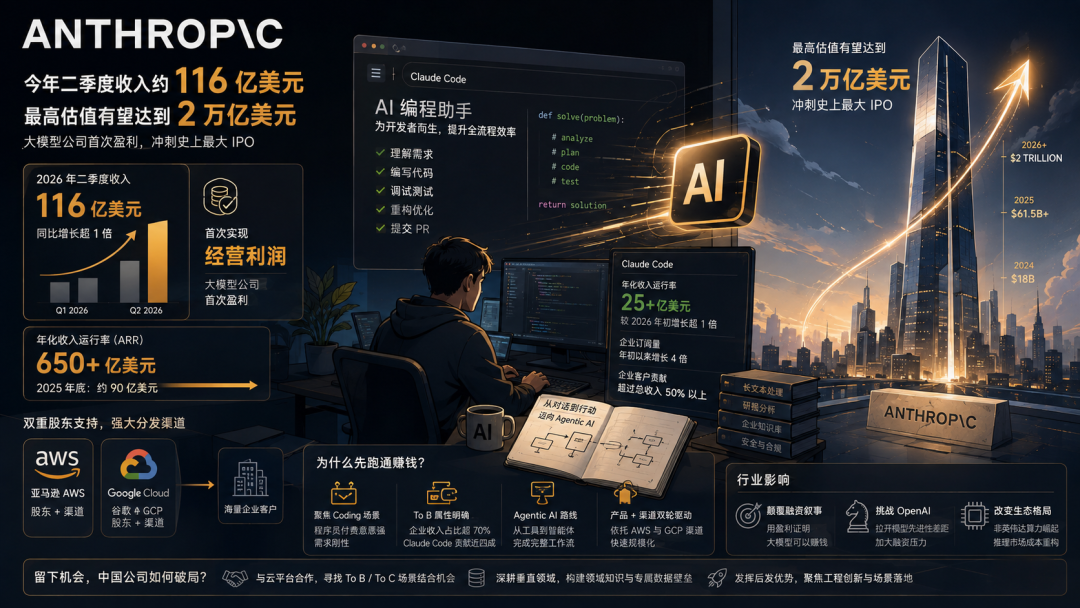
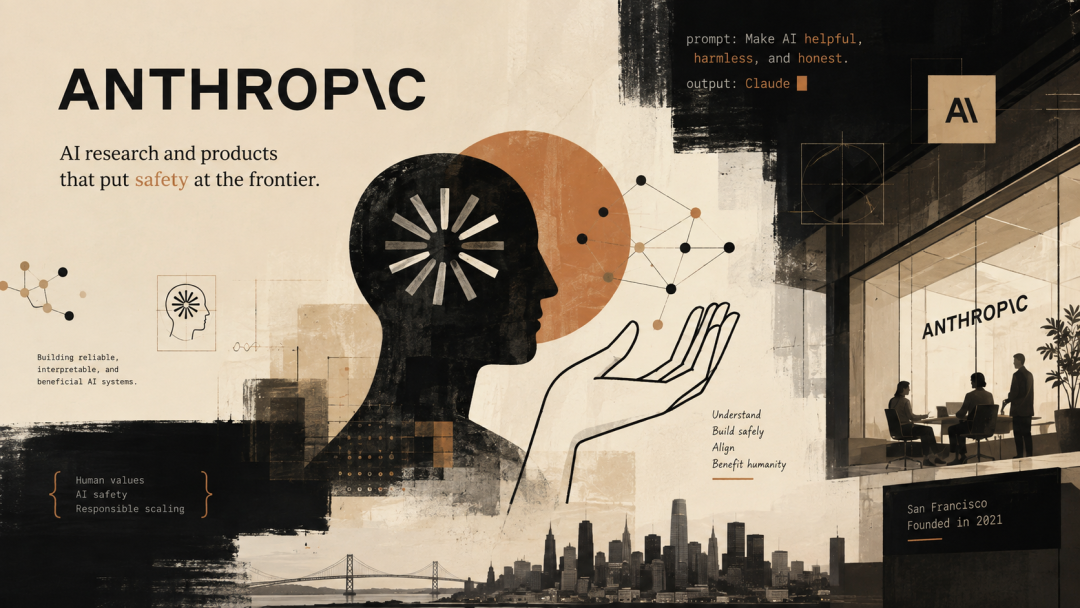
Cover Image|Produced by Pencil News
The second quarter of 2026 marked a pivotal moment in the large-scale model industry.
Media reports indicate that Anthropic's revenue soared to approximately $11.6 billion in Q2 2026 (translating to about RMB 900 million in daily revenue), more than doubling from Q1 and surpassing OpenAI's revenue of approximately $6.7 billion during the same period for the first time.
More notably, Anthropic achieved a modest operational profit in the quarter, while OpenAI's operational loss widened to $12.3 billion during the same period.
Anthropic has demonstrated one key fact: large-scale models can indeed be profitable.
The momentum continued. By the end of July 2026, Anthropic's annualized revenue run rate (ARR) exceeded $65 billion, up from just around $9 billion at the end of 2025.
This is no mere ranking change. "Anthropic's profitability challenges OpenAI's previous funding narrative," Zhang Ran (a pseudonym), an executive at a domestic large-scale model company, told Pencil News. Previously, it was believed that significant upfront investment in computing resources and prolonged financial losses were prerequisites before considering a business model. However, Anthropic has shown the market that profitability can be achieved in just four years.
With a current valuation of $965 billion (approximately RMB 6.46 trillion), Anthropic has become the world's most valuable unicorn. It is set to go public as soon as September-October 2026, aiming for the largest IPO in history. Market estimates suggest its valuation could reach $2 trillion or even higher.
- 01 - Why Did Anthropic Achieve Profitability First?
OpenAI and Anthropic started with vastly different resource bases—OpenAI raised over $100 billion, while Anthropic secured only a few billion in early funding.
"Anthropic's success stems from two key factors," Zhang Ran summarized. "First, it dominated a specific scenario, particularly coding. Second, it has a strong B2B focus, which drives its evolution toward Agentic AI."
Anthropic's smooth B2B journey owes much to its two "godfathers"—Amazon AWS and Google GCP. Both are Anthropic shareholders and possess vast enterprise customer bases. Once Anthropic developed its B2B capabilities, AWS and GCP naturally became its distribution channels.
This mirrors the pre-installation logic of the mobile internet era—you have the app but lack distribution channels; smartphone manufacturers have the channels but need quality apps. When the two combine, user acquisition surges. Anthropic is the high-quality app, while AWS and GCP are the pre-installing smartphone manufacturers.
However, distribution channels alone are insufficient—the product must be robust. Anthropic's true game-changer is Claude Code, an AI programming assistant for developers.

The coding scenario was a perfect choice. Programmers are among the groups with the strongest willingness and ability to pay. Their demand for AI tools is rigid—tools that can write code, debug, read documentation, and refactor save time worth far more than a few thousand dollars in annual subscription fees.
Venture capital firm Menlo Ventures calls coding the first true "killer application" of generative AI. It can understand tasks, invoke tools, write code, execute tests, and submit pull requests, completing an entire workflow autonomously.
In February 2026, Anthropic revealed that Claude Code's annualized revenue run rate exceeded $2.5 billion, more than doubling since early 2026. Enterprise subscription volume surged fourfold year-to-date, with enterprise clients now contributing over half of Claude Code's total revenue.
In Q2 2026, enterprise revenue accounted for over 70% of Anthropic's total, with Claude Code contributing nearly 40%. In contrast, OpenAI's consumer business still dominated, while its enterprise segment grew at a much slower pace than Anthropic's.
"Products like ChatGPT lack sufficient incentive to drive OpenAI rapidly toward Agentic AI," Zhang Ran said. "By the time Anthropic fully pioneers the Agentic AI path, OpenAI will gradually lose its early first-mover advantage."
OpenAI is not short on funds—it does everything: text, images, video, voice, and robotics, with an extremely broad portfolio. While Sora's video model is technically impressive, its commercial returns remain distant.
Anthropic, with limited funds, was forced to focus. It deeply cultivated the coding vertical, mastering a specific scenario, while continuously refining high-frequency enterprise needs like long-text processing and research report analysis. The result: deeper scenarios, stickier clients, and expanding revenue.
- 02 - NVIDIA Can No Longer Rest Easy
Anthropic's profitability hits OpenAI the hardest. "It may intensify funding pressure on the OpenAI camp."
Anthropic's success raises a question: If a four-year-old company can profit from large-scale models, what is the industry leader burning hundreds of billions on while still incurring losses?
"Currently, OpenAI has fallen somewhat behind Anthropic in model advancement," Zhang Ran said.
The impact runs deeper at the ecosystem level. Previously, companies aligned with OpenAI saw their stock prices rise together, forming so-called "OpenAI concept stocks"—from NVIDIA to various AI application firms, all benefiting from the OpenAI narrative. However, with Anthropic's rise, this collective prosperity may end.
"In the future, companies tied to OpenAI are unlikely to see the same collective stock price surges as before. Instead, firms with clear Anthropic ecosystem characteristics may find it easier to secure funding and support their stock prices."
NVIDIA exemplifies this shift. Previously, NVIDIA was deeply integrated with the OpenAI ecosystem, dominating the AI chip market with margins exceeding 70%. However, Anthropic relies on Google TPU and AWS Trainium—non-NVIDIA computing architectures now deploying at scale.
"In terms of total cost, this non-NVIDIA computing architecture can be less than 50% of NVIDIA's. NVIDIA's past high margins have left its computing ecosystem at a cost disadvantage in the inference market," Zhang Ran said.
This is not baseless speculation. In Q2 2026, Google Cloud's TPU business revenue surged over 200% year-on-year, while AWS Trainium secured major clients like Anthropic and Stability AI. The inference market is extremely cost-sensitive—once viable alternatives emerge, how long NVIDIA can sustain its high margins is a question the entire industry is pondering.
- 03 - Opportunities for Chinese Companies
What does Anthropic's profitability mean for China's AI industry?
"A key takeaway is to collaborate with existing cloud platforms. For example, partnering with Tencent could explore integration with its consumer-facing scenarios. Partnering with Alibaba could identify opportunities aligned with Alibaba Cloud's B2B business. The goal is to uncover genuine commercial opportunities in these areas."
So, where do opportunities lie for China's large-scale models?
Zhang Ran believes China is unlikely to see a North American-style duopoly. Instead, the market will probably remain fragmented. "Once this technology enters China, barriers are not excessively high. Technologies and talent are accessible to multiple players."
General-purpose models will likely be dominated by large internet ecosystems like Alibaba, Tencent, and ByteDance—if smaller firms can build general models, larger firms can too, while integrating them into their ecosystems.
The real opportunities lie in vertical domains.
Zhang Ran cited Moderna as an example: in healthcare, developing cancer-related AI by deeply integrating domain-specific knowledge bases for targeted model training and capability orchestration. "A crucial future direction is to dive deep into specific fields, especially those lacking publicly available internet data. Only by achieving sufficient depth in one area can true value be created."
A deeper difference lies in the industrial environment. North America is a highly competitive free market where new technologies can reshape landscapes and birth new giants—as seen with OpenAI and Anthropic growing from scratch into trillion-dollar companies. In China, however, large-scale models as an "imported technology" tend to align with existing power and capital structures, making it difficult to truly alter competitive dynamics.
Zhang Ran advises Chinese companies to leverage late-mover advantages and follow leading firms rather than reinventing the wheel. "Engineering optimizations are feasible, but many Chinese firms focus on areas that are not currently prioritized by overseas leaders. The reason is simple: overseas leaders are not constrained by computing resources, so they don't need to optimize excessively around compute efficiency at this stage."
This does not mean opportunities are absent. They lie not in head-to-head competition over general-purpose large-scale models but in vertical domain expertise. Companies that achieve sufficient depth and specialization in a niche industry can build their own moats.
This article does not constitute any investment advice.

-
![]()
Yu Chengdong's Harmony Intelligent Travel Achieves 'First in New Force Deliveries', Netizens: Unbeatable Win
-
![]()
Six Entities Invest 8.2 Billion to Launch Shenlong Technology
-
![]()
Give BMW X3 a Chance?
-
![]()
Chengdu: Leading in New Car Sales, Yet Losing the Favor of Rolls-Royce and Its Luxury Peers
-
![]()
Shenzhen Speed: The New Era
-
![]()
Shenzhen Speed Gets a New Version
-
When AI Becomes Too Powerful to Ignore: OpenAI Hits the Brakes for the First Time in History
-
![]()
Why Have Small Commuter Cars Priced Under 50,000 Yuan Seen a Slump in Sales?