Shenzhen Speed: The New Era
 08/21 2026
 466
466

Editor|Sun Jing
For an extended period, the CES (International Consumer Electronics Show) in the United States has served as a leading indicator for trends in the global consumer electronics industry.
Numerous innovative products have made their worldwide debut at CES.
However, the 'first launch' of many new tech consumer products no longer occurs at trade shows or involves lengthy keynote speeches. Instead, a brief TikTok video, lasting just a few seconds, can help an AI-powered pair of glasses or a 3D printer secure its first overseas users within days.
Many of these innovative products trace their origins back to Shenzhen.
The city boasts the world's most densely packed 3C supply chain, renowned for its legendary speed—transforming a 'morning blueprint into an afternoon prototype and then into mass production within three days.' It has also fostered tech consumer brands like Anker Innovations and UGREEN, which have achieved global reach through cross-border e-commerce.
However, while Shenzhen was once primarily discussed in terms of its manufacturing speed, as content becomes a crucial arena for validating new products, the essence of 'Shenzhen Speed' is evolving: from rapid product manufacturing to swiftly capturing demand, iterating, and launching globally.
China's 3C 'Shenzhen Speed' is now being recognized by the world in a new light.
01 3C Goes Global, With a New Core
Shenzhen has long been a powerhouse in the global consumer hardware industry.
Leveraging the electronics manufacturing ecosystem in the Pearl River Delta, the Huaqiangbei business district can assemble 95% of a smartphone's components within an hour and turn an AI cultural companion concept into a prototype in just one day.
Over the past two decades, this unparalleled supply chain efficiency has repeatedly positioned Shenzhen at the forefront of global consumer electronics innovation. From mobile phones, Bluetooth earphones, and smartwatches to drones, action cameras, AI glasses, and 3D printers, an increasing number of tech innovations originate here, earning Shenzhen the undisputed title of the 'Cross-border E-commerce Capital.'
However, when examining growth models, many 3C products previously relied on distributors and buyers to enter overseas markets, with manufacturers earning only marginal profits from supply chain scale. Even the traditional cross-border e-commerce model, which involves heavy inventory, essentially followed the same logic.
This explains why Shenzhen's 3C industry is evolving from being a 'Huaqiangbei OEM sourcing hub' to a global 'high-tech industrial cluster.' Every participant in the market understands that technological innovation and branding are the only sustainable paths forward.
But replicating the success of Anker Innovations is no easy feat. Today's cross-border e-commerce landscape is witnessing a new divide: mature product categories face price wars, while innovative products struggle with search discoverability.
The cost of maturity often manifests as innovation fatigue, product homogenization, and price competition. A Shenzhen motherboard merchant once complained that during the worst market conditions, they earned just 3 RMB profit on a motherboard costing over 300 RMB. Zheng Haixing, the cross-border operations lead at Bemag Technology, a leading Shenzhen 3C accessories brand, told us that in traditional data cable categories, where consumers primarily care about price and connector compatibility during active searches, competition devolves into endless price cuts.
The fortunes of innovative categories diverge sharply from traditional 3C products. 'Black tech' products like AI glasses, translation earbuds, and 3D printers struggle to gain traction on shelf-based e-commerce platforms because consumers can't search for what they don't know exists.
Creality 3D, a leading consumer 3D printing brand whose products appeared in Meta founder Mark Zuckerberg's home as early as 2022, still grapples with expanding beyond niche audiences to mainstream consumers. AI glasses startup LUSBY learned this lesson the hard way—co-founder Rong Jianhua revealed that after launching on traditional e-commerce platforms, the product received zero exposure and conversions for months, even incurring tens of thousands of RMB in losses from inventory overstock.
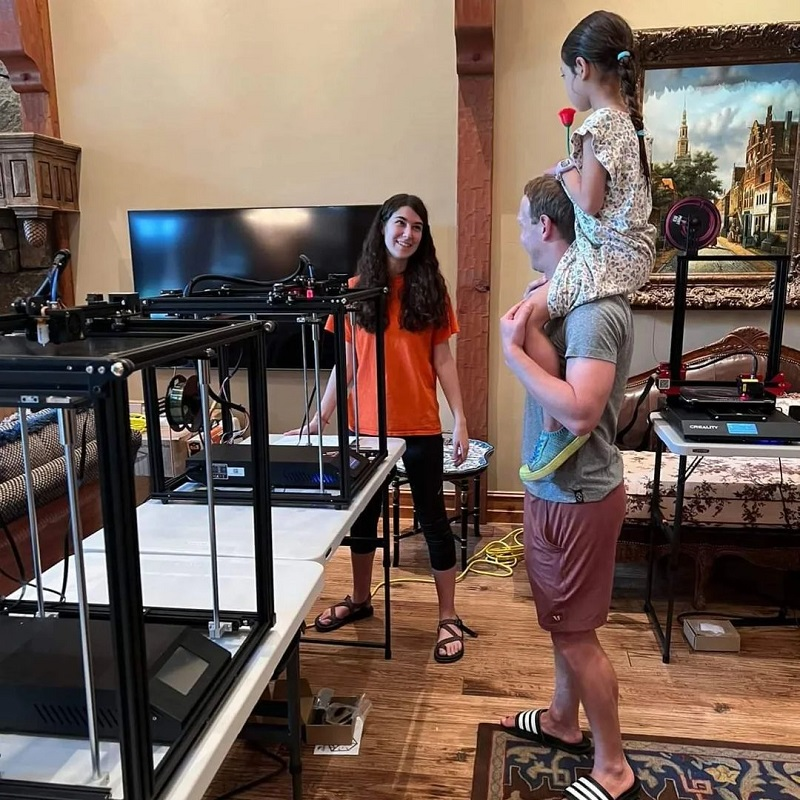
▲Mark Zuckerberg's 2022 Instagram post showing his home office with two Creality 3D printers
A new bottleneck has emerged, but with it comes a fresh wave of entrepreneurial opportunities. While cross-border e-commerce once solved how to sell products overseas, today, more 3C companies realize the critical question has shifted to making consumers first recognize a product's 'worth buying.'
Only by precisely aligning Shenzhen's supply chain speed and corporate R&D accumulations with overseas demand and usage scenarios can product innovation unlock greater value and provide a more solid foundation for branding.
Bemag, LUSBY, and Creality 3D have all begun new experiments on TikTok Shop.
02 New Products Break Out Through Content
When Bemag decided to go global in August 2025, they didn't realize how powerful product 'generational gaps' could be.
Since its founding in 2019, Bemag had achieved annual domestic sales exceeding 400 million RMB for a single data cable product within six years.
Their core product—a foldable stand data cable—wasn't a major innovation in China's 3C accessories market, but it effectively solved daily pain points: the 90° bend design resisted breakage, and the integrated rotating stand allowed hands-free phone use for streaming, messaging, or meetings during charging, making it consistently popular.
Unexpectedly, these performance upgrades taken for granted by Chinese users represented a 'consumption upgrade' for foreign users accustomed to traditional cables.
On TikTok Shop, Bemag's overseas brand Basemo sold 60,000 data cables within three months of launching. An American tech influencer with just 6,418 followers created a review video clearly explaining the 'charging + stand 2-in-1' feature, which garnered over 12 million views and directly generated approximately $55,000 in sales.
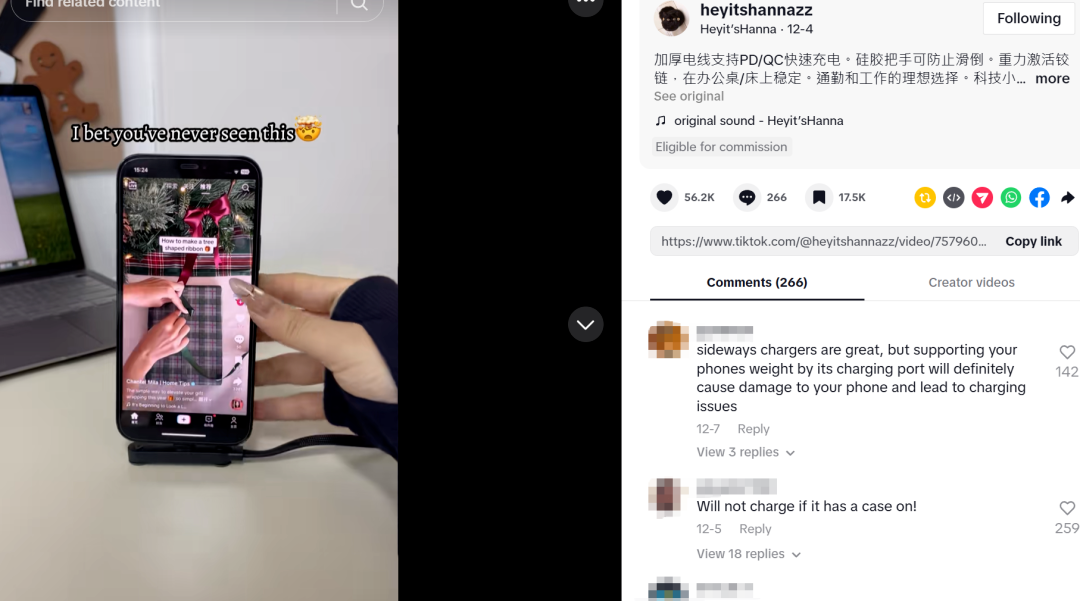
▲TikTok creator @heyitshannazz's video went viral, boosting Basemo data cable sales
A simple 10-second demo video can intuitively showcase the 'novelty' of traditional products. This has become a new solution for many Shenzhen 3C products on TikTok Shop: using content to first make consumers notice, then understand, and finally generate interest and purchases.
During the 2025 Black Friday period, AI glasses brand LUSBY achieved nearly $1 million in sales. This new Shenzhen-based brand became a dark horse in the AI glasses category through viral content.
Through native content created by U.S.-based TikTok creators, a pair of AI glasses priced under $60 found compelling usage scenarios for American mothers of three, blue-collar repair workers, and skiing enthusiasts.
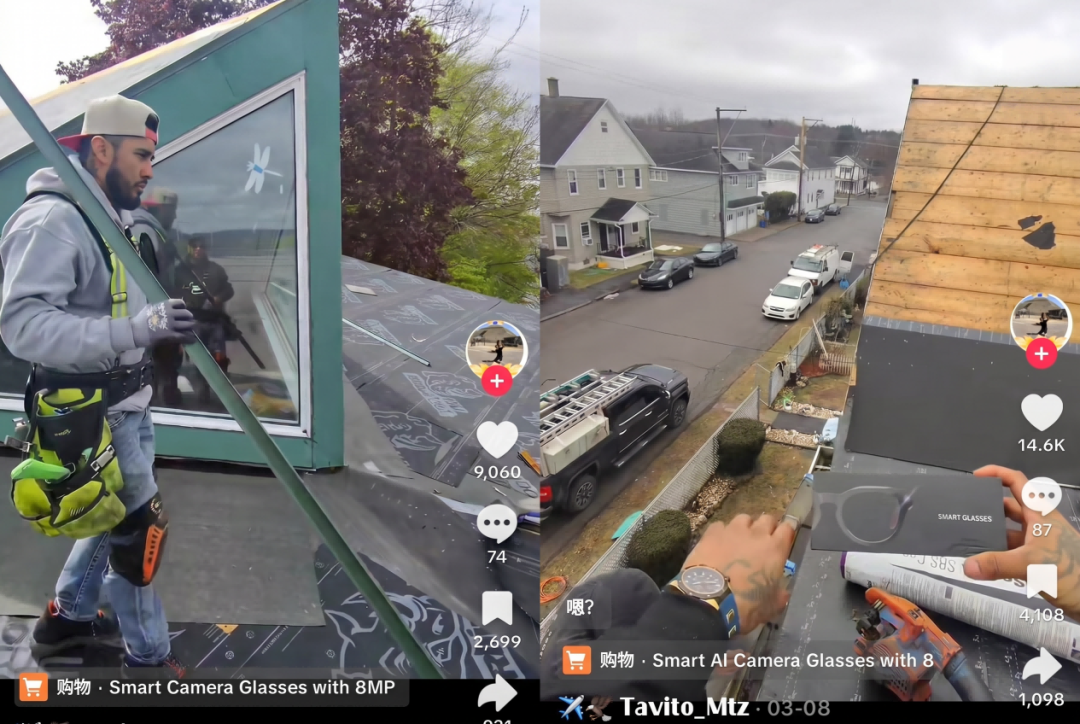
▲A Spanish-speaking construction worker in the U.S. wears Shenzhen-made AI glasses while working on a rooftop, shooting video simultaneously (Source: TikTok screenshot)
LUSBY co-founder Rong Jianhua later summarized: To sell a new product category, the first step isn't proving how advanced it is, but helping people visualize using it themselves.
In this process, finding suitable overseas creators and achieving effective localization is crucial.
Rong initially assumed tech influencers would be the key to popularizing AI glasses, but discovered ordinary Americans were more effective. In one video with over 62,000 likes, a Black creator demonstrated the glasses' translation feature to eavesdrop effortlessly on Arabic speakers nearby. Another creator, repairing a roof in strong winds, documented the work scene from a first-person perspective, earning millions of views.
Creality 3D's TikTok Shop operations lead Shi Ke discovered a creative influencer last year. While unboxing a Creality 3D scanner, the creator spontaneously modeled himself and printed a lifelike full-size statue nine hours later. The video exceeded one million views and drove 1,500 scanner sales.

▲TikTok creator @HiddenSteals prints his full-size head statue
At $200 per scanner, this content directly contributed $300,000 in sales.
During these experiments, multiple sellers found that for products requiring explanation, the most effective content isn't necessarily polished advertisements but rather spontaneous moments captured by ordinary users.
This creates a new growth path for new products: viral content drives social sharing, which in turn creates hit products, forming a closed loop from inspiration to sales. Objectively, this content-driven 'equalization of voice' allows white-label manufacturers and domestic brands to compete fairly with global giants.
For Shenzhen's 3C merchants, content e-commerce's appeal extends beyond visibility—it offers another possibility: thriving without engaging in price wars.
This is because in content ecosystems, a product's success depends more on its clear differentiation and the content's ability to communicate that differentiation effectively.
This is particularly crucial for niche, high-ticket new products.
When products aren't limited to price comparisons in search results but can showcase 'why they're worth buying' through content, Shenzhen's 3C industry competition logic shifts from 'selling cheaper' to 'how innovative' the product is.
03 Products Sell, Demand Returns
More profound changes occur after products gain visibility.
Traditionally, a cross-border new product's journey from factory to consumer involved R&D, production, listing, marketing, and then months of sales data analysis to determine market viability. Mistakes meant costly inventory write-offs and marketing expenses.
Today, new product validation cycles are collapsing.
After Basemo's rapid sales surge, Zheng Haixing initially believed the 360° rotating stand had solved overseas users' core needs. But he soon noticed repeated requests in influencer video comments: 'Can the cable be longer? 1.8 meters possible?'

▲Basemo data cable product image
Zheng realized that while 1.2-meter cables are standard in China, overseas housing and electrical habits favor 1.8 meters.
Bemag immediately adjusted its production lines. Within two weeks, the new cable version had replaced inventory in overseas warehouses.
LUSBY's AI glasses underwent a similar process. Early versions required touching both temples to power on/off, which many users found inconvenient, leading to negative reviews. The team quickly relayed this feedback to R&D: the product was redesigned for single-side operation and added features like auto-power-on when worn and auto-shutdown when folded.
From user complaints to the next improved version hitting shelves took about a month. When Black Friday traffic arrived, the product receiving demand was no longer the initial version but an AI glasses model continuously refined through user feedback.
This represents a crucial shift TikTok Shop brings to Shenzhen's 3C industry: consumer voices return to product development faster. Short video comments, live stream interactions, creator reviews, user ratings, and return data collectively form real-time market signals, transforming the traditional linear 'R&D-production-sales-review' process into a circular 'R&D-testing-feedback-iteration-sales-R&D' loop.
Shenzhen's supply chain strengths find new applications in this accelerated validation process.
As new product validation speeds up, brand growth trajectories transform.
Previously, cross-border brands slowly built overseas recognition through heavy advertising, long sales cycles, and channel expansion. Today, a viral TikTok hit isn't just a sales opportunity but the start of brand equity accumulation.
Through 'content,' consumers see not just a cold product link but real people, a clear product philosophy, and sustained innovation capabilities. When these elements appear repeatedly, Shenzhen merchants' supply chain advantages gradually crystallize into brand equity recognizable to overseas consumers.
'Visibility' builds trust, while store followers, video and live stream clips, influencer content, user reviews, and authentic usage content become trust assets for new users and future products.
After Bemag's TikTok breakthrough, multiple overseas traders initiated contact. Within months, the factory received 1.5 million cross-border orders, forcing the brand to upgrade production capacity by expanding its Shenzhen plant.
04 Young People Inherit 'Shenzhen Speed'
As Shenzhen's 3C industry shifts growth logic, the people in its supply chain are also changing.
Manufacturers previously prioritized engineers, procurement specialists, and foreign trade talent. Today, foreign language anchors, influencer managers, user researchers, and brand content specialists are becoming essential for 3C global expansion.

▲Creality 3D's global team at work
Some young people previously seen as distant from manufacturing are finding new roles. Those with backgrounds in media, design, or art may lack familiarity with factory technical parameters but excel in expression, communication, and aesthetics, making them adept at quickly capturing overseas trends and consumer interests.
Young people with an 'online sense' are helping Creality open up new horizons. In 2025, 'Black Myth: Wukong' became a global sensation. Shi Ke's team launched a related challenge on TikTok, attracting hundreds of thousands of overseas users to participate. Young people connected 3D printing with gaming culture, bringing products originally targeted at geeks into a broader community of interests.
These transformations are reshaping the talent landscape within the 3C industry.
Shi Ke has noted that in Shenzhen's current overseas market, professionals adept at handling the surge in orders from TikTok Shop are in exceptionally 'high demand.' For the new breed of 3C enterprises, a mere grasp of the supply chain is insufficient; they also require individuals capable of transforming products into compelling content that resonates with, is visible to, and is enthusiastically shared by overseas consumers.
This shift also signifies a generational handover among Shenzhen's 3C industry professionals.
The preceding generation of entrepreneurs tackled the challenge of 'product manufacturability.' Leveraging supply chains and product technology, they successfully introduced Shenzhen-made products to the global stage. The current generation, however, must address the issue of 'product visibility and selection.' They harness content creation, responsiveness to user feedback, and technological innovation to enable overseas users to appreciate the ingenuity of Shenzhen-made products and to willingly pay a premium for them.
As this generational transition unfolds among Shenzhen's 3C professionals, the 'Shenzhen Speed' is no longer confined to the rapidity of factory machinery or the swift distribution in Huaqiangbei; it now embodies the innovative pace propelled by the entire industrial ecosystem.
While Huaqiangbei continues to thrive with activity, Shenzhen has evolved beyond being merely a global hub for 3C products. A novel connection is emerging, linking supply chains, technology, content, and global consumers. Previously, Shenzhen-made products competed based on the speed of market introduction; nowadays, the competition hinges on the swiftness of identifying consumer needs, iterating products, and disseminating Chinese innovation worldwide.
Perhaps this encapsulates the contemporary essence of 'Shenzhen Speed.'
-
![]()
Yu Chengdong's Harmony Intelligent Travel Achieves 'First in New Force Deliveries', Netizens: Unbeatable Win
-
![]()
Six Entities Invest 8.2 Billion to Launch Shenlong Technology
-
![]()
Give BMW X3 a Chance?
-
![]()
Chengdu: Leading in New Car Sales, Yet Losing the Favor of Rolls-Royce and Its Luxury Peers
-
![]()
Shenzhen Speed: The New Era
-
![]()
Shenzhen Speed Gets a New Version
-
When AI Becomes Too Powerful to Ignore: OpenAI Hits the Brakes for the First Time in History
-
![]()
Why Have Small Commuter Cars Priced Under 50,000 Yuan Seen a Slump in Sales?