A Sample of AI Breakthrough for a Company
 08/21 2026
 516
516
Betting on AI: What NetEase Youdao Got Right
On August 20, NetEase Youdao released its financial report for the second quarter of 2026: net revenue reached 1.47 billion yuan, up 3.5% year-on-year; operating profit hit a new single-quarter high; net operating cash inflow was 330 million yuan, an 80.7% increase year-on-year. The company has now maintained positive operating profit for eight consecutive quarters.
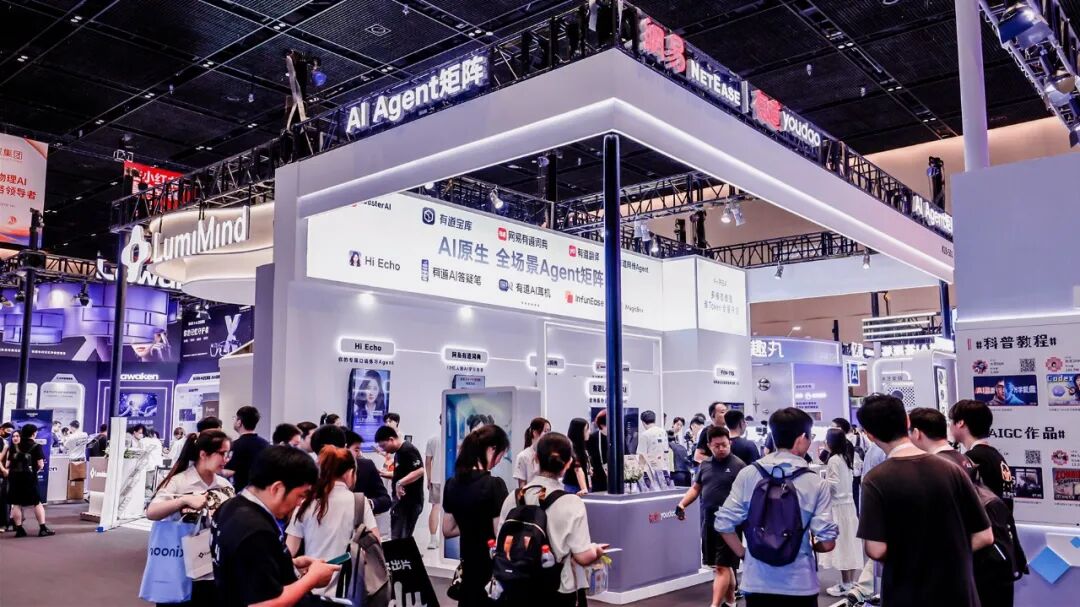
Beyond the numbers, the redefinition of its positioning is even more noteworthy. Late last year, CEO Zhou Feng announced a shift in Youdao's positioning from a "leading edtech company" to a "Learning and Advertising AI Application Service Provider." At WAIC in July this year, Youdao's AI Agent matrix made a collective debut, giving the new positioning a complete product form.
However, while products generate buzz, business is business. Since the rise of large models, the narrative of "AI empowerment" has been retold to the point of diminishing returns. The market's patience is reserved for one type of evidence: whether AI applications remain a viable business after accounting for narrative premiums. This financial report provides precisely such a window for observation.
01 A Sample AI Company
Describing Youdao as a "sample AI company" centers on its high degree of sample completeness.
Globally, several clear paths for AI application monetization have emerged.
Consider these typical examples: AppLovin validated the monetization potential of marketing AI through its self-developed advertising engine, AXON; Duolingo drove ARPU and overall revenue growth with its high-priced AI subscription tier, Max; and Meitu integrated AI Agents into its imaging product matrix, similarly boosting total business revenue and net profit year-on-year.
These three companies represent three models of AI application monetization: marketing efficiency, subscription upgrades, and tool-based payments. Youdao's uniqueness lies in its simultaneous layout (layout) across all three areas, with verifiable progress in each.
Breaking it down, Youdao's AI system features a "one foundation, multiple branches" structure: its self-developed "Ziyue" large model serves as the technological foundation, with parallel extensions upward into AI subscription services, a multi-Agent advertising marketing closed loop , LobsterAI, AI hardware terminals, and other business lines, each targeting different implementation scenarios.
According to the company's disclosed evaluation data, Ziyue 4.0 completed an upgrade in the second quarter of this year. With 27 billion parameters, its multimodal mathematical reasoning capabilities lead among models of the same scale, achieving an 81.4% accuracy rate in Chinese pure-text mathematical problems, a 43.2% reduction in thought chain output length, and an approximately 80% increase in translation reasoning speed.
These figures demonstrate Youdao's ability to self-develop models. However, what truly determines the company's value is whether the Agents built on these models can generate revenue in specific scenarios.
Zhou Feng once stated, "Beyond models lies the true product strength of AI applications." Multi-Agent systems introduce complexities in handovers, state synchronization, permission hierarchy, and debugging. In most scenarios, stabilizing, controlling, and evaluating single Agents first proves more effective.
The implication of this judgment is that Youdao does not pursue the concept of general-purpose Agents but instead integrates Agents into specific workflows, solidifying one scenario at a time.
At this year's WAIC, Youdao unveiled its AI Agent matrix: AI earphones that automatically generate meeting minutes; an office Agent enabling natural language remote computer control; a simultaneous interpretation Agent supporting multilingual translation and live simultaneous interpretation; and three marketing Agents covering the entire online marketing process... Beyond the old label of an education company, a new landscape of AI applications has unfolded.

This is the profile a sample AI company should have: a self-developed foundation, diverse scenarios, implemented Agents, and overflowing capabilities.
02 After Agents Enter Workflows
With the profile established, how does it hold up in practice? Let's examine each business line.
Net revenue from online marketing services reached 580 million yuan, with a gross margin of 28.7%, up approximately 3 percentage points year-on-year. AI application and short-form drama advertising revenue in high-growth industries each grew by over 50% year-on-year. In the second quarter, over 100 new advertisers were acquired, and the repurchase rate increased by approximately 5 percentage points quarter-on-quarter.
Together, these figures point to a clear judgment: Youdao is actively cutting low-quality advertising inventory and shifting resources toward AI-driven precision marketing.
What supports this shift? Behind it lies a marketing closed loop (closed loop) composed of three Agents: iMagicBox, Xiaozhi 2.0, and YODA.
iMagicBox handles content production, utilizing over 2,000 localized digital humans to reduce costs by approximately 70%; Xiaozhi 2.0 optimizes ad placement, managing all accounts through a single portal to improve operational efficiency by 70% and reduce placement waste by 60%; YODA manages influencer marketing, encapsulating Youdao's years of frontline service experience into replicable capabilities, connecting with 30 million creators globally, and transforming influencer resources previously held by individual employees into company-level data assets.
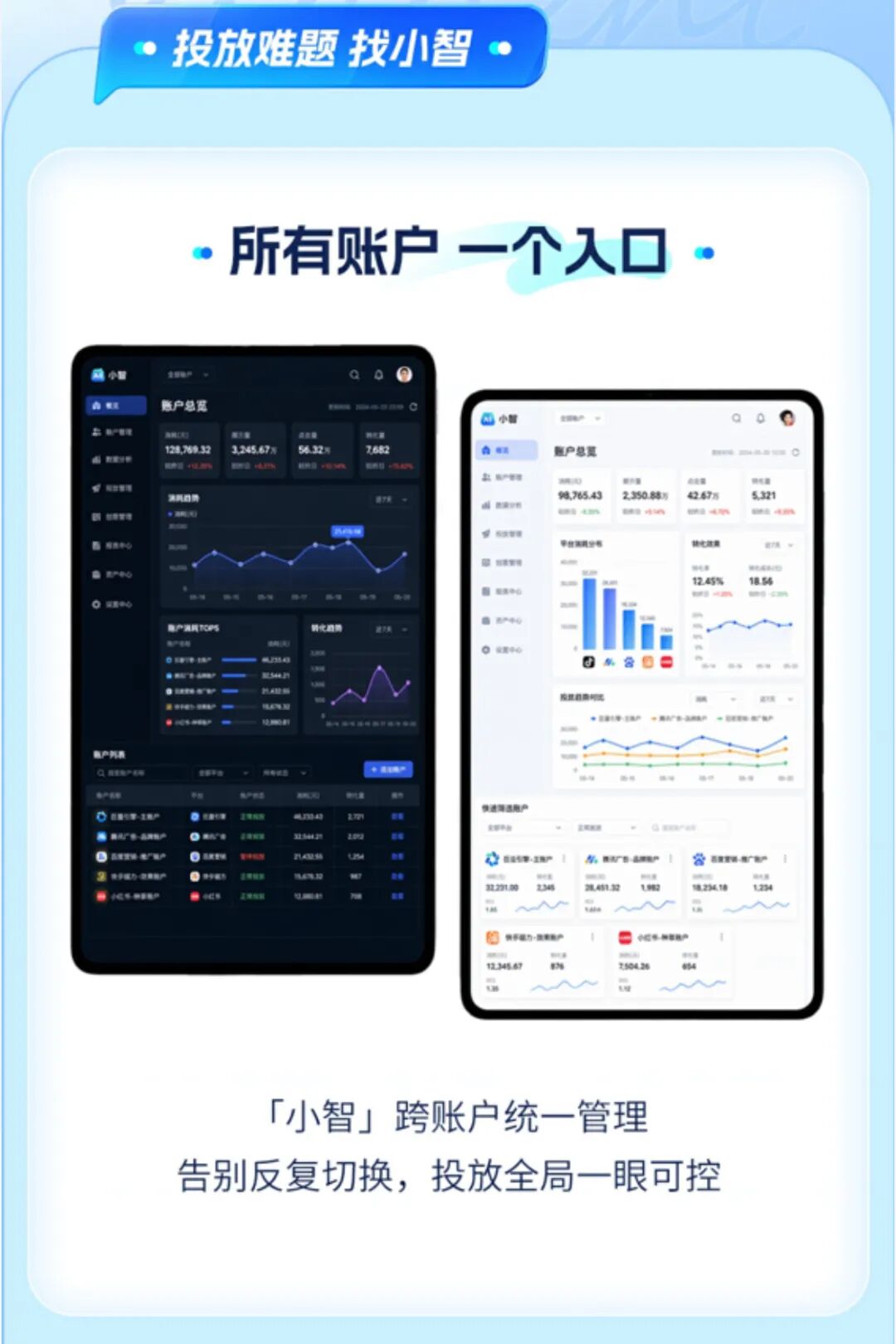
NetEase Zhixuan AI Ad Placement Optimizer
Xiaozhi 2.0's cross-account unified management function
Contrast this with AppLovin's AXON, a logic already validated by the global market: AI-driven ad placement can deliver extremely high profit margins. Youdao's three Agents cover the entire chain from content production to placement optimization and influencer distribution, making the system heavier and more complete than AXON. The 3-percentage-point increase in advertising gross margin is just the beginning—in the eyes of some market observers, if the Agent closed loop (closed loop) continues to function smoothly, profit margins have further room to rise.
On the subscription upgrade front, learning services represented the fastest-growing business in Q2: net revenue reached 800 million yuan, up 20.9% year-on-year.
The structural highlight within this segment comes from AI subscription services—sales reached approximately 100 million yuan in the second quarter, up over 20% year-on-year, showing rapid growth.
The momentum behind AI subscriptions is more evident in specific products. Usage of the simultaneous interpretation function in Youdao Dictionary doubled year-on-year, while sales of Hi Echo, an AI oral tutor, grew by over 100% year-on-year, leading to a partnership with IELTS officials.
The growth of Hi Echo stems from a crucial product insight. The team discovered that in real-language communication, users often struggle to initiate topics, extend expressions, or maintain thought flow due to nervousness—problems passive Q&A-style AI cannot solve. Based on this, Hi Echo underwent a complete upgrade: from a passive virtual tutor to an intelligent oral Agent capable of contextual understanding and proactive guidance. The new version no longer waits for user questions but dynamically tracks conversation progress, asking follow-ups, extending topics, and providing feedback to help users overcome speaking barriers and make expressions smoother and dialogues more natural.
The simultaneous interpretation function represents another breakthrough direction. In March this year, Youdao pioneered the industry's first "Simultaneous Interpretation Agent": users simply click "Simultaneous Interpretation" on the Youdao Dictionary homepage, activate "Earphone Simultaneous Interpretation," and connect their usual earphones to automatically complete an entire information processing workflow—real-time speech recognition, instant translation, automatic generation of timestamped original-translation records, and AI meeting summaries and mind maps to help users quickly organize information structures and extract key points.

Youdao AI Simultaneous Interpretation's "AI Summary" function
The logic of AI features driving paid conversions has precedents overseas: according to Duolingo's financial report, penetration of its high-priced Max subscription tier rose from 5% to 9%. Youdao's simultaneous interpretation and Hi Echo both doubling indicates this logic holds equally in the domestic market.
For hardware, figures must be viewed over a longer time horizon. Youdao proactively contracted resources to core categories—during the 618 shopping festival, the Youdao Dictionary Pen secured the top sales spot on JD.com and Tmall for the seventh consecutive year, showing no shake in its category dominance.
More critically, the business model has changed: the Dictionary Pen X8 pioneered a "hardware + subscription" model, shifting from one-time hardware sales to recurring service revenue. In the short term, subscriptions reduce current recognized revenue—a lesson all companies transitioning to subscriptions learn. However, once renewal rates stabilize, the certainty of revenue and valuation logic transform completely—the SaaS industry spent over a decade teaching the market this lesson, and hardware companies are now reliving it.
The upcoming Youdao OpenPods earphones represent another direction: Agents with bodies. Featuring dual microphones and bone conduction pickup, they enable recording, transcription, summarization, and translation in a closed loop, transcending traditional earphones to become a permanent Agent worn in the ear.

Youdao AI Earphones OpenPods
03 Rewriting the Valuation Model
Beyond the three proven paths, Youdao has a less visible but significant hidden clue (underlying thread): LobsterAI.
To grasp its weight, we must first examine the table it sits at. In the Agent era, as AI can read materials, use software, and complete tasks step by step, tech companies are once again vying for the computer desktop: users need only specify goals, and Agents mobilize various tools to deliver results. Entering the second half of 2026, activity at this table has noticeably accelerated, with a "Big Four" pattern (landscape) of office Agents emerging.
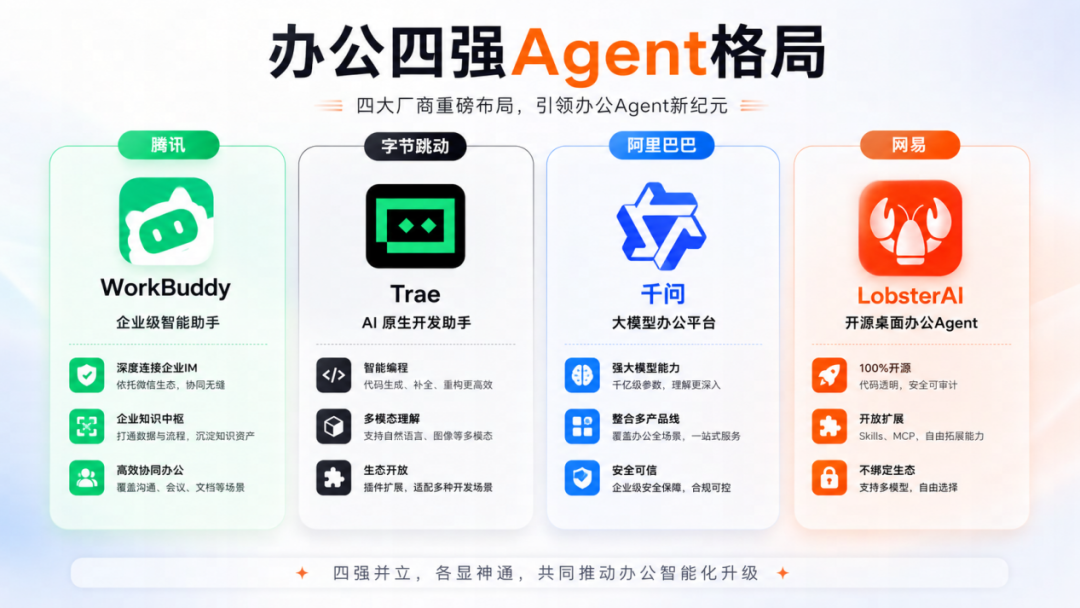
The Big Four Office Agent Landscape
Tencent is promoting synergy between QClaw and WorkBuddy's departments while launching "human-machine dual writing" for WorkBuddy; Alibaba, based on QoderWork, introduced "Qianwen Office" and initiated small-scale beta testing; ByteDance is driving collaboration among Doubao, Feishu, and Volcano Engine, with the beta version of Doubao Enterprise Edition already integrated into Feishu Docs, Sheets, Meetings, Group Chats, and enterprise knowledge bases. All three giants are indiscriminately integrating Agents into real workflows.
The fourth player is NetEase, wielding LobsterAI developed by Youdao. As the earliest domestically developed desktop-level Agent to achieve full open-sourcing, it went open-source in February this year, garnering over 5,900 GitHub stars. According to the company, user scale has surpassed 1 million, with active user retention exceeding 80%. It continues to make aggressive moves: Gradually launched (sequentially launching) position expert suites, Sites, multi-Agent collaboration, and other functions while offering "large points (points) upon login" to all NetEase users, lowering the experience barrier.
For Youdao, its strategic significance extends beyond a single product—it enables Youdao's AI capabilities to overflow from learning and advertising, two vertical scenarios, into the broader office market, securing NetEase a seat in the four-way contest for office entry points.
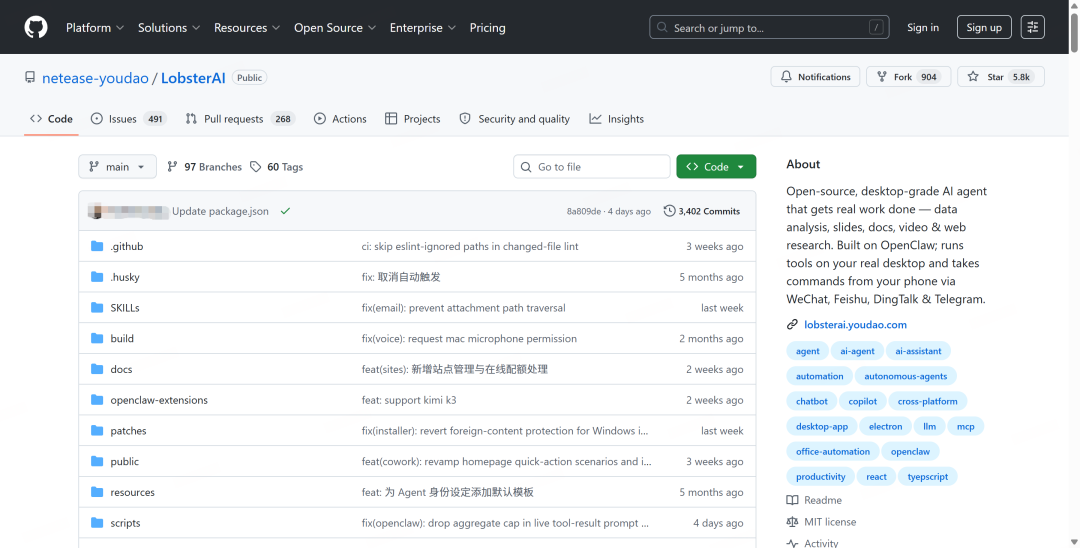
LobsterAI's GitHub Page
The explicit lines contribute profits, while the hidden lines open up space. Capital markets are already reassessing the company.
However, when it comes to putting real money on the table, many hesitate—the TTM P/E ratio exceeding 200 times does raise doubts. At this valuation level, the company appears far too expensive within the framework of education companies. TAL Education's current market cap is approximately $6.5 billion, with a P/E ratio around 7 times; New Oriental's market cap is about $8 billion, with a P/E ratio below 20 times.
But if we switch the yardstick to AI application companies, the conclusion changes entirely. The market has already completed revaluations of several "AI delivery companies."
Meitu's shift from a "tool app company" to an "AI application company" framework triggered an upward shift in its valuation center, with a current market cap of approximately HK$19.3 billion and a TTM P/E ratio around 31 times. AppLovin's market cap once exceeded $140 billion, becoming a global benchmark for AI application commercialization valuation. Kingsoft Office sustains a market cap of approximately 120 billion yuan with its AI office narrative, with WPS AI exceeding 80.13 million domestic MAUs and daily Token calls surpassing 200 billion.
These form a complete group of precedents for "AI delivery leading to valuation reconstruction."
NetEase Youdao is no exception—the company has completed its AI infrastructure buildout, with Agents operational across multiple business lines and profit elasticity beginning to release.
Goldman Sachs noted in a recent research report that Q2 2026 may represent a turning point where AI agent activities produce observable, quantifiable impacts on software companies' fundamentals. Gartner predicts that by 2028, one-third of enterprise software applications will embed Agentic AI capabilities. Against this backdrop, truly differentiated companies are those that master both model foundations and real-world scenarios while integrating Agents into workflows.
Describing NetEase Youdao as an "AI company sample" lies precisely in its complete demonstration of how a traditional tech company can reconstruct itself with AI: from self-developed models to Agent implementation, from internal efficiency gains to external output, from business model reshaping to valuation logic shifts. Every step in this process has been validated or refuted by global peers and supported by real financial data.
The answer sheet for Q2 provides a starting point. The structural changes behind the numbers deserve serious attention: the gross profit margin of advertising is increasing, the growth rate of learning services is accelerating, AI subscription revenue has surpassed 100 million, hardware has shifted from selling single products to selling services, and LobsterAI has established a reputation in the open-source community.
In other words, the AI value of NetEase Youdao is indeed still on the rise.
This article is original to Xinmou. For authorization to reprint or business cooperation, please contact us.
— END —
-
![]()
SenseTime’s SenseNova U1.5 Lite Goes Open Source: Ushering in a New Era of Predictable AI Image Generation
-
![]()
Collaboration Initiated! Tesla Officially Welcomes Doubao Onboard
-
![]()
WPS: From Alternative to Leader, Kingsoft Software Bets on AI Office, H1 Revenue Nears 5 Billion
-
![]()
Can TECNO Mobile Expand Beyond Africa?
-
![]()
A Sample of AI Breakthrough for a Company
-
![]()
Goldman Sachs Raises the Bar: China’s Global Expansion Steps into the '3.0 Era,' Now Exporting AI Industrial Prowess
-
![]()
Aunt Wu Advises Everyone Not to Be Afraid
-
![]()
Chengdu Auto Show: BMW and SAIC Volkswagen Adopt Direct Strategies