WPS: From Alternative to Leader, Kingsoft Software Bets on AI Office, H1 Revenue Nears 5 Billion
 08/21 2026
 463
463
WPS fully supports Kingsoft Software.
On August 19, Kingsoft Software released its 2026 H1 financial report: total revenue reached 4.927 billion yuan, up 6% year-over-year; net profit attributable to shareholders was 1.639 billion yuan, doubling year-over-year.
However, this significant profit growth did not come from its core business but rather from unrealized gains on equity investments in joint ventures and associates.
After adjusting for non-recurring factors, the adjusted net profit attributable to shareholders was only 581 million yuan, down 13% year-over-year, indicating real pressure on the core business's profitability.
Breaking down the business segments, office software and services contributed 3.313 billion yuan in revenue, accounting for 67% and up 25% year-over-year, with an operating profit of 873 million yuan, making it the group's only stable source of profit. In contrast, gaming revenue declined by 19% year-over-year, transforming from a former cash cow to an operational drag.
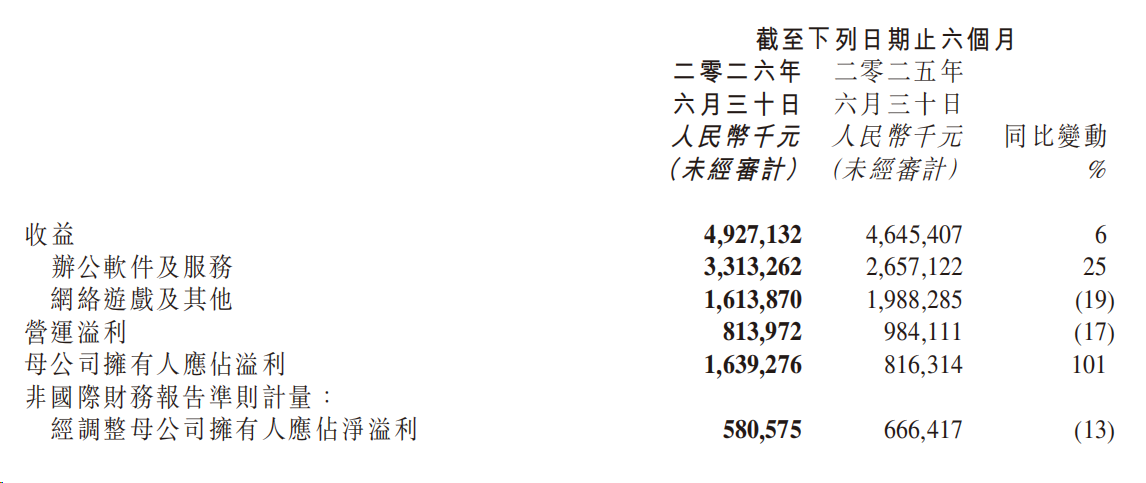
Image source: Financial report
It can be said that the WPS-centric office business has become the absolute pillar of the company.
From being a "Microsoft alternative" in its early years to becoming a domestic leader in the era of information technology innovation, and now a pioneer in the AI office wave, WPS has reached the forefront of the industry through continuous product refinement.
Now facing competition from Microsoft, DingTalk, Tencent Docs, and others on multiple fronts, is WPS's growth foundation solid?
From Edge Tool to Group Anchor: WPS's Three Turns
WPS's growth trajectory almost mirrors the story of domestic substitution in China's office software market. Three key turning points have transformed it from a struggling edge tool to the core value driver of the group.
The first phase was survival and breakthrough. In the 1990s, Microsoft Office swept the globe with Windows, reducing WPS's market share to single digits. WPS survived by fully compatible (compatible) with Office formats and maintaining government and enterprise purchases, long labeled as a "cheap alternative."
The second phase was overtaking on bends. After the mobile internet boom, Microsoft was slow to respond on mobile, while WPS preemptively deployed across all mobile platforms, capturing hundreds of millions of users with a free, lightweight strategy.
In 2019, WPS listed on the STAR Market and simultaneously began transitioning to a subscription model, upgrading from "one-time license sales" to "recurring service fees." At the same time, it seized the information technology innovation wave to secure an absolute share of the government and enterprise market, becoming a standard for domestic office software.
The third phase was value leapfrogging. After the rise of generative AI like GPT, WPS was the first to implement full-scenario AI functions, upgrading from an efficiency tool to an intelligent office assistant, directly driving increases in both paid conversion rates and ARPU, opening a third growth curve after mobile internet and information technology innovation.
Today, WPS is Kingsoft's cash flow source, valuation anchor, and strategic core, with its business trends largely determining the group's overall performance.
From the H1 financial report, Kingsoft Software's AI business has entered the monetization phase.
The company's 3.313 billion yuan in H1 office software revenue was supported by three major segments: personal business, institutional business, and software licensing. AI has moved beyond hype to become a real revenue driver.
Personal subscription business is the revenue foundation.
In Q2 2026, WPS's personal business revenue was 1.039 billion yuan, up 17% year-over-year; H1 personal business revenue totaled 2.014 billion yuan, up 15.20% year-over-year, accounting for over 60% of office business revenue.
In terms of user scale, WPS is already an industry leader.
As of end-June, it had 676 million monthly active devices globally, up 4% year-over-year; domestically, it had 48.25 million cumulative annual paid personal users, up 15% year-over-year.
Objectively, WPS's user growth is slowing, for a simple reason:
The Traffic dividend (user growth dividend) in China's consumer office market has largely peaked, with mainstream office users almost fully covered, leaving very limited room for new user growth. While overseas markets are accelerating, they cannot yet provide sufficient scale to take over.
This means WPS's era of driving revenue growth through "user acquisition and scale expansion" is largely over. The focus must shift to Explore the value of existing users (monetizing existing users): using AI features to enhance product appeal, converting free users to paid, and upgrading basic members to AI-inclusive premium members, using ARPU growth to fill the gap left by slowing user growth.
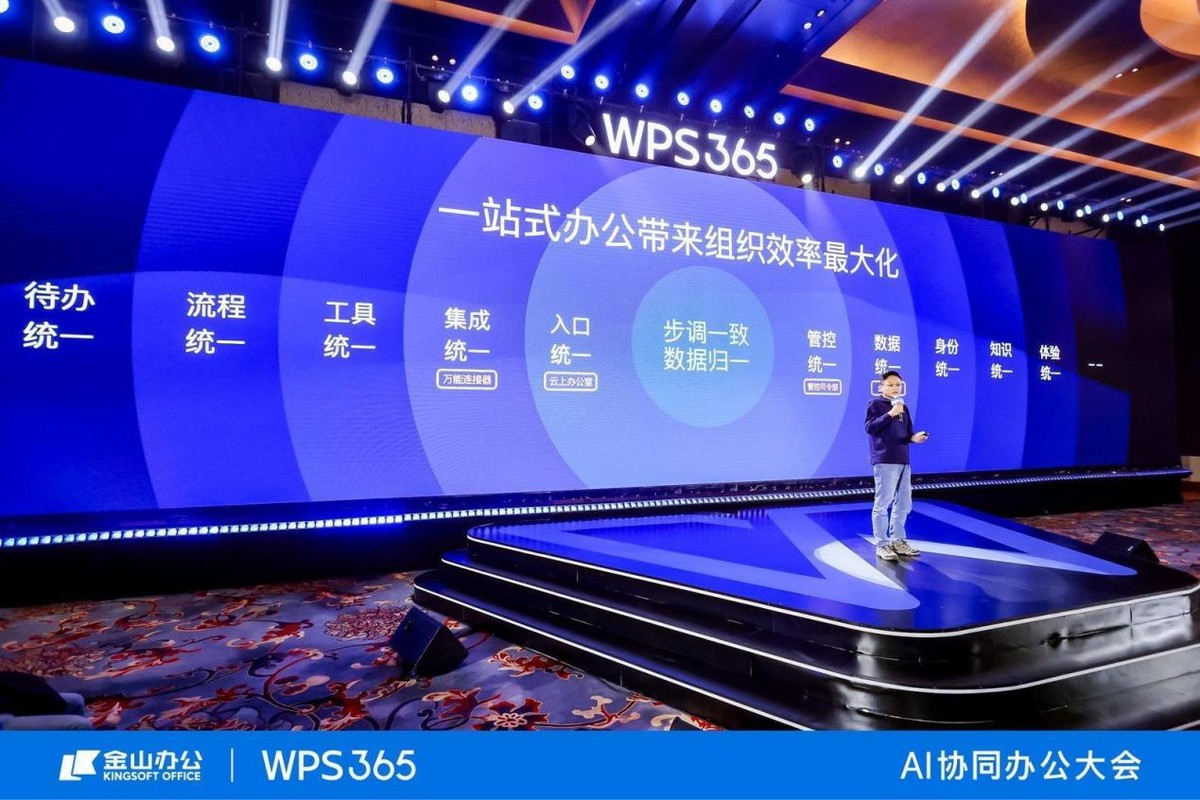
WPS 365 institutional subscriptions are the strongest growth engine.
Q2 revenue was 253 million yuan, up 61% year-over-year, maintaining high growth around 60% for multiple quarters.
Growth comes from cloud subscriptions replacing traditional perpetual licenses, with AI further expanding growth space.
The newly launched WPS Comate enterprise AI assistant can connect to internal corporate knowledge bases, covering 26 typical scenarios across 11 major fields like HR, finance, and legal, driving customers from "purchasing tools" to "purchasing intelligent office solutions," significantly boosting ARPU and renewal rates.
Software licensing is a high-margin moat.
Q2 revenue was 376 million yuan, up 34% year-over-year; H1 revenue was 722 million yuan, up 33.36% year-over-year.
According to A-share listed company Kingsoft Office, this segment has a gross margin of 95.02%, making it the company's most stable and profitable business, with revenue primarily coming from information technology innovation procurement in Party and government sectors and eight key industries.
Public information shows WPS covers 93% of central enterprises and 97% of provincial governments in China. As information technology innovation deepens in finance, energy, manufacturing, and other fields, incremental demand continues to release.
Siege Warfare: Fierce Competition in Crowded Tracks
From a segment perspective, WPS does not compete in a single track but faces intense competition from top players across two segments, with each opponent having distinct strengths and clear boundaries.
In the professional office suite segment, WPS and Microsoft have a clear duopoly, with other players struggling to catch up.
According to IDC's Q1 2026 China Office Suite Market Tracker, by end-user license count, Kingsoft Office ranked first domestically with a 32.1% share, followed by Microsoft at 28.5%, forming a very stable duopoly.
Microsoft's core strengths lie in the high-end market and ecosystem barriers. Its complex macro programming, third-party plugin ecosystem, and global format standard dominance remain clear shortcomings for WPS. As a result, multinational corporations, professional design, and high-end finance scenarios are still firmly dominated by Microsoft.
WPS's advantages lie in localization and compliance. Its full PDF processing workflow, massive template library, and Docer materials bank better fit domestic user habits, priced at just 30-50% of Microsoft's, while supporting full on-premises deployment and data localization, giving it irreplaceable compliance advantages in sensitive government and enterprise sectors.
In China's information technology innovation office software market, according to IDC's Q1 2026 segment statistics, WPS holds over 60% market share overall and absolute dominance in Party and government offices, with a very stable leading position.
Objectively, as the earliest entrant in information technology innovation office software, WPS was among the first to achieve full compatibility with domestic infrastructure software and hardware, covering all mainstream domestic CPUs like Kunpeng, Feiteng, and Loongson, as well as mainstream domestic operating systems like UOS and Kylin, with industry-leading compatibility depth and breadth.
Microsoft Copilot's China version faces data export regulatory restrictions, making it difficult to shake WPS's information technology innovation foundation in the short term.
In the collaborative office segment, WPS struggles to gain traction, locked out of B-end entry by DingTalk, Feishu, and WeCom.
According to QuestMobile Q2 2026 data, DingTalk, WeCom, and Feishu together account for over 90% user coverage in China's collaborative office platform market, with DingTalk exceeding 200 million MAU, WeCom over 100 million, and Feishu around 30 million. In contrast, WPS 365's market share in collaborative office platforms is estimated at just 2.5% in terms of user coverage.
Objectively, this gap stems not from product capability but fundamental differences in segment logic—they compete in different dimensions.
DingTalk, Feishu, and WeCom are essentially "enterprise operating systems," starting with organizational structure, instant messaging, and approval workflows to occupy core enterprise management entry points, with documents being just one supporting module in their ecosystems.
WPS 365, in contrast, extends collaborative capabilities backward from professional document tools, with its core strength always in document processing professionalism.
This genetic difference directly caps B-end growth potential: collaborative platform procurement is a top-down "CEO-level decision." Once deployed, a company's organizational structure, approval workflows, business data, and customer resources become deeply entrenched, making switching costs extremely high.
For a medium-sized enterprise, replacing a collaborative platform means overhauling work habits, business processes, and system integrations across the entire company, with decision cycles lasting six months to a year and high implementation risks.
Office software procurement, however, is often a department-level decision where IT departments purchase licenses as needed, making it difficult to displace collaborative platforms at the entry point.
Currently, DingTalk, Feishu, and WeCom are all enhancing their document capabilities: DingTalk Docs, Feishu Docs, and WeCom's embedded Tencent Docs are strengthening basic editing and collaboration features. While not as professional as WPS, they sufficiently cover 80% of enterprises' daily lightweight office needs.
For most enterprises, the "free documents that come with collaborative platforms" are adequate, eliminating the need for additional procurement of office software with collaboration features.
This means WPS 365 is unlikely to grow into a complete enterprise office platform; its best path is to serve as a professional document tool embedded in existing collaborative ecosystems, rather than replacing entry points.
WPS is currently developing integration solutions for DingTalk and WeCom, but this dependent positioning means it can never access core enterprise data flows, limiting deeper value Excavate (mining).
Gaming Business: From Cash Cow to Operational Drag
In stark contrast to WPS's strong performance is the gaming business's continued weakness.
Financial reports show H1 online gaming and other business revenue was 1.614 billion yuan, down 19% year-over-year, with segment operating losses of 64 million yuan, transforming from a former profit pillar to an operational drag.
The core reason for the decline is that the 17-year-old PC game JX Online 3 has entered the late stage of its lifecycle, with revenue naturally declining, compounded by the overall shrinkage of the PC gaming market, making a short-term reversal unlikely.
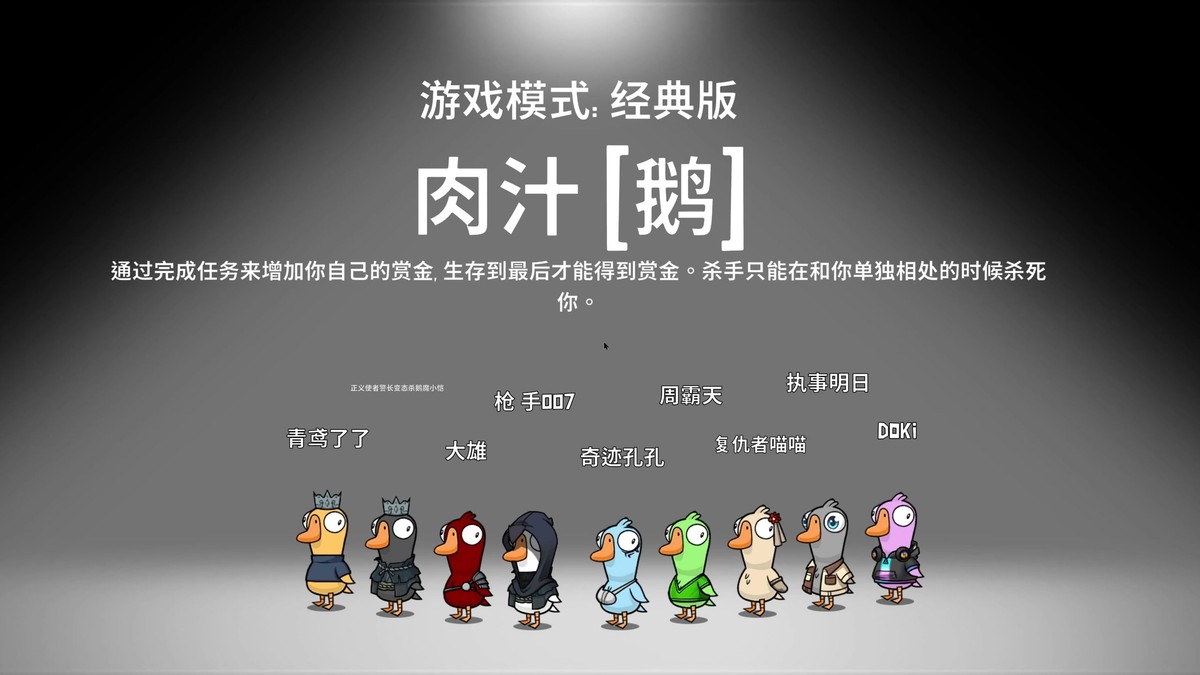
Among new releases, the mobile game Goose Goose Duck (agent-published) was the only bright spot. Financial reports cited QuestMobile data showing it ranked among the top three newly launched domestic mobile games in 2026 by MAU, with strong IP collaboration momentum, once reaching the top five on iOS bestseller charts.
However, the gaming segment is fiercely competitive with generally short product lifecycles and high single-product dependency, making it difficult to fully reverse the overall segment's downturn.
Currently, the gaming segment's strategic focus has shifted to "maintenance + cost reduction," using long-term operations to slow the decline while exploring AI-enabled R&D cost savings, though revenue contributions have yet to materialize.
Capital Markets Back WPS with Real Money
As of August 19 closing, Kingsoft Software's stock price was HK$25.56, with a total market cap of approximately HK$35.1 billion, corresponding to a TTM P/E of about 11x, up approximately 20% over the past three months, primarily driven by the AI office theme.
Compared to other Pan office AI (general office AI) stocks like Foxit Software, Wondershare Technology, and iFLYTEK, Kingsoft Software has seen more pronounced gains.
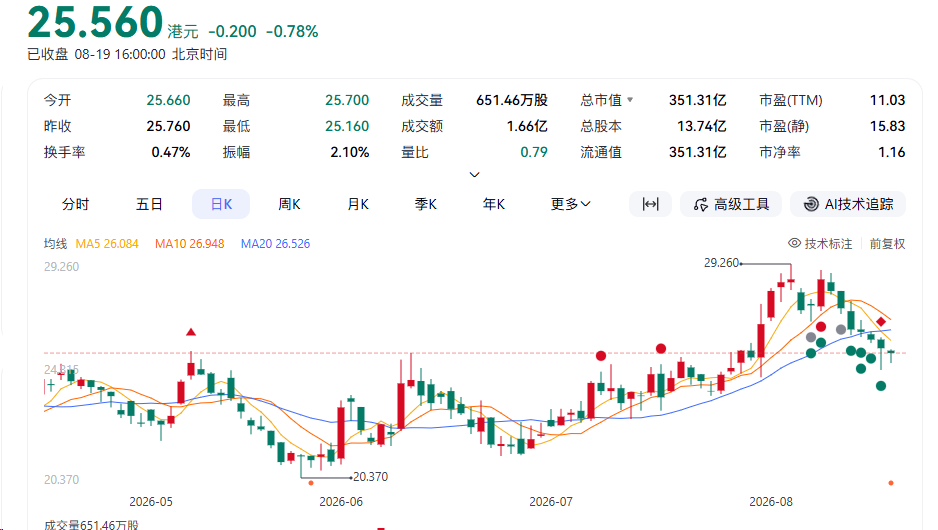
(Kingsoft Software's stock price has been rising for the past three months)
Overall, Kingsoft Software's rally is not purely speculative but built on WPS AI's commercialization and substantive core business performance, which the market generally recognize s.
Market Valuation divergence (valuation disagreements) on Kingsoft Software center on three points:
1. Profit quality disagreement: Net profit doubled, but adjusted profit fell 13%, with equity investment gains deemed unsustainable.
2. AI monetization disagreement: WPS AI has entered commercial validation, but price hikes and paid conversion rates still require quarterly data verification.
3. Business structure disagreement: Uncertainties remain around when the gaming business will bottom out and when Kingsoft Cloud (associate) will improve profitability.
In terms of institutional ratings, top brokerages set target prices concentrated at HK$28-33, implying 10-30% upside from current levels, with an overall cautiously optimistic stance.
Currently, Kingsoft Software is no longer a "gaming + office" dual-engine player but a holding platform centered on WPS and betting on AI office transformation.
Nearly all growth expectations and valuation flexibility hinge on WPS.
Fortunately, amid the dual waves of domestic software and AI office, WPS has defended its position in the domestic office software market and secured entry into the AI era.
Over the next 1-2 years, the pace of WPS AI's commercialization will determine whether Kingsoft Software undergoes a true revaluation.
Source: Chaoyang Capital Theory
-
![]()
SenseTime’s SenseNova U1.5 Lite Goes Open Source: Ushering in a New Era of Predictable AI Image Generation
-
![]()
Collaboration Initiated! Tesla Officially Welcomes Doubao Onboard
-
![]()
WPS: From Alternative to Leader, Kingsoft Software Bets on AI Office, H1 Revenue Nears 5 Billion
-
![]()
Can TECNO Mobile Expand Beyond Africa?
-
![]()
A Sample of AI Breakthrough for a Company
-
![]()
Goldman Sachs Raises the Bar: China’s Global Expansion Steps into the '3.0 Era,' Now Exporting AI Industrial Prowess
-
![]()
Aunt Wu Advises Everyone Not to Be Afraid
-
![]()
Chengdu Auto Show: BMW and SAIC Volkswagen Adopt Direct Strategies