Aunt Wu Advises Everyone Not to Be Afraid
 08/21 2026
 382
382

Listen to Aunt Wu.
Author I Xue Xingxing
Editor I He Jian
Cover I The Wolf of Wall Street
Over the past few years, Alibaba has seen frequent executive and organizational changes, and just as frequent adjustments in its financial reporting metrics. In Alibaba's newly released financial report for the first quarter of FY2027 (Q2 2026 in the calendar year), the reporting metrics have been adjusted once again, continuing its aggressive push towards AI.
Among the changes, Alibaba's China E-commerce Group, International Digital Commerce Group, and Hema have been integrated into the "Alibaba E-commerce Group." Mr. Jiang now oversees half of Alibaba's operations, acting as the gatekeeper of its traditional e-commerce business and diligently supporting the group's AI strategy.
The Cloud Intelligence Group has been integrated with T-Head to form "AI Cloud and Computing Services." Previously categorized under "All Other Segments," the AI model lab, Qianwen 2C division, and Qianwen Office have been combined to form "AI Labs and Applications." The "Other Segments" now only include peripheral businesses such as Alibaba Health, Orca Entertainment, and Amap. The gaming business Lingxi Huyu, once criticized by veteran Alibabans as lacking "Alibaba's DNA," has just been sold.
In short, according to the latest adjusted reporting metrics, Alibaba appears to be a full-fledged AI technology company, no longer a damn retailer. E-commerce business is now unworthy of mention in Wu Yongming's financial report statements. Wu Yongming said that Alibaba is now in a very favorable position to seize the tremendous growth opportunities in the artificial intelligence and AI computing markets.
However, while the cloud business contributes to revenue growth, it also drags down performance due to excessive capital expenditures. In the second quarter of this year, although Alibaba's revenue increased by 9% year-on-year to RMB 268.953 billion, operating profit decreased by 57% year-on-year, adjusted EBITA decreased by 30% year-on-year, and net profit plummeted by 75% year-on-year. Net profit under non-GAAP decreased by 38% year-on-year but still fell short of market expectations.
One of the incentive (could be translated as "contributing factors") for the profit decline was the quarter's capital expenditures of RMB 67.678 billion, a 75% year-on-year increase, far exceeding market expectations of RMB 36 billion. This quarter, Alibaba's free cash flow saw a net outflow of RMB 44.67 billion, compared to just RMB 18.815 billion in the same period last year.
Last year, Alibaba was often criticized for burning money to compete with Meituan, with the spending on several food delivery wars exceeding the combined losses of Zhipu and MiniMax over the past three and a half years by several times. Now, Alibaba is significantly increasing its capital expenditures to align with international giants, but the market is spooked instead. Last night, Alibaba's U.S.-listed shares briefly fell more than 5%.
Wu Yongming had to continuously reassure investors during the conference call, repeatedly stating that the return on investment for computing CAPEX is highly certain and can be recouped within three years or even less, finally sending the stock price up 1.26% by the close.
AI Investments Will Definitely Pay Off
Perhaps anticipating market panic over this quarter's excessive capital expenditures, or maybe due to preemptive moves by rival Tencent, Wu Yongming spent almost the entire Alibaba financial report conference call last night explaining the necessity of AI investments.
"The RMB 67.7 billion this quarter is indeed high, but due to the cyclical nature of hardware delivery, it's not evenly distributed each quarter but rather fluctuates based on equipment delivery," Wu Yongming emphasized to analysts, implying that this year's overall capital expenditures are still within a controllable range and that the high Q2 figures are an exception rather than a linear trend.
However, attributing it solely to hardware delivery fluctuations was not enough. To dispel market doubts about the ROI of AI investments, Wu Yongming spent considerable time explaining the business model of Alibaba's "full-stack AI platform." In short, all monetization is built on the foundation of AI computing centers. Only by increasing computing center construction can rapid growth be achieved, necessitating CAPEX to lead the way.
These investments also come with certain returns. Wu Yongming rarely disclosed externally that they expect the current CAPEX investments to be recouped within three years, "with a very high certainty of ROI." Additionally, as the gross profit margin of Alibaba's AI products continues to rise, the future payback period is expected to shorten to two and a half years or even less. This is the first time Alibaba's management has explicitly provided an ROI timeline for AI investments.
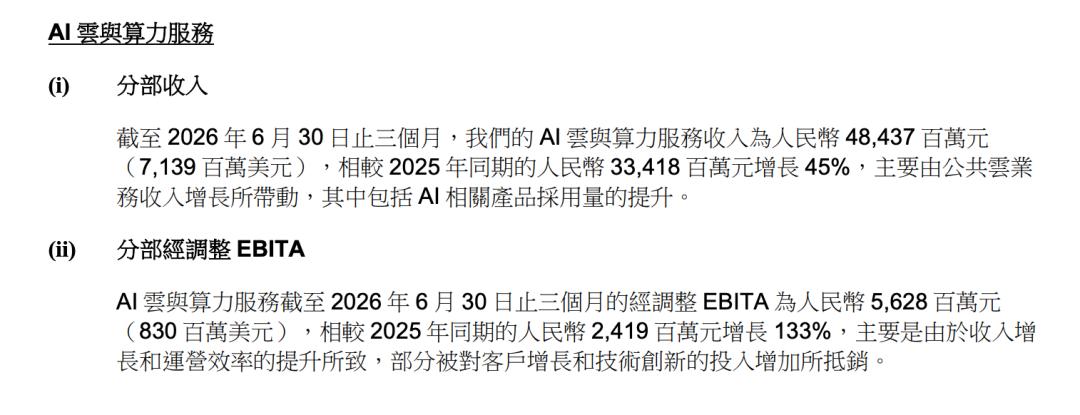
Alibaba's cloud business growth is indeed impressive. The newly formed AI Cloud and Computing Services generated RMB 48.437 billion in revenue this quarter, with total revenue and external customer revenue both increasing by 45% year-on-year, marking the highest revenue growth in 22 quarters. Among them, AI-related product revenue reached RMB 12.376 billion, marking the twelfth consecutive quarter of triple-digit year-on-year growth.
Alibaba's Q1 FY2027 Financial Report
Even compared to global cloud service giants, Alibaba's cloud business growth stands out. For comparison, Amazon AWS revenue increased by 37% year-on-year in the same quarter, while Microsoft Azure and other cloud services grew by 43%. However, their revenue bases are also significantly higher than Alibaba's. Compared to Google Cloud, which is still catching up to AWS and Azure, Google Cloud's revenue growth reached 82% in the same quarter.
Alibaba's cloud service profitability also significantly improved this quarter. Adjusted EBITA for the segment reached RMB 5.628 billion, a 133% year-on-year increase. Based on revenue, the segment's EBITA margin was approximately 11.6%, compared to about 7.2% in the same period last year.
During the financial report conference call, Wu Yongming continued to express confidence. He stated that next quarter, Alibaba's annualized revenue from AI-related products would approach USD 10 billion. As of August, the ARR for MaaS services has already exceeded RMB 16 billion and is expected to reach RMB 30 billion by the end of the year.
Wu Yongming said that the AI cloud platform, centered around AI computing, is the biggest super app of the AI era. He reiterated Alibaba Cloud's goal of achieving USD 100 billion in external customer revenue by 2030, stating, "We have strong confidence" and also expressing confidence in achieving a profit margin of over 20%.
In contrast to the impressive growth of cloud services, the newly formed AI Labs and Applications fared poorly. Revenue for AI Labs and Applications was RMB 3.338 billion this quarter, a mere 16% year-on-year increase. However, losses continued to widen, with adjusted EBITA losses reaching RMB 13.861 billion, compared to RMB 3.224 billion in the same period last year. Alibaba stated in the financial report that the losses mainly stemmed from model investments and Qianwen App inference costs.
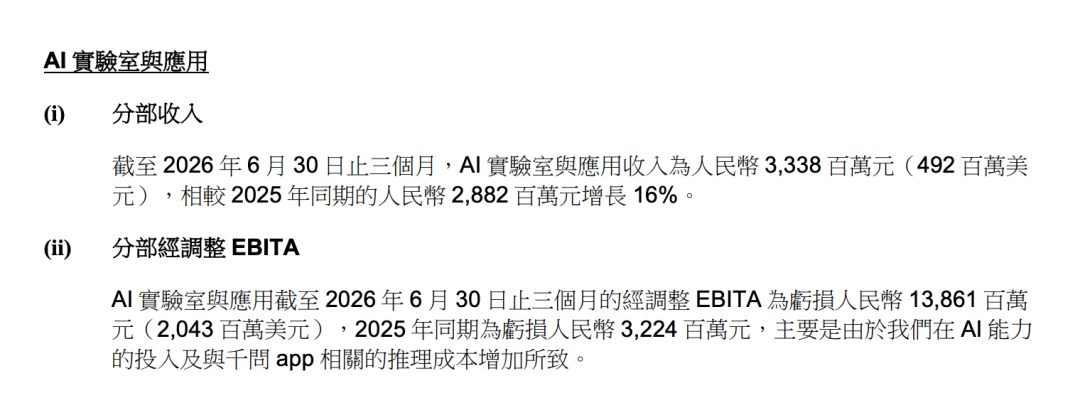
Alibaba's Q1 FY2027 Financial Report
A simple calculation shows that the RMB 5.6 billion profit Alibaba earned from its cloud business is barely enough to cover Qianwen's burning for a month. When combining Alibaba's cloud business and AI Labs for observation, the combined adjusted EBITA loss for both businesses this quarter was approximately RMB 8.233 billion, compared to just about RMB 805 million in the same period last year.
However, Alibaba has already begun cutting marketing spending for the Qianwen App. Management stated that losses for AI Labs and Applications have significantly narrowed quarter-on-quarter and are expected to continue improving in the coming quarters. Bloomberg expects Alibaba's AI business to continue generating cash losses.
E-commerce Holds Profits, Instant Retail Drives Growth
While AI cloud services experience rapid growth, Alibaba's e-commerce core remains under pressure. Revenue for Alibaba's e-commerce group increased by 4% this quarter, but nearly all the new revenue came from instant retail. Excluding instant retail, revenue from other e-commerce businesses declined by approximately 5.9% in total.
Breaking it down, revenue from Alibaba's China e-commerce business under the e-commerce group was RMB 110.9 billion, an 8% year-on-year decrease; China instant retail revenue was RMB 53.295 billion, a 45% year-on-year increase; international retail e-commerce revenue was RMB 27.761 billion, a 1% year-on-year decrease; and global wholesale revenue was RMB 13.906 billion, a 7% year-on-year increase.
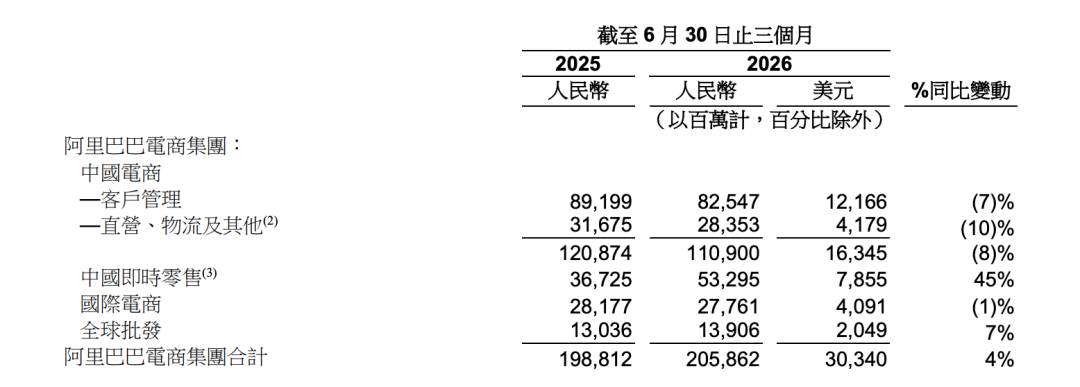
Alibaba's Q1 FY2027 Financial Report
CMR revenue, which contributes the most to e-commerce, decreased by 7% year-on-year this quarter. Alibaba explained that the decrease partly came from revenue offsets generated by new business expansion plans. Under these plans, platform subsidies linked to merchant marketing investments are offset against revenue. Excluding this impact, CMR revenue would have slightly increased by 1% on a like-for-like basis, reaching a near three-quarter low, on par with Q4 2025.
The recently concluded 618 shopping festival was once again dubbed "the most lackluster 618 in history" by the media. According to the Consumption Market Big Data Lab at Fudan University, online retail sales of physical goods across the entire network during 618 increased by 3.2% year-on-year, further slowing down from last year. National Bureau of Statistics data shows that online retail sales of goods increased by 4.8% year-on-year in the first half of this year, compared to 6% last year.
The good news is that the e-commerce segment still managed to hold onto profits, with adjusted EBITA for Alibaba's e-commerce group reaching RMB 39.749 billion this quarter, a slight 1% year-on-year decrease.
Instant retail contributed the most growth to Alibaba's e-commerce segment. This quarter, in addition to Taobao Flash Sales, the segment newly included instant delivery revenue from Hema and Tmall Supermarket, with the entire instant retail segment growing by 45% year-on-year. Jiang Fan stated during the financial report conference call that last quarter, amid increases in user and order numbers, UE significantly improved, and losses narrowed considerably.
He expects that the transaction volume of non-food categories in the flash sales business will surpass food categories in the next fiscal year, with the entire instant retail segment projected to achieve overall profitability by FY2029. "In the long run, we believe instant retail has the potential to contribute 30% of the platform's total transaction volume, becoming the second growth curve for the e-commerce segment."
Last year's high-profile food delivery subsidy wars have come to an end. This quarter, Alibaba's marketing expenses decreased by 10% year-on-year, with the proportion of revenue declining from 21.3% in the same period last year to 17.6% (excluding equity incentives).
The food delivery market has become lackluster. Dong Ge, who was always in the spotlight delivering food last year, has been quiet for a long time this year. Meituan significantly reduced losses in the first quarter of this year, with core local commerce operating losses of only RMB 2 billion, compared to RMB 10 billion at the end of last year. Wang Xing expects UE for food delivery in Q2 to be significantly better than in Q1.
Alibaba's massive spending on food delivery last year has achieved phase achievement (phased results), at least contributing growth amid a sluggish e-commerce market. Jiang Fan is now the goalkeeper for all of Alibaba, tasked with holding down the e-commerce core while the AI battle continues to burn money upfront.",
-
![]()
Aunt Wu Advises Everyone Not to Be Afraid
-
![]()
Chengdu Auto Show: BMW and SAIC Volkswagen Adopt Direct Strategies
-
![]()
The Battle Among Big Firms for AI Talent: People Are More Expensive Than Computing Power
-
![]()
NetEase: Still Relying on Legacy Assets Without Burning Money, But With Strong Financial Foundations
-
![]()
Zhuque-3 Successfully Recovered, But How Far Is It from True Reusability?
-
![]()
Xiaomi Surmounts the 'Storage Storm,' Approaching a Pivotal Moment
-
![]()
Blockbuster Move: Jensen Huang's Strategic Investment Tied to Elon Musk's Ventures
-
![]()
When Even Boxy SUVs Embrace Smart Driving, What Future Awaits Off-Road Vehicles?