Did Alibaba Say AI Investments Would Pay Off in Three Years, Then Turn Around and Ask Shareholders for HK$80 Billion to 'Tide Over'?
 08/24 2026
 489
489
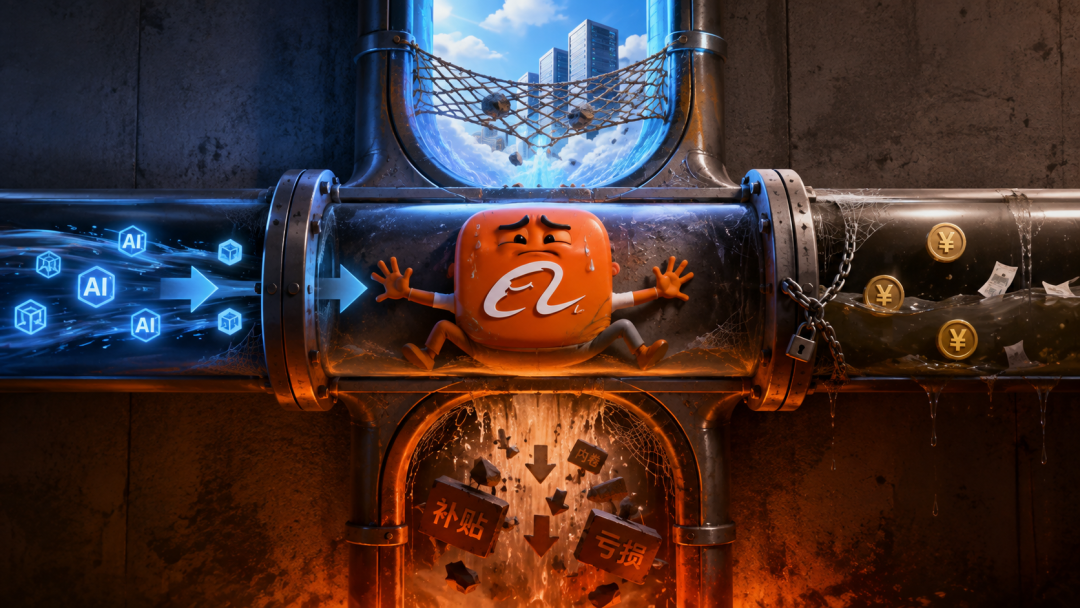
AI Is a Money Printer, So Why Is It Printing New Shares in the End?
On August 20, Alibaba released a financial report that was somewhat contradictory but not bad.
In this quarter, Alibaba's revenue reached RMB 268.953 billion, up 9% year-on-year; net profit plummeted 75% year-on-year, with a net outflow of free cash flow of RMB 44.67 billion. However, the AI business, which the market cares about most, remained impressive: Alibaba Cloud's external commercialization revenue grew 45% year-on-year, AI-related product revenue achieved triple-digit growth for the 12th consecutive quarter, and quarterly capital expenditure surged to RMB 67.678 billion, up 75% year-on-year.
Heavy investments in AI are starting to pay off.
Wu Yongming even made an optimistic judgment at the earnings call: With the growing demand for AI and the gradual deployment of self-developed chips, Alibaba's AI capital expenditure is expected to break even in about three years. With continuous improvements in the gross profit margin of AI-related products and an increasing proportion of self-developed chips, the payback period could even be shortened to 2.5 years or even 2 years.
Initially, the capital market chose to believe this story. Although Alibaba's ADRs fell noticeably at one point after the earnings release, they quickly recovered and ended up rising 1.26% on August 20, closing at $130.53.
However, the tone changed dramatically just a day later. On August 21, while the Nasdaq rose 0.43% and the Dow Jones rose 0.98%, Alibaba's ADRs suddenly plummeted 8.57%, with trading volume reaching 32.4 million shares, more than twice the average over the past 50 days. The financial report, which seemed to have been fully digested by the market just a trading day earlier, suddenly seemed unappealing again.
It wasn't until Sunday that a delayed announcement revealed that Alibaba had an HK$80 billion share placing waiting in the wings.
On August 23, Alibaba announced plans to issue new shares to raise HK$80 billion, explicitly stating that the proceeds would be 100% used for full-stack AI capabilities and AI infrastructure construction. Although insiders said the placing was quickly oversubscribed after launch, it also drew criticism from many ordinary investors. More importantly:
Since AI is expected to break even in about three years, why didn't Alibaba issue bonds instead of diluting shareholder equity? And were those optimistic statements about AI returns, cloud growth, and self-developed chips made during the earnings call meant to explain the business or to pave the way for this HK$80 billion placing?
01 Before the HK$80 Billion Placing, Alibaba Showed Its Best Side to the Market
The HK$80 billion placing was not a hasty decision.
According to public information, Alibaba's equity placing involved multiple investment banks, including Morgan Stanley, HSBC, UBS, and CICC. It quickly became oversubscribed after launch and even expanded the offering size to HK$80 billion due to strong institutional demand.
Such a transaction clearly requires advance preparation, from determining the financing method and finding underwriters to communicating with potential investors, pricing, and finalizing the offering size.
Yet, just three days earlier, Alibaba held a completely positive earnings call and shared nearly all the good news about its AI business.
During the call, Alibaba's management was quite positive about the AI business: Cloud external commercialization revenue grew 45% year-on-year, marking the fastest growth in 22 quarters; adjusted EBITA for the cloud business grew 133% year-on-year; AI-related products achieved triple-digit growth for the 12th consecutive quarter; and demand for AI computing power remained strong.
Wu Yongming judged that the demand for commercial reasoning is exploding rapidly, and computing power has transformed from a cost center into a 'means of production' that directly drives AI revenue growth.
Regarding the market's biggest concern—massive capital expenditure—Alibaba even took time to explain why continuing to buy computing power remains a business with 'very high certainty of return on investment.'
Wu Yongming's first reason was supply and demand. Alibaba judged that the tight supply of AI computing power would not fundamentally change until at least 2030. With sustained strong demand, Alibaba Cloud can not only maintain high server utilization but also renew contracts with new and existing customers at healthier prices.
Based on the current average gross profit margin of AI products, the relevant CapEx can be recouped in about three years. If the gross profit margin continues to improve and the proportion of self-developed chips increases, combined with high-margin businesses like MaaS, the payback period could be shortened to 2.5 years or even two years.
The second reason was that these expensive computing assets are not as prone to obsolescence as the market imagines. Wu Yongming specifically cited examples: The V100s purchased by Alibaba's data centers in 2018 and the A100s purchased in 2020 are still operating near full capacity today. According to Alibaba, this means that even if a batch of servers recoups its investment in three years, it can continue to generate positive cash flow for several more years, with an actual economic lifespan significantly longer than the theoretical depreciation cycle.
Alibaba even proactively considered the question of whether to reduce investments.
Wu Yongming said that based on the current payback period of about three years, theoretically, positive cash flow could already be achieved if business growth were controlled below 33%. However, given that AI is still in its early stages, Alibaba prefers to continue increasing CapEx to maintain high growth above 40%. In the future, with improvements in gross profit margins and increased substitution with self-developed chips, Alibaba hopes to achieve positive cash flow while maintaining growth above 40%.
In short, from computing power supply and demand to asset lifespan, and then to gross profit margin, cash flow, and payback period, Alibaba calculated nearly every reason why it should continue to heavily invest in AI for investors.
Initially, the market did accept this narrative. After the earnings release, Alibaba's ADRs fell briefly but quickly recovered, ending up rising 1.26% on August 20.
However, this optimistic narrative lasted only a day.
On August 21, while the broader U.S. stock market rose, some smart money in Alibaba's ADRs seemed to have received some news, and the stock price suddenly plummeted 8.57%, with trading volume also noticeably increasing. Two days later, the mystery was unveiled: Alibaba planned to place about 710 million shares at HK$112.7 each, a discount of about 8.4% from Friday's Hong Kong stock closing price of HK$123, to raise HK$80 billion.
Thus, the earnings call, which had initially seemed quite impressive, took on a different context in hindsight.
After all, when a massive equity financing was about to materialize, Alibaba conveniently presented the most attractive aspects of AI growth, computing demand, asset lifespan, and return cycles to the market.
As for the financing itself, it only officially met ordinary shareholders days later.
This, of course, does not directly prove anything, but at least it makes the phrase 'very high certainty of return on investment' sound less straightforward than it did three days ago.
02 Alibaba's Two Fronts Have Both Turned Into 'Trench Warfare'
If Alibaba is so confident about AI returns, why did it ultimately choose equity financing instead of continuing to borrow?
The answer may lie beyond AI itself.
Over the past year, Alibaba's two most heavily bet-on new growth engines—Taobao Quick Commerce and AI Cloud—have undergone almost the same transformation: Last year, they were fighting for market share; this year, they are defending their positions.
Taobao Quick Commerce is the most obvious example. By the end of April 2025, Taobao Quick Commerce officially launched and surpassed 40 million daily orders within a month; by August, peak daily orders reached 120 million, with weekly average daily orders at 80 million. Jiang Fan even stated during the earnings call that if only looking at food delivery orders to home, Alibaba had become the market leader.
At that time, Taobao Quick Commerce did feel like a 'blitzkrieg.'
Alibaba used subsidies to exchange for orders and leveraged Taobao's traffic to support Ele.me, quickly dragging Meituan into a price war. In the third quarter of 2025, Meituan recorded an adjusted net loss of RMB 16 billion, compared to a net profit of RMB 12.8 billion in the same period last year, marking its first quarterly loss since 2022. Wang Xing described this price war as 'unsustainable' during the earnings call and even used the phrase 'bad money drives out good' to evaluate industry competition.
However, this approach came at a significant cost to Alibaba as well. In the third quarter of 2025, Alibaba's adjusted EBITA fell 78% year-on-year to RMB 9.1 billion, with the company explicitly attributing the decline mainly to investments in instant retail, user experience, and technology; for the entire fiscal year 2026, adjusted EBITA for China's e-commerce group also fell 44% year-on-year.
This year, the narrative around Taobao Quick Commerce has clearly changed. During the latest earnings call, Alibaba no longer emphasized how many daily orders it had achieved or how much market share it had captured but instead focused on 'maintaining market share' while improving UE, increasing average order value, and fulfillment efficiency.
In this quarter, instant retail revenue reached RMB 53.3 billion, up 45% year-on-year, with losses narrowing significantly; the next step is to continue integrating Hema and Tmall Supermarket and expand non-food categories and front-loading warehouses. Alibaba's timeline is to achieve overall profitability in instant retail by fiscal year 2029.
From fighting for orders to defending market share; from focusing on scale to calculating UE. Taobao Quick Commerce hasn't lost, but the easiest territories to capture have clearly been taken.
The same is true for AI. Over the past year, Alibaba Cloud has accelerated nearly every quarter: Revenue grew 26% in the June 2025 quarter, 34% in September, 36% in December, 38% in March this year, and reached 45% in the latest quarter. AI-related product revenue has maintained triple-digit growth for 12 consecutive quarters.
At that time, the capital market was concerned with something else: Who dares to invest more in AI. But this year, the question has slowly shifted to: When will this money start to pay off?
Reuters once analyzed that global large investors have shifted their focus on AI from 'how much tech giants spend' to 'who can ultimately sustain profitability'; HSBC Asset Management also mentioned that the market is increasingly distinguishing between companies that can convert AI capital expenditure into revenue and free cash flow and those that still rely mainly on expectations.
Behind this is growing cash pressure.
Alibaba's latest quarterly CapEx reached RMB 67.68 billion, up 75% year-on-year; free cash flow saw a net outflow of RMB 44.67 billion. Nearly half of the three-year, RMB 380 billion AI investment plan has already been executed, and Wu Yongming said in May this year that the final investment could even exceed the original RMB 380 billion. That's why, during this year's earnings call, Alibaba spent an unusual amount of time explaining gross profit margins, server lifespans, and payback periods of two to three years.
Last year, Taobao Quick Commerce focused on orders, and AI focused on growth rates; this year, both sides started calculating the books simultaneously. Thus, Alibaba's two most promising fronts now face a rather similar situation:
The issue with Taobao Quick Commerce is uncertainty about when a true winner will emerge; the issue with AI is uncertainty about when to stop expanding. One requires continued investment in fulfillment, front-loading warehouses, merchants, and users; the other requires continued investment in chips, servers, data centers, and models.
Neither side can easily retreat.
If instant retail retreats, Meituan may continue to penetrate from high-frequency consumption into traditional e-commerce territory; if AI investment is insufficient, the growth Alibaba Cloud has regained, as well as the full-stack advantages of Tongyi and self-developed chips, could all be overtaken by competitors again.
In this light, the HK$80 billion placing becomes somewhat easier to understand.
After all, debt has a maturity date and must be repaid when due; while equity, though expensive, has no repayment date.
If AI were truly a project capped at RMB 380 billion with a payback period of two to three years, Alibaba could continue to rely on cash flow and debt rollovers for investment. Precisely because it increasingly resembles not a project but an arms race without a clear endpoint, Alibaba needs permanent capital that doesn't require repayment.
In a sense, the caution revealed by this HK$80 billion placing is even more worth pondering than the optimism expressed during the earnings call:
Alibaba dares to say that a batch of AI computing power can pay back in two years, but it seems no longer willing to bet on when this AI war will end.
- END -
-
![]()
Can Domestic Autos Still Hold Their Own Against Joint Venture Brands?
-
![]()
Domestic Cars Priced Above 300,000 Yuan Are Gaining Ground in Chengdu
-
![]()
BBA Takes a Leap of Faith: No Sales, No Tomorrow
-
![]()
Chengdu Unfaded: BYD and Geely Vie for Championship While the Weak Exit
-
![]()
3X Salary Poaching, 40 Executives Depart: Autonomous Driving Talent is Batch-Producing Embodied AI Leaders
-
![]()
Apple’s Foldable iPhone and Huawei’s Straightened Pura X: Two Paths, One Vision
-
![]()
Dong Yuhui Departs with Traffic, Yet East Buy Crafts a Profit-Generating Engine
-
![]()
Did Alibaba Say AI Investments Would Pay Off in Three Years, Then Turn Around and Ask Shareholders for HK$80 Billion to 'Tide Over'?