Chinese Home Appliance Giants Face Collective Awkward Phase | WaveTide
 08/27 2026
 412
412
Editor | Yang Xuran
In China, there may be no industry quite like home appliances, which boasts such a long and solid history of going global.
Starting from the OEM manufacturing era in the late 1980s and early 1990s, Chinese home appliance companies have been supplying global consumers. On production lines in the Pearl River Delta and Yangtze River Delta, countless refrigerators, TVs, and washing machines bearing foreign brands were shipped worldwide, gradually establishing the reputation of 'Made in China.'
Over the next three decades, Chinese home appliance companies have steadily taken root in the global market through efforts such as building overseas factories, cross-border mergers and acquisitions, and localized operations.
Today, in terms of overall scale, Chinese home appliance brands have firmly secured the top global position, with leading Chinese companies confidently referring to themselves as 'international conglomerates.'
However, a clear trend is emerging: while the overseas markets of Chinese home appliance giants remain hot, the domestic market has started to deteriorate even further.
The Chinese home appliance industry has entered a somewhat paradoxical historical period—where the challenging domestic market is continuously siphoning off the gains from international market development.
This article is an in-depth value piece from the content team of

Shift in Foundation
The trend of shifting strengths between domestic and international markets for Chinese home appliance companies is highly evident. By 2025, several leading companies have achieved historic milestones in their overseas revenue proportions.
Haier Smart Home's annual report shows that its full-year overseas revenue reached RMB 154.545 billion, up 8.15% year-on-year, accounting for 51.12% of total revenue. This marks the first time Haier's overseas business has surpassed its domestic business in revenue scale.
Hisense Visual Technology also achieved a reversal in 2025. Revenue from outside China reached RMB 29.23 billion, accounting for 50.68% of total revenue, surpassing domestic business for the first time.
Although major appliance companies like Hisense Home Appliances and Midea Group still have a massive domestic base, their annual overseas revenue now accounts for over 40% of total revenue, just shy of half.
Small home appliance companies are also seizing the opportunity to go global, continuously increasing their international business proportions.
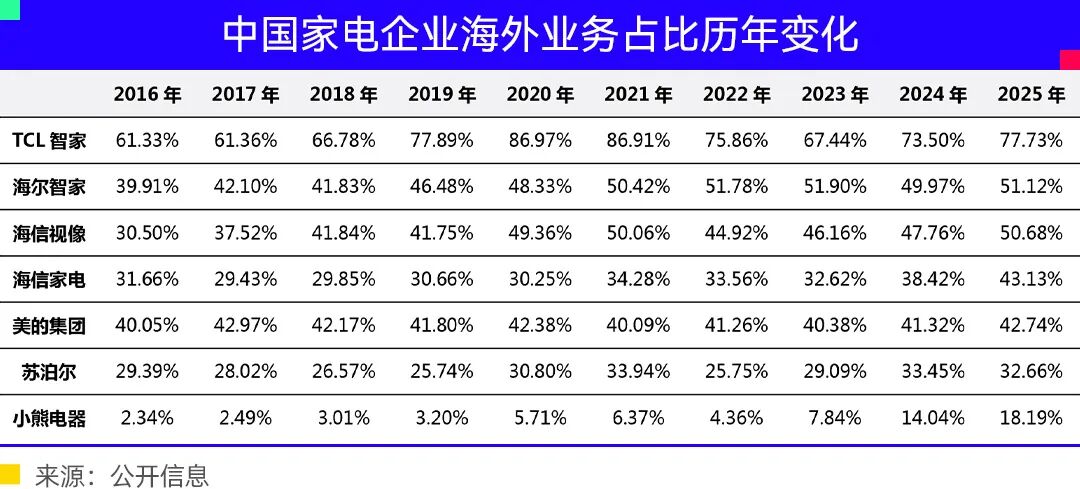
The slogan 'the bulk is overseas,' shouted for many years, has finally translated into tangible figures in financial reports.
As we enter the first half of 2026, the pace of this foundational shift continues to accelerate.
Hisense Home Appliances' overseas revenue reached RMB 21.383 billion, with its revenue proportion further rising to 45.72%. Regionally, white goods revenue in the European market grew by 20% year-on-year, with washing machine sales surging by 39%. In the ASEAN region, refrigerator revenue increased by 50%, while air conditioner revenue in India skyrocketed by 90%.
The ecological layout of global '7+1' regional centers is enabling Hisense Home Appliances' overseas business to flourish in multiple areas.
TCL Smart Home's level of internationalization is even more extreme. In the first half of the year, its overseas revenue reached RMB 8.407 billion, up 16.01% year-on-year, with the proportion of total revenue soaring to a historic high of 84.63%. In other words, for every RMB 10 earned by this Guangdong-based home appliance company, over RMB 8.5 comes from outside China.
Notably, its overseas self-branded business revenue surged by 77.07% year-on-year, with core regions like Europe and North America seeing revenue growth exceeding 100%. This indicates that TCL Smart Home is upgrading from ODM manufacturing to self-branded products, enhancing the quality of its global expansion.
Although Midea Group has not yet disclosed the precise proportion of overseas revenue for the first half of 2026, starting from 42.74% at the end of 2025 and with the continuous advancement of its globalization strategy in 2026, coupled with explosive growth in air conditioner exports driven by heatwaves in Europe, industry-wide estimates suggest its overseas revenue proportion has risen to around 45%.
Its management has set a target to exceed 50% overseas revenue by 2028.
For an increasing number of Chinese home appliance companies, the foundation of their performance is shifting from China's domestic market to the global landscape.
This should be a cause for celebration: Chinese manufacturing has finally climbed up from the low end of the global value chain and is now truly participating in global brand competition. However, the reality is that the acceleration of internationalization has not helped companies expand their overall business, as the continuous contraction of the domestic market casts a shadow over overall performance.
The brilliance of overseas growth is overshadowed by the starkness of domestic decline.

Gains and Losses
While international business surges ahead, the domestic market continues to contract.
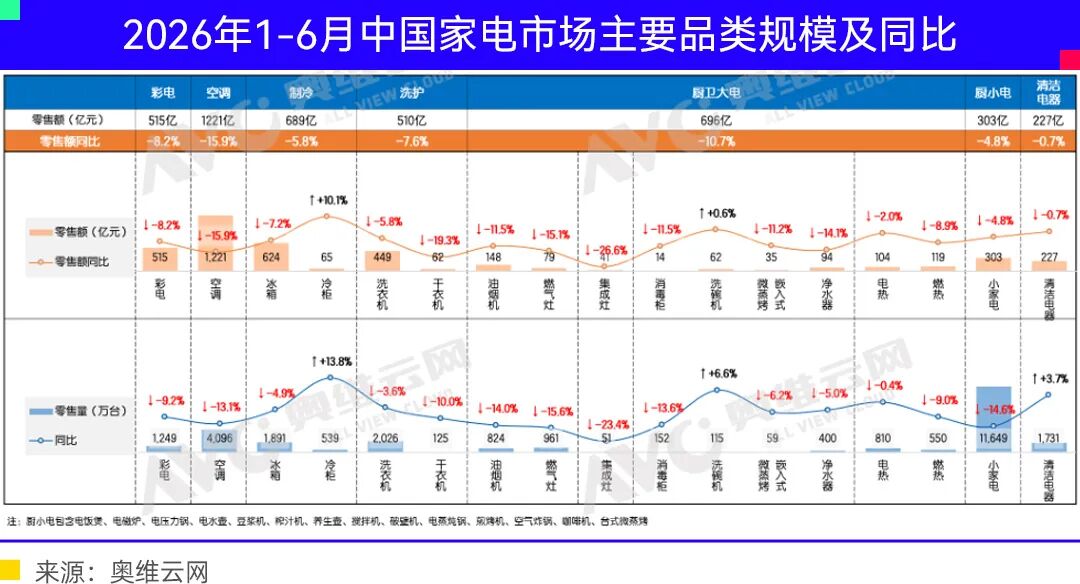
Data from All View Cloud shows that in the first half of 2026, total domestic home appliance retail sales across all channels reached RMB 425 billion, down 9.9% year-on-year. Quarterly data reveals a 6.0% decline in the first quarter, widening to a 12.4% drop in the second quarter, indicating an accelerating downward trend. Prior to this, in 2025, the domestic home appliance retail market had already shrunk to RMB 893.1 billion, down 4.3% year-on-year.
In other words, starting from the second half of 2025, the domestic home appliance market entered a negative growth phase, with the decline widening further in the first half of 2026, resulting in across-the-board declines in both volume and value for nearly all product categories.
From January to June 2026, retail sales of air conditioners, major kitchen appliances (range hoods, stoves, dishwashers, embedded products, water heaters, and water purifiers), refrigeration appliances, TVs, laundry appliances, small kitchen appliances, and cleaning appliances reached RMB 122.1 billion, RMB 69.6 billion, RMB 68.9 billion, RMB 51.5 billion, RMB 51 billion, RMB 30.3 billion, and RMB 22.7 billion, respectively, with year-on-year declines of 15.9%, 10.7%, 5.8%, 8.2%, 7.6%, 4.8%, and 0.7%.
The pressure is particularly tangible for individual companies. TCL Smart Home's domestic revenue in the first half of the year was only RMB 1.527 billion, a sharp decline of 31.51% year-on-year, equivalent to a loss of approximately RMB 700 million in domestic revenue within six months. Given that TCL Smart Home's domestic business already accounted for a relatively small proportion, this indicates that the entire company is now essentially all-in on the international market.
Hisense Home Appliances fared slightly better, but its domestic revenue still declined by 1.47% year-on-year, with its proportion in total revenue continuing to decrease. Even Midea Group, with the most stable domestic base, has seen a significant slowdown in domestic business growth, unable to sustain overall growth as it did in the past.
What adds even more pressure for many companies is that growth in overseas markets can no longer offset declines in the domestic market.
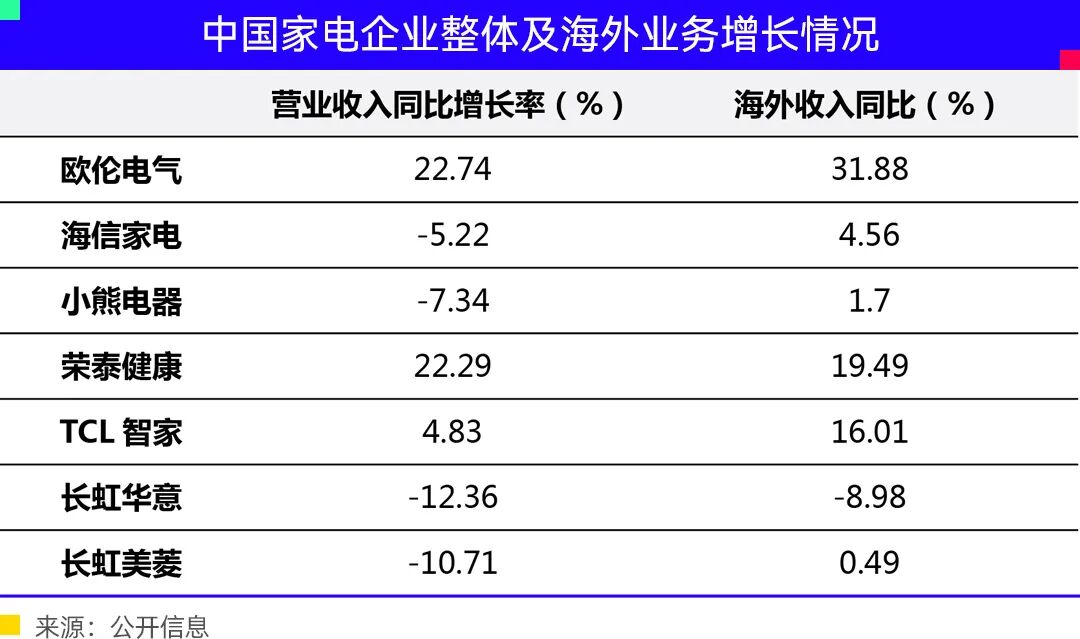
According to published first-half financial reports, Hisense Home Appliances' overseas revenue grew by 4.56% year-on-year, but total revenue declined by 5.22%. Similarly, Bear Electric Appliance achieved positive growth overseas, but its total revenue fell by over 7%. TCL Smart Home's overseas revenue increased by over 16%, yet its total revenue only grew marginally by 4.83%.
The logic behind these gains and losses is not complex. The Chinese home appliance industry is entering an 'Ice Age' of Stock game (stock competition), burdened by three major challenges.
The first challenge is the disappearance of demographic dividends. As durable consumer goods, demand for home appliances is highly correlated with household numbers and demographic structure. With China's total population entering negative growth, the number of new marriages leading to home purchases continues to decline, sharply reducing the number of new households and directly causing a contraction in demand for new home appliances.
The second challenge is the profound adjustment in the real estate market. Home appliances are a typical post-real estate cycle industry, with new home deliveries directly determining the demand for Supporting household appliances (supporting home appliances).
There's a saying in the industry: 'National subsidies in 2024 acted as a catalyst, 2025 saw dependency, and by 2026, the market has become 'immune.'' The sharp decline in the first half of 2026 largely represents 'paying back' for the policy dividends of the previous two years.
Policy subsidies have their limits, and consumers' demand for replacements is not infinite.
Behind the red-hot internationalization lies the industry's growth anxiety. No one can easily provide an answer to where future growth will come from.

Internal and External Challenges
Faced with future development dilemmas, home appliance companies are pinning their hopes on two paths: expansion and upgrading.
Expansion refers to doubling down on internationalization. The continuous contraction of the domestic market has made going global not just an 'option' but a 'necessity.'
Deepening overseas layout (layout) is indeed the most direct antidote to the domestic downturn. Chinese home appliances' global expansion is gradually entering deeper waters, encountering problems no less daunting than those at home.
The most prominent issue is being 'large but not strong': market share continues to expand, but profitability remains unimpressive.
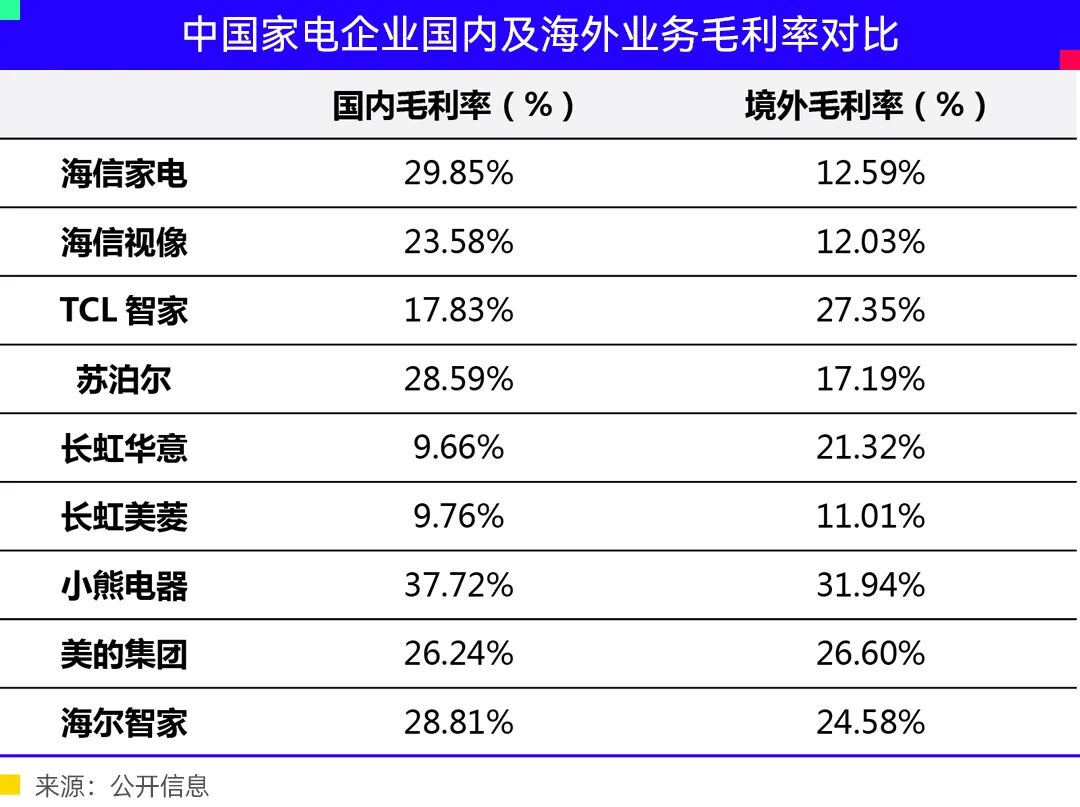
Financial data from 2025 shows that the gross profit margins of overseas businesses for major home appliance companies are generally lower than those domestically. For example, Hisense Home Appliances' domestic gross margin was 29.85%, while its overseas margin was only 12.59%, a difference of 17.26 percentage points. Hisense Visual Technology and Supor also saw margin differences between domestic and overseas markets exceeding 11 percentage points.
The larger the overseas business grows, the lower the overall gross margin becomes—a paradox many companies cannot avoid.
Behind the low profitability lies the stubborn barrier of the high-end market.
Omdia data shows that in the global high-end TV market (priced above USD 1,000), Samsung has long dominated, with Sony and LG maintaining brand leadership. While Chinese brands have made significant inroads in the mid-to-low-end market, the association between 'high-end' and Chinese home appliances remains weak in consumers' minds.
Geopolitical and exchange rate risks also loom large. TCL Smart Home's net profit in the first half of the year declined by nearly 20%, largely due to exchange rate fluctuations. After excluding foreign exchange factors, its net profit attributable to shareholders actually grew by 6.24% year-on-year. Unilateral RMB appreciation, inflation in overseas markets, and changes in trade policies—any of these variables could instantly erase several percentage points of profit.
For companies with overseas revenue exceeding 80%, exchange rate management capabilities are almost as important as product competitiveness.
Overseas markets offer incremental growth, but the domestic base cannot be neglected. Against the backdrop of stock competition, home appliance companies generally view AI upgrades as the key variable to stimulate the domestic market.
At the 2026 AWE exhibition, 'everyone was talking about AI' became the most intuitive (intuitive) impression. Refrigerators can now identify ingredients and recommend recipes, washing machines automatically match washing modes based on fabric types, air conditioners sense human positions and adjust airflow direction—AI seems to be making home appliances increasingly 'smart.'
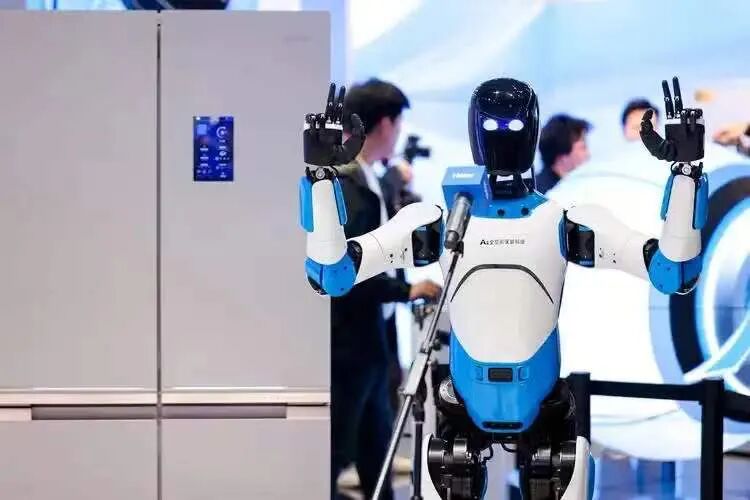
Even at the China Robot Conference in August, various kitchen robots and AI-powered cooking devices made appearances, indicating that industry-wide upgrade expectations are indeed rising.
However, upon closer inspection, most AI home appliances today are still at the stage of functional superposition (stacking), primarily adding voice control, scene linkage, and other capabilities to existing products without fundamentally altering the user experience or value proposition of home appliances.
The industry is waiting for an 'iPhone moment,' anticipating the emergence of a revolutionary AI home appliance product that, like smartphones disrupting feature phones, will completely activate consumers' desire for replacements. At least so far, that moment has not arrived.
Clearly, consumers won't replace a perfectly usable old refrigerator just because it can now identify ingredients, nor will they redo their home Decoration (renovation) just because an air conditioner offers voice control.
With replacement cycles continuously lengthening, AI upgrades at the functional level alone are insufficient to drive large-scale stock replacements. The true arrival of the stock replacements that all companies hope for still requires patience.
-
![]()
ARR in August Surges Past $800 Million, MiniMax's Darkest Hour May Be Over
-
![]()
Major Changes in the Mobile Phone Industry: From 'Small Profits and High Sales Volume' to 'High-Priced Game of One Phone per Person'
-
![]()
Even Sues XGIMI in U.S. Court: $1.2 Million ‘AI Glasses’ Crowdfunding Campaign Abruptly Stops!
-
![]()
The world's third largest mobile operating system was born in China! Installed on over 1.3 billion devices
-
![]()
Chinese Home Appliance Giants Face Collective Awkward Phase | WaveTide
-
![]()
Is 18 Months Truly Adequate for a Vehicle to Go from Design to Market?
-
![]()
Li Auto Reports Q2 Net Loss of 1.7 Billion Yuan
-
![]()
Zhao Changjiang: ZHIJIE RX Stands Unrivaled