Spending $1 Billion to Enlist Google as External Support: Can Apple's AI Turn the Tide?
 01/16 2026
 645
645
Apple's AI Efforts Falter, Google Steps in as the 'Rescue Captain'
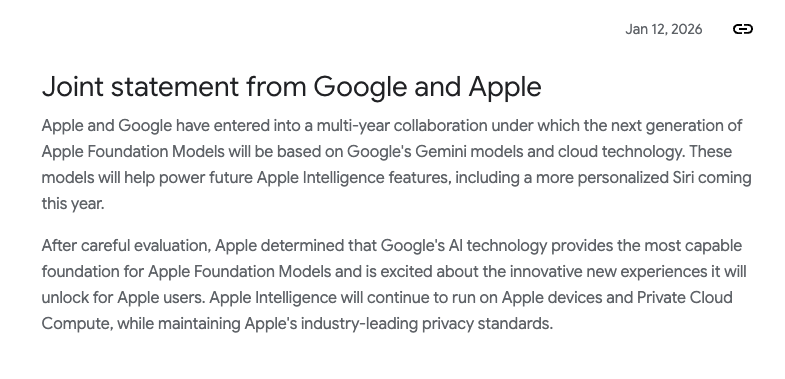
On the morning of January 13, 2026, Apple and Google inked a multi-year cooperation pact. Apple's next-gen foundational models will be built atop Google's Gemini models and cloud technology, paving the way for future Apple intelligent features, including the much-anticipated personalized Siri.
Apple underscored that after a thorough evaluation of various options, it concluded that 'Google's AI technology lays the strongest foundation for foundational models and is excited about the innovative experiences it will unlock for users.'
Following the official announcement of the partnership, both Apple and Google's stock prices surged. Apple's shares closed at $260.25, up 0.34%, while Google's shares finished at $332.73, up 1.09%, boasting a market capitalization exceeding $4 trillion, second only to Nvidia.
Indeed, integrating Google's Gemini models will significantly bolster the AI capabilities of Apple devices. However, this move does not alter the reality of Apple's weak in-house AI technology. Thus, while collaborating with external AI firms can help Apple swiftly address its deficiencies, it is unlikely to propel it to true victory in the AI race.
01. Siri's Struggles and Apple's Negative Perception in the Capital Market
As a global tech behemoth, Apple's foray into AI technology was far from early. As early as October 2011, Apple unveiled the intelligent voice assistant Siri, offering voice dialing, alarm setting, weather inquiries, and other functionalities. However, due to its persistent iteration along the structured NLU technical route, Apple's Siri has seen sluggish progress and has been repeatedly lambasted as 'artificially impaired.'
It wasn't until November 2022, when ChatGPT, built on large models, stunned the world, that Apple awoke and shifted its technical approach.
After years of cultivation, at the WWDC held in June 2024, Apple showcased its in-house AI achievements. Apple Intelligence, introduced by Apple, comprises a device-side model with 3 billion parameters and a high-performance cloud model, supporting text proofreading, image generation, natural language search, and other functions.
Leveraging Apple Intelligence, Apple also unveiled personalized Siri, capable of deeply understanding users' personal contexts, recognizing screen content, and achieving fine-grained control over applications.
Unfortunately, Apple's AI 'vision' has not been smoothly realized. Initially, Apple planned to launch personalized Siri in iOS 18.4, slated for release in April 2025. However, in early 2025, Apple announced an indefinite postponement of personalized Siri. To this day, personalized Siri remains unlaunched.
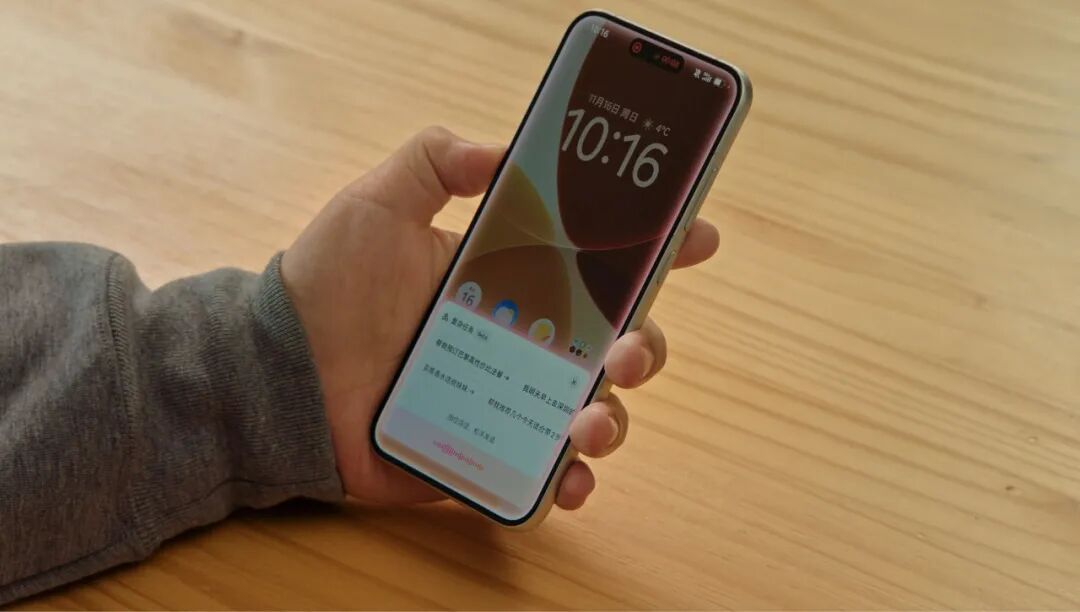
In contrast, smartphone manufacturers like Huawei, Xiaomi, and OPPO have not only launched intelligent assistants supporting natural language dialogue but have even introduced AI Agents. A prime example is the 'Doubao Phone,' launched at the end of 2025, which can take over the screen like a real person, automatically clicking, inputting, and swiping across application barriers, sparking widespread discussion.
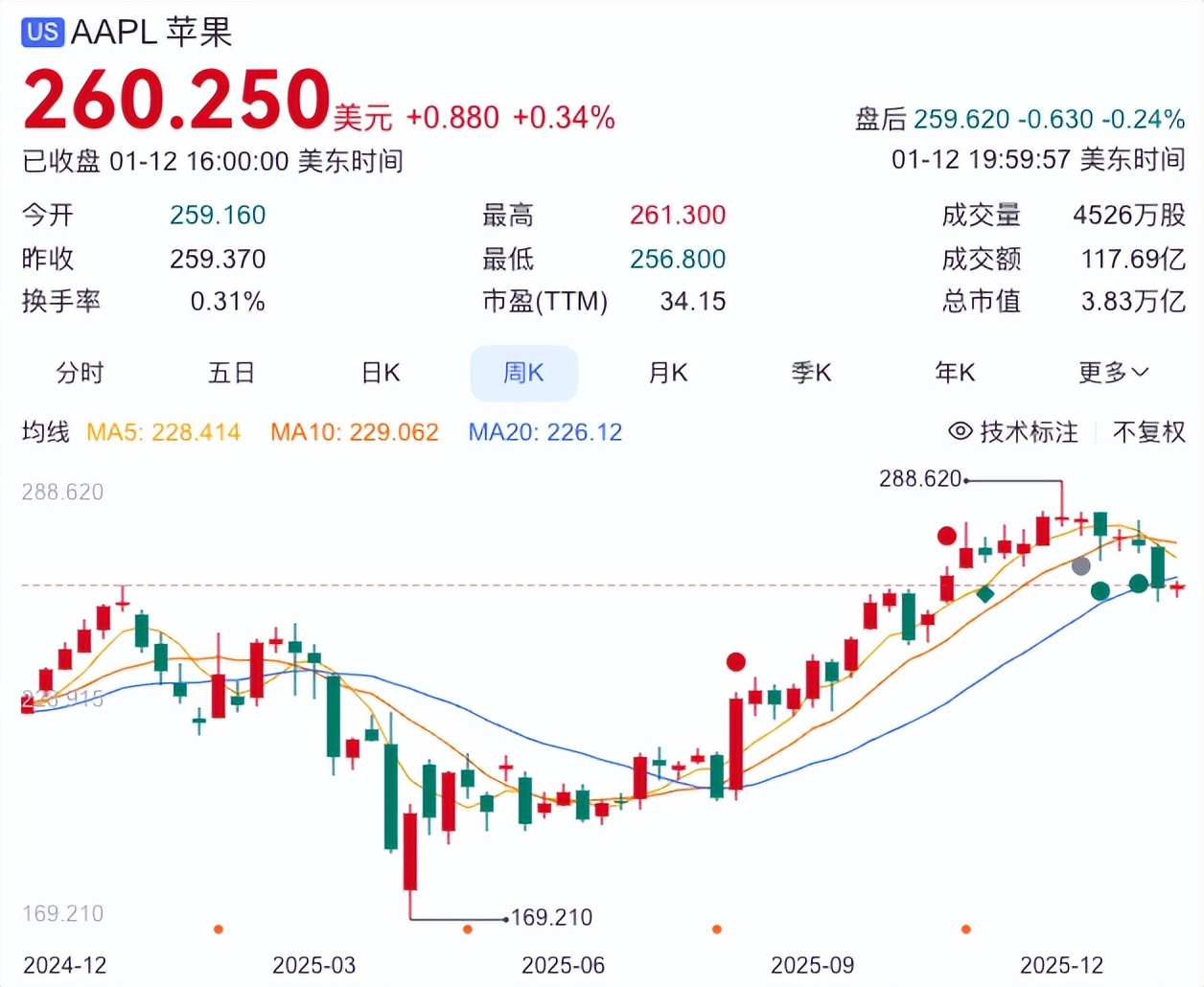
Due to the significantly lagging performance of its in-house AI technology, Apple is being viewed with caution by the capital market. In 2025, Apple's stock price only increased by 8.39%, not only far below the over 65% increase of Google's parent company, Alphabet, but even lower than the 16.4% increase of the S&P 500 index and the 20.4% increase of the Nasdaq 100 index. Since 2026, Apple's stock price has even declined by 4.27%.
Seeing Apple's diminishing potential, Warren Buffett, a proponent of 'value investing,' has begun to act accordingly.
Previously, Apple had always been Berkshire Hathaway's largest holding, accounting for over 50% of its portfolio. Since 2024, Berkshire Hathaway has continuously reduced its Apple holdings. As of the third quarter of 2025, Apple stocks only accounted for 22.69% of Berkshire Hathaway's investment portfolio.
In stark contrast to reducing its Apple holdings, Warren Buffett has shifted his focus to Alphabet. In the third quarter of 2025, Berkshire Hathaway purchased approximately 17.85 million shares of Alphabet, corresponding to a market value of approximately $4.3 billion at the end of the quarter.
Obviously, as an investment maestro concerned with a company's long-term viability, Warren Buffett's choice serves as a wake-up call for Apple. Although Apple can still achieve impressive results relying on its closed ecosystem at this stage, as AI technology gradually matures, Apple's business model faces the possibility of collapse.
02. Apple's Dominant Position and Google's Inability to Access Privacy Data
Although Apple had previously collaborated with Google to switch Safari's default search engine to Google, introducing Google AI within its own ecosystem this time is entirely different from past collaborations.
Previously, Apple acted merely as a 'traffic vendor,' selling platform access to Google. For this, Google needed to pay Apple approximately $20 billion annually. In subsequent collaborations, Apple did not interfere with whether Google collected user data.
During the recent AI collaboration with Google, to maintain control, Apple is no longer a 'traffic vendor' but has become a 'traffic buyer.' In November 2025, Bloomberg reported that to introduce the Gemini model, Apple needs to pay Google $1 billion annually.
Appleinsider reported that as Google's client, Apple has not ceded control of Siri and Apple Intelligence to Google. Instead, Google's Gemini model with 1.2 trillion parameters merely serves as a 'mentor,' assisting in background training and enhancing Apple's in-house foundational models, Apple Foundation Models. During this process, Apple user data is processed on Apple's devices or servers, and Google has no right to access it.
Google's willingness to act as a pure technical provider may have been a key incentive (translated as 'incentive' or 'reason,' but kept as pinyin for uniqueness) for Apple to abandon OpenAI. At WWDC 2024, Apple announced that it had reached a cooperation agreement with OpenAI, and when Siri encountered problems it could not handle, it would access ChatGPT to provide answers.
Bloomberg, citing insiders, reported that Apple's cooperation with OpenAI 'would not bring significant revenue to either party' because Apple believed that the value generated by embedding OpenAI's brand and technology into hundreds of millions of Apple devices was sufficient to offset the fees it should pay.
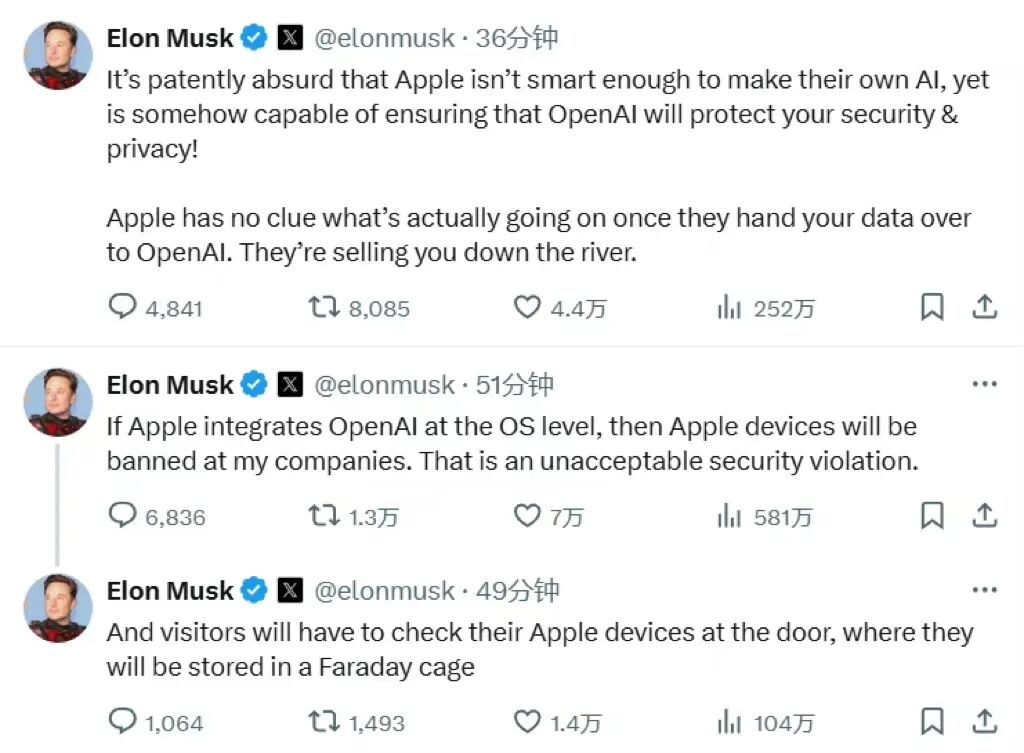
The cost of Apple 'freeloading' on OpenAI is naturally the loss of control. After Apple and OpenAI officially announced their cooperation, Tesla CEO Elon Musk posted on a social media platform, saying, 'Apple is not smart enough to build its own AI yet believes it can ensure OpenAI protects your safety and privacy. This is obviously absurd! Once you hand over your data to OpenAI, Apple won't know what's happening. They are selling you out.' Subsequently, Musk posted a parody image suggesting that OpenAI would indirectly suck away Apple users' privacy data through iPhones.
Considering that Gemini cannot enter the Chinese market, if Apple wants to swiftly promote the implementation of AI functions in the Chinese market, it is likely to seek a local large model company.
In February 2025, Jack Ma, co-founder and chairman of Alibaba, stated externally, 'Apple has always been very discerning. They have held talks with multiple companies in China and ultimately chose to conduct business cooperation with us. They hope to use our AI technology to empower their phones.'
Currently, Alibaba's Tongyi Qianwen series includes over 300 large models, covering parameters from 0.5B to over a trillion, meeting the needs of diverse scenarios. In November 2025, Alibaba launched the AI assistant Qianwen App for ordinary users. After 30 days of public testing, its monthly active users exceeded 40 million.
Whether in terms of the underlying large model capabilities or understanding the needs of local users, Alibaba can be considered an ideal partner for Apple AI in the Chinese market.
03. Cook's Imminent Departure as CEO and Apple's Need to Reevaluate Its AI Strategy
Introducing external partners can indeed immediately enhance the AI capabilities of Apple devices, but it cannot conceal the deep-seated anxiety over Apple's sluggish progress in in-house AI technology.
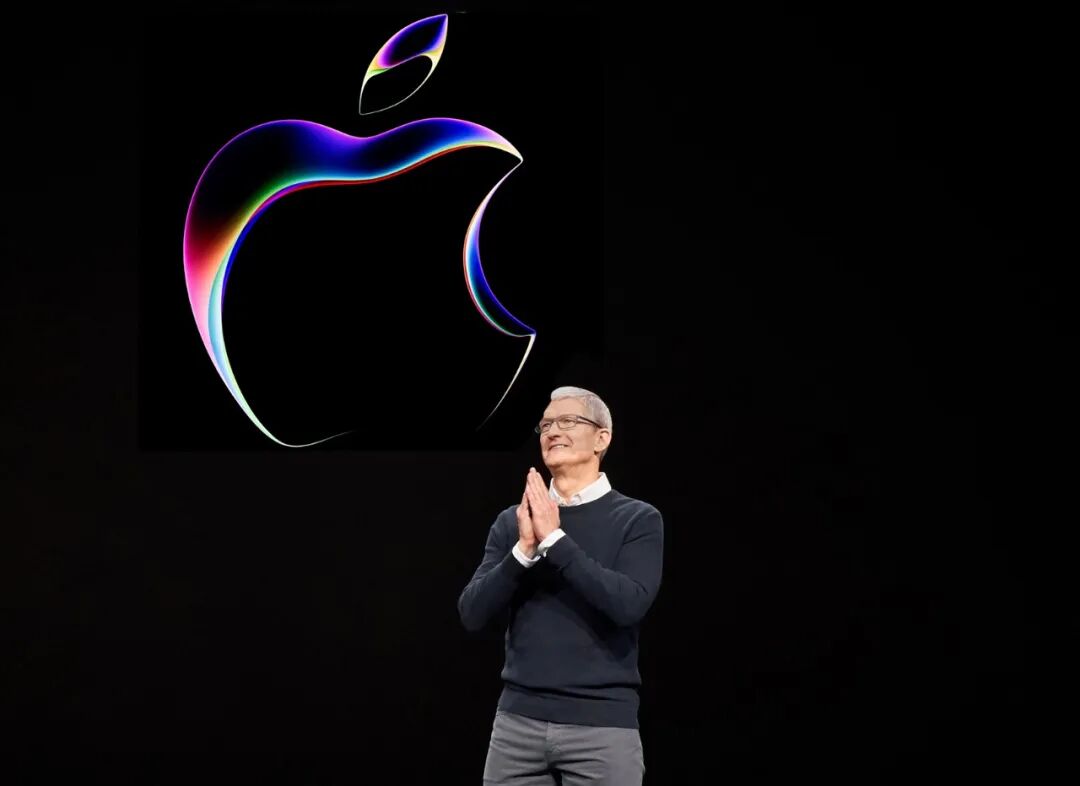
Over the past few years, under the leadership of CEO Tim Cook, Apple has reaped substantial profits through strategies such as a closed ecosystem, vertical integration, and simplified packaging, occupying the throne of the world's most valuable company for a long time.
However, in the face of rapidly evolving AI technology, Tim Cook's response has been unusually sluggish. In April 2025, when discussing why Apple's AI efforts had repeatedly encountered setbacks, insiders told The New York Times that Cook was experienced in operations but appeared indecisive in product development, consistently reluctant to provide clear and direct guidance on product development over the years.
For example, the development of AI technology highly relies on continuous substantial investment, yet Tim Cook lacks a sufficiently clear and firm long-term plan. In June 2025, Bloomberg reported that for AI investment in 2026, Apple had only approved several billion dollars for running its in-house cloud models. In contrast, the annual AI budgets of leading U.S. tech companies such as Microsoft, Meta, and Google all exceed $50 billion.
When discussing Apple's AI progress, Wedbush analyst Dan Ives pointedly stated, 'Their AI strategy is a disaster. Look at OpenAI, Microsoft, Meta—these large tech companies are all crazy (translated as 'crazy' meaning 'crazy ly' or 'intensely,' but kept as pinyin for uniqueness) investing in the AI race, while Apple is far behind. It's like there's an F1 race going on now, and Apple and Cook are just sitting on a park bench drinking cappuccinos, watching from the sidelines.'
Farsight believes that Apple's sluggish progress in in-house AI technology is largely due to the significant gap between Apple's pragmatic corporate culture and the ethereal nature of AI technology.
As Tim Cook said, 'Apple's innovation never pursues being the first to release but pursues the best experience.' Previously, when Apple developed products such as the Mac, iPod, and iPhone, it often had a clear commercialization direction from the outset—precisely meeting the needs of ordinary consumers and creating differentiated usage experiences to achieve high profit margins.
In contrast, the AI industry lacks clear and differentiated implementation paths. Typical examples include Zhipu and MiniMax, which, although both AI companies, have vastly different business models and profitability, and are both mired in losses.
Duan Yongping once predicted that Apple would never venture into electric vehicles, 'not because of technical issues but because of what they can actually achieve. For such a large car, the value Apple can provide is very limited.' The same logic applies to the AI sector. Against the backdrop of rapidly rising large model costs, how to provide differentiated usage experiences to users in a homogeneous competition to maintain strong profitability has long plagued Apple. This is also why Apple's AI strategy has long wavered.
Fortunately, Tim Cook will no longer need to directly confront the AI 'nightmare' in the future, as Apple will welcome a new 'decision-maker.' On January 8, 2026, The New York Times reported that Tim Cook had told company executives that he felt exhausted and hoped to reduce his workload. In light of this, Apple is accelerating the selection process for Tim Cook's successor, with John Ternus, Senior Vice President of Hardware Engineering, expected to become Apple's next CEO.
As an executive with a hardware background, John Ternus undoubtedly has a more product-oriented perspective compared to Tim Cook. However, finding the right balance between AI and hardware, openness and closedness, and efficiency and privacy will long test Apple's next leader.
-
![]()
Hardware is the skeleton, AI is the soul, and data integrates the two
-
![]()
China’s AI Industry: A Unified Pivot Towards Monetization?
-
![]()
New Progress! Infineon Completes Acquisition of ams OSRAM's Non-Optical Sensor Business
-
![]()
35 Million Bet on an Optical Future! Tengjing Technology Makes a Move in AR
-
![]()
Why World Models Get Stuck on Construction Roads in Autonomous Driving Applications
-
Alibaba Initiates Cultural Transformation: Is Jack Ma Making a Strategic Comeback?
-
Tianfeng Heads to Hong Kong for IPO with RMB 3.8 Billion in Funds: Xingyu's Cross-Border Foray into Embodied AI Faces Uncertain Future
-
![]()
Mengshi Auto’s High-End Aspirations Dashed: Huawei Partnership Fails to Revive Sales, New Model’s Entry Price Dips Below 300,000 Yuan