Can Zhou Yunjie’s ‘Openness to Feedback’ Reverse Haier Smart Home’s Market Valuation Trend?
 04/03 2026
 404
404
Editor: Evin
Reviewer: Xuxu
Recently, Haier Smart Home unveiled its latest financial results.
The data indicates that annual revenue soared to 302.347 billion yuan, marking a year-on-year increase of approximately 5.7%. Meanwhile, net profit attributable to shareholders reached 19.553 billion yuan, up about 4.4% from the previous year. Both revenue and profit have witnessed growth.
Simultaneously, Haier declared its intention to elevate the dividend payout ratio from 48% to 55%, with plans to incrementally raise it to 60% over the next three years. Additionally, the company announced a share repurchase program valued between 3 to 6 billion yuan.
Generally speaking, share repurchases and increased dividends are strategies employed to bolster market confidence. So, why is Haier Smart Home’s management taking such decisive steps despite the annual growth in revenue and profit?
One reason is not hard to surmise: the profit decline in the fourth quarter surpassed external expectations.
In the fourth quarter of the previous year, Haier Smart Home’s revenue stood at 68.293 billion yuan, a year-on-year decrease of 6.7%. Net profit attributable to shareholders plummeted to 2.180 billion yuan, down about 39.2% from the same period last year.
It’s crucial to note that Haier Smart Home is a dominant force in the industry, holding a strong position in the premium market and experiencing steady growth with brands like Sanwingbird and Casarte. Given this, why did profit performance take a sudden downturn in the fourth quarter? Why does Haier need to enhance market confidence through repurchases and dividends?
These questions warrant in-depth exploration.
Zhou Yunjie, Known for Being ‘Open to Feedback,’ Must Chart a New Course for Haier
The profit decline in the fourth-quarter financial report can be attributed to several factors.
The first factor pertains to external costs.
In 2025, Haier Smart Home’s annual gross profit margin was 26.7%, a year-on-year decrease of 1.1 percentage points. The decline in gross profit margin stemmed not only from market competition but also from the impact of escalating costs for bulk raw materials and tariffs.
Currently, crude oil prices continue to surge, and there is a high likelihood that costs for bulk raw materials like copper will rise in the near future, potentially leading to further margin compression.
So, can profit levels be stabilized amidst rising costs?
I’m afraid it will be challenging.
This brings us to the second factor: internal demand.
In 2025, government subsidies have already over-consumed part of the market demand, making it highly probable that domestic demand will temporarily stagnate in the near future. In other words, to sustain growth, marketing expenses may face increased pressure in the coming quarters.
When demand is robust, expense pressure is relatively minimal, and profit margins are larger. Conversely, when demand is weak, companies encounter greater pressure on expenses, leading to margin compression.
Under the pressure of marketing expenses, whether Haier’s profit margins will be further compressed in the coming quarters may be a key focus for external observers.
My assessment is that Haier Smart Home’s expense structure is unlikely to undergo significant changes in the future, and the room for profit improvement may be limited. The reason is that there is little scope for optimizing the expense structure.
In terms of expenses, Haier Smart Home’s annual report reveals that the three major expenses (selling, general, and administrative) have already been further optimized.
For instance, selling expenses were optimized by 0.6 percentage points year-on-year, general and administrative expenses rose slightly by 0.3 percentage points, and financial expenses were optimized by 0.36 percentage points. Notably, the increase in general and administrative expenses in the fourth quarter was related to one-time costs for organizational efficiency improvements in the European market.
Considering that the pace of AI transformation cannot slacken and overseas expansion must persist, achieving further structural improvements in research and development and administrative expenses among these three expense categories will be difficult.
Moreover, if government subsidies weaken further in the future, and given the intense industry competition, stabilizing revenue may necessitate increased selling expenses. From this, it can be inferred that the profit decline in the fourth quarter may just be the beginning, and the coming quarters will pose a real challenge.
In reality, short-term profit fluctuations will not significantly impact Haier’s fundamentals. After all, Haier Smart Home has ample cash reserves, and cyclical profit fluctuations are unlikely to affect specific business operations.
Compared to profit fluctuations, the market may place greater emphasis on highlights in product and brand strategies.
Has Haier Smart Home undertaken any notable actions in the past year?
Yes, but perhaps not enough.
Zhou Yunjie’s emergence as a prominent figure is a core highlight of Haier’s strategic maneuvers.
It’s beneficial for the leader to cultivate a persona of being ‘open to feedback.’
Dongpeng Special Drink heeded netizens’ advice and sponsored Zhang Xue, reaping substantial online traffic. Haier’s Zhou Yunjie, by being ‘open to feedback,’ led to the emergence of a user co-creation model for the ‘triple-drum washing machine,’ followed by the launch of shoe washers, washer-dryer combinations, and models like the ‘Pro Triple-Dry Edition.’
Haier’s co-created niche market products with users have indeed gained popularity, and Zhou Yunjie has drawn inspiration from Lei Jun. However, Haier Smart Home cannot rely solely on Zhou Yunjie.
‘Openness to feedback’ is essentially a ‘tactical’ move that may address growth in some niche markets, but Haier needs more than just niche markets—it requires a ‘second curve.’
For Haier Smart Home, growth in niche markets can certainly boost confidence, but more importantly, the window for transformation among home appliance companies is already narrow.
Looking ahead, Haier Smart Home needs to rejuvenate its brand and seize structural opportunities in AI. Relying solely on the leader being ‘open to feedback’ is probably insufficient.
In fact, the core of today’s smart home industry cycle is not just intelligence but AI-driven transformation.
At this year’s AWE, Haier Smart Home showcased AI Eye 2.0, launched three ‘Haiwa’ (AI companions), and revealed that companion robots and cleaning robots are expected to hit the market by 2026.
Among traditional home appliance companies venturing into AI and robotics, only Haier may have the confidence to do so. Even so, making AI transformation its future second curve will not be straightforward.
The most challenging aspect is brand transformation.
In traditional industries, many brands have gradually become perceived as ‘old-fashioned’ by users.
Once the brand perception of ‘old-fashioned’ is established among young consumers, it is difficult to alter. For example, no matter how hard Toyota and Honda try to promote new energy vehicles, users’ brand perception inertia persists.
This is particularly true for young people.
For instance, young people opt for Dyson, Dreame, and Xiaomi products. How many post-2000s or post-2010s consumers purchase Gree or Haier products? Thus, the challenge for ‘old-fashioned’ brands is not a lack of technology but the difficulty in aligning traditional brand perceptions with the new era in users’ minds.
As these perceptions become increasingly ingrained, brand transformation becomes even more arduous.
AI-era Haier and Gree bear resemblance to the Gome and Suning of yesteryears. Back then, with the rise of e-commerce, JD.com and Tmall’s GMV soared year after year, prompting Gome and Suning to transition online.
Subsequent results demonstrated that transitioning from traditional to modern commerce is not as simple as rebranding but requires a series of thorough transformations, including organizational structure, R&D systems, and talent iteration.
Today, as the industry shifts from ecosystem-driven to AI-driven, the same principles apply.
Transformation is not about hosting a dinner party or simply promoting the brand; it may also require confronting more challenges outside the industry.
Underestimated Haier Awaits a Revaluation
Traditional home appliance giants like Haier Smart Home face two primary challenges:
1. Increasing competition from ‘outside’ players makes it difficult to replicate the success of brands like Sanwingbird and Casarte in the AI era.
In the past, Haier rebranded as Haier Smart Home and launched the high-end smart ecosystem brand Sanwingbird, pursuing both high-end and intelligent paths. These moves were relatively successful in the traditional home appliance industry. According to Tianyancha APP information, Qingdao Sanwingbird Technology Company was established in 2020, and Haier’s intelligent transformation has only spanned a few years.
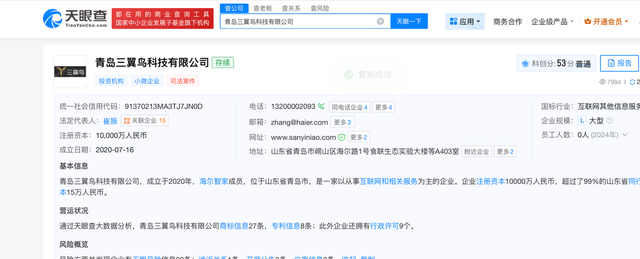
In the AI cycle, Haier Smart Home aspires to recount another ‘Sanwingbird, Casarte’ narrative.
However, the dimensions of competition in the home appliance industry have shifted: from internal competition within the home appliance industry to ecosystem competition involving smart technology and smart homes.
Today, industry players are not just home appliance companies.
Besides Huawei and Xiaomi, there are also ‘latecomers’ like Dreame and Roborock.
The appearance of Dreame’s home ecosystem at the Spring Festival Gala already signaled that competition in the smart home ecosystem will only intensify under the wave of AI and robotics.
In this new round of competition, traditional home appliance giants may not possess absolute advantages and could even be encumbered.
After all, traditional brand transformation in the AI era is subject to inertia. This inertia lies in incremental growth in the high-end market and overseas market expansion.
Take Haier Smart Home, for example. In 2025, overseas revenue reached 154.545 billion yuan, up 8.15% year-on-year, accounting for over 51% of total revenue for the first time. Revenue from emerging markets like Southeast Asia, South Asia, and the Middle East and Africa grew by over 24% year-on-year.
For Haier Smart Home, its core advantages in the high-end market persist, and rapid growth in overseas markets indicates that its past growth logic has been validated.
Whether this logic applies in the AI era and the robotics track remains to be verified.
2. Haier’s capability radius and valuation radius are set, but it still requires an opportunity for revaluation.
In the AI era, Haier Smart Home has made numerous strategic moves.
For example, it completed a strategic equity investment in industrial automation leader STEP Electric Corporation. Additionally, Haier Capital systematically invested in embodied AI companies like Star Era, Stellaris, and Orbbec.
Currently, entering through capital seems to be the most feasible path. After all, AI and robotics essentially exceed the capability radius of traditional home appliance giants.
In my view, integrating AI into washing machines and refrigerators represents a software-hardware integrated technological approach, which is what tech companies specializing in smartphones and tablets excel at—areas outside Haier Smart Home’s core competencies.
As a typical home appliance brand, Haier Smart Home has traditionally excelled in branding, manufacturing, and channel distribution. This capability radius initially determined that the upper limit of its intelligent transformation may be relatively low.
To put it bluntly, even in today’s smart home era, traditional home appliance giants seem to be competing on ecosystem and technological capabilities, but in essence, they are still relying on marketing and channel strategies.
Reflected in the financial statements, Haier Smart Home’s R&D expenses in 2025 were approximately 10.1 billion yuan, about one-third of its annual selling expenses. The ratio of R&D to selling expenses was about 0.3.
The data speaks for itself.
In the market’s view, high selling expenses relative to R&D are not problematic for a home appliance company—this is an objective industry norm. However, for a tech company, opinions may differ.
Consider tech giants with technological premiums: the ratio of R&D to selling expenses for most is around 1 or even exceeds 1. For example, Xiaomi’s Q3 ratio was 1.10, and Apple’s was 1.25.
From a capital market perspective, investors focus not on brand barriers but on tangible data. In the market’s view, if your products lack irreplaceable technological barriers, you must continuously rely on channels and marketing to drive sales. This is one reason why companies must maintain selling and administrative expenses.
Thus, the market ultimately prices Haier Smart Home accordingly: with annual revenue of 300 billion yuan, its market capitalization is just over 200 billion yuan.
This valuation is significantly lower than its revenue, indicating that Haier is undervalued. This may also be one reason why Haier announced the repurchase.
However, the market is always rational. As long as Haier’s business remains highly concentrated in traditional home appliances like refrigerators and washing machines, no matter how compelling the ‘AI’ narrative is, the market may still be unwilling to grant it the high valuation afforded to tech companies.
The old era has passed. When will Haier Smart Home’s next revaluation arrive in the new era?
The market will ultimately provide the answer.
Disclaimer: This article is based on legally disclosed company information and publicly available data, offering commentary. However, the author does not guarantee the completeness or timeliness of this information. Additionally, the stock market carries risks, and caution is advised when entering. This article does not constitute investment advice; investment decisions must be made independently.
-
![]()
Smartphone Prices Surge Amid Manufacturer Anxiety
-
![]()
Orbbec Soars to Record Heights, Eyes Further Capital Influx of 980 Million!
-
![]()
Tongding Interconnect Sets Up Shop in Shaoguan with 800 Million Yuan in Registered Capital
-
![]()
Before Kimi’s A-Share Debut, Zhipu Aims to Secure More 'Strategic Funding'
-
![]()
Innovative Leap | Fiber-Pluggable 1470nm Laser Source: Revolutionizing Precision Laser Weeding
-
![]()
73-Day Rapid Listing: Where Does Unitree's Wang Xingxing's 'Sense of Urgency' Come From?
-
![]()
AI Project Mindverse, Backed by Meituan, Faces Data Inflation Allegations Over Its Macaron Product
-
![]()
3000-word In-Depth Analysis | What Makes Physical AI So Magnetic? It Has Captivated Masayoshi Son, Jensen Huang, and Justin Sun All at Once